
Today's guest on the High Volume Hiring Podcast says that he loves reference checks, which might sound odd until you understand that he's sat on just about every side of the desk during his 20 years in the HR tech space.
James Lord is the Head of Americas for Refapp, which develops intuitive digital tools that help recruiters and hiring teams make accurate, secure, and seamless hiring decisions. Refapp modernizes the reference checking process by giving references the flexibility to respond when it suits them, in a way that’s easy, professional, and safe.
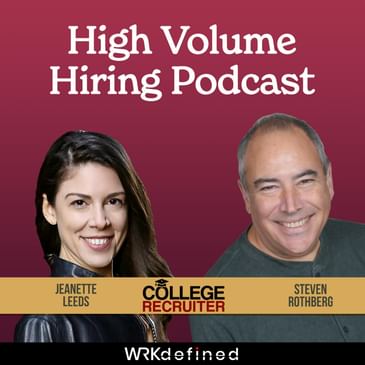
Cohosts Jeanette Leeds and Steven Rothberg of College Recruiter job search site talk with James about the difference between background and reference checks, when reference checks should happen in the hiring process, best practices for what questions to ask, and how to get actionable information back within 24-hours.
Powered by the WRKdefined Podcast Network.
[00:00:12] Welcome to episode 127 of the High Volume Hiring Podcast. I am Steven Rothberg. I'm the founder of College Recruiter Job Search Site. Joined here as almost always, hopefully, it would be better if it was always, that's for darn sure. Sometimes I'm on a plane. So my great co-host Jeanette Leeds, good to see you. Hi everyone, good to see you as well. I'm excited for this episode. Let's see, we are up to episode, I don't even know, 128, 127. We're like up there. We are, it's awesome. 128 minus one.
[00:00:43] Okay, that's your math. Math in your head. Well, this is going to be a good one. We have James Lord here with us. He is head of Americas for RefApp. And James, I know you've been in the space like a lot of years. I won't say the number of years because that'll date all of us. But I'm excited to have you on the show. Just tell our listeners like, what's RefApp? Who are you a little bit more in case they don't know you, which they should, but just get the quick.
[00:01:10] Thank you guys, first of all, for having me on. I really appreciate the opportunity to be here. So I've spent close to 20 years in HR technology. I said the number. Why not? I know, I know. I hear you. I'm 20 plus, so we'll just leave it at that. Said the number. James was eight when he started working in the industry. Yeah, exactly. I was eight years old. I was four, so it's fine.
[00:01:35] Yeah, so look, I've kind of spent a lot of time in really all different facets of the HR technology world. And Stephen and I know each other from not quite 20 years ago, but probably about 15 or so years, Stephen, because I started in the job board space back in the UK. And I've worked for aggregators. I've worked for programmatic organizations. And then I've done a little bit of a stint of staffing in there as well. So I did work for a recruitment agency back in the UK.
[00:02:05] And I did 360 staffing for a year, which I probably will never do again, hopefully. Because it's really hard. But yeah, for the last 10 years, I've been working in reference checks. So making the process easier and safer for everyone to get intelligent candidate insights with a click inside their ATS. So that's what RefApp does. We're a 10-year-old business. We've got many huge international clients.
[00:02:36] And a little bit about me and this accent to address that for your audience. I am the first person on the ground here in North America helping us expand our European business. It kind of rings a bell for you, though, just not Jeanette. I know. I was like, I was the first one on the ground for Olia, which used to be WCN. So same thing. It expanded out. So it's really fun doing that. So it's awesome. Well, good stuff. So OK, so here I have one question, which we didn't even talk about beforehand.
[00:03:04] So this is like because I've been in a variety of global roles over the time, sometimes references get mixed up with like background checks or they can be part of it. So maybe you could just like start out addressing to the audience, like how do you define reference checks within the reference check world versus background? That's a good question. And it wasn't a scripted one. So I love that. No, it wasn't. But I figured it was an easy one. Look, background checks and reference checks are not the same thing, right?
[00:03:34] A background check will tell you that James is not a criminal. That doesn't mean to say that James can do the job. So we have to be asking really intelligent, you know, role specific questions of the job that James has applied for or is being considered for to understand if he has the behavior traits that are going to see him be a high performer or a low performer ultimately.
[00:03:58] So I think references really presents us with that opportunity to dig in and see other people's opinions rather than the candidate throughout our whole process. They're kind of waving the hire me flag, right? Their interview is great. It's the best version of themselves. Their resume is probably generated with some sort of AI, but it's a polished version of them anyway. So, you know, references is the uncut.
[00:04:27] Give me the full story. You know, it's never a black and white area. Recruiting is great. There's always a story. And that's what lies in the references if you ask the right questions in the right way. So I'm one of the biggest fans of reference checks in general, obviously. It's important to love what you do and what you sell for sure. It is. You know, James, over the last, I guess it's probably like six, seven, eight years.
[00:04:52] On the assessment side, I've seen that shift much earlier in the hiring process. It used to be assessments were done probably for the finalists. You know, 100 people applied. You have three of them do assessments. And I think a lot of that was the difficulty and the expense. And I'm wondering if the same is happening with reference checks. If more employers are starting to do more of their reference checking earlier in the process.
[00:05:22] I think they are. We certainly encourage our clients to do it earlier in the process. The reason for that is because you can, especially if you're using a tool that gets references turned around in 24 hours, like RefApp does, you know, you can get that information and then bring that into a final or a second from final interview. To say to the candidate, like, hey, X, Y and Z person said this about you. Can you kind of shed some light on that? Or can you speak to that?
[00:05:51] And that can actually give us a really nice way of seeing how the candidate reacts to that information in real time, because you're probably going to catch them off guard. But the burden of doing the references, you know, this isn't phone tag. This isn't asking the candidate to supply three of their buddies that they play baseball with, right? We're going to put instruction and rigor and science around the whole process, and then we make it quick, simple and safe.
[00:06:19] So if they've got a process like that, that allows us as the hiring organization to bring that further up in the funnel. And usually it's the short list of candidates is what we recommend. It's like the short list should be reference checked. Turnaround time is 24 hours. So why would you not? Well, that's awesome because the whole like issue with like doing references is trying to do it at scale, right? And making it easy for everyone involved. So like, let's talk more about that.
[00:06:47] And you also touched on like making sure it's not like someone's baseball buddies who are just like, oh, yeah, Jeanette's great. You know, like what's like how can you do that? That person would clearly be lying. Sure, right? At least when it comes to baseball. That's not my sport. Not. Or basketball being Fortet. So like, so how do we like just more around that process? How can that work at scale and make it easy? Like I'm trying to picture how that works.
[00:07:13] Well, so, you know, a good reference checking tool will integrate with the applicant tracking system. Or will integrate with the HRIS. So, you know, what many organizations have is they're like, okay, we're moving this candidate along the process. Let's just say it's screening or due diligence or offer shortlist, whatever that tag is associated.
[00:07:35] If you're using, you know, you can have, if you've got fairness in there and you've got automation, you can get this information really quickly back. And therefore, the volume doesn't really matter, right? It doesn't matter if you're doing one or two a month. Or I've got clients that are doing 2,000 a month, right? You know, it's really easy. It's the exact same process and you're treating everybody in the exact same fairness kind of measurement.
[00:08:04] And then, you know, from a compliance perspective, obviously everything's in there with audit trails and all that good stuff. So you've got that digital behavior tracking as well is something that's very common now as well. So Jeanette, you know, you said about, okay, what happens if they do put their buddies from baseball and how do we have that? So it's really important to look at the sources of information, you know, the validity of that.
[00:08:25] So digital behavior tracking, obvious ones, IP addresses and device tracking, browsers, date and time stamps, all that good stuff. But then you've got MFA as well, you know, multi-factor authentication, logging to another platform to verify that Jeanette is Jeanette and Stephen is Stephen. Whether you're a payroll pro or an employee wanting to understand your paycheck better, we've got you covered.
[00:08:48] Tune into It's About Payroll for expert insights on payroll trends and compliance or check out It's About Your Paycheck, the go-to podcast for employees looking to understand their pay and rights. Two great shows, two great hosts. Listen now, brought to you by Work Defined, where payroll meets clarity. Okay, that's interesting because I've never done reference checking on behalf of a large organization.
[00:09:17] I've only done it on behalf of small ones. And it's a very informal, inconsistent process, which can lead to a lot of problems. And it kind of like, I'm self-teeing up my question. You kind of touched a little bit indirectly on formalizing, having consistency. I think you talked about structure and rigor.
[00:09:41] Talk about, if you will, the kinds of questions that Ref App would recommend being asked. And also the ones that you would recommend not asking. Ooh. Yeah, nice frame in there. I think, look, it really, it comes down to science. We're always led by the science.
[00:10:05] So we're constantly looking at job roles and, okay, what makes a person in that particular role super successful? So let's look at the traits, the personality traits, the attributes that they have. You know, one example is like the caregiving community, for example. We really need to ensure that there's high levels of compassion in the way that they provide their services, the way that they work, right? They're kind, they're patient, they're compassionate. That's super important.
[00:10:33] But I think, you know, the biggest takeaway that I always say is, would you rehire them is not a valid reference check question. Sure, you can ask it if you really want, but it doesn't really give us anything. Like anything that provides a yes, no response is never enough detail for us. And yes, we want people to be able to complete this information quickly and easily. But at the same time, you know, the analogy that I sometimes give, right? It's like asking your friend, hey, how are you?
[00:11:03] Stephen, how are you? And you're like, yeah, I'm great. But how are you really? How was your morning? How was your weekend? What did you think about the USA winning 4-0 in the World Cup the other day? All of these sorts of things. When you start to dig a little bit deeper, that's when you really uncover who that person really is. And if you can do that in a structured format at scale with an intelligent set of questions, then you start to get real, you get insights and benchmarks and comparisons.
[00:11:33] And that's when it starts to get really fun. I love it. I love it. Well, I'm just looking at the time. I think we have time for one more question or so. So I'm going to take it. Okay, so this is, I think it's a fun one. And I love crazy stories. What's the most outrageous story or thing you've heard about or learned from looking at all these references over the years? What's the craziest? I actually don't have insomnia, so I can sleep. But if I couldn't, there are so many. And that's why I put that framing around that.
[00:12:01] I actually had, or we had, sorry, a major bank. I'm not going to name their name because you guys, you might even have a debit or a credit card in your wallet. They were hiring a senior audit manager. And this audit manager had nominated three references, all of whom were supposed to be in Manhattan. There was one in Toronto and there was one in London, UK.
[00:12:27] All came back from some suburban address in rural Canada in the middle of nowhere. Anyway, we started poking around a little bit and we found out that it was the candidate acting as all three references themselves on Gmail addresses that they controlled in their own basement. And there were a number of kind of tells for that. But the main, obviously the obvious one is the IP address. They're all on the same IP. And then you've got social email.
[00:12:54] So if they're all coming back from a Gmail or a Yahoo or a Hotmail, it's not an at organization or at company.com. But the other big giveaway is the time, right? If I've nominated three references and I've said, hey, I haven't worked with Stephen and Jeanette for five plus years, but all three references come back in less than two minutes with like a compelling argument of why this person should be hired. You're like, okay, that's a bit suspicious. The irony of all of this story is that this person was an audit manager at the bank. Like they were being audited. I mean, you can't make this up.
[00:13:24] Like that is unbelievable. The auditor was being audited and they were a liar. Cool. Yeah. Wow. Amazing. There is that expression, something about like if you want to think like a criminal or find a criminal, you ought to think like one. Yeah, maybe they would have been an amazing hire. I mean, who knows? Yeah. Or. Wow. Or maybe not. Or maybe not. Yeah. Well, on that note, James, this was awesome.
[00:13:53] I feel like we could keep talking for hours and hours on this. Lots to cover, but this is like lots of food for thought. Yeah. And. Thank you. Definitely. Definitely changes some of the things that I've been thinking about reference checking. Yeah. Like the, would you rehire this person? That's been a go-to for me. Should not be. Lesson learned. Yeah. Amazing. Yeah. James. Cheers. Until next time. Cheers. Thank you very much. Take care, everyone. Take care, guys. Cheers.
Sponsors
