
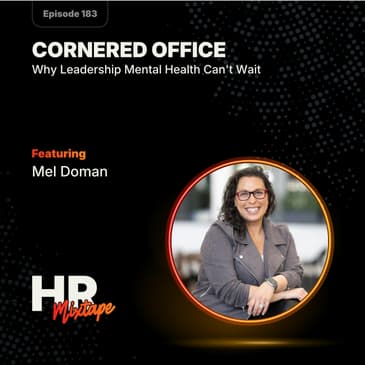
Leaders are burning out quietly, and most organizations are still pretending it isn't happening. Mel Doman, organizational psychologist, author, and founder of the Workplace Mental Health Method, has spent years equipping leaders at Google, Microsoft, and Salesforce with the skills to have real conversations about mental health at work. In this episode, she breaks down why we've systematically dehumanized leaders, what that costs us, and what we can do about it right now.
What you'll take away:
- Why leaders need a "fence, not a door" when it comes to emotional expression at work
- How gender-based emotion shaming affects everyone, regardless of gender identity
- What U.S. organizations can learn from the global concept of "duty of care"
Timestamps
00:02 Intro: What is the HR Mixtape?
00:16 Mel's background: from clinical therapy to organizational psychology
01:06 The moment Mel decided to leave clinical work and why
03:38 Why shared language is the foundation of mental health conversations
04:48 Introducing Cornered Office and why she wrote it
08:20 Leaders are human too: the forgotten truth in organizations
09:30 The Nike/Air monologue and what it reveals about how we treat leaders
12:00 The fence, not a door: how leaders can navigate vulnerability and authority
13:03 Gender-based emotion shaming and why everyone is affected
18:54 What U.S. organizations can learn from global duty of care practices
Guest Bio
Mel Doman is an organizational psychologist, author, and founder of The Workplace Mental Health Method. A former licensed therapist, Mel made the shift from clinical practice in 2013 to tackle mental health at a systems level. She has since worked with global organizations including Google, Microsoft, and Salesforce, equipping leaders and teams with the conversational literacy they need to talk about mental health, communication, and team dynamics at work. She is the author of two books, including her latest, Cornered Office: Why We Need to Talk About Leadership Mental Health. Mel has lived and worked across the U.S., U.K., and internationally, giving her a uniquely global perspective on workplace culture.
Brought to you by Paylocity
Paylocity is the fasted growing unified platform for HR, Finance, and IT. Paylocity brings your people, processes, and data together in one place so HR leaders can spend less time managing systems and more time doing the work that actually moves their organizations forward. Learn more at paylocity.com
Keywords: leadership mental health, workplace mental health, organizational psychology, HR podcast, Mel Doman, Cornered Office, duty of care, gender-based emotion shaming, employee wellbeing, people leaders, burnout, HR Mixtape, Paylocity
Powered by the WRKdefined Podcast Network.
[00:00:01] You're listening to the HR Mixtape, a podcast for leaders who want to understand people, strengthen culture, and navigate change with clarity. Today's conversation starts now. Joining me today is Mel Doman, organizational psychologist, author, and founder of the Workplace Mental Health Method. Mel is a former therapist who now equips leaders at companies like Google, Microsoft, and Salesforce to have constructive, skills-based conversations about mental health at work.
[00:00:37] Mel, thank you so much for jumping on the podcast with me. Thank you so much. I've really been looking forward to this. I have had the opportunity to speak to a few people that have been in the clinical side of therapy and have made the transition to different types of work. You made the transition into organizational psychology. And I'd love to hear a little bit about what your perspective was, what gap you saw that really wanted you to make that transition.
[00:01:06] Mel Doman You know, I can nail it down to the day. Mel Doman I was standing in my office in between clients and I thought to myself, this is not going to change the system. This is not going to change the narrative around this. And I feel like I'm treating clients in a broken system and a broken narrative. Mel Doman Because really most, if not all of my clients, felt that they couldn't talk about mental health outside of therapy or outside of with their friends.
[00:01:33] And most of my clients felt like their workplaces were torturing them. And so I was like, talking to one person at a time, small group at a time is not going to move the needle. I need to do something on a larger scale. And so I made a very difficult decision in 2013 to leave clinical work. And that's, you know, back then clinicians didn't really leave clinical and go into non-clinical disciplines. It just wasn't something that happened back then that often.
[00:02:00] And I remember transitioning into very traditional, you know, IO psych work and doing people in leadership development and employee development and working on, you know, emotional intelligence, constructive conflict, intentional communication, helping people share their toys a bit better in the playground of work. But I noticed that in doing that work, and I still do that work, I love that work, that whenever I talked about mental health, people would like proverbially hiss at me.
[00:02:31] And I was like, well, it's not a dirty word. So that's weird. But it wasn't until 2018 when I was living in London with my husband. I was doing a people leadership development contract. They were like, hey, you used to be a therapist. Could you do a mental health awareness campaign? I was like, oh, my God, yes. And then from there, it just kind of, you know, took off because the market was saying it needed it and it was ready.
[00:02:55] And it has been an amazing journey just equipping people with the skills and most importantly, the conversational literacy they need to talk about mental health, communication and team dynamics in the workplace. Because it's a language we all need to know how to speak and saying it's important is just not enough. So that's the gap I saw was, you know, a lot of people were saying mental health matters. And I go, great. What are people supposed to do with that?
[00:03:23] You know, you got to give them the education, got to give them the skills if you actually want to make change. And so I have been on a eight year harangue doing that. The fact that you anchored in language is fascinating to me because I find that so valuable when you have the shared languages, the right words to use. You really can communicate better and differently.
[00:03:51] I know that those who are listening can't see this, but I keep on my desk and I will show you. It's the wheel of emotions. And I use this very regularly, both personally and professionally, because, you know, telling somebody that you're happy isn't necessarily the word you're feeling in the moment. And so having the word to look at and go, hey, you know what?
[00:04:12] I actually feel really inquisitive right now or I feel really playful right now has helped me in my own way of communicating both on the podcast and the speaking circuit and the stuff that I do. I love that you anchored in that. And it's one of the reasons for me, I think I'm such an avid reader because just diving into books and the language can really help propel you forward, which leads me into kind of my next question is your new book is called Cornered Office. Yeah. And I don't want to add the premise.
[00:04:40] I think I'd love for you to describe kind of what's the premise behind Cornered Office and why did you write the book? So, you know, I named it that because we love a good pun. And, you know, my husband actually helped me come up with the title, you know, and I give credit where credit's due because the book, Cornered Office, Why We Need to Talk About Leadership Mental Health,
[00:05:06] basically uses irrefutable logic and data about how we've historically dehumanized leaders and still do and how they cannot do what we demand of them without humanizing them and giving them the support they need to do the job. It's really that simple. Where irrefutable logic has to cut through big feelings and narrative.
[00:05:31] That's where we are, is there is a lot of data and sources and interviews in the book, something like 140 valid, peer-reviewed, got to say that these days, sources and like 25 anonymous qualitative interviews. Because if you're going to challenge an idea, as the kids say, you got to bring receipts. Is that what the kids say? I'm not cool. I feel like that's what they say. I don't know if anybody's saying bring receipts anymore, but we'll let that one go. Oh, damn it.
[00:06:01] Well, I, what do they say now? Six, seven, whatever the heck that means. That's the point. It doesn't actually mean anything. So you're fine. Oh, God. I'm, I'm, I'm still cool as an elder millennial and I will stick to, to this.
[00:06:14] So the reason I wrote the book is because I lost count of the number of leaders over the years who had panic attacks to me, who felt like nothing they could ever do was good enough, or who felt like they were always expected to show up for other people and they can't say that they need help. And the social narrative around leadership did not allow for them to speak up without tremendous risk of those disclosures.
[00:06:43] And I was like, all right, I am going to be the vessel. That's what I'm going to do. And I wanted to write a book with, like I said, irrefutable logic that we create leaders into these things that they, they aren't actually. And then we don't give them the social permission or support to be that thing.
[00:07:06] And it's getting harder and harder and harder to be a leader, let alone a good leader, especially in this climate, gestures to everything. And I thought to myself, well, what do I call this thing? And I was talking to my husband about it. And he just like, for anybody who's listening to this podcast, they can't see my face. But to anybody who's going to see the clip, we were just like laying in bed and talking about it. And he went, cornered office. And I was like, oh, my God, that's it.
[00:07:35] Because it's such a good pun and like how it feels for so many leaders where they're like, I am on the chopping block in every way if I make a certain misstep or even talk about the fear of that. And so I basically rage wrote 75,000 words being like logic data, logic data, logic data. And we know better. So we have to do better.
[00:08:03] So it's a very spicy meatball. Whereas the first book is much more like informative and instructional. And the second book is more like, hey, you know, this long term held idea we all have. Well, here's why it's freaking nonsense and why we need to do better if we want our leaders to do better. We so forget the humanity at the highest levels. I you know, there's a few months ago, our leadership team, our CEO had to give kind of a difficult message.
[00:08:32] And whether I agree with the message or not was that was not the point of why I did what I did next. But this person delivered it so eloquently and actually brought a lot of humanity in into sharing what they had to share. And I sent them a note afterwards. And this is somebody levels, levels, levels above me, you know, and I just said, hey, I really appreciated the way you showed up today as an employee. I felt seen and valued and you did a great job.
[00:08:58] I know that that couldn't have been the easiest, you know, crap conversation that you had to do. And it was probably maybe the second time ever in my career I've sent a note like that to somebody at that level. And it gave me the moment internally to reflect and say, but why? I want that. Like, I want people to send me notes like that. Why wouldn't this person just because they have this title? It's exactly your like no brainer concept. But it is not a no brainer. Like people don't think that way.
[00:09:28] I know. They don't think that way. I that's the thing is I actually cited this monologue from the movie Air. And I'm not a sports buff by any means, where it's Ben Affleck and Matt Damon in the early days of Nike, where they're trying to land Michael Jordan to to help their basketball division take off. Again, not a sports buff.
[00:09:54] But I love the movie because it has so many lessons about like mental health and perseverance and adversity and leadership. And there's this monologue that this guy who's a real person, Sonny Vaccaro, who gives to the then pre famous Michael Jordan being like, people are going to build you up into something that you're not even that thing. And they will expect you to be that thing. And then when you're not, they will tear you down because that is the most predictable pattern in human history.
[00:10:23] And I was like, and that's leadership. And that's what we're talking about is just because we build people into things that we expect them to be doesn't mean they are those things. And we have to acknowledge and we have to acknowledge and I get it. And I write this in chapter one or two about how we create these mental representations of leaders based on these long term archetypes and what we need from a biological anthropology perspective.
[00:10:51] Like we want them to protect us and to be better and to protect, you know, stop bad things in our environment. Tell us, you know, what's the way I get that. But with how much our prefrontal cortex has developed as human beings, it is not impossible to recognize that these are other people of the same damn species who are supposed to do these things.
[00:11:17] It's that it either doesn't occur to us or we don't want to because they're in positions of power. They have more visibility. They have more influence. In a lot of cases, they make more money. And a lot of leaders have done a lot of bad things throughout history and currently. So we're not incentivized to.
[00:11:38] But that doesn't mean that it's less valid or less important or a practice we shouldn't do to try to support more leaders to do more good things and make more good leaders. I feel like I'm screaming in another crowded room like no one's hearing me because to me it's painfully logical. It's it's beyond logical. And yet it's still really difficult. Yes.
[00:12:06] I think especially because leaders often don't know how to appropriately balance the vulnerability and authority. They feel like they have to show up, especially younger leaders. I feel like we have not done a good job of teaching younger leaders what what true leadership looks like. They kind of grow up thinking, oh, it's about authority and it's the authority is given by the title and the title gives me respect.
[00:12:34] And some of those, you know, kind of really cliche ways of looking at leadership. We've definitely made a change and we've started to talk about this. But there definitely does still sit that place of vulnerability and authority. And because we are two females having this conversation, let's layer on the female perspective of that as well, because we are not allowed to be vulnerable as leaders. So I will I will pause there and just get your reaction, your perspective on that.
[00:13:03] I have big feelings and we're on the same page. But here's what I'll say. There's two things I want to focus on. The first thing is, and I talk about this in the book, that I really want people, especially in positions of leadership, to visualize that we're not trying to create an open playing field. We're not trying to have them make an ironclad door. They need to build a fence. They need to decide what they let through and what they keep out.
[00:13:30] And it's really about normalizing why talking about the emotional struggles of leadership is a sign of healthy leadership and that success and struggle exist in the same body. That's the goal, not just talking about their struggles, but talking about why that's healthy and what they're doing to manage it.
[00:13:53] Not just to humanize themselves, but to show that they also have capacity limits, even when people say that they shouldn't. And it's not about creating, you know, excuses for bad behavior in leadership. Hell no. It's about basically showing me talking about my struggles means I am self-aware and I'm trying to self-manage so I can do the job and show up for you.
[00:14:20] And making that irrefutable case without apology. Now, the social norms will need to catch up to that. I am not twisted about that, but it doesn't make it less true. And I've seen leaders do it seriously and do it very well.
[00:14:38] Now, when we sprinkle gender on top, there is a concept that I came up with in my first book that it was not on my bingo card to cite myself in my second book, but that's what happened, called gender-based emotion shaming. Now, what that means is regardless of the gender you identify as, everybody is screwed because we have these arbitrary social norms connected to gender and emotional expression and especially at work.
[00:15:08] So the through line, because I'm so conscious of time and I could go on an hour harangue on just this, is having someone's gender held against them for emotional expressions and leadership is just toxic.
[00:15:23] So if someone is villainizing a behavior, and I just had this conversation at my book launch a few weeks ago about how male-associated emotional expressions are more socially acceptable than female-associated expressions at work. For example, raising your voice and being angry is more socially acceptable than crying.
[00:15:47] However, if those are switched and women in leadership show that they are angry or men in leadership show that they are crying, they are both judged in ridiculous, unfair, different ways. So in those moments, and as I'm sure you can tell, I'm a little more bold than most, it comes down to me being comfortable with my emotional expression seems like it's creating discomfort in you, but I'm not going to carry that.
[00:16:16] So again, there are like gentler ways to say that, but you understand the through line of what I'm trying to imply. Yeah. And I would add to that when you're dealing with employees from a coming into your office, not necessarily leadership perspective, but, and they have a heightened emotion. Yeah. You know, I think I, I align with you in that. I don't think it's, I think any of those emotions get distorted.
[00:16:46] It's not just one gender. Both genders are experiencing it in different ways. A hundred percent. And I've, I've shared with people, emotions are emotions. The female employee crying in your office isn't different than the male employee who's screaming in your office. Yes. They're heightened emotions. So let's address it that way. So a hundred percent. Yeah. It's, we're complicated. People are complicated. That's just, that's life, you know? Absolutely.
[00:17:11] And with your feeling wheel, by the way, which my husband has a pillow version of that in his office, you know, why, okay. Why would we come prepackaged out of the box with the ability to feel these emotions unless we were supposed to use them? Regardless of gender, it is data to us about how we feel, what's going on in our environment. And if we need support, something's wrong, whatever it is.
[00:17:37] And, you know, a message I want to give, not just to leaders, but, but individual contributors, everybody, is that there are certain environments where having these conversations are psychologically safe. There are some where people just don't know how, but they're open to it. And there's other environments where it will never be okay.
[00:17:58] There are certain companies, certain teams, even certain industries where they're making it very, very clear that they don't want to and will never have these conversations. But the goal for the 8 billion people on this planet is to try to get them to become so common and so normalized that the ones that don't are like the weird ones in the corner. I love that. You know, I'm, I'm curious, and we are getting short on time here, so maybe this will be my last question for you.
[00:18:29] You've had the opportunity to work in, with giant companies. You've had the opportunity to work with different countries, South Korea, England, Australia. I'm curious, as you've done that, that breadth of work, you know, what, what can we in the U.S. maybe learn about something that somebody in other countries actually getting better than us? How can we bring that into our organizations in the space around mental health? You might actually be the first podcast host who's ever asked me that.
[00:18:58] And I love that question because living abroad and working with international clients is what helps me keep that well-rounded perspective. So I think that, oh gosh, there is so much on this answer. How do I reduce it down? So in the U.S., we are famously known for living to work as opposed to working to live.
[00:19:24] And working at speeds where the cost of innovation is our sanity. And it's really difficult because a lot of companies in the U.S., you know, we put a lot out. We innovate in really incredible ways and influence the global market in some really positive ways and some really negative ways. Very negative ways.
[00:19:50] So what I notice in other countries, even that don't, don't have a lot of open mental health conversations, and I want to make that very clear. In other countries where they don't have very, like, on-the-nose mental health conversations like we may in the U.S., because we talk about it a lot, depending on where you are, the circles you run in.
[00:20:15] There is a level of just decency and care that companies abroad show through duty of care to their staff that you just don't see in the U.S.
[00:20:30] And in the U.K. and, you know, in Canada and in mainland Europe, like, in certain countries, that's a legal mandate duty of care to make sure that you're not just, like, physically taking care of the welfare of your staff, but also the mental well-being.
[00:20:47] So I think that that duty of care piece and the decency and just consideration for the daily challenges of being alive or is the cost of doing business, as my sister says, is just a common practice that through our individualistic society in the U.S. is just, like, not a thing when it should be. So I hope that makes sense.
[00:21:15] Yeah, the duty of care language, that's going to be my takeaway and my challenge to my audience is, have you had the conversation in your HR department, in your leadership teams around the duty of care? I love that language. Very helpful. Melissa, we could talk forever and ever and ever and ever. I would love to, yeah. I will wrap us up here. I will say, if you haven't checked out Mel's books, I'll make sure to link them in the show notes so that you can grab them.
[00:21:45] They sound fascinating. And I love that you were able to reference yourself as somebody who has done some research. That's always a plus. So, Mel, thanks for jumping on the podcast with me today. Thank you so much. It was a blast. Thanks for tuning in to the HR Mixtape.
[00:22:08] Like, share, review, and subscribe to support the show and help more people discover these conversations. Until next time, keep the conversation going.
Sponsors
