
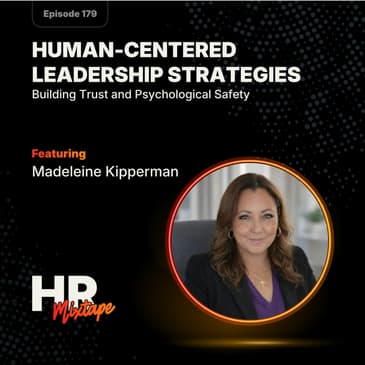
In this episode, Dr. Shari Simpson speaks with Madeline Kipperman, Human Resource Leader at Gorilla Glue, about the importance of leading with humanity in the workplace. They discuss how compassion and transparency can enhance leadership effectiveness, especially in high-pressure environments.
Listeners will learn practical strategies for fostering trust and psychological safety among team members.
• Understand the role of metrics in fostering conversations rather than just evaluating performance.
• Recognize the importance of having difficult conversations with clarity and compassion.
• Learn how to model humane leadership behaviors on the production floor.
• Discover actionable steps to build trust when it is low among team members.
• Identify the key elements that the next generation of employees seek in leadership.
Timestamps:
00:00 -- Introduction to the episode and guest
00:52 -- The importance of leading with humanity
01:54 -- Metrics: helpful or harmful in leadership?
03:14 -- Example of leading with humanity vs. without
08:08 -- Coaching managers for difficult conversations
10:01 -- Leadership in high-pressure environments
12:09 -- Building trust and psychological safety
15:09 -- Transparency in communication with employees
18:02 -- What the next generation wants from leaders
19:17 -- Actionable steps for humane leadership
Guest(s): Madeline Kipperman is a Human Resource Leader at Gorilla Glue. She specializes in HR strategy, workforce development, and leadership, bringing a frontline perspective to her role. Madeline has a strong commitment to fostering human potential in the workplace.
Keywords: human leadership, workplace compassion, HR strategies, building trust, difficult conversations, employee engagement, metrics in HR, psychological safety, next generation workforce, leadership transparency
Powered by the WRKdefined Podcast Network.
[00:00:01] You're listening to the HR Mixtape, a podcast for leaders who want to understand people, strengthen culture, and navigate change with clarity. Today's conversation starts now. Joining me today is Madeline Kipperman, Human Resource Leader at Gorilla Glue. Madeline brings a frontline and business-ready view of HR strategy, workforce development, and leadership.
[00:00:33] Madeline, thanks for jumping on the podcast with me today. Madeline Kipperman Thank you so much for having me, Sherry. It's a pleasure. Madeline Kipperman So you have this passion around being known as a champion of human potential. Madeline Kipperman And I'm curious what pulled you toward really leading with humanity at the core of what you do? Madeline Kipperman That's a great question and thank you for asking. Madeline Kipperman You know, Sherry, it was life and lived experience.
[00:00:57] Madeline Kipperman You know, I see what happens when the systems that we support in our capacity and our craft, forget the people, right? Madeline Kipperman And what happens when a leader chooses to see where the humans live anyway. Madeline Kipperman And what my career has taught me is process, you know, all the process and things that we must be accountable for. Madeline Kipperman But what life has taught me is compassion. Madeline Kipperman And that's where leadership to me and my philosophy really lives, is we are in the people business. Madeline Kipperman And I say that, Tanya and Chick, because people are not a business, right?
[00:01:26] Madeline Kipperman None of us is a business. Madeline Kipperman We are not a widget. Madeline Kipperman But leadership is about stewarding potential and human potential. Madeline Kipperman I love that. Madeline Kipperman And I think so many of our HR professionals, you know, really do resonate with that ideology. Madeline Kipperman And we are sitting in this role where leaders are under a lot of pressure to hit metrics, right? Madeline Kipperman So where have you seen where metrics can really help us in that narrative and where are they hurting us?
[00:01:53] Madeline Kipperman I feel that metrics do help us to, we do have to capture our output, right? Madeline Kipperman That is something that as a business and as supporters of the business, because we want the businesses that we support to thrive and be financially secure so we can do all of the wonderful things. Madeline Kipperman I think metrics help us to start the conversation, right? Madeline Kipperman Because if we're looking at something, let's say we're looking at how much output we have in evening on a manufacturing floor.
[00:02:19] Madeline Kipperman If we find that we consistently are not meeting on a specific line and other lines are, that opens the conversation to say, hey, what is happening? Madeline Kipperman Let's take a look, let's see where the breakages are, and let's fix those, right? Madeline Kipperman What do we need to do to remove those barriers so we can be successful and get the output that we desire?
[00:02:38] Madeline Kipperman Where metrics hurt is when we don't say this is going to open a conversation, when we don't use our natural curiosity, when we don't seek to solve problems, but we just see a problem because we're not hitting the numbers. Madeline Kipperman There's definitely a different approach to leading with humanity compared to leading with something else.
[00:02:59] Madeline Kipperman So maybe for our audience, if you could give us an example of where one person is leading with humanity in a scenario and one person has chosen not to lead with humanity in that same scenario to kind of paint a better picture of what does this actually look like? Madeline Kipperman I'll use myself as an example. Madeline Kipperman How's that? Madeline Kipperman I love that. Madeline Kipperman Okay, great. Madeline Kipperman This is when I was young in my career. Madeline Kipperman And I was what they call a rising star. Madeline Kipperman Remember those like you're a rising star and I was like, woo, woo, woo.
[00:03:27] Madeline Kipperman But my background is I did come from a background that was neither one of my parents have achieved the success that I have. Madeline Kipperman And they didn't go to college, none of those things, right? Madeline Kipperman So here I am in my mid-20s. Madeline Kipperman I'm doing great. Madeline Kipperman I'm like the top leader in my profession and I'm just like, whoa. Madeline Kipperman And so, but I have that background. Madeline Kipperman I don't know a lot of business acumen, so to speak. Madeline Kipperman I was really good at what I did and really good at leading people. Madeline Kipperman At this point, I was a people leader.
[00:03:55] Madeline Kipperman I was not in the human resource field. Madeline Kipperman I was a direct people leader. Madeline Kipperman And I was invited to corporate because I was received an award and it was for a fortune 500 company. Madeline Kipperman And so I came in dressed as I would know to dress from where I'm from. Madeline Kipperman And it was totally inappropriate to go to corporate, right? Madeline Kipperman I had on a bright teal, like silky outfit, mules, blah, blah, blah, blah, blah. Madeline Kipperman It was cute. Madeline Kipperman It was very cute, but it was not appropriate.
[00:04:25] Madeline Kipperman And I'll never forget, there was a people leader that everybody was afraid of because she was so intense and I was walking by her office and she said, stop. She said, come here. Madeline Kipperman And I was like, oh my goodness, what did I do? Madeline Kipperman I don't ever get in trouble. You know, you're young. I'm like, I don't ever get in trouble. Madeline Kipperman And I come in and she says, close the door. And I said, yes, ma'am. So I closed the door and I sat down. Madeline Kipperman I said, what's going on? She goes, where are you going today? Madeline Kipperman I said, oh, I'm going to corporate. Madeline I was so excited. Madeline Kipperman She was like, and you're wearing that?
[00:04:54] Madeline Kipperman I'm like, yeah, yeah, I am. And she said, no, you're not. And she explained to me why. Very kind, very transparent. She shared that she really was always rooting for me from afar and that I needed to go home and I needed to put on the same suit that I wore to get my job. And I said, oh, okay, I'll be happy to do that. Luckily, I was a salaried employee, so I could run home real quick. It was like seven minutes away. I changed into my suit. I changed my hair.
[00:05:23] And I went to corporate and everyone that I walked, that was a little bit ago. When I walked in, everyone was dressed very similar to how I was dressed. And that's a small story, but that to me speaks to the humanity and the kindness and that sometimes the littlest things we do or the littlest things that the leaders that we support do with the people that we support make a huge difference. Had I gone dressed the way that I had planned to go, my career would have been totally different.
[00:05:52] They wanted to promote me to VP at one point. And I did say I didn't feel I was ready, even though they did feel I was ready to be a VP. But I truly know in my heart of hearts, had I gone, all of the knowledge, all of the things that I had accomplished, my presentation would have held me back. But I didn't know that. And so for us, I think, as leaders or whether it's in the human resource craft that you and I hold
[00:06:19] or whether it's our people leaders, it's really taking those moments to see people, to have the tougher conversations, to be confident, to be transparent, and to really give people an opportunity to shine and to thrive. Not just go, what is she wearing? And let me go up there, right? That would have changed the trajectory of my career. But she chose to take time out of her day to say, stop. Come here. Let me talk to you. Let me tell you what's going on. Let me tell you why this is important.
[00:06:49] And you might not know this, but I'm always rooting for you. And that's why I'm having this conversation. It's such a good example of, I think, where an HR professional took off that hat of like, should I say this? Should I not say this? And went back to the human outlook. Now, granted, clothing can be a sticky issue. So I will say that in general, right? That topic can be a sticky issue. But your example wasn't necessarily about the clothing.
[00:07:19] It was really about the taking the time to see somebody for where they are and where you know they want to go. And can you help them get there and give them the peek behind the curtain as to some of the things that will help them accomplish that? Which I think that's fantastic. I think that's a really great approach. What's hard, though, sometimes is how do we coach managers how to do that, especially when I think about some of the hard discipline conversations that they need to have.
[00:07:48] So often, that's such an uncomfortable conversation in general that it's much easier to follow a script, cover these bullet points, be very robotic. How do we teach them to actually bring that humanity back into some of those conversations? That's a very good question. One of the things I say all the time is clarity is kindness.
[00:08:14] I think, you know, when I'm working with my people leaders, prior to them having the conversations, I do ask them, would you like my assistance within preparation and delivery? Are you comfortable with this? I offer if they like, I can sit in. I don't have to. It's up to them. However, I always share with them that they need to be clear that avoiding hard conversations isn't kind. It's not compassionate. A lot of people are like, oh, let me avoid this. I want to stick my head in the sand. I don't want to be that person.
[00:08:44] But when we do that, it's actually the opposite of compassion, right? We're actually doing a disservice to that individual as well as the business, as well as ourself as a leader. So when fear shows up, we don't make good decisions. We can't be fearful of having those conversations. We need to make sure that when we're coaching them that we're sharing, especially if they are a new leader, how to deliver the information in a way that is going to keep the person whole and that is not going to demotivate but motivate our employee.
[00:09:14] And build connection. You can build connection with somebody in a coaching conversation. It's how you go about the conversation, right? Setting the stage when that individual walks in the room, asking how they are. We're going to meet today. This is why we're meeting today. And having a true discussion with the individual and learning more. And then learning how we can support them to be successful in the future. And that's how I always close it with them.
[00:09:41] And a lot has, I've seen a lot of success with that. If somebody, you know, a leader has to be willing to see us as a partner in order for that methodology to work. But those that have taken that and taken that my hand have done very well in coaching and mentoring their team members, even through difficult conversations. I've asked this question to other guests before. And I'm curious with, you know, your perspective on this type of leadership style.
[00:10:09] How do you see this translating to leadership on, let's say, a plant or a manufacturing floor or construction? Where I think often there's other things governing the work, right? There's very specific metrics. There's OSHA regulations. There's safety stuff. And sometimes you just have to have the person do the safety thing right this second. There's not a lot of time for gentle parenting. There's not a lot of time for gentle parenting. You kind of just need to get to it.
[00:10:37] But that doesn't mean you have to remove humanity. So what does it look like in those roles, do you think? Well, funny you should ask that. I actually work in a production plant now. So that's what I do now. I actually sit on the production floor with my leaders. I could sit in the HR office. See this role modeled in action every day. Yes. The team members know exactly where I am. And during the lunch and breaks, they're there. I'm walking the floor with them and hand in hand with them. I'm having safety conversations.
[00:11:07] And with the leaders, I think that, like with all of us, it is important for people to see behaviors modeled. It is important for them. I know this isn't for every HR. I know everyone doesn't love it. When I worked in construction, I used to go out to the construction sites. Now that I'm in a warehouse, a distribution center, I go out on the floor every day and I sit in the different areas in a desk. But to your point, sometimes we don't have the time to say, hey, Sherry, let's go. We need to have a talk. And they don't have that. So I always say, though, in every conversation, we need to be prepared.
[00:11:37] We need to be honest. And we need to be respectful. So, you know, if you see somebody, yes, you need to address it immediately. But remember, we need to be prepared, honest, and respectful in our delivery. Do we have the information? Can we explain the why? Can we explain the expectation? And can we deliver that information in a tone, pace, body language? Everything should say, I respect you. This is why we need to do it this way. We can have a different conversation later if you so desire. But right now, this is what I need you to do.
[00:12:07] Yeah, those three points about being prepared, being calm, being respectful, that can go a long way for any conversation that you're preparing to have. So I think that's great. How have you helped, you know, leaders build trust when it's low? Because, you know, a lot of the work that we do can only be successful in getting the feedback we need from our employees if we've built that psychological safety.
[00:12:38] And that comes to trust and transparency in a lot of places. And I think there's no overarching definition of how to build psychological safety. That's the complexity of it because it's humans, right? So we have to navigate that. So what are the nuggets that you've given to leaders on building psychological safety and helping when trust is low? So as you're probably quite aware because you've been doing this as well,
[00:13:04] trust in all relationships, whether it's at work or whether it is at home, right, with our own families and friends, trust has pillars that it's built on. And that is showing up. That is having conversations. That's letting people feel seen and heard. And, you know, I've worked with leaders that really had very low trust with their team members. And so one of the things that I tell everybody is, and everyone manages differently and leads differently, but, you know, I've shared with them.
[00:13:34] I'm very transparent. I've led over 100 people at a time. And you can make one minute per person per day to stop in. Hey, Sherry, how are you doing? Da-da-da-da-da. When people start to know that you see them as an individual and not somebody that's just pushing the work so that you can look good and they start to see you as another human being that they're connecting with, that builds trust. Doing what you say you're going to do. If somebody comes to you and you say, yes, I'm going to get that on the vacation calendar, or yes, I'm going to look at that,
[00:14:03] or it's having the same sense of urgency that you want from them, you need to have that sense of urgency. You need to keep your word. You need to be truthful in your word. If you do not know an answer to something, don't give people random information. Don't give them bad information. If you need to be honest and say, I have done it. I'm sure you've done it. Like, I really don't know. That's a great question. I'm going to find that out for you. And this is the timeline by which I'm going to find that out.
[00:14:33] And we have to be consistent. We have to have parity. Whether it is one of our leaders on the floor, whether it's us, parity is so important because if I really like Sherry, so I have that bias of I like her. And oh, yes, I'm going to do this because I just like her. Well, no. People see that. People feel that. We have to be fair. And we have to be consistent. Because when people know that they can trust you, they know that you're consistent. They know that you're fair.
[00:15:00] And that you might not always be able to do what they want you to do. But you're going to do your best to support them. And that's when we start to build those relationships. And there's a good opportunity in those conversations when you don't have the answer or when you do have the answer and you can't share it. Because often we find ourselves in that position in HR where we have the information and we can't share it. That doesn't mean that you lie, right? It doesn't mean that you give half information, right?
[00:15:30] There is a way to be able to deliver those messages, say like, hey, I really appreciate you sharing that. Right now, I'm not able to share where we're at in the organization with this particular topic. And tell them why. Because of legal reasons. Because we're still figuring it out. Because we're exploring. Whatever the thing is. You usually can share the why behind something without having to share the exact information. I think that's also true for when you see things like you have an engagement survey
[00:15:57] or maybe even a benefit survey where information has come back and it's like, well, we really want more PTO or we really want more whatever. Instead of just ignoring that feedback on the form, be honest about, hey, you know what? We got this feedback. And right now in our budget cycle, we actually don't have the ability to evaluate it, to add it financially this year. But we've added to our list of budget reviews for next year. There are definitely opportunities to be transparent to a point where you are bringing that humanity
[00:16:26] in the conversation and not treating them like they're less than, you know, and that can build that trust. I concur. And it's funny. This is a great segue. I know this is going off course a little bit. But where I support currently, we actually participate in the top places to work every year. This is our 15th or 16th year. And we always get great results. But we do take the feedback seriously.
[00:16:54] And we've made so many changes based on that feedback. But also we're in growth mode right now. So some of the conversations this year are going to look different, right? When you're growing, we know what that means. And so I've recently had to have some of those conversations because I champion one of our ERGs, which is our diversity committee. And so with that in mind, some of the things are changing. And I'm like, you know, we're still going to do the, we're still going to do things.
[00:17:19] How we do them is going to look different because the overarching goal of the organization right now is growth. And so in all facets, we're going to support that because it's good for you and it's good for me. It's good for all of us, right? But just being honest and transparent, we're going to do it. It's not going to look the same. Why isn't it going to look the same? Can't go into great depth, like you said, but I can give them enough to hopefully satisfy that curiosity. Yeah, that makes a lot of sense.
[00:17:44] You know, working in the environment that you work in, I'm always curious what the next generation of employees is looking for. You know, in my organization, it's very knowledge worker heavy. It's very desk based. So what is, what are you seeing out of your population that they, that they want from humane leadership? It's so interesting because as you know, we have the largest amount of generations in the workforce that we've ever had. So it makes our job very complex, but also very fun at the same time.
[00:18:13] What I see, and my children are the next generation of workers. So I also see it in just how they show up in the conversations because I work in HR. So they're like, mom, I want to talk to you about this. I'm like, okay. And so their perspective is, can be different sometimes from mine, which is okay. But what I've noticed is that they really, I've keyed into, they, they, they like transparency to the point that we can provide transparency. If it is at all available, flexibility is extremely important.
[00:18:42] They like flexibility. They like having a purpose. I was taught, you're just going to go to work and work, work, work and make money, money, money. That's how I was raised. But that's not the same. Like purpose is extremely important to this next generation. And being able to be authentic is very important to them as well. In my opinion, that's my observation. Yeah. As we wrap our conversation, I want to leave you with this last question for our audience.
[00:19:09] You know, what's one action that you think our listeners can take in the next 24 hours to lead with more humanity? It's so simple, Sherry. I would ask our leaders to have a one, one real intentional conversation. And what I mean by that is you're not looking at your phone. You're not looking at your computer. You're not thinking about what your next meeting task to do burning fire is.
[00:19:36] I want to ask that you take a few minutes, five to seven, to have a real conversation with somebody that you support. Truly hear them. Listen with intentionality. Get to know them and learn how you can best support that individual and their success. I love that. What a great nugget. Well, thank you for taking some time out of your day to sit and talk to me about bringing back more humanity into not only HR and what we do, but also to the leaders that we support.
[00:20:06] Thank you so much for the opportunity, Sherry. I appreciate it. Thanks for tuning in to the HR Mixtape. Like, share, review, and subscribe to support the show and help more people discover these conversations. Until next time, keep the conversation going. Bye.
Sponsors
