
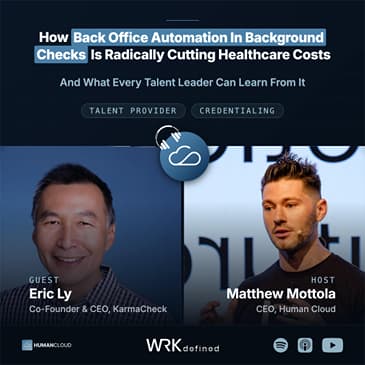
Everyone wants to talk about AI in the front office: matching, interviewing, diagnosis, the sexy stuff. Almost nobody is talking about the back office, where administrative burden has quietly become the biggest cost in the system. In healthcare, the number of doctors and nurses has stayed roughly flat for 50 years while the number of administrators has gone up like there's no tomorrow. That curve is the problem.
Eric Ly built KarmaCheck to bend it. KarmaCheck is a background check and credentialing company focused on healthcare, where credentialing is the path to reimbursement and a doctor who gets credentialed in one month instead of six means more revenue and more care delivered.
We're building Human Cloud to do the same thing for the flexible workforce, so businesses can find, vet, and deploy the right talent solution in minutes instead of months without the administrative drag.
In this episode, Eric Ly shares:
- Why the AGI debate is now an academic question: the technology is already good enough to shift real work, whether or not we ever cross the line
- The 50-year chart every operator should see: flat providers, exploding administrators, and why that is the real driver of healthcare cost
- Why credentialing is the path to revenue, and what cutting it from six months to one does to a health system's margin
- Why the biggest AI opportunity is in the back office, not the front office, and why almost nobody is building there
- How every compliance-heavy function, from procurement to HR, has the same disease, and why Human Cloud and KarmaCheck are attacking it from opposite ends
Eric Ly is Co-Founder and CEO of KarmaCheck. He previously co-founded LinkedIn, where he served as its founding CTO, and has spent three decades building in Silicon Valley across multiple waves of technology.
Listen now on Apple Podcasts, Spotify, or wherever you get your podcasts.
About Human Cloud: We help companies find and deploy the right flexible talent solutions in minutes instead of months. We automate discovery, compliance, and orchestration across 1,000+ workforce platforms — so business teams move fast, procurement teams stay in control, and rogue contractor spend turns into a strategic advantage.
Powered by the WRKdefined Podcast Network.
[00:00:04] [SPEAKER_00] Alright, Eric, thank you so much for hopping on. Listen, this is an honor for all of us. This is an episode I wish happened a year ago, or two years, or five years, but it's happening now, and it'll probably be the first of many. So, I'll give you listeners some context. So, this episode could go in two directions. It could be about KarmaCheck, or it could be about you. And I'm going to let you decide and balance it.
[00:00:31] [SPEAKER_00] But so, the context of this episode, for all you listening, is you will not find a more seasoned Silicon Valley, both entrepreneur but technologist, to basically make sense of what's happening right now. And when I say make sense of, I mean, yes, AI, but also technology as a whole. And so, Eric, I don't want to speak for you, but you've seen multiple waves.
[00:00:59] [SPEAKER_00] This is not your first time seeing a trend, but it might be your first time seeing something as transformative as AI, but we'll get deeper into that. But, I mean, you all listening right now, you are going to be able to listen to probably one of the foremost leaders from a Silicon Valley perspective. You're not in Silicon Valley, you're in Austin, which also, Eric kind of shows that you've been in the game, because there was a lot of movement, as we know.
[00:01:26] [SPEAKER_00] But let's sort of start off, Eric, you want to give a quick just background on yourself, and then we'll kind of, we'll let the episode drive from there.
[00:01:34] [SPEAKER_01] Sounds good. And that's a great intro, Matt. So, thanks for having me here. Sure. So, I actually grew up in, you know, Silicon Valley. I was a kid when I got there, and I became enamored with computers at a very young age, and just really, you know, ran with it. It became my passion, you know, my hobby.
[00:02:03] [SPEAKER_01] And I'm very fortunate to have made a career, you know, a life so far, you know, out of my passion. And I feel like that's, you know, very lucky. Kind of, I guess, not an accident growing up in Silicon Valley, where you're surrounded by other technology folks. You know, we were talking about how there's been multiple waves through Silicon Valley, starting from the beginning with chips, you know, hence the namesake.
[00:02:35] [SPEAKER_01] But it's hard, Matt, to be involved in that and to be inspired by that as you're growing up there. And so, I kind of fell into it naturally, but on the other hand, it was also very easy to continue with it because, you know, it's really all around you. And it's, I think in a word, it was very inspiring to have that almost around you and to keep, you know, doing stuff in that realm.
[00:03:02] [SPEAKER_00] Yeah. And what, so let me get as, or what I think, Eric, was let me get a Silicon Valley nerdy and then we'll kind of broaden. So, if I were to mention the Homebrew Computer Club, is that something that you were like, oh, knew about it, knew the people there, whatever? Or is that the typical, because here's where I'll say, there's a lot of books that talk about it.
[00:03:30] [SPEAKER_00] How real, how real was the Homebrew Computer Club?
[00:03:35] [SPEAKER_01] Well, thankfully, as we were discussing, I only read about that through books. So, I'm not that old, but I also thought about it through books. So, that definitely predated me. But, you know, there were definitely, you know, early days there, right, where Apple, you know, Homebrew Computer Club, you know, led to Apple.
[00:03:57] [SPEAKER_01] So, and, you know, at that time, Apple was just a much smaller company, you know, building these interesting Apple computer, Apple IIs. And when I was going to high school, you know, there were definitely Apple IIs. And that was the introduction of the Macintosh. And it was an exciting time.
[00:04:24] [SPEAKER_01] And so, the company, Apple, was really just around the corner from where I lived. And it was just great to be in the midst, you know, of all that, you know, before most of the world knew about Apple and, you know, used its products, you know, all the time. It was just kind of a very interesting computer company. You know, with a very interesting, you know, founder and leader.
[00:04:55] [SPEAKER_01] Co-founder, I should say. And leader, because there were two Steves. And, but no, it was, that was part of the inspiration, right, of being in Southern Convalley at that time.
[00:05:07] [SPEAKER_00] So, I have one more nerdy question, okay? And then we're going to get into, because you alluded to probably the question I'm going to ask after this one. Which is, hey, you could see what technology was doing to the world. How have you navigated that? And why are you doing what you're doing today? So, that's going to be the question I'm going to ask after this quick nerdy one. The quick nerdy question I have for you. Are we all just copying from Xerox Spark?
[00:05:34] [SPEAKER_01] Well, it is true that, you know, when, you know, in one of the waves of technology development, that there was a lot of borrowing from Xerox Spark to, you know, realize some successes and fortunes.
[00:05:55] [SPEAKER_01] But I would say that, you know, since then, there's been, you know, amazing waves of innovation that have taken, you know, what Xerox Spark did, you know, with the graphical user interface and, you know, extended it plus plus to do, you know, so many more things. And so, it's a very exciting time right now as technology continues to evolve.
[00:06:18] [SPEAKER_00] Well, which I'm going to mention a quick story, Eric, and I'm going to say it in the realms of why, and this is going to get so nerdy, but then for you listening, you're going to hear the exact theme of Eric, what you're working on now and everything. So, I'm going to tell you a quick story of how stuff was taken from Xerox Spark, but then I'm saying it in the realms of why verification, credentialing, and things like background checks are so important.
[00:06:45] [SPEAKER_00] And I can't wait to get your very nerdy assessment on why that aspect of the world is so important. But the quick story I'm going to say, what always, I always remember what cracks me up is, can you just imagine Jobs continuously taking the tour to write stuff down to then tell his team, hey, I saw this at the park, make sure you work on that, right? So, imagine that happening nowadays.
[00:07:12] [SPEAKER_00] And the tie-in is, yeah, there's a lot of stealing and cutting corners and everything. And when we talk about AI and all of this, it's never been more important to have a reliable credentialing, verification, background check partner, which is why now let me ask the question, Eric, tell us about your current company. Give us the elevator pitch.
[00:07:39] [SPEAKER_00] And then let's get into a little bit about why. Like, why did someone like you build this? Because you could be doing anything, Eric. You could be doing absolutely anything, but you'd decide to work on background checks. So, let's get into that.
[00:07:56] [SPEAKER_01] Well, I'll give you the surface level explanation of Carbon Check and what it's about. Wow. So, we are a background check company. And, you know, further than that, we have primarily focused in the healthcare area.
[00:08:13] [SPEAKER_01] And the reason why that's been interesting is that, you know, all the folks that take care of us, you know, whether they're nurses or doctors, have to go through a certain kind of checks to be certified to provide care to, you know, patients whenever we get sick, whenever we go in for a checkup or anything like that. Those are qualified, certified professionals there.
[00:08:41] [SPEAKER_01] And what we do is we really try to make that process go as quickly and as effortlessly, as conveniently as possible. Because, you know, there's more care that could be given and it could be given more efficiently. And us as a background check company, we have a special brand of that called Credentialing, which is just a super duper version of background checks.
[00:09:10] [SPEAKER_01] We help make healthcare, providing healthcare more efficient. And that's what Karma Check does.
[00:09:18] [SPEAKER_00] Tell me, Eric, if I were to just ask a very basic question, Credentialing. What is it? Why does it matter? Yeah.
[00:09:27] [SPEAKER_01] What does it matter? Yeah. So, you know, it matters because there's a shortage of healthcare professionals these days, nurses, even doctors, and it's going to get worse in the coming years. So that's one. The other thing that's happening is that if you look at healthcare, we all know that the industry, it's big, but it's also very, you know, costly. It's a lot of money.
[00:09:55] [SPEAKER_01] You know, we're not talking about the drugs, you know, and the pharmaceutical. That costs a lot of money to develop and they're expensive and all that. But the care itself is also, you know, very expensive. And then you also have a trend that's going on in this country where we're all getting older. The population is getting older. And so as time goes on, you know, we're going to need more and more care as a society.
[00:10:20] [SPEAKER_01] And so when you add all that stuff together, it's, you know, kind of a perfect storm that we all want to avoid. We want to have efficient healthcare. We want to have personalized healthcare. And I believe that, you know, AI is also going to be part of the answer here. You know, AI powered healthcare. But there's always going to be a need for people, for doctors, for nurses and others in healthcare.
[00:10:49] [SPEAKER_01] And we're trying to, you know, bring the cost down, bring the administrative cost down and continue to, you know, help healthcare professionals get to the bedside and deliver that healthcare. That people are going to need more and more of as time goes.
[00:11:08] [SPEAKER_00] Absolutely. Which, let's dive into AI. So here's where, so I always joke with a lot of our partners and buyers and customers. And when I talk about AI, I always tell them, I'm just so glad I'm not you. And what I mean by that is, I don't really touch that sensitive of data. Now, I told you a little bit. So, you know, I built a product at Microsoft back in 2018.
[00:11:34] [SPEAKER_00] And Eric, I'm just going to say, that really sucked because everything that we did, it came back to trust. And it came back to data security and data privacy. And it felt like you would start to take a step like this and it would turn into, did you think about all the ramifications? Have you thought about GDPR? And what about PII? And how is this protected? And how is this safe? And I always laugh now when I look at AI, what we're able to do with human cloud, because, yeah, I don't have that sensitive of data.
[00:12:04] [SPEAKER_00] And so I can just go create things in hours that used to take months. I can literally ship stuff in days that used to take years. And I no longer need the millions of dollars of expenses that I used to have. And so I'll give you some quick nerdy stuff. So for us, QA, yeah, it's now a skill, right? Like we don't really have, we don't have the human in the loop anymore just because our data, it's okay if our production code is kind of crap.
[00:12:33] [SPEAKER_00] Now, I always say, though, look back to the, I'm glad I'm not you. I always follow that by, I'm glad I'm not doing things like dealing with healthcare. I'm glad I'm not touching banking information, sensitive data, things in banking. So you, you are, right? So what you're going to tell us about your view on AI is you are seeing the riskiest, the most hypercritical applications of AI.
[00:13:01] [SPEAKER_00] So I guess let's start, Eric, like what is your, what is your view on it? And then I really also want to get into like, are you surprised by where it is right now? Where do you see it going? What are the implications for all of us, meaning all of us business leaders? But let's just start very broad, Eric. What's, what is your point of view when we talk about AI?
[00:13:21] [SPEAKER_01] So there's a big question right now that I think everybody's trying to answer is what is going to be the impact of AI on the job market? Are people going to work and how is it going to impact that? Is it going to actually displace, you know, people? And that's a really important question. I think it's, you know, everybody's trying to figure out the answer to that.
[00:13:46] [SPEAKER_01] And, you know, I think that most certainly there's going to be certain industries that are going to be more impacted than others. Right. So, for example, you have software engineers, right? Some of the more entry level positions are definitely getting eliminated because of, you know, AI and what it's able to do in terms of coding.
[00:14:13] [SPEAKER_01] Like, when I started, right, as a software engineer, you know, those jobs are, you know, starting to go away, right? Thankfully, I'm no longer coding. I've moved onward, upward, I suppose, and I'm still, you know, of value. But those jobs are going to go away. But there are certain industries also where people, as far as we can see, are going to continue to be needed, right?
[00:14:43] [SPEAKER_01] What a surprise to know that, for example, you know, some of the white-collar, you know, jobs are going to go away. But a lot of the trades, you know, where you have plumbers and electricians and construction workers, that's, you know, as far as we can tell, are not going to go away because they involve, you know, things that robots, you know, cannot do, at least not yet. Or we can't see it being done right now. Those jobs will stay.
[00:15:13] [SPEAKER_01] And kind of the same thing in healthcare. You know, it's very interesting in that, you know, we still feel that the care that a human can provide to a patient is sacrosanct and is going to be there for a long time. You know, certainly there are some aspects of that care that can be automated through AI, and that's probably going to be a good thing, right, in certain cases.
[00:15:40] [SPEAKER_01] Diagnosis, you know, things like that makes a lot of sense. Personalized healthcare that are AI-enabled, it's going to do a much better job because we just simply don't have enough healthcare providers to personalize that care for everybody. So AI is going to have a part of that. So I think it's going to be a very interesting world where we are definitely going to be displacing certain jobs, and AI is going to take them, but there are certain industries where they're going to continue to exist.
[00:16:10] [SPEAKER_01] And I'll just add one more point about AI. It's very interesting. I think we're going to see not only some of the expected use cases, but there are also going to be some surprises that we never thought would have been possible that are literally just right around the corner. And we'll be surprised, you know, at that, even in the next 12 months, even, you know, to talk about, you know, the next couple of years.
[00:16:39] [SPEAKER_01] So it's going to be, it's a very interesting time to see how AI develops.
[00:16:45] [SPEAKER_00] Are you, are you surprised, Eric? Like, did you see, did you see this happening? And I, and I asked that because I, I am surprised. Uh, and I didn't, I would say I was skeptical because to me, I didn't see anything uniquely different.
[00:17:10] [SPEAKER_00] Now, I didn't fully understand the difference between the LLM versus the deep learning versus the machine learning, right? So like, it seems like the LLM has, has been what really has driven all of this, right? And, and enabled this broad application. But at the same time, like, this all was percolating, right? For so, so long. And there's been multiple waves of AI. And even like yesterday, I was thinking about it, you know, someone had asked her like, are we sitting in a world of AGI?
[00:17:39] [SPEAKER_00] Which a year ago, if you told me we were going to hit AGI in the next 10 years, I'd be like, ah, you're crazy. Now, I, I think we're totally living in AGI, Eric. Like when I, I'll give you an example of this podcast. Um, the RAI and, and our, you know, our own unique human cloud LLMs are going to determine the most interesting parts of this episode. And that used to be a human, right? No longer.
[00:18:07] [SPEAKER_00] RAI is better now at being able to say, here are the 15 clips that are better. Here are the top three bullet points. To me, that's AGI. I, I, I think we're in it. But so are you surprised by the current advances of where we are right now?
[00:18:24] [SPEAKER_01] So, um, in a nutshell, I, I am surprised to be honest. So, uh, and I've known this stuff for a long time. You know, when I was, uh, when I was in college, uh, I was really interested in AI. And in fact, I, you know, had that as part of my major to study AI at the time. So I knew a lot about AI when the latest wave of, um, large language models, you know, foundation models and stuff. I knew a lot about that and how they worked.
[00:18:54] [SPEAKER_01] And I, to be honest, I had my doubts because I knew about the kind of theoretical foundations of how the stuff worked. And I said, well, you know, I knew the problems back then. They still exist because it's the same basic architecture. So there's still going to be limitations. But as I said, I have been surprised. And why is that?
[00:19:16] [SPEAKER_01] You know, look, I think that, um, what I realized was at some point, despite the limitations, uh, the technology has already gotten so good that it's almost an academic question that doesn't, it's an irrelevant question to ask whether we're, you know, pre-HEI or post-HEI. Honestly, it doesn't matter.
[00:19:42] [SPEAKER_01] It's, it's getting so good that it, it doesn't matter. It's good enough. And it's capable enough to do so many things. And it's only going to get even better. And so there's going to be a world where, you know, AI is going to do so many things and it's going to be competent enough to add so much value, um, that, you know, work and,
[00:20:11] [SPEAKER_01] and jobs are going to shift over to the AI side of things. And that's going to happen. Um, and so that's really it. It's, it's, it's becoming an academic question that really doesn't matter. And, and so it's, it's going to be good enough and it's going to be in inevitability. So do we, are we going to reach HEI? Uh, it, it doesn't really matter whether that is honestly going to happen or not.
[00:20:38] [SPEAKER_00] Um, I, I fully agree. I love, I love that framing of it's an academic question. Um, the, listen, I, I wish Eric, I wish we could talk now about like, Hey, like, so what do you think the implications of education and higher ed are? But I want to get very detailed into, into healthcare and I want to look at the value chain and I want to deeply understand one, like what, what, what is that tiny little,
[00:21:08] [SPEAKER_00] from a lens of Pareto's principle, right? Of usually one thing creates a hundred X impact and it's finding that one thing that nobody else sees that'll burn you. And my understanding when looking at AI in healthcare is a lot of people are going to want to look at the sexy things like cancer research, right? And like what it can do to doctors of my understanding and being in this talent industry for so long, but then also being at Microsoft and seeing how one little problem creates a recursive
[00:21:38] [SPEAKER_00] loop that then ruins everything. And no one wants to talk about that one problem before it happens. And I say this because my assumption is, and you're the expert here, so feel free to say I'm totally wrong. My assumption is credentialing and background checks are something that nobody wakes up going, Oh my God, let's make sure we strategically plan for this. But when all hell breaks loose, it might've been that, that was the core reason.
[00:22:06] [SPEAKER_00] And if that was solved for, you wouldn't have the billions of dollars of having to walk out from something. That's my assumption is that what you're doing is so important that someone like you is even focused on it. But I don't think most people understand that. So help me understand like the healthcare value chain and where credentialing fits in that. Cause I also think this is something that's applicable for every industry, but it's helpful to have this
[00:22:35] [SPEAKER_00] healthcare sort of use case because if you can solve it in healthcare, Oh my God, you can solve it in probably everything else. But yeah, help me understand the credentialing aspect of the value chain.
[00:22:44] [SPEAKER_01] Yeah. That's why we're so passionate about what we're doing. And it's, it's exactly that what you're, you're getting to, you know, there's a, there's a very interesting graph, you know, that I saw recently is if you look over the last few decades of, you know, people in healthcare, you'll see that over the last 50 years or so, the number of healthcare providers in the, in, in the industry has remained relatively constant.
[00:23:13] [SPEAKER_01] There's been kind of a constant supply of doctors. There's a constant supply of nurses. That's relatively constant. But if you look at that same graph and you layer on the amount of administrative people, administrators that are needed, that are in the healthcare industry, it has gone up, uh, like there's no tomorrow. And so if you're providing the same amount of care, but your administrative burden is increasing
[00:23:42] [SPEAKER_01] all the time, this is a symptom of, you know, runaway costs in the healthcare industry. And that's what we're part of. We're, we're hopefully part of the solution that bends that curve on administrative costs inside of healthcare. And oh, by the way, uh, credentialing is a key process because, um, it's the path to revenue. It's the part, it's the path to reimbursement.
[00:24:11] [SPEAKER_01] That's how healthcare and health systems get paid for the care that they provide. Right. And so if you can have a doctor that can get credentialed that much faster from six months down to one month, uh, or nurses, you know, on, um, you know, a similar kind of level of improvement, um, that's going to mean more revenue, uh, and, and better care, uh, you know, inside of healthcare.
[00:24:36] [SPEAKER_01] And so that's why we're so interested because the regulations have gotten even more complicated, but the solutions to address the regulations and the deal with compliance have not. And so we want to solve that. And we happen to believe that, you know, healthcare is, yes, it's a very complicated industry in terms of compliance, but there are other compliance heavy industries that have the same issues that we could make more efficient.
[00:25:04] [SPEAKER_01] So, you know, there's a lot of sexy AI, you know, in the front office, you know, interviewing candidates when we talk about, you know, talent or HR, uh, you know, interviewing candidates, um, you know, doing matching, that sort of thing. But I frankly think that there's a ton of opportunity that very few people are focused on in terms of applying AI in the back office. And so when you can really kind of take a big chunk off of the, you know, administrative
[00:25:32] [SPEAKER_01] costs, um, and processes in the back office, you're going to, you're going to win, you know, as an organization, um, in, you know, delivering care and, you know, having more revenue, higher margins. Those are the problems that karma check, you know, that we're attacking.
[00:25:48] [SPEAKER_00] Can I, let me play that back. Um, cause I think I want to double collect on the administrators, uh, side of it, but so playing back what you just told me is we all can relate to healthcare costs going like this. Um, which side topic, Eric, uh, maybe we'll, we'll discuss this in person at dinner. And so for all you listening, we're having an incredible dinner with you, uh, next week, meeting when this episode goes out next week.
[00:26:13] [SPEAKER_00] And Eric, I'm going to ask you about how come a country like Singapore has figured this out. And I asked because living there, boy, was my healthcare cheaper. Um, but, but I've been in that. Okay. So what I'm playing back sort of what you're telling me is healthcare costs have gone up. We all know that looking at the actual providers. So the doctors that stayed the same. What's boomed is the administration fee or the administrative side. Why?
[00:26:43] [SPEAKER_00] Like, is this because there's problems and rather than actually solving it, they're just applying more administrators. And, and I, let me just add one more thing to that is I don't think it's going to get better. Meaning when I look at AI, especially in recruiting, I actually think we're creating a conundrum where all the, all the people looking for a job are using AI, all the recruiters are using AI, and we're probably going to create, I think we're already in this massive standstill where it's like, I don't trust any of these people because I'm seeing a bunch of AI
[00:27:13] [SPEAKER_00] optimized resumes and I'm using my AI to decipher them. I think we're only going to see longer times in, you know, traditional talent channels, but that's my little tirade. I'll get off that one, but let me double click on, on the increased administrators and how that ties to the back office as well.
[00:27:32] [SPEAKER_01] I mean, there's a whole bunch of things going on and, and, um, you know, I don't claim that I, you know, uh, you know, all the answers. Um, you know, I think one of the, you know, aspects of, um, you know, healthcare that we have in this country is the fact that, you know, a lot of these, um, uh, health systems are nonprofit. And so, you know, the, the, the mission of these health systems is good in that, you know, they're really all about delivering care and ensuring that patients, you know,
[00:28:02] [SPEAKER_01] heal and recover and all that, but it's not necessarily run with, uh, kind of a, you know, business, you know, mindset, you know, around budgets and stuff. And I do think that probably, you know, the health systems in this country have gotten a little bit, you know, sloppy and inefficient in terms of just, you know, letting the administrative burden, um, you know, kind of, you know, escalate. I think there's some, some other structural, you know, uh, you know, things as well.
[00:28:29] [SPEAKER_01] And that this country has, I think a robust regulatory, you know, framework around compliance for healthcare providers, which I think is very good, you know, in a way it, it, it is definitely good. It's not just good in a way it's really good, but it has, um, has had a consequence of just increasing the cost to provide, you know, healthcare, you know, plus, you know, the kind
[00:28:53] [SPEAKER_01] of litigious kind of, um, you know, society that we live in doesn't make healthcare, you know, that cheap, you know, either. So there's probably a whole bunch of factors. And again, I don't claim to know where's the, the single point, you know, root cause, uh, that if you solve for that, we'll make everything else better, like you were saying before. But, you know, in the midst of this, the reality that we have to deal with is there's a heavy administrative burden, a lot of reporting that needs to be done.
[00:29:23] [SPEAKER_01] Um, and so how do we deal with this? And so, you know, hopefully we can start, you know, untangling, you know, one of the threads, one of the key components of how healthcare works in terms of, you know, credentialing and, uh, you know, revenue cycle management and, uh, you know, pull on that thread and see, you know, how far we get. And there may be other areas, uh, where we could apply AI to continue to, you know, bring down
[00:29:50] [SPEAKER_01] the administrative burden and overall make the system more efficient. So it's, it's something that take time and there's probably maybe, you know, more companies that are going to, you know, take a piece out of the administrative burden. Um, but hopefully over time, you know, uh, we can both work on the efficiency side through technology and we can also work on the, you know, uh, regulatory, uh, structural side to
[00:30:17] [SPEAKER_01] bring down the cost as well, but it's kind of out of control right now, you know, as a founder, uh, and, and as a, you know, owner of a small business, admittedly, you know, the healthcare premiums continue to go up year over year with less than less, you know, coverage. Uh, that seems like a very unsustainable model.
[00:30:39] [SPEAKER_00] All right. So like I said, listeners, if you want to have continuous conversation, come to dinner next week. Um, Eric, I cannot wait to jam on the different models and the incentive structures and that. I think the, the theme I would use for this episode is going to sound so boring to some, Eric, but for those, uh, for those that get it, they're going to get so excited that we're finally talking about this.
[00:31:05] [SPEAKER_00] And that is the need to reduce administrative burden by prioritizing back office operations and not just throwing AI on it. If I were to summarize this whole episode, I would say, yes, AI is real. It's transformational. You and I have both admitted that even being deep in the AI world, we are surprised by how good it is.
[00:31:33] [SPEAKER_00] And you nailed it when you said, who cares if we're in AGI or not? The reality is it's going to transform everything. With that said, most, and emphasis on most, most sectors are totally plagued by massive administrative burdens. And at the macro level industries like healthcare and education are obvious areas that we look and we all can relate. Yep.
[00:32:01] [SPEAKER_00] Those seem like there's been an administrative something that has made costs go crazy high, but at the micro level, I would argue some functions have to deal with that as well. So things like procurement and HR, there's been a lot of burden as well, where we're just trying to get work done and holy crap, have we made it so hard to just simply say, get this done, right? Whether it's the processes we've added, whether it's the provider angles of that.
[00:32:28] [SPEAKER_00] So if I were to summarize this episode, I would say, if you care about reducing administrative burden so that your organization can drive more revenue and reduce cost, holy crap, Eric, people need to reach out to you. So last question and most important, where do you want every single one of our listeners to go right now?
[00:32:50] [SPEAKER_01] To go right now? You know, I would say there's multiple ways to answer that question. But like you were saying, I think it's really important to be open, you know, as a leader, right? To open-minded as a leader to these developments and technology and AI that are upon us and to figure out for ourselves, for our companies, how we're going to take advantage of them, you know?
[00:33:19] [SPEAKER_01] And to really look at it, you know, not as like a blanket, oh, I'm going to just deploy chat GPT among my team and it's going to be done. No, there's definitely much deeper work going on. And to look for those solutions that really bring the value measurably to our organizations. And they're all going to be there. I think the companies that exist in five years, very much a hybrid between lots of AI and people too. But it's going to be a very different mix.
[00:33:49] [SPEAKER_01] And the potential for radical improvements and efficiencies are really going to be there. And that's the competitive landscape that, you know, all the companies who are going to be at. So it's really important.
[00:34:05] [SPEAKER_00] I totally, totally agree. All right, Farrakh, we're going to have the pleasure of literally seeing you. And when this episode goes out a couple of days for listeners, if you want to be at that dinner, let me know. You should be. I would argue everyone should be flying into Dallas for it. But listen, Eric, thank you. Thank you so much for hopping on. Again, listeners, go check out KarmaCheck. You know, everything we said in this episode, please go talk with Eric about and his team.
[00:34:32] [SPEAKER_00] And if you love AI, yes, make sure you go reach out to Eric too and talk about a hard problem you're solving, Eric. So thank you. Thank you for hopping on. I'll see you in a couple of days. Great seeing you, Matt, here. And I will see you in a few days.
[00:34:45] Thank you.
Sponsors
