
The tech industry laid off thousands of people 18 months ago. This past year it hired almost all of them back, nearly one to one. That whiplash is what happens when companies chase AI headlines instead of a workforce strategy. Technology does not create value. People working with technology create value.
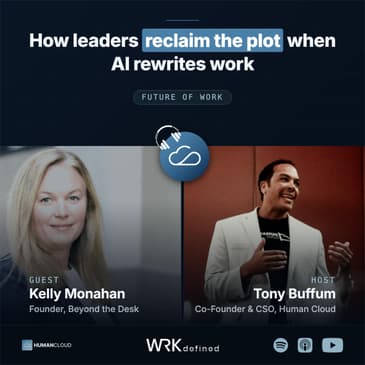
Kelly Monahan built Beyond the Desk to keep leaders from losing the plot on exactly this. Her team of behavioral scientists works with executives on the people side of AI transformation: change management, reskilling, and work redesign. Her new book, Reclaim the Plot: How Leaders Rewrite the Story When AI Rewrites Work, is out September 29.
We're building Human Cloud so leaders can act on the same thesis from the talent side, finding and deploying the right flexible talent solutions in minutes instead of months, and re-spending the capacity AI frees up on people who create new value.
In this episode, Kelly shares:
- Why AI transformation has no technology problems left. The tooling and data are solved. What remains is change management, reskilling, and work redesign, and that work belongs to HR, not the CIO
- The CHRO skills supply problem. Boards now want systems thinkers with product and engineering fluency, and Google's formula is a third product design, a third engineering, a third traditional HR expertise
- AI is the elevator, not the skyscraper. Companies find 45 to 50 percent automation in real workflows, but few know how to re-spend that capacity dividend on new value instead of headcount cuts
- The dark corners: "tokens over talent" mandates, arbitrary 25 percent workforce reduction targets, and why every AI agent still needs a locus of control with human accountability
- Why the flexible workforce wins this transition. Independents keep growing while workforce participation shrinks, small businesses are building AI-native flexible teams first, and it's the same thesis Human Cloud is building infrastructure for
Kelly Monahan is the founder of Beyond the Desk, former leader of the Upwork Research Institute with prior roles at Meta, Accenture, and Deloitte, and author of Reclaim the Plot (out September 29, 2026).
Listen now on Apple Podcasts, Spotify, or wherever you get your podcasts.
About Human Cloud: We help companies find and deploy the right flexible talent solutions in minutes instead of months. We automate discovery, compliance, and orchestration across 1,000+ workforce platforms, so business teams move fast, procurement teams stay in control, and rogue contractor spend turns into a strategic advantage.
Powered by the WRKdefined Podcast Network.
[00:00:04] [SPEAKER_00] Hey everybody, I'm Tony Buffum with Human Cloud. I am so excited today to be sharing a really cool podcast with my former colleague, always friend, Kelly Monahan of Beyond the Desk. Kelly, welcome to the Human Cloud Podcast.
[00:00:21] [SPEAKER_02] Thank you so much, Tony, for having me and it's so good to see you again today.
[00:00:24] [SPEAKER_00] Yeah, it's terrific to see you again. And as I just alluded to, we work together during part of our time at Upwork, so we'll cover that. But I want the audience listening or watching to just get a quick refresher on your background and how you got to where you are now.
[00:00:42] [SPEAKER_02] Okay, I will highlight the hallmark moments of how we ended up here. Very first, I started my career as an HR business partner and got into HR because I thought that's where leadership development happened. That's where we engage employees. And this is going back, you know, 15, 20 years ago and robotic process automation was coming onto the scene and the CFO called me aside and was like, Kelly, your first assignment is going to be doing a reduction of workforce, a ref.
[00:01:08] [SPEAKER_02] And going through that year-long process of understanding how organizations make decisions, the trade-off costs, and just like the human consequence of having to lay off 200 people in a matter of 12 hours, I think changed the way that I think about data, research, and what's needed to actually put people's first practices in place. I think so often in HR, it feels like soft and squishy. This needs to be like a very scientific approach or else we're not going to get the CFO's attention or CEO's attention.
[00:01:37] [SPEAKER_02] So that was like a hallmark moment of realizing if we don't get technology right, people will lose their jobs in a very like blunt way. Fast forward, then I got the opportunity in like my mid-30s to work with CEOs at Fortune 100 companies and between Deloitte and Accenture in the consulting world, seeing firsthand how often these leaders were like, but what about the people? What are we doing on the people side of this?
[00:02:02] [SPEAKER_02] And there was so little conversation that like felt good to me of there was a plan in place. So then fast forward, I got the opportunity to work at Meta and Facebook. And so getting inside technology and thinking like, okay, they must have cracked the code of human and people and the technology intersection. No, so many questions opened. And so that's where I am today. I still feel very much as an explorer, a researcher trying to figure out how do we accelerate technology progress, not hold that back,
[00:02:32] [SPEAKER_02] but making sure that people are coming along in such a way that we haven't lost the plot of what work is all about.
[00:02:38] [SPEAKER_00] Yeah. I think we hear about like these people, these startups hitting, you know, a billion bucks, these unicorns with no employees. And that's the future. That's an exception to the rule. Yes. And so often we see technology adoption. The first thing naturally, it's driven by the public companies and the media narratives around, hey, we got to replace people because that brings productivity.
[00:03:03] [SPEAKER_00] And when we adopt technology, that allows us to be more efficient and get rid of our biggest cost, which is people. But the people always come back. The technology doesn't live on its own. So tell me a little bit about that dynamic in your experience and why it's so important for the leaders to really understand the people opportunity.
[00:03:23] [SPEAKER_02] Yeah. Well, Tony, I know you, so I know you must be tracking this. It is fascinating to me of how many layoffs the tech industry did about 12 to 18 months ago and how many people they've now hired back this past year. I mean, it is almost one to one when you look at the data. And so to your point, I think people got so excited about the shiny object. And don't get me wrong, agentic AI is changing my world and it's going to turn, I think, a lot of people's worlds upside down.
[00:03:52] [SPEAKER_02] However, I think we've front loaded that, figured we could do all these things without people. And then to your point, technology does not create value. People working with technology creates value. And I think we lost that value proposition somewhere along the way because of these headlines of the $1 billion company with no employees. And I'm like, is that really the purpose of business? Is there something more that we should be doing here by creating economic opportunity, by helping out local communities? There's so much more to business than just transactional wealth, right?
[00:04:21] [SPEAKER_02] There's such a bigger purpose there and we seem to have lost that. And AI seems to be the scapegoat for losing that for whatever reason these days.
[00:04:27] [SPEAKER_00] Yeah, it does seem like a really easy default to be like, oh, well, AI kind of means we get to work with people less. But the reality is AI doesn't happen without people. And we're not trying to be altruistic and saying like, oh, you got to bring people along. And no, that's how businesses are successful. And everybody knows it. It's finding the right balance.
[00:04:50] [SPEAKER_00] Because to your point on the firing folks and hiring back, frankly, for me and my HR formative experience, that's what really drove me crazy is living in that cycle of like, oh, we got to get rid of people. We got to hit these numbers. And then we do that. And they're like, we needed some of those people. Let's go get them back. Like it's that tug of war. That's kind of the definition of insanity, right?
[00:05:15] [SPEAKER_00] So the change, like the real impact, that dance is all for metrics, in my opinion. Yes. The real impact is when you actually put the effort into doing it right, solving for it, and bringing the people on the process. And people listening to this might be like, this is what I expected hearing two HR people talk to each other. But it's because there's a reality around it. Help me explore that a little bit further.
[00:05:40] [SPEAKER_02] Yes. Well, listen, Tony, I'll tell you what, when I started Beyond the Desk, I, like my background's in HR, like home base for me is HR. I have barely working with HR leaders right now. I am mostly actually working with technology leaders. And it's because AI transformation has found itself mostly on the CIO's agenda or CTO's agenda. And they are realizing now a couple years into this whole transformation that there's no longer technology problems to solve for. Like they have figured out the tooling. They have figured out the data concerns.
[00:06:10] [SPEAKER_02] It is now change management, reskilling. It is all the issues that should live in HR that technology leaders are grappling with. And that is part of a lot of the work that I'm dealing with is do we really want technology leaders leading the change management and people side of this? Where is the CHRO? Where is the CHRO? And how do these roles? I mean, in some like areas too, there's been conversations about do these roles eventually merge? Like does this become one C-suite function overseeing a human plus AI workforce?
[00:06:38] [SPEAKER_02] I think these are still like very emergent and frontier conversations to be had. But I am so worried if we do not get HR in the conversation, we are missing out tremendously in the value that could be here. Because it's not really technology's job to figure out the reskilling, work redesign, and change management side of this.
[00:06:55] [SPEAKER_00] I 100% agree, of course. And I think I've seen examples and I've met people that are in HR leadership roles that now all of a sudden have either the whole technology function or at least responsibility for AI implementation fall under them. And they're kind of struck with both this, oh, wow, like this big responsibility and this big budget are all aligned underneath me. So there's high expectations. And also this, I don't know if I want this hot potato.
[00:07:24] [SPEAKER_00] And I wonder to your point of you're dealing less with HR leaders than tech leaders. I can't help but wonder are HR people really, is the problem, they're not really embracing this. They're kind of still sitting on the sidelines. Like, what do we, like, let me know when you need me. In the meantime, I just want to see what's happening. Or do they just not have the skills and therefore the confidence to take the lead?
[00:07:51] [SPEAKER_00] What do you see as the major hang-up for HR getting involved the way it should when it comes to the most important transformation that's going on in organizations?
[00:08:02] [SPEAKER_02] Yeah. So I've been doing this really cool research project with Hindricks and Struggles. And I think Hindricks and Struggles is, they're going to be releasing a white paper soon. I think they're ahead of this. Because being a recruiting platform, you know, recruiting company, they are hearing from the CEO that they are demanding a different set of skill sets that they're expecting from their CHRO. And so how they've defined it is there's a supply problem.
[00:08:25] [SPEAKER_02] Like, there is not enough qualified HR people who have the systems thinking, who have a product background, who can work with engineering teams and think about this from a first principles set of problems. And so to me, I think what needs to happen after doing this research is the CHRO has to rethink through the skills that they have. Right now, it's very functional expertise. We think about performance management, learning and development, employee relations.
[00:08:51] [SPEAKER_02] We need the kind of thinking that's going to stretch across all of that into the actual business. And we've been talking about business document. This is something different. This is more system-wide. How does this enterprise create value today? I'm not sure most CHROs or their teams have been equipped or skilled to think that way and then handle that problem. And so I think a lot of this has to do, like, if you're a CHRO today, as I'm working with some of these teams, how do you rebalance?
[00:09:17] [SPEAKER_02] Like, you might need Google's formula, which is a third product design, a third engineering, a third traditional HR expertise. And I think, like, ServiceNow, I think, is an example that's really interesting where AI transformation partly sits under their CHRO of rebalancing that team to actually be able to handle the new CEO proposition right now, which is help me translate this moment into enterprise value. And it's very different than having a traditional HR perspective of here's the programs and policies they put in place.
[00:09:46] [SPEAKER_00] Yeah, I think you bring up a really good point. And I've had this conversation with several folks in HR. The fact of the matter is, I think you have to be starting out as an HR leader with that strategic outlook. And if you're not engaged with the business strategically, which requires that business acumen, you know, that those are table stakes, traditional HR background, at least as a generalist, table stakes.
[00:10:09] [SPEAKER_00] But being strategic includes having the ability to influence and drive discussions and decisions with the C-suite. If you're not already positioned strategically, which I do think has that systematic view across the organization, there's no way you can step into the moment now, which is to understand this major impact on your people and the way that you work.
[00:10:34] [SPEAKER_00] And it requires taking a step back and thinking about not only your company's value proposition, but how you deliver that and how you kind of build that back up, you know, from the ground up with now AI as a major contributor and people being both full time and flexible. You know, all those different elements need to come to bear.
[00:10:57] [SPEAKER_00] And you can't think about that if historically your job has been compliance and, you know, pool parties.
[00:11:05] [SPEAKER_02] Yeah, that's right. And I mean, I don't know, Tony, if you're seeing this too in your work. Like, listen, like behind closed doors, what I'm also hearing from CHROs is they are also tired. They were the ones shouldering the organization during the pandemic. And that turned things upside down pretty dramatically for most HR professionals. And so it's like they had just come through that, getting ready to catch their breath. And now they're being put right back in the spotlight with AI transformation.
[00:11:32] [SPEAKER_02] And to your point is CEOs asking them, how do we become an AI native or AI enabled organization? I think every CEO is probably asking their CHRO that to an extent. And so I don't know. I mean, in some ways, I'm very worried that there's just a true burnout and exhaustion of our current pipeline because we have gone through something pretty radical over the last 10 years. And it really has landed on the CHRO in particular to handle the breath of what's happening.
[00:11:59] [SPEAKER_00] Absolutely seeing the same thing. And, you know, this is one of the one of the charts I used to show all the time when I was still at Upwork, which is this massive turnover within HR. And the fact that there was something like I'm going to forget now was a really interesting stage survey. But a broad majority of HR people wanted to leave the function. So I do think there is functional burnout of people just going, I don't want to do this anymore. And what do I attribute that to?
[00:12:27] [SPEAKER_00] I attribute that to the lack of technology adoption. Because I would often show that slide and then show right next to it, HR is in last place when it comes to digital transformation. You marry those together. Of course, HR people are like fed up and I'm out of here.
[00:12:42] [SPEAKER_00] But what you just described, if we pretended for a moment that that dearth of technological advancement didn't exist, if we pretend it doesn't exist, what you described is what we want to do. As a leader, the biggest moment in the decade for all organizations, everybody's looking at HR. Then the next biggest right after that, everybody's looking at HR.
[00:13:09] [SPEAKER_00] If there's a question about the value and potential for impact, there's no doubt that the challenge is you're at the table. Everybody's looking at you. What do you do? You either throw in the towel or you sit back and look over to the tech team to step up. And then you get behind them. That's kind of what I feel like is happening instead of us being able to really, and I say us, us as the broad HR community,
[00:13:36] [SPEAKER_00] really being able to step up and own this moment and drive the change the way that HR should at this point in its evolution as a function.
[00:13:46] [SPEAKER_02] Yeah. And I think it's been so interesting. I think partly where, you know, some of the CHROs I'm working at who have like a very traditional HR background are really leaning into the non-traditional backgrounds right now to help supplement their bench strengths. Yeah. So that they're not just relying on technology. Like one of the biggest complaints I get to is HR, let's talk about their tech stack for a second, because it's usually outdated. It hasn't, you know, data's all over the place. Oftentimes it's because they cannot get the internal technology support to prioritize the HR function as part of the technology roadmap.
[00:14:16] [SPEAKER_02] So they've been asking technology for a long time of update my workday, update my, you know, whatever SaaS platform they're on. And it's now becoming a huge issue because now they need to add AI to the tech stack. So we need technology to begin to prioritize HR and or what I'm seeing is even better, HR building their own engineering team and beginning to actually self-service what they need in this moment.
[00:14:40] [SPEAKER_00] Yeah, they do. Well, and again, if I go not only back in time now, my message to HR leaders is you're not getting it, go get it. You can, you can tap into, you know, talent marketplaces and other resources outside your organization. If you're not getting the attention you need and just go get it. Tell your tech teams, Hey, I've got resources. They need to partner with you and me, but I, I figured out the budget. I've got the resources. We need to make this happen because I totally agree with you.
[00:15:10] [SPEAKER_00] That's the big hangup and that's made it. That's where I think HR folks feel like they're handcuffed already. I was at a couple larger talent events earlier this year talking about talent leaders, transformation, particularly related to AI. And I think it's, you know, like the, to me, the front line of HR, AI transformation is recruiting because there's so much expense around recruiting.
[00:15:35] [SPEAKER_00] There's also been this massive spike in people applying to jobs and there's also fraud in there. So there's all these issues. So how do we deploy AI to get our arms around this and control it? And systematically the, the first, I don't want to say excuse. Although I just said it, the first bottleneck or the first hurdle is, Hey, we know our data stinks.
[00:16:02] [SPEAKER_00] So until we get our data, like, I don't want to put a tool on top of bad data and then end up with something that is still only telling me half the truth. We need to stop and clean that up, but I don't have time to stop and clean it up. And to me, that's change management. That's practical, practical. Okay. So what do you need to do? Like you've got to manage that, like a project because not doing it doesn't make things any better.
[00:16:29] [SPEAKER_02] Right. That's right. I mean, why do you think, like, you know, you went to Cornell. I went to RIT. Like we learned change management. Like those textbooks are as relevant today as they were back then. Like how did we lose change management? When did that go out of style? I'm like, it's just fascinating to me to your point. It's not like some new invention we need to figure out here in HR. It's literally going back to some of the basics and remembering this is good practice.
[00:16:54] [SPEAKER_02] And I just don't know where we've lost the plot when it comes to completely bypassing change management for one of the biggest transformations we're trying to do right now.
[00:17:02] [SPEAKER_00] Yeah. I think it's, we get, when push comes to shove, every function, you know, we're harping on HR, but we know this exists in a lot of functions. True, true. You can't help but, you know, huddle back in that space of safety. Yeah, that's right.
[00:17:46] [SPEAKER_00] Bob still does. I could always see this reaction of the HR leader being curious and interested and then the wheels turning and then them starting to feel like this sounds like work. This sounds like I want to do this, but oh, this is going to take, I'm going to have to work upstream with hiring managers to get them to think differently about the way we construct roles and how we resource getting things done.
[00:18:11] [SPEAKER_00] When I know that they're just going to be like, just give me a butt and a seat. That's all I want. Like, that's not always the best answer. Actually, most of the time it probably isn't the best answer. There's a, especially more and more now, but that result, that means there's conflict and pushing back. And so I think more and more with as busy as overwhelmed as we just described, as HR leaders are, it's the pack of least resistance. And maybe someone else will drive that change.
[00:18:40] [SPEAKER_00] And it's really tech. So maybe I don't have the skills or the knowledge to implement it anyway. Sure.
[00:18:48] [SPEAKER_02] Yeah. No, that makes sense. Well, I'm hopeful. I'll be curious what your take is, as we think about human cloud, like in the independent talent community, like as someone who just started my own business, I am immediately thinking of like, how do I build an AI negative flexible talent organization myself? Like, and I know like there's probably pros and cons as you look at these different models, but I am bullish on the opportunity.
[00:19:11] [SPEAKER_02] If there's more people like you and I who are now going out on our own, I'm immediately thinking of the flexible talent market right as my first go-to. Because I'm like, first of all, I know you're going to be more skilled. I know you're going to probably work a lot faster and you're going to be very motivated to keep up with the times. Like, I just, that is a profile of the person I want working for me as a business owner, if that makes sense. So do you think that market is going to continue to maybe grow or evolve for smaller, medium-sized businesses as we all kind of figure out what does AI mean for us?
[00:19:40] [SPEAKER_02] And, or I don't necessarily have the income coming in to hire a huge, you know, W-2 employee set, but I've got enough income coming in that I need someone else's expertise and can pay them, you know, obviously very well.
[00:19:52] [SPEAKER_00] Yeah, a hundred percent. I mean, we see that the independent space, freelancers, independent contractors continues to grow at the same time that the overall workforce participation rate shrinks. So they're moving in opposite directions, which stands to reason for a lot. We also have tons of people retiring at a fast place and we can replace them. We have people leaving the workforce in order to be independent and we have people that are graduating that go straight into being independent.
[00:20:19] [SPEAKER_00] There's a different dynamic and we, we could have a whole separate podcast on why that is. It's probably related to beginning the conversation of these, this layoff back and forth and not being able to really rely on employers the way that people did decades ago. So I do think there's that dynamic exists, but it grows faster. You know, it's kind of like that Jew God innovation mentality, like necessity breeds that innovation that includes resourcing and talent.
[00:20:49] [SPEAKER_00] When you don't have that many resources and you need to get some marketing collateral put together, you don't think I need to hire a full-time marketing person. You think I need to hire someone that can put this together and then be done and move on. And oh, by the way, they've done that a million times for a million other people. They do it better than probably someone that I hire. I had a friend reach out to me years ago. We worked together at, uh, Stanley Black and Decker. Now he's on his own. And he said, Hey, Tony, he reached, we hadn't talked in a while. He called me. He's like, I need a marketing person.
[00:21:18] [SPEAKER_00] What do you need him to do? I need him to build collateral, do our social media. I need to build a marketing strategy over a new product launch. And I'm like, okay, dude, you're not going to get all that in one person. If you do, they're going to hate half the stuff that you have been doing. Cause it's like so beneath their level or you're going to get someone junior that doesn't know how to do the strategic or you could just source for each one of those independently, not hire someone full time and save a ton of money and whatever you don't spend, put it into something else.
[00:21:48] [SPEAKER_00] And it was like, man, that's a really good point. And within literally within two weeks resourced all those jobs. So didn't go through two or three month hiring process. But that's all to say, I definitely think the growth is with small and medium because one, they make decisions faster and they need to. The bigger question is how do enterprises keep up?
[00:22:12] [SPEAKER_01] Yeah.
[00:22:12] [SPEAKER_00] Cause it, that's right. The same value proposition exists for them, but it's kind of like the old cliche of turning the Titanic. You know, like it's, it's really hard to get them on board, even if it's good for them, because there's so many easy ways to get caught up in some kind of bureaucracy or some kind of, we don't do it that way excuses.
[00:22:31] [SPEAKER_02] Yeah. So it was so interesting. I was having a conversation. I was lucky enough to be with a CHRO at one of the large AI companies recently. And we were chatting and the question came up, which was around, how do we think about the exact question? I'm like, at an enterprise level, how do we reinvent performance management? How to reinvent skills pathways, how to reinvent everything that we've built now that we know AI is here.
[00:22:58] [SPEAKER_02] And I think one of the exciting things they said to me was, and I totally agree with this because I've started getting into codecs and vibe coding and I just like, my mind is blown what were AIs right now. Actual human talent has been so constrained in large organizations. It's been very constrained and software is also a pretty big constraint right now as well. And so what happens when you can remove those constraints? And then how do you then design the environment so that human potential actually can become unleashed?
[00:23:27] [SPEAKER_02] And really not just human potential, but expertise. There's all this trapped expertise that remains in silos or just friction in the ways in which we work. And that to me is what I'm really excited about. And that's a lot of the work I'm trying to do right now is how do we actually go back? I'm kind of using a blueprint as the analogy here of we got to go back to the blueprints and redesign ways in which expertise can now actually be unleashed within your organization. But it will continue to be trapped if we design work the way we've always been working for the last 20, 30 years.
[00:23:55] [SPEAKER_02] So I think where there's real crossroads, it's really hard and it's contextual though. Like you've got to get your hands dirty and figure out what does work look like? What value are you creating? And I've designed this game. So I make them play like you've got to either augment something, automate something, remove something, or reinvent something in a real workflow. And it's been really fascinating. Most, when we do this, most companies are finding upwards of 45, 50% automation of like almost no brainer.
[00:24:21] [SPEAKER_02] But then the real question becomes to your point at enterprise level is how do you re-spend that capacity dividend? It's not just workforce reduction. That's the problem. And once you realize, wow, there's so much newness we can begin to create with this workforce capacity dividend, that is what I'm excited about. And that is the organization actually reinventing itself. But so few companies are ready to spend that capacity dividend.
[00:24:43] [SPEAKER_00] I like what you describe. It makes me think of, we both worked with Robin Jasuth-Hasan back in our days. And he had this really cool diagram I used to use a lot that showed the impact of AI and HR. And the short of it is, it takes away so much of the administrative burden of our function and allows us, it opens up, just like you said, that potential, that creativity, the value add, the frankly, the why we get into HR.
[00:25:12] [SPEAKER_00] We want to have room to influence. Yes. We want to have room to really dig into things like that change management impact. We got to get rid of all this nonsense, all this stuff that doesn't add value, all this stuff that could be self-service. That opens up the aperture for HR folks to really be engaged and use more of their creativity. And they have to, because just like we said, they have to rethink all the things that we do already. And that, you can't do that when you're cycling through wrecks and trying to figure out, you
[00:25:42] [SPEAKER_00] know, where things are within your ATS, whatever. Like there's so much stuff that's easy to get burdened out with. I love that it should enable all of this potential. We've, we've both been talking now, like AI is all good and all great. Yeah. We also, there's a dark side. So I want to, I want to like kind of pivot a little bit because if I'm going to listen, I'm like, okay, yeah. Like you guys are, as my kids would say, you're glazing AI. So let's back off with that for a second ago. Well, what are the watch outs?
[00:26:11] [SPEAKER_00] Because embracing AI can be dangerous. And I was at a PE conference back in June and I heard a couple of things I found really interesting. One, it was an organization said, Hey, we encourage everybody to build a new agent every month. And that sounds really cool because it's like you're encouraging creativity. But then it begs the next question of how are you managing all these agents now? Like where, what are you doing? How do you make sure they're, how are you sustaining them?
[00:26:40] [SPEAKER_00] How are you making sure they're remaining compliant and not creating risks? When do you decide to shut it down? Cause there's no value. And then aligned with that, I heard another conversation around tokens over town. Hey, let's freeze our talent and let's just figure out what the scalable token approach is to giving people more things to work with in terms of AI tools rather than adding any more people. Those to me are dark corners.
[00:27:10] [SPEAKER_00] Not all bad, but like just describing it. And I can tell by your reaction, like inherently you see, Oh, that's risky. Like, wait a minute. Is that the right strategy or is that just sandbox gone wild?
[00:27:24] [SPEAKER_02] Oh my God. I love, first of all, sandbox gone wild needs to be like a teacher or something. I love that. But, um, Oh no, like I, this like strikes the chord because I originally wanted the book I have coming out called We've Lost the Plot, but the publisher said it was too negative. But like, I think we've lost the plot when I hear like executives say this, it drives me bonkers. Like the other thing I'm going to add to your list of We've Lost the Plot is there's so many organizations with a 2030 readiness program where the board has set a target to reduce the workforce for 25%.
[00:27:53] [SPEAKER_01] Yeah.
[00:27:53] [SPEAKER_02] It's like, why? And it's your point. It's like, well, you should be driving that much efficiency through AI. So I think a couple of things here is number one is we have lost the sense of what is our North Star value? Like what does good actually look like? When I hear of this like token maxing examples or cut your workforce, those are not aspirational. Like this is our vision of what good looks like today. An example I keep using is like AI is the elevator and everyone's so excited that we're
[00:28:21] [SPEAKER_02] going from floor one to five so much faster and cheaper with less people. That does not change the landscape. It took 30 years and all of a sudden all of our cities had skyscrapers. And so what I'm pushing executives towards is what is this skyscraper opportunity in your industry? Someone is going to find it. Like AI is available. It's here. But how do you capture the goodness of that and create value and not actually erode your core value, which I see happening over and over again?
[00:28:47] [SPEAKER_02] And the second thing I want to say is I've been playing around a lot, as I told you, with Codex. I was blown away. So I'm like building this leadership simulation and I thought I was working with one agent I had created. Well, this agent went and then subpopulated six other specialist agents at the same time working on these tasks. And before I know it, my entire desktop is like filled with all these different work strengths. And I'm like, whoa, time out. Like, what is the locus of control that we have? Right.
[00:29:17] [SPEAKER_02] Because HR people, we should have a locus of control number for AI agents. I have not seen that thinking done. If anything, we're like exploding locus of control. We like don't believe in middle management anymore. We're like, you got these tech companies being like, oh, everyone reports up to the CEO to some degree. And so to me, like that is a huge watch out is like there is still human accountability at the end of this. And if every agent is going to spin up six to seven agents to complete your task, you have completely now we're operating in the wild, wild west.
[00:29:46] [SPEAKER_02] And that's what concerns me. We don't, again, these are all HR issues. These are people issues we've got to intentionally design for.
[00:29:52] [SPEAKER_00] Yeah. And I can't help but think when you hear these are somewhat arbitrary targets around like workforce production and getting back to we've lost the plot. We lost it a long time ago when organizations really just got this, this numbers mentality, like headcount, headcount needs to change from this. These are the people that are leading your organization. These are your future C-suite folks. And but it's no longer there's no longer that relationship.
[00:30:22] [SPEAKER_00] So now that's why we see the pendulum swinging left and right in terms of control between employers and employees or workers because they no longer had this paternalistic relationship where we're going to take care of you and, and we want to build you build a career here that doesn't exist. Now it's be happy if you get a couple of years out of somebody because they're going to promote themselves. They're no longer waiting for you.
[00:30:50] [SPEAKER_00] But all of that to me, it's, it's, it's just as true. This tokens over talent mentality of your employees that work there now, or the ones that are left over after a big layoff announcement, what do you think they're learning about who your company really is? And what does that tell them about how they plan for their future? Even though they survived this one event, they're thinking differently about their future now.
[00:31:14] [SPEAKER_00] And the same applies to AI implementation when you're going at it with the goal of reducing their colleagues, maybe even reducing them. How do they think about their career differently at your organization in that context? And I think that's something that organizations have lost the plot on, but you mentioned that was the negative, no good title. What is, what is the approved title of your new book that you can't wait for it to come out?
[00:31:42] [SPEAKER_02] Um, reclaim the plot, how leaders write the story.
[00:31:45] [SPEAKER_00] Much better.
[00:31:46] [SPEAKER_02] I like that actually. Okay. Well, yes. Cause they were like Kelly, like what executive is going to go order a hundred books for their team? They're walking around the organization. We've lost the plot. I'm like, all right, fair enough. Um, but yeah, I mean, the story is still the same. So what I've done here is I created a fictional company because at the end of the day, this is not about a blame game. I mean, you and I could probably point to a dozen leaders, a dozen companies of who's lost the plot. Like that is not the purpose of this. It's actually to reflect and realize that everything's a win-win right now.
[00:32:16] [SPEAKER_02] And there's really hard trade-off decisions leaders need to make. And so I've created this fictional company called Driftwell and it follows this leadership team as they're having pressure from the board, from private equity investors, from their workforce. Like it is coming at them at all sides. And you begin to see where they lose the plot at times of like favoring profits over people in a short-term approach. And then eventually we get to the dream state of where at the end of the day, one of my favorite chapters is called the unsexy win.
[00:32:45] [SPEAKER_02] Because business today is not necessarily that unicorn growth that I think everyone's looking for that 10 to 20 X valuation. It is slow, steady, and sustainable. And I'm like, we've lost that to some degree. And I'm like, you still see that in the hospitality industry or the retail industry where they understand they cannot erode their value proposition to their customer. I think we all want to be the next Amazon, the Netflix, the next Google. And I'm not sure that's where I'd be looking right now for HR practices. Like, I think there's other places to look that are actually better.
[00:33:15] [SPEAKER_02] That's a little bit kind of what I hint towards in the book.
[00:33:18] [SPEAKER_00] I love that. I love all that thinking. And it sounds like required reading if you want to get yourself in the mindset to be able to approach this modern work landscape. Absolutely. And people need that reset. They need something that's going to help them put everything into context. Because everything you described, activists, investors, and the arbitrary headcount reductions,
[00:33:45] [SPEAKER_00] all those things exist in more than just the organizations that we've lived in. They exist everywhere. And people feel intimidated. So intimidated by it. So navigating that in a productive way, I think, requires that mental reset around how you approach business so that you can do it confidently and proactively rather than reactively to all
[00:34:11] [SPEAKER_00] of these different inputs that just are pressure to do things that can kind of be knee-jerk and desperate versus the right thing for your people and your business.
[00:34:22] [SPEAKER_02] Oh, love it, Tony. Summarize it beautifully.
[00:34:24] [SPEAKER_00] Well, listen, we get to have more of this conversation because we could go on forever. Yes, totally. And we will have more of this conversation in just a few weeks. So thank you very much for agreeing to join Matthew Mottola and I at a dinner we're hosting in Dallas, September 29th. For folks that are interested, they're going to be in the area. Maybe they're attending the SIA CWS and Collabix Conference, which, by the way, Kelly is keynoting that. Maybe you're attending those events or maybe you're just in Dallas and you want to hang out and have dinner with us.
[00:34:54] [SPEAKER_00] It's a very limited access dinner where you're going to be our special guest and we're going to have some more of this conversation, but we're also going to have really good food and I'm going to have enough martinis for both of us because I think you have some other possibilities. So I'll pick up the slack for you. I am going out, Tony. And you're dropping your book though. When does your book come out?
[00:35:14] [SPEAKER_02] Tony, my book comes out that day, September 29th. So that is book launch day. So it is going to be a very special dinner for a variety of reasons.
[00:35:22] [SPEAKER_00] That's awesome. Well, you'll at least have a glass of champagne, right?
[00:35:25] [SPEAKER_02] A thousand percent. Yes. Me too.
[00:35:27] [SPEAKER_00] Well, Kelly, so people are listening to this podcast. I'm sure they're loving it. How do they get in touch with you? Where do they go to learn more about Beyond the Desk? And Reclaiming the Plot? Where should they find it?
[00:35:40] [SPEAKER_02] So simple, reclaimtheplotbook.com. There is a bunch of free resources too. So there's the Leadership Discussion Guide, the Leadership Simulation you can take, just to kind of get hands on with some of the material before the book even comes out. And then beyondthedesk.com. That's the company. I've got a couple, small but mighty team of biopsychologists. And we're going out every day working with leaders and trying to make sure that they don't lose the plot in this moment. Like that's literally what Beyond the Desk is about.
[00:36:05] [SPEAKER_00] So that's awesome. Well, I wish you all the best. I can't wait to continue this conversation. Thanks so much for joining the Human Cloud Podcast, Kelly. And everybody, please go check out those resources.
[00:36:16] [SPEAKER_01] Thanks, Tony.
Sponsors
