
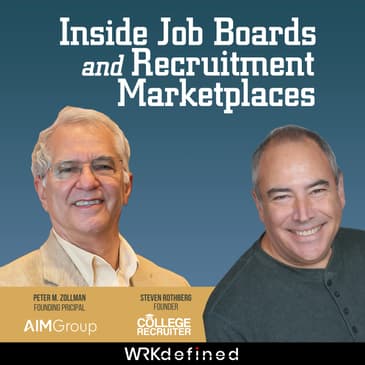
Cohost Peter M. Zollman of AIM Group is home from Budapest, Hungary, the site of their 2026 RecBuzz conference. By all accounts, it was a tremendous success.
Peter shares some of the highlights of the discussions with cohost Steven Rothberg of College Recruiter job search site, including the shift away from traditional metrics of success such as traffic, listings, and applications and to placement rates. SEEK, for example, is saying that it is now the source for 36 percent of hires in its home market of Australia.
Driving much of this shift in metrics is the shift toward the use of AI for matching, screening, and even selection. Will job boards / recruitment marketplaces continue to play a major role over the coming years?
Powered by the WRKdefined Podcast Network.
[00:00:12] Welcome to episode 134 of the Inside Job Boards and Recruitment Marketplaces. I am one of your co-hosts, Steven Rothberg with College Recruiter Job Search Site. And we have a bit of a special episode today. It's just going to be Peter Zollman, my other co-host and me. And we're going to be talking about an experience that he had that I didn't, that I'm envious of. And I'm hungry for the news, Peter.
[00:00:39] That was very funny, but the most... That was a long buildup to a really bad joke. Yeah, that was a bad joke. But the most amazing part, RecBuzz was astonishingly good. RecBuzz is our recruitment marketing conference. We held it a few weeks ago in Budapest.
[00:00:58] I got there early because you can't trust airplanes nowadays. And I was there the night that Victor Orban lost decisively or Peter Magyar won decisively, depending on your point of view. And the town went crazy. It was a remarkable experience.
[00:01:22] And we knew that some people in our audience might be in favor of Orban and others might be in favor of Magyar. But regardless of your preferences, it was just overwhelmingly wonderful to be there and feel the city and the change in the nation. It's amazing to be someplace when history is being made and you know it.
[00:01:52] Yes. Right? It's like this is an experience that people will be talking about for years that I'll remember forever. Good, bad, ugly. But it is... These things stand out. It was astonishing to see all the people out in the streets waving flags and honking their horns and cheering and all of that stuff. But let's talk recruitment. So they weren't all celebrating your arrival in Hungary then? Some of them were, but not all of them.
[00:02:20] I highly doubt that any of them even noticed. And that's quite all right. Cool. So... That's quite all right. Okay. What we wanted to do for today's show is I couldn't be at RecBuzz this year. I've gone multiple times. I will go multiple times in future. This year just didn't work. But some of the people who listened to our show also weren't there. They probably also are envious. So we thought you could give us a bit of a summary of the major themes that came out.
[00:02:49] Okay. That's always good and fun. And it's really not themes of the conference. It's themes of the recruitment and the recruitment job boards and recruitment marketplaces. Right? What's happening? Well, the two letters obviously are A and I. Artificial Intelligence. A couple of years ago, we were talking about it. Three, four years ago, we had barely noticed it. Last year, we were talking about it. This year, it is clearly making an impact.
[00:03:18] And just getting started at the same time. But job boards, recruitment marketplaces are going through a fundamental change. Really fundamental. Number one, it's no longer about traffic. Right? You remember when everything was, what's your traffic? How many people can we get every month? How many clicks? How many of that stuff? Right? That's still important, but it's not about traffic anymore. It's no longer about listings. How many listings do we have?
[00:03:47] How many jobs do we have? It's no longer about applications. When people can send out a thousand applications in an hour, right? And every employer is flooded and flooded and flooded with applications. And the big complaint now is how do I get through all of this muck?
[00:04:06] Some of it's great stuff. Some of it's great stuff, but how do I find the great stuff in the muck? It's no longer about applications anymore. AI is changing everything. And the sentiment was just you wait. It's just getting started.
[00:04:23] So the expectation is that in some years. And I think it's five years to eight years. It may be a little more, maybe a little less. We're going to get to the point where the job finds the candidate rather than the other way around.
[00:04:40] And the question becomes, do job boards slash recruitment marketplaces still play a role in that? My answer and the consensus answer at RecBuzz was absolutely. But boy, are things going to look a lot different than they do now.
[00:04:58] Interesting. And I'm really glad, Peter, that you put a timeline onto that because I've heard similar things from other people who I definitely consider to be experts in the industry and they do not attach a timeline. So you can't tell when listening to them. Are they talking about like today, this year or 40 years from now? That the five to eight years for the vision you painted, that seems very reasonable to me.
[00:05:25] And, and, and I think it's right. I mean, obviously, otherwise I wouldn't have said it, but things are moving so quickly. Number one, number two, the surface has just been scratched and, um, lots of companies, for example, um, well, you know, for the past couple of years, we've talked about indeed and disposition data and tracking what happens.
[00:05:55] With somebody when they come into your system all the way through to the job and disposition data. And some companies even track to a year into the job, something like that. So tracking disposition data, but the discussion at RecBuzz.
[00:06:16] And I think it's going to, the, the discussion in the industry is going to change pretty rapidly from disposition data to placement rates. What is your placement rate? If you can gain share in placements, if you can gain share in people you have put into roles or, you know, however that described, seek, which is the big Australia slash.
[00:06:45] Southeast Asian job board marketplace. Tracks its replacement rates. Tracks its replacement rates very closely. They track them in Australia. They track them in New Zealand and they track them in the six other countries and actually in subset markets of those six, uh, of those countries. And they say their placement share in its markets. Uh, Peter Bithos said placement share went from 29% to 36%.
[00:07:15] Hey everybody. Tim Sackett host of HR famous, a new podcast on the work to find network. Am I famous? No, I'm HR famous. My wife says I'm a micro celebrity and 13 HR ladies around the world want their picture with me, which I think is funny. So, Hey, what do we talk about on the pod? We talk about all the dumb stuff we do in HR in any given day, week, month, and we have fun with it. And we have some great guests. Come check us out. We're not famous. We're HR famous.
[00:07:44] If I understand correctly.
[00:09:46] Our placement rate is 36%. Our placement rate is 36% is very, very powerful. And pushing that number up, uh, uh, uh, Peter Bithos said that when they report their placement rates to the, they're publicly traded. When they report them in their quarterly earnings, their stock price goes up. Yeah. You know, because the placement rate goes up, the stock price goes up and they, he didn't say this, but I bet you their rates, their prices go up too.
[00:10:16] And probably moving more towards like a cost per hire model, which begs the question. And I know we want to move on to sort of the next topic that was discussed, um, in, in April at rec buzz, but it begs the question of, are you still a job board or recruitment marketplace? Are you a staffing company? And I think the lines have always been somewhat blurry. There are loads of examples that you can find where it's no, that's a pure staffing company. Doesn't have a job board at all.
[00:10:45] Or job board doesn't do any kind of staffing. It's getting more and more blurry. Where does the job board and where does the staffing agency begin? Um, when job boards are paid for screening and selection, that's traditionally a staffing function. Are you now a staffing agency? And at some point, I don't think it really matters that much. Um, do you help people get hired? Do you do it at an effective cost for your customer?
[00:11:15] At the end of the day, that's what I think is what we all have to be focused on. And reality is that not only is the line getting blurred, but it's, it's going to go away. And the ultimate example of that is recruit, which is a giant staffing company worldwide, which owns indeed.
[00:11:35] Indeed. And they're moving closer and closer so that indeed is more of a staffing company and, uh, indeed flex, which is a staffing model and so forth and so on. They're, they're coming closer together. There was a lot of discussion. Uh, or some discussion about standing versus sitting workers. Sometimes we talk about them, physical workers, blue collar versus white collar, but that's not exact. None of those are exact.
[00:12:02] And who's going to be displaced by AI. Um, the consensus was pretty much that mid-level knowledge workers, sitting workers are most at risk from AI. Uh, while people who still turn the widgets and, you know, move the things along the factory assembly line and move the boxes.
[00:12:28] Now the boxes get palletized by the robots, uh, that those people will still be around the, the blue collar, the standing workers and the job boards slash recruitment marketplaces will still have a role to play in helping the employers find those folks.
[00:12:51] So we got by far the best ratings we've ever had for the conference. Very high, very high ratings. If you look online for hashtag red rec buzz, you'll see all sorts of great reviews. Uh, it was very powerful and next one's in Barcelona next year. Uh, we're looking forward to that one.
[00:13:13] And we usually say at this point, we have time for one more question, but we don't have questions and answers. So I'm just going to wrap up with something that Jonathan Turpin, whom you know, well, our, our, uh, managing principal, uh, said success going forward is about delivering a lot less applications, many more high fit applications.
[00:13:37] And delivering really strong placement levels. I think that's a good place to end it. I do. And that's, it's going to be very interesting to, to watch that come together. If it, if it, if it does, I think it's better for everybody. I don't think it's a question of if it does, it will. Yeah. The question is how, how fast and who's left standing. Bingo. Welcome home. Thank you, sir. Welcome home. Adios. Uh, and welcome to me.
[00:14:07] See you guys. Cheers.
Sponsors
