
The mad scientist of online recruiting a/k/a Chris Russell of RecTech Media / Job Board Secrets is the guest on today's episode of the Inside Job Boards and Recruitment Marketplaces Podcast.
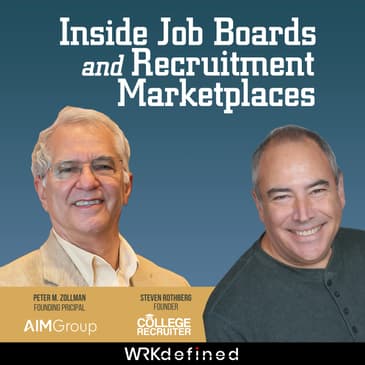
Peter M. Zollman of the AIM Group (Marketplaces / Classifieds) is back from his fantastic vacation exploring some of the fantastic islands between Scotland and Iceland. Together with Steven Rothberg of College Recruiter job search site, we discuss some of the biggest mistakes new and long-time job board operators make.
Some mistakes are similar to those that small business people in any industry make. Others are very much specific to our industry. Which ones did we miss?
Powered by the WRKdefined Podcast Network.
[00:00:13] Welcome to episode 137 of the Inside Job Boards and Recruitment Marketplaces Podcast. I am one of your two co-hosts. I'm Steven Rothberg, the founder of College Recruiter, and I am the one who has not been traveling the last couple weeks. Peter, good to see you.
[00:00:29] And I am the one who has. Good to see you too. People always say Iceland is amazing. That is absolutely true. And I had a wonderful time in the Shetland Islands, the Orkney Islands, and the Faroe Islands too. Just fabulous. We are joined today by Chris Russell of New Hampshire, which I believe is in the country. It's named after Hampshire in England, but that's the new one, right?
[00:00:58] Connecticut, isn't it, Chris? Yes. Oh, I was close, but not close enough. Oh, well. Connecticut, New Hampshire, whatever. Chris is CEO of RecTech Media Job Board Secrets, an inestimable consultant to job boards, especially small and mid-sized ones, and the HR tech people who help them.
[00:01:22] And Chris is going to count down a list of 10 things that job boards do wrong. However, he's going to do one, then you're going to do one, then I'm going to do one, then we'll have 20. Well, we're going to have 10 in total.
[00:01:41] So we've now burned two minutes, so let me introduce Chris. I already have. Chris, why don't you tell us one of the things that job boards do wrong with the concomitant, and here's how they could do it better. I appreciate that, guys. Thanks for having me.
[00:01:56] All right. I'll start at number one, mistake job boards make, talking about something I've seen a lot in my 20-plus years as a consultant in the space, which is job boards, treating it as sort of this passive income and just kind of setting and forgetting about it. And I say that because I've seen too many sites where the founder just kind of just lets it go over time, and at the end of that period, it's not worth anything anymore. It's a shell of what it once was.
[00:02:24] So it's an active business, right? You have to constantly work at it. And, you know, customer service, sales, marketing, content, you can't treat it as a set-it-and-forget-it product out there. It does run on its own, but you can't treat it that way, and you can't manage it that way. That's one of the biggest mistakes I've seen job board founders make over the years. And these are in no particular order, right? So for me, my biggest mistake on my list is no conversion data.
[00:02:52] A lot of job boards will drive a lot of traffic to employers, ATS, or some other third-party site like that, and the job board will not know which of those clicks are converting into applications, interviews, hires, whatever it is. And employers do not buy postings for the sake of running postings or for driving clicks to their ATS. At the end of the day, they need applications. They need people they're going to interview. They need people that they're going to hire.
[00:03:22] And the closer that you can get to that with the conversion data, the better you can show your value to those customers. And then they're going to spend more money with you. My number three is failing to build a community. If you're just listings and you're just hit the apply button, so what?
[00:03:44] But if you build a community of people who feel like they belong, mainly the job seekers, but also the employers who contribute and feel like this is my site as opposed to this is a site. But if you can make it feel like this is my site, you win. Number four, Chris, you are up. That's a great point, Peter.
[00:04:11] I just talked to Dan Rohn from journalismjobs.com, and we talked about that on my show recently. And it's about building a community and making you feel a part of it over time and maintaining that too. So number four, I've got failure to realize that running a job board today is an internet marketing business. You have to know the A to Z of internet marketing in order to run that site and attract traffic.
[00:04:40] Because at the end of the day, it's all about traffic. How much traffic can you bring in from the seeker standpoint and the employer standpoint? And if you don't understand internet marketing, you cannot run a job board today. And I counsel a lot of new people trying to come into this space, and they just don't have the marketing chops to really, you know, make it successful. And so they fail to understand that. They fail to grasp that, how important that is in running a job board today.
[00:05:05] So Chris, are you seeing a lot of people whose tech skills are good, and they think that that's good enough, but they're missing the marketing piece? Yeah, they tend to underestimate the power of internet marketing, what you have to do to run a job board. If you're starting from scratch, which a lot of people are, how are you going to build an audience, right? You have to know how to build an audience in this space. If you can't do that, then good luck. I mean, it's not going to work. You really have to know how to attract an audience.
[00:05:32] That means, to me, everything in marketing from A to Z, whether it's paid, social, search, content, podcasting, everything, right? You have to know all that stuff in order to attract and build an audience over time. My next one is competing on price. And I see this with especially small businesses all the time, where they're launching a new venture product. And the way that they decide to compete against the more established players is to try to undercut them on price.
[00:06:00] And what you end up doing is you end up killing your margins and you make it impossible to make money. So much better to compete on service or having a premium product than just having the cheapest product. Customers that are attracted to the vendor with the cheapest price tend to be the customers that are the least loyal. And so you'll lose that customer if they can save 25 cents and walk across the street.
[00:06:28] Welcome to Don't Tell Me About Yourself, the podcast where old school hiring meets a modern reality check. I'm Lorna Erickson. And I'm Victoria Gates. And we're the co-founders of Expert Interviewers. Between the two of us, we've got 40 years of hiring experience. We've studied interviewing techniques. We've trained thousands of people globally to stop making the same mistakes over and over again. And we've got 340,000 people following us online because apparently everyone has a story about a bad interview. You know the ones.
[00:06:55] The illegal questions, the 45-minute monologues, showing up late with no apology. So every week, we're tackling the biggest subjects in hiring. We bring real stories, real data, and real talk about how to make interviews actually work for everyone. Because great hiring isn't luck. It's a practice skill. So whether you hire, apply, or just love a good interview train wreck, the show is for you. Well, I wasn't going to go with this one next, but I'm going to then.
[00:07:21] It's a combination of too many upsells and way too complicated pricing. Because if the pricing isn't simple, especially for a small business, if you're an HR team that has 150 people on the HR team, and you've got 30 people who are placing their advertising and doing programmatic and on and on, you don't worry about complicated pricing. But for a small business and even a mid-sized business, give me the price.
[00:07:51] If you want to give me a good, better, best, that's fine. But don't make it so complicated that I can't figure it out. And the corollary to that is job seekers really should be ticked off when there's more than one or two sales pitches at them. Okay, we can help you with your resume. Okay, we can do one more thing. If you pay us, we'll do it for you.
[00:08:20] Otherwise, don't constantly upsell and make the pricing simple, simple, simple. Follow the kiss rule. So don't be Spirit Airlines or Ryanair and charge more for this and more for this and more for this and more for this. Hey, don't knock Spirit. I'm still in mourning that they went out of business. They were fabulous for me. And they rest in peace. Exactly. And they rest in peace. All right.
[00:08:48] Another mistake I see job owners make is the building versus buying. So what I mean by that is the job board software, right? So I've gotten many calls over the years, guys, where they're 20, 30 grand into building a job board that does not work. Okay. And I'm like, you should have called me six months ago.
[00:09:09] I could have saved you thousands of dollars here by pointing you to one of the job board software vendors that do a really good job at allowing you to launch a job board from day one. And, you know, you don't need to worry about the technology. And that's what the job board software vendors allow you to do. They also let you prove that a market exists before you actually build something on your own. Right. So it gives you a chance to sort of experiment and see if there is a, you know, a niche for the market for the niche you're going into overall. So I've seen that many times over the years.
[00:09:39] So go out and find a good job board software and start here. That's my advice. That's well said, Chris. Peter, I remember you and I had an episode on sort of when does it make sense to build versus buy. And the answer was unless you're a giant job board, buy. Yep. Yep. Absolutely. You're up for number eight, Steven, and right on time. Yeah.
[00:10:04] So my next one is selling the product instead of selling the benefits. So this kind of goes back to the employers are not coming to your site and job seekers are not coming to your site to simply post a job or apply to a job. The employers are coming there to hire people and job seekers are there to get hired.
[00:10:30] And the more that you talk about the mechanics of it, put in a job title, we're going to send your job to these places. Your job is going to run in the search like this. All of these sort of more technical aspects. At the end of the day, they don't care. They want to hire someone or they want to get hired. Pretty simple and straightforward. Mine is, again, a corollary to what you just said. It's a two-sided problem.
[00:10:59] Making it too easy to apply. Making it too hard to apply. Too easy means push the apply button and you apply to everything. And those applications then go into sorting and go into this and going to that. And the employer gets, you know, thousands of applies. And it's just click to apply, click to apply, click to apply, click to apply, click to apply. There's got to be a little thought, got to be a little effort. There's got to be a little customization.
[00:11:28] Flip side of that is I go and I want to apply to this job and I can't find out how. Or it takes me to a different site where I have to fill in all the forms again. And then I have to answer questions. And then I have to do this. And then I have to do that. And then I have to do the next thing. Certain things should be formulaic, should be simple, should be straightforward.
[00:11:53] But just click to apply, click to apply, click to apply leads to garbage, garbage, garbage, garbage. Yeah. The Goldilocks rule is what you want, right? You don't want the porridge to be too hot or too cold. You want the mama burr. You want it to be just right. There you go. Chris, that brings us to number 10. And then we'll all say thank you and goodbye. Take us home, Chris.
[00:12:17] My last one's going to be more of a job war 101 mistake, which is do not launch your job war without jobs in it. Believe it or not. That's actually happened. I saw it recently, like in the last few months. I saw a press release somebody put out. I won't name a job war because I want to embarrass them. But I went to their site. Sure enough, there were zero jobs. Like literally zero. Literally zero. And I'm like, okay, there's tons of backfill on the market.
[00:12:45] Like just at least go and manually put them in yourself. Like have something in there. You can't launch a job war without jobs. Guys, you have to have something for the seekers to see. Because they're the most important people to attract right now. Like they're the hardest people to get. It's a secret. Come to your site. Post a resume. Sign up for a job alert. Click on the apply button. Those are hard to get. You got to work at that. And you can't do that without jobs. So come on, guys. Chris, it's a catch 22, right? A lot of job boards, I'm sure, when they're coming to you or others, it's like I'm launching a job board.
[00:13:13] How do I get job seekers if I don't have any jobs? How do I get jobs if I don't have any job seekers? But you hit the nail on the head, backfill, or even just manually post jobs for free. You can build up some critical mass. Critical mass is a key, but community is another key. We are out of time. Christopher, sorry I put you in the wrong state, but, you know, New Hampshire, Connecticut, they're all the same. Stephen, you're still in Minnesota?
[00:13:41] Any day now, it'll start snowing again. Oh, yeah. You're assuming it stopped. That's true. On that note, guys, thank you very much. Have a good one. Cheers.
Sponsors
