
The future of work isn't slowing down—and neither can the way we prepare people for it.
Artificial intelligence is reshaping industries, career paths are becoming increasingly nonlinear, and the skills that once guaranteed success no longer offer the same certainty. In a world defined by constant disruption, the question is no longer, "What do you want to be when you grow up?" It's: How do we prepare people to thrive through continual change?
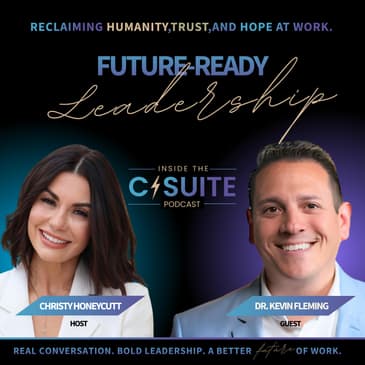
In this episode of Inside the C-Suite, Christy Honeycutt sits down with Dr. Kevin Fleming, Founder and CEO of Catapult Masterclass, to explore what true readiness looks like in today's rapidly evolving workplace.
Drawing from decades of experience in education, leadership, and workforce development, Dr. Fleming challenges traditional thinking around career preparation and professional growth. Together, they discuss why adaptability has become a leadership imperative, how organizations can build cultures of continuous learning, and why individuals must take ownership of their own development.
Because in a world that refuses to sit still, our greatest advantage may not be certainty—it's our willingness to remain curious, adaptable, and teachable.
What You’ll learn:
- Why today's professionals should expect multiple career transitions
- How adaptability becomes a competitive advantage
- The leadership traits that outlast technological disruption
- Why authentic relationships remain the foundation of leadership
- How organizations can rethink learning and development
- The role of mentorship, coaching, and community in long-term success
- Practical ways to take ownership of your growth and expand your opportunities
- How informational interviews expand opportunity and social cpaital
One of my favorite takeaways: In a world defined by disruption, our greatest advantage may not be certainty—it's our willingness to remain curious, adaptable, and teachable.
If you're leading people, building a career, or navigating change, this conversation is packed with insights you won't want to miss.
| Connect with Us |
Follow Dr. Kevin Fleming:
LinkedIn – https://www.linkedin.com/in/kevinjflemingphd/
Company Page – https://www.linkedin.com/company/catapultmasterclass/
Facebook – https://web.facebook.com/kevinjflemingphd?_rdc=1&_rdr#
Instagram – https://www.instagram.com/kevinjflemingphd/
YouTube - https://www.youtube.com/user/TelosES
Website – https://www.kevinjfleming.com/ | https://www.catapultlpd.com/
(Dr. Kevin Fleming is the Founder and CEO of Catapult Masterclass, an organization dedicated to helping educators prepare students for life beyond graduation through career-connected learning and workforce readiness initiatives. A former college vice president, author, speaker, and nationally recognized thought leader, he brings decades of experience at the intersection of education, leadership, and human development. His work challenges organizations and institutions to rethink how they cultivate adaptability, purpose, and lifelong learning in a rapidly changing world.)
Follow Inside the C-Suite:
LinkedIn – https://www.linkedin.com/in/christyhoneycutt/
Subscribe on Spotify – Inside the C-Suite
Subscribe on Apple – Inside the C-Suite
Follow WrkDefined:
LinkedIn: https://www.linkedin.com/company/wrkdefined/posts/?feedView=all
Instagram: WRKdefined (@wrkdefined) • Instagram profile
Facebook: WRKdefined
Website: WRKdefined Podcast Network: Conversations Pushing The Boundaries of Work
Want to be on the show or know someone who would be a great guest?
Contact Form – Inside the C-Suite Podcast
Powered by the WRKdefined Podcast Network.
[00:00:00] I don't have any advice for someone that has a blank sheet of paper that wants to just become an expert in underwater basket weaving or something. I don't know how you knew that. But what I could speak to is if know your lane. Don't just wake up and say, I'm going to be a motivational speaker and talk about people how to lose weight or something like maybe but given your expertise, your individual background, knowing what you have done, your journey, your stories, your truth, find your lane and make it as narrow as possible.
[00:00:27] Some people say if you want to go into speaking or book writing, you want to have as broad of a topic as possible that will reach the widest audience possible. And as you're shaking your head, because you know, like that's the opposite advice, you actually want to be so narrowed, so tailored, so specific that when you're writing or speaking, you have like a person or a fake avatar of someone that you're speaking to that is a very specific human being, not just a parent, not just someone in the C-suite, but someone that is like very specific.
[00:00:57] And carve your niche narrow. Hi, I'm Christy Honeycutt, your host for Inside the C-Suite, where execs get real about leadership, impact, and what truly drives high-stake decisions. Today's guest is challenging one of society's biggest assumptions, a degree automatically equals success.
[00:01:24] He weighs in on AI, the speed of learning, and the type of mindset needed to survive in an ever-changing, unpredictable world, regardless of your rank or your title. Dr. Kevin Fleming is a career education architect, best-selling author of Redefining the Goal, founder of Catapult, and creator of the viral presentation, Success in the New Economy.
[00:01:45] After more than 20 years as a faculty member, dean, and vice president, Kevin has become one of the leading voices, helping schools, organizations, and leaders rethink education, workforce readiness, and human potential. Today, we're diving into skills versus credentials, the impact of AI on learning and work, and what leaders need to understand about preparing themselves and their organization's talent for the future. And Kevin Fleming's got a new book coming out. You don't want to miss this one. Let's jump in, shall we?
[00:02:15] Hi, Kevin. It is so great to see your face. Thank you so much for joining us. I know that my introduction did not do you justice. I would be so honored if you would share a little bit about yourself, your company, and your mission and purpose. Well, thanks for having me, Christy. It's a pleasure to talk to you always. My name's Kevin Fleming. I've been in education for a majority of my career, left as a college vice president three years ago as the founder and CEO of Catapult Masterclass. And we provide professional development for teachers. I tell my daughter we teach teachers.
[00:02:45] That's what daddy does. And so we provide hybrid masterclasses. And our sole lane, there's a lot of things we could focus on. Our focus is on career development and world readiness for students. So they're not just ready for graduation, but they're ready for life after graduation. So a lot in the career-connected learning space. Author, speaker, father, all that good stuff. He's very humble, guys. We're going to get into it. So some of you may be thinking, why does Christy have Dr. Kevin Fleming, an educator at heart, on to talk to a bunch of emerging leaders in C-suite?
[00:03:12] And the reason is, is there's a lot of applicable lessons that we can learn. So I am really, really curious about what you're seeing in education because we're all navigating this new way of working. AI, is it really what everybody says it is? Are the layoffs really happening for a reason? So from your lens, if we're looking at our children today, how are we, how should we get them ready? What should we be looking out for based on some of your research? Yeah, great question. At a very high level, here's the short answer.
[00:03:40] Education today is different than it was 20 years ago. And it'll be dramatically different 20 years from now. I'll give you one stat that kind of helps to prove that or what I'm talking about. When I went to college in the 90s, it was projected, Christy, we would have six jobs throughout our life. And if you think about people you've known or people that are in their 40s or 50s, that sounds about right. Well, then about 10 years ago, that number escalated. And it said that students graduating from high school or college around 2015, plus or minus, we're going to have 12 jobs.
[00:04:08] So it doubled, 12 jobs throughout their lifespan and maybe in two careers. Well, now fast forward to just this spring. McKenzie and company came out with an updated statistic that because of AI and technology advances, today's graduates can expect to have, any guesses? Gosh, 20 plus? Yes, 24 jobs. Now think about it. They said 24 jobs across three different careers. So as a parent, as an employer, think about that.
[00:04:35] So it's in the lifespan, assuming you're going to live 80, 90-ish, maybe longer with medical advances. That means an average of one job every three years, maybe three and a half. And think about the workforce right now. That's about what we're seeing. So it is no longer appropriate to say, what are you going to do the rest of your life after graduation? That's the wrong question. It's not even what do you want to do for the first decade? That's also the wrong question. And if they're going to be in three different careers, like three different industries, we're no longer preparing people for a job. We're preparing them for multiple transitions.
[00:05:05] And that requires a different way of looking at it, a different way of preparing them for career navigation, a different way of parenting and preparing students to launch. What does launch look like anymore? Like that's different. Yeah. And with AI coming on board, I'll say this is a footnote. If anyone says they know what's going to happen with AI, they're lying. Oh, yeah. Because none of us know. Like, I don't know. Like, I mean, I'll be honest. I can share with you my thoughts or what I've read or what I think. We can go down. And there's a dark side and a light side to what might happen with AI. No one really knows.
[00:05:34] But what we do know is the rate of change is faster. And you bring me to my next question, which you always do, is the rate of AI of how quick it's accelerating in our world everywhere, right from every angle. What should we be looking at differently? Like, is the education system keeping up with the speed of this technology and how to train for it? And then let alone are companies keeping up with the speed of this technology and are they training for it?
[00:06:01] Because I feel like we're seeing a lot of knee-jerk reactions with mass layoffs. I still think it's too early to fully understand the ROI in my point of view. And I used to sell this stuff. So I do have a point of view. It's good for certain things, but you can't remove the human. What's your thoughts on that? So I'll answer that through a recent analogy. I'm talking to my programmer this last week. We created a whole delivery platform for Catapult Masterclass. And he shared with me that now with AI agents, he literally just finished a project. It would have taken him a year, a year ago.
[00:06:31] He did it in three weeks. Wow. Real scenario, real project. So when you look at what the rate of that change is, that means he could do 10 years of programming and platform and coding work in one year now. And I'd be foolish to assume it's going to slow down. Like the tools will just get better. The technology will just get faster. So play that out. So if that's the case, well, now in theory, and again, not to be dark, but you need one tenth of the workforce on the platform programming, computer science development side. Doesn't mean we need less people going into cybersecurity.
[00:07:00] Don't misperceive that. But you asked the question, is education keeping up? Well, you know the answer. We haven't caught up for a long time, let alone a recurrence now. So what does that mean? Right. So if you're hiring someone or if you have a kid that's in high school or going into college, I mean, you can't rely on a two year or four year degree to give them what they need. It's almost going back. You know what it's like? It's like going back 40 years where now we're going to the liberal arts foundational stuff.
[00:07:23] And we just want someone to understand how to think, how to learn, how to communicate, and then start them down the road of learning like terminologies and skills. But then they just have to be iterative and learn more quickly. So if our king of the world and my wife likes to tell me I'm not, we would change a four year degree to like one year. And it would just be about, do you know how to learn and how to work with asynchronous teams?
[00:07:45] And you know, whether it's Monday, Notion, ClickUp, Slack, like Monday, Asana, whatever it is, do you know digital tools, which a lot of schools don't teach? And can you perform in a high paced, fast learning environment? And if we teach them how to do that, then we can launch them in any direction and they'll figure it out. It's no longer them being prepared. How do you be prepared for something that's always changing? It's more a matter of can you pivot? Can you adapt? Can you learn? Can you sprint?
[00:08:12] Again, coming from someone who loves formal education, that's a question we don't ask. I mean, we're not assessing students' readiness by agility. Typically, we're measuring it off of seat time and standardized tests and knowledge gains from a benchmark, right? So the whole thing has to change and it will or it dies. I mean, again, not to be blunt about it, but any system that doesn't evolve perishes. And that's, I think, what we're going to see in the next 10 years, either evolution or locking the doors.
[00:08:37] So I'm seeing a shift in the multigenerational workforce that we all find ourselves in right now, which is a beautiful thing. But I'm seeing a shift as far as students that have the mindset. So if we look at the different shifts, I'm seeing a communication challenge across the board. They all speak different languages, right? Right. There's a difference of what's acceptable and not acceptable if they've got an open mindset or closed mindset. And we know that that, like, is a honeycomb effect and it goes into their background, how they were raised, financial. There's lots of different components that go in there.
[00:09:06] But are you seeing there is a change or more emphasis put on the communication, the open-mindedness, the ability to learn and be agile? Or would you say it's about even with the technical skills that are required to navigate? First of all, it's a great question. And you're so brilliant. I love the honeycomb analogy and the phrase that are used. I can't take credit for that, but it is a good one. It's from Gal O'Baskey of O'Baskey Change. But you get credit for knowing it and dropping it appropriately. There we go.
[00:09:33] I would say this. The technology skills and the knowledge gets you the job. It's the interpersonal acumen that keeps the job. So, I mean, you have to know a baseline to get in the door. You can't be a complete imbecile but be a good people person to get a job. Like, you can't clearly do that. So you've got to have baseline to get in. But once you're in, we've all worked with people and we're like, how are you here?
[00:09:52] Like, if they're not articulate, if they're not meeting deadlines, if they're not fitting into the culture, if they don't have that X factor, right, that we talk about, that undefined, you can't see it on a resume, but you know it when you're sitting across from somebody. That's what's going to keep the job, get you the promotion, enable someone to ride those S curves as the industry changes to adapt and evolve with whatever's next that we don't know. That's what's going to keep the job.
[00:10:15] So from an educator's standpoint, here's my takeaway is it's no longer appropriate to complete any degree or certificate and then be prepared for a job. It is now our job in the C-suite to have a professional development plan for every employee to keep them upgraded. And if they have the skills, the knowledge, how are we upgrading then that X factor? How are we identifying it? How are we really embellishing it or expanding it and cultivating it?
[00:10:40] So any company now, if you don't have individual learning plans for every employee, they will either fall behind or leave you. I mean, that's and that wasn't a thing 10 years ago. And many today, a lot of HR offices are not focused on that. Supervisors are not asking in the performance review, what's your learning plan next quarter? How are you growing and developing? Like, what do we need to be reading together, discussing together? Where do I need to send you or what online things you have to go through? Like, how are we growing you should be the question. And if that's not on people's frontal lobe, they're going to leave.
[00:11:08] Yeah. So I've created coaching programs for various different companies over my career. And I've always said the same thing. I love that leaders want to have coaching and L&D and all the things. But you cannot force someone to want. Right. Just because you create a program. And I would always tell them, like, you're going to have your hypos. You're going to have your people that are clawing for more. Those are easy to identify, coach, train and pour into.
[00:11:31] How would you recommend organizations or people in the C-suite who have the heart and want to embrace this for their employee population, but they're just not quite sure how do they go about it? How do they get the gain in from the ones that don't really want it? And then you've got the hungry ones. What advice would you have to kind of lean into what you're saying and to create a better tomorrow? It's a great question. In our framework at Catapult, there's classes, there's community and there's coaching. So there's different ways of looking at it, right? So first one is classes.
[00:11:58] What content or knowledge base does someone in your environment, your department, your org chart, what do they need? So there's a content piece. Second piece is what community are they in to get it? It might be individualized. It might be asynchronous. It might be a conference. It might be a formal degree program. It might be with folks internal. It might be with folks external. But then the coaching piece is coaching is not for everybody. So it might be a mentorship program. It might be a one-on-one. It might be someone in the company. It might be an external association fellowship.
[00:12:25] Look, there's so many different shades of gray, right, with what that looks like. So what I see when I'm talking to my peers is they have a one-size-fits-all approach. And they say, oh, yeah, we did a coaching program. We hired Joe and he coached everybody. And I'm like, well, that might have worked for some folks. But others need maybe more of a mentorship. Some need someone outside of the company that they can truly be candid with. Some people just need someone inside that can teach them the ropes and the culture. And they have a mentor when they're first hired.
[00:12:53] So the mistake I see people making, honestly, is thinking there's one way to do it. One-size-fits-all. Yeah. Yep. And it never does. But a lot of our companies, they have one. They say, here's our approach. Here's our program. Instead of saying, here's 11 different options or whatever the number is, here's five different options. And depending on that person, their need, their expertise, their experience, they can choose their own adventure. Did you ever read those choose-your-own-adventure books? No. Okay. So there used to be in the 80s. I read these as a boy. There's these books called Choose Your Own Adventure.
[00:13:22] And you'd be reading a passage. And then it would say, like in the book, oh, if you want to open the treasure chest, turn to page 84. If you want to return to the boat, turn to page 107 or whatever, right? So you could decide as the reader, you could shape the direction of the book. And then you could read the same book multiple times, choose different things. And then the book has different endings. But you're flipping all around the books. You never know. It's not a linear read in sequential order. That's in my mind. That's my analogy to say our professional development should be the same.
[00:13:50] We need to let every employee choose their own adventure. And this goes for us, like for our individual growth and learning plan, choose your own adventure. What's the next quarter or the next season look like for your development? It might be content this semester, external community the following term. And then maybe in the fourth quarter, you're going to do a fellowship or a coaching program and try different things and find out works best. Because other footnote to this that I've seen is people don't know what they need to know. Like a lot of folks haven't experienced all these different versions. So they don't even know to say, yes, supervisor.
[00:14:20] Yeah, vice president. I really think I would benefit from a 10 month mentorship program with an external person. Like they don't even have the vernacular to know that's an option to say something that specific versus whatever you think I need, I'll do boss. Right. So part of it is having the conversation and the culture to know what the options can be and then working with someone to tailor for them to choose their own adventure of what's the right way for them to grow and develop. But people are going to hop now. And we're seeing that churn where if we in the C-suite, if we don't make the proactive
[00:14:50] decision to have that conversation and invite someone into that growth PD plan conversation, they're just going to leave under the false assumption. We don't know. We don't care. And there's no growth opportunities for them there. And I'm sure you've seen that too. I have. I mean, I've got 20 years of experience and in recruitment and talent operations. So I've seen this very, very well. And I remember the days that you would have a manager say, I don't want to talk to this person because they've been in three jobs in the past five years. They're obviously not dedicated. So that moved.
[00:15:20] The needle moved a little bit to where it got to. Well, as long as they're in the role for at least two years at a time, then I'll talk to him because that shows a little bit of commitment. And I kind of think, well, what about the guys that are hopping because they want to learn? They want to grow. They want to get a higher salary. They're obviously type A, like, and they want more things. When I was coming up, I begged for a demotion so I could learn a different organizational structure so I could bring it back to where I was going. And I had to beg and threaten to quit to get it.
[00:15:49] I did it for 30 days. And within 30 days, they promoted me to levels above where I was originally because I was so adamant that I was going to grow and they didn't have a program. So I do think there are a lot of hungry emerging leaders that are on listening to this show. What do they do if they can't find it at their organization? Besides leaving because they need to grow in the moment, what top three tips would you give them? First of all, I want to go back one click. I heard someone say two weeks ago, they were reviewing resumes and they saw someone who's
[00:16:18] at a place for 10 years and their thought, they're like a hiring manager in their late 20s, thought, what is this person's problem that they stayed there for 10 years? Like, why couldn't they move on? Like, why were they complacent? Right? Right. So what's fascinating is the pendulum in some environments has totally swung the other side where job hopping used to be negative. And now if you're there for a long time, it's like, what was your problem? How come you couldn't advance or evolve? And I was kind of shocked when I heard that. But I'm like, well, that makes sense. Like, that's the tide that has changed. Right. They call those sevens. What do you mean?
[00:16:48] So if you rank your employees, right, you've got your 10s and 10s, like you got to promote them, right? H are steady. Sevens are, they're good attaboys. They're going to do the job, but they're going to do the job and nothing else. So they call those sevens. I've heard that called sevens because they're happy with status quo. So it's interesting because what you're talking about, again, is the generational workforce we find ourselves in and how different we all think and how different we all communicate
[00:17:15] and how different we perceive the same information. Yeah. Oh, I like that sevens. That's good. The other thing that's that you made me think about is, and we're about the same age, but in high school, right? I don't know if you remember, but they used to have home ec. They used to have shop class, home ec, automotive, the things where you could learn basic functions to survive once you got out of your parents' home. They don't really do that anymore, to my understanding.
[00:17:40] And I know for as a single mom for a long time, if my son went to prom, I had to pull up YouTube to figure out how to tie a tie, to teach him how to tie a tie, right? It's funny how we change over time and historically how the jobs change and the way that we think about it changes. So I love that you're so passionate. You're leaning in to this because our world needs it. Like, I don't care. I'm glad you're focusing on the students, but everybody needs to understand this because it's so crucial.
[00:18:08] And you said, I was on YouTube University yesterday learning something I had to fix in my house. That's the way we all do it now, right? So play this out. If the way we now learn is on demand, when we have a specific issue or problem, we go online, we search for the video, we find either the Reddit list or we find like the user testimony that says, oh, I had the same problem. Here's what I did. We learn just in time. So I believe that's the way we have to not just pivot as organizations, but in education,
[00:18:36] it's got to pivot to just in time learning. And if it doesn't, this multi-generational workforce you're talking about, it's going to start excluding more than half of the workforce that continuously now we're seeing year after year after year. Less students are wanting to go to get a four-year baccalaureate degree, knowing that it may not actually help them four years from now to get a job that will churn by the time they're learning the content. So I think we're going to see a huge shift in behavior, a shift in
[00:19:02] how we learn and how we want to learn and learning modalities, getting more hybrid, more online, more just in time. We're going to have less and less same day, same time, sit in a classroom and hear a talking head. That's not going to be the way we, I mean, we'll still learn that way. Footnote high school, like middle school, elementary school. We need that. Don't get me wrong. I'm thinking more like higher ed, right? We're not going to be having adult learning in semester blocks. It'll be these micro-credentials around just hours, not even days.
[00:19:30] So going back to my question of the top three things that you would encourage people to do if they don't have the resources, I'm good at rolling you back. If they don't, if they don't have the resources in their current, with their current employer, how can they better themselves? Like what, what would be Dr. Fleming's recommendation? Any age, just what are the top three things? Any age, any industry, anywhere in the organization. If you want to grow and learn step one, you have to realize no one will care more about this than you. So you have to take in command your own
[00:20:00] learning. Do not expect or want your supervisor or HR to create the learning plan for you. It's got to be personal, professional, spiritual, financial, physical, however you want to like plan your growth for the next quarter. It's on you. So you just have to pull out pen and paper or spreadsheet, whatever you want to do and create it for yourself and braid together for yourself. Use AI as a thought partner to identify what you need to learn and how can you learn it. And so you, so step one is you
[00:20:28] got to do it for yourself. There's a lot of, there's a lot of bad bosses out there. And so you can't assume they're going to know how to do that for you. So step one, mentally take control of your own learning. Don't expect someone else to provide that for you. And I know that's a common thing to say. That's not like a insightful, never before thought of nugget, but it's surprising how many folks don't pause and take responsibility and ownership for their own, again, personal, professional development. This could be, again, like I said, spiritual, physical, financial, however you want
[00:20:56] to think about growing as a human, you're responsible for outlining that. So that's like step one. Step two, I would say is you wanted three. So I'll give you three. Second one is after you have that identified, you need to make that proposal to your supervisor, to your boss, to your CEO, to HR and say, okay, I've gone through a process to identify how I can add value. Here's the two or three things I'd like to learn about or learn from. Can you connect me? Can you invest in me? Can I get this additional project? Can you send me to this place to learn this thing? And you have to make the proposal and
[00:21:25] make the ask, of course, realistic and specific. In higher ed, some people would ask for a sabbatical for a whole semester or a year off to do something. And it's far more rare than people think because very few organizations, even a college can afford for someone to be gone for a semester or a year, but you have to make the ask realistic and structured that, hey, here's what I'd like to learn and why. Here's the opportunity and give them the opportunity then to say yes and to invest in you. So that's step two is document it, outline it, propose the learning. Step three, I would say
[00:21:54] in terms of like a very micro suggestion is find your own mentor, find your own coach. One of the skills that I teach students to do, and it works for us as well, and I did this when I became a vice president, is called an informational interview. I think we've spoken about this before and just on a sidebar, Christy, but this is when find out who are the folks you want to learn from. And the third tip I would say is reach out to them and say, hey, my name is Kevin. I see that you do X, Y, and Z. I want to learn about X, Y, and Z. Can we take 20 minutes, a Zoom or a phone call
[00:22:24] or a Google chat? And can I just interview you about what you do, how you got there? And most people would be willing to take a few minutes out for a colleague, a stranger, just someone that is interested in what they do and do a bunch of those informational interviews. And that'll increase your knowledge base, your social capital, all the things. But when I speak to groups about this and I talk to organizations, Christy, it's amazing to me how few people reach out to someone they just see on LinkedIn that they admire or is in a position they aspire to someday and just put themselves out
[00:22:53] there and ask them, hey, can I just pick your brain for 20 minutes? I know you're busy. I respect you, but here's why I'm reaching out to you. Can we connect for 20 minutes? And nine out of 10 times, they'll say yes. So Oprah Winfrey said this and it's in my 20s and it stuck with me, not to me personally, but on my TV. And she said, you get 50% of everything you ask for. And so what I will tell what I'll give some guidance because I've been in the talent world forever. I have spoken to so many
[00:23:19] people that reached out to me authentically, that followed my content, that interacted with my content, that knew about what I did, didn't just reach out to me because it was a shiny picture and title, but literally looked in to see what things were. And they reached out and would mention something and said, I know you're busy, but I would love 15 minutes of your time. I've never not said no. When I've said no is when someone will blindlessly, although they're connected with me, blindlessly send me their resume, ask me if I can review it and give them feedback. And do I have
[00:23:49] anybody I can connect them to? I don't have time for that. Right. And I feel like that's a little disrespectful because you didn't even say, hi, how are you? Like there's no communication, no check-in. So what you're saying is if you earnestly do want that, there are people that see that want and have that heart and want to give back, but you have to ask in the appropriate way. So I love that you said that. That's really important. If people just tuned out, back up two minutes and hear what she just said. Because that's the
[00:24:16] missing step. I'm so glad you said that because people will just blindly reach out. They won't do their homework. They won't look at the person's content or assets and they'll just see the position and say, oh, you're in sports marketing at Nike. I want to be there too. Can I interview you? And it's like, that's the extent of the homework that they did. The answer will probably be no, it might go unresponded. So that's gold. I love that. Do your homework. Do your homework. Yes. Now the other thing I wanted to talk about a little bit. So talk about doing my homework. How's the sticker company coming?
[00:24:46] Wow. You pulled that out. That's pretty good. That's examples, boys and girls. That's how you do it. Yeah. So it's going well. So on every Friday on Facebook, I posted dad joke just for fun and then started making dad joke stickers as a total side hobby company number three off there in the ether. And it's fun. You know, I'll tell you the backstory behind that, Chris. It's my daughter's fault. So she loves stickers and I love dad jokes. And one day she suggested that I should make dad joke
[00:25:14] stickers and I looked online and it didn't exist. It wasn't a thing. So two days later, website, Shopify, we're up and running. We've got dad joke stickers and it becomes a thing around Father's Day. Dadjokestickers.com. Shameless plug. So my daughter is the vice president of stickers at age nine and she does the inventory in the garage of all the stickers. But yeah, it's fun to have a little, a little comedic relief amongst all the hard work we do too. Yeah. And I think that speaks to your legacy, which is what I'd like to kind of shift to.
[00:25:42] What would you hope that people would say in 20 years with all the work that you've done with various different institutions and universities? What would you hope that they would say? It's like this because Dr. Kevin Fleming put the work in. Wow. That is a deep question. That's good. You know what? And I don't think anyone's ever asked me that before. So I don't have answer number 11. I can just pull out and regurgitate for you. You're good. All right, Christy, let's see. So the long-term legacy difference I want to leave.
[00:26:11] If I'm being totally, again, candid and honest, that's probably a different answer now than it was just a few years ago. So when I was a vice president of a college, the plan was to be a president. And so my answer would have been around reshaping an institution or two and evolving it and expanding its impact and culture. In a geographical area, there'd be one or two institutions. Since I founded Catapult and then left higher ed as an administrator and am now working nationally, it's a very different answer. But you didn't know this. So my answer is actually going to change
[00:26:41] beyond what you think it's going to be. I'm about to put out my fifth book is a spiritual, a religious text around identity and work and development. You know what? I'm going to go really personal for a second here and share it to you. I want you to. And your audience. I've never said this out loud before. When I worked at a community college and in public education in America, you have to separate church and state. There's no like religious environment or conversation in a public school. You have to separate that and be very
[00:27:08] secular. So I have a spiritual and religious side to me that I could never really embrace or communicate at work. Since I left that post, it's taken me a few years to kind of re-find, I guess, and re-center my identity, which used to be around the business card and the title, not so much the holistic three-dimensional human being that I am. And so for the first time, I'm putting out something that is a spiritual work that frankly looks at the Bible and says, what does the Bible say about career, about identity, about calling, about who you are
[00:27:37] and about what you should do? Because someone that's focused on career development for 20 years, I've always had a secular answer to that. And now I'm braiding that with more of a spiritual answer. So to your question, 20 years from now, what would I like people to say is different because of my work? I hope there'll be far more of a human approach to career development that is not just based off of labor market or skills, but around the three-dimensionality of us as humans, including a
[00:28:03] spiritual, physical, intellectual, and interpersonal side. And not just the sliver of it, you can measure in a standardized test or on a transcript. And I think our view in America is so narrowed of professional development or academic development. And so I would love, as I continue this work that is still in draft form, but I would love to see that expand. And for the goals of institutions to expand, for the metrics that we measure to expand, and to start looking at people as full, complete,
[00:28:32] three-dimensional people, and not just looking at their grades on one test or in one class. We forget sometimes that our employees or our students in class, they have a life outside. And we just want to look at the work they do at the job or the assignments they do in that class. And we ignore everything else. I mean, I had colleagues that, here we had these students college. They had a job, they had a family, but we would ignore it. We wouldn't ask about it. We wouldn't let that come into the classroom. Like, we just wanted to know, here's the content, here's the assignment. Did you pass the class? And everything else didn't matter.
[00:29:02] But man, it matters so much. And it arguably matters more than anything else we're doing in the class. So I'd like us to expand our systems and our language to really look at the whole person. Thank you for sharing that. And you know, what's really beautiful about what you shared is that when we speak things out into existence, it gives them power to grow. It's the craziest thing. I was on a podcast a year ago, two years ago. I'm actually featured in a book that's coming out called The
[00:29:27] Lioness. And the interviewer asked me a question that I didn't expect. And she said, similar to that, like, well, what would you expect? What do you want to accomplish? And I was like, wow, that's a tough question. I've never thought about, like, what do I want my impact on the world to be? And my answer was, I want to help people find peace. And I want them to find purpose and know that they matter. And that sounds really super soft and buttery, but it literally is my purpose. Like, I want every person to feel seen and heard and be impactful in their life so they can be impactful
[00:29:55] in other people's lives because it's kind of like an effect. I came across that soundbite, it was like a couple weeks ago. And I sat back and was like, oh my gosh, words spoken out loud become so powerful because now I'm an executive coach. I have a book coming out. I speak I hold space for people. I get to do cool interviews like this to help you speak things out loud. And I can't wait to see what you do. Well, thank you. And first of all, I love that for
[00:30:20] you, the Lioness. And I think that's wise words. I was watching in my YouTube feed, Tony Robbins popped up and he was talking about, he doesn't believe in self-affirmations, but intonation and actually articulating things. And so we use a different vocabulary for it. And he thinks that we can't just think things. We have to say them out loud. And we do have to hear ourselves verbalizing the incantation of what we want to be and the impact we want to have. And I do believe there's probably some great neurological research on this about hearing the
[00:30:46] words come out of your mouth is very different than just thinking of them or writing them down, but speaking into being and manifesting then the future reality you want to have. So I do believe there's power in verbalizing it and doing those. I believe in that daily affirmation and hearing yourself say things. I do it in the car when I'm driving. You know, what's really funny is there's power in the tongue, but there's also death in the tongue. So if you speak negative about yourself, your body and your brain doesn't
[00:31:14] realize you're talking, they just think that they're going to receive those negative inputs, right? And so just speak the positive inputs and look who you're around and kind of go from there. I could talk to you for days. I have just one or two more questions. So you have just redefined success. You have lots of books. You are somebody that I admire deeply. I'm just curious for all the people that are out here in the world and they're navigating and we've had a lot of layoffs. We've
[00:31:40] had a lot of people that have been without work for several years or economies a little, you know, what would you recommend for people that are transitioning into their five, six, seventh role or different industries or whatever? We're in the new world of social economy. Like you have to be out there. You have to be on podcasts. You have to write books, all the things. And I know that you particularly were on 72 flights last year. Did I get that right? Yeah, that's right.
[00:32:05] So how does someone like me who spoke their power into existence get on 72 flights to help people find peace and purpose? How did you do that? I've been speaking for over 20 years. And so it was always a side hustle that I've grown somewhat organically. And it was always connected to my work and my research. And it was ancillary to my job, but connected to. I don't have any advice for someone that has a blank sheet of paper that wants to just become an expert in underwater basket weaving or something. I don't know how you knew that.
[00:32:34] But what I could speak to is if know your lane, don't just wake up and say, I'm going to be a motivational speaker and talk about people how to lose weight or something like maybe, but like given your expertise, your individual background, knowing what you have done, your journey, your stories, your truth, find your lane and make it as narrow as possible. Some people say, if you want to go into speaking or book writing, you want to have as broad of a topic as possible that will reach the widest audience possible. And as you're shaking your head, because you know, like that's the opposite advice.
[00:33:04] You actually want to be so narrowed, so tailored, so specific that when you're writing or speaking, you have like a person or a fake avatar of someone that you're speaking to that is a very specific human being, not just a parent, not just someone in the C-suite, but someone that is like very specific and carve your niche narrow. My niche has been in any industry, I picked education. Then within that, I picked career connected learning. And then within that, I picked the administrators and
[00:33:32] the education disruptors that want to prepare students for life after graduation. It is a subset of a subset of a subset. And that's my audience. And that's who I encourage and speak to and work with and consult with and write for. And so the first advice I'd say is if you're in that transition, be as narrow as you can and try not to be all things to all people, but be everything to a few people. And that is a totally different approach in how to identify the work.
[00:33:58] I think the guidance you gave is spot on. You kind of just identifying your niche, right? And kind of how to do that, which is beautiful. But if you have like a top three quick punchy, like look out for this, this and this, then go for it. You know, let me just say this. I'm working on my fifth book. And so people do ask me a lot about how to write or why to write. Or is it still, someone asked me last week, is it still even a thing like to write a book? Or the question was, it was a smart question, Christy. They asked, should I write a book or should I start a podcast? Like what's going to give me more
[00:34:26] credibility or eyeballs? So here's my response to that. I think it depends on your goals and what you're trying to do. If you're trying to build a community or if you're trying to educate and inform. So I think part of it depends on what medium you pick. But you said this earlier, the power of verbalizing something is very strong. And so I have found when I write a book, it clarifies my thoughts. It structures my position. It organizes all these different
[00:34:52] pieces of my reality and makes it digestible and consumable. So I believe, my opinion is, it's still very valuable to write a book, to outline it, to force yourself to organize your thoughts on paper or on keystrokes, what have you, and then put that out on the world. I do still think there's a credibility factor to that. If I'm going to hire you to be a speaker, like, do you have a book? Like that can accompany your talk or that people can go to for more information. So I would
[00:35:17] still say, if you don't have that, do it. And it's easier than ever to self-publish and to do it on Amazon or it's called KDP, Kindle Direct Publishing, and just put your book out there. It doesn't cost a lot of money anymore with all the tools. You can have AI design a cover and do the formatting and all that stuff. But I would say that's probably the first advice. Know your lane and then organize your thoughts and put it down into a book. And with those two things, that's probably the two pillars of a strong foundation. Then at least you're heading in the right direction. That's a beautiful answer.
[00:35:46] I love it. Well, and as we wrap up, you are one of my favorites and I'm so grateful for your time. And yeah, right back at you. Thank you. I am so grateful for what you're building. And I know I've shared this with you, but my son is a college administrator and helps people with careers and students. And it's a really weird time. And him, like you, are lifelong learners, very high achievers and just really want to help other people. So I naturally have a heart for you because you remind me of him. But is there anything we didn't cover, like any final thoughts that you'd like to share
[00:36:15] with the audience? And how can they get in touch with you or work with you? Yeah. In terms of getting in touch with me, kevinjfleming.com is my own website. So you can reach out to me there. I still read all my own emails or if anyone sends me a message, I don't have an AI agent doing that for me yet. So there's that out of the way. But in terms of like next steps for advice, you know what? With the way the world is going, which is it's predictably
[00:36:40] unpredictable with technology and all this. What I would just say is just focus on the basics again, like focus on the fundamentals, build relationships, build community, get outside, find your tribe and identify not what you can get, but where you can give. And I mean, it sounds like a bumper sticker or something. It's not like, again, unusual advice, but I think so many folks, regardless of their age, is still looking for how they can be heard amongst the
[00:37:07] noise and stand out and differentiate. And I would just encourage flip it around. How can you listen? How can you add value? How can you help someone else solve a problem? And how can you just focus on those fundamentals of relationship and community? Because regardless of what happens with tech or industry trends, that will always be there. It'll always be important and will always be the fundamental backbone for who we are and what we need. I love that. And don't be afraid to try and change. We were talking about that earlier. It's
[00:37:34] just like, you don't learn unless you fail and you got to try. Ioko said, she said, you win some, you learn some. Yeah. So there's no fail. That's right. There's only try. That's right. Only try. Well said. Thank you so much again for your time. And guys, Dr. Kevin Fleming is the real deal. So if you liked what you heard, go like, follow this guy and definitely like, follow, comment and reshare this podcast because everyone needs to improve. Until next time. Bye. Bye. Thanks, Christy. Bye. Bye. Bye. Bye.
Sponsors
