
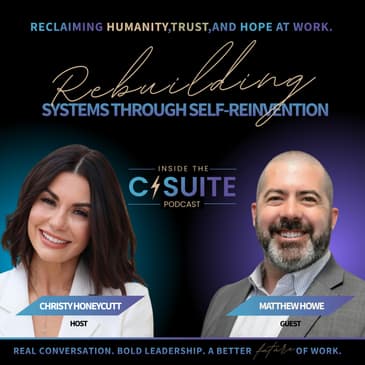
In many organizations, hiring is treated as a transaction—roles open, resumes are reviewed, and decisions are made quickly. But beneath that urgency is often misalignment between expectations, capability, and culture fit. As automation reshapes hiring, the human side can become diluted.
In this episode of Inside the C-Suite, Christy Honeycutt sits down with Matthew Howe, founder of Tread Talent Solutions, a disabled veteran-owned recruiting firm built on discipline, structure, and operational clarity. His work focuses on helping companies rethink not only who they hire, but how they approach hiring itself.
Matthew shares his journey from military service to corporate recruiting, the automotive industry, and entrepreneurship. A major turning point came when he realized his original business model was unsustainable. Rather than forcing growth, he rebuilt around a more aligned model centered on recruiting process outsourcing (RPO) and long-term partnership over transactional staffing.
The conversation explores how leadership connects to standards, accountability, and clarity. Matthew discusses how military discipline shaped his approach while emphasizing a critical truth: hiring is not just filling roles—it’s understanding readiness, capacity, and long-term fit.
The discussion expands into onboarding, leadership, and organizational systems. Companies often underestimate the time and investment required to properly integrate employees into teams. Without alignment and support, even strong hires can struggle.
At its core, this episode is about reinvention—of business models, leadership assumptions, and the discipline required to rebuild when existing systems no longer work.
What You’ll Walk Away With
• Why hiring failures often reflect system design, not candidate quality
• How military discipline translates into leadership and recruiting standards
• Why organizations underestimate onboarding and integration
• The difference between staffing, recruiting, and true business partnership
• How misaligned expectations impact performance
• Why self-awareness matters for founders navigating growth
• How AI is reshaping candidate behavior and hiring systems
• The importance of balancing speed with thoughtful evaluation
• Why many hiring managers default to “post and pray” recruiting
• How better job design improves candidate quality
• Why reinvention often requires dismantling what already works
• How leaders can better coach—not just evaluate—talent
00:00 – Intro to Inside the C-Suite & Matthew Howe
01:06 – Military background and transition into recruiting
02:10 – Early corporate recruiting experience
03:45 – Business model breakdown and challenges
04:42 – Shift from staffing to RPO
06:05 – Self-awareness, burnout, and candidate experience
06:53 – AI, applications, and hiring authenticity
08:05 – Hiring standards and leadership gaps
09:33 – Misalignment in hiring expectations
13:08 – Onboarding as leadership investment
15:42 – Military influence on discipline and standards
18:48 – Emotional reality of rebuilding a business
22:48 – Reinvention journey at Tread Talent Solutions
26:14 – AI’s role in recruiting systems
29:40 – Advice on uncertainty, timing, and action
32:54 – Closing reflections
🎙️ Watch the full episode here:
| Connect With Us |
Follow Matthew Howe:
LinkedIn - https://www.linkedin.com/in/matthewhowe2/
Company Page - https://www.linkedin.com/company/treadts/posts/?feedView=all
Website - https://www.treadts.com
(Matthew Howe is the founder of Tread Talent Solutions, a disabled veteran-owned recruiting and talent strategy firm specializing in helping small and mid-sized businesses optimize hiring systems. With experience spanning military service in the 82nd Airborne and corporate recruiting leadership, he brings a disciplined, systems-driven approach to talent acquisition. His work focuses on aligning hiring strategy, candidate experience, and organizational growth through practical, scalable recruiting frameworks.)
Follow Inside the C-Suite:
LinkedIn – Christy Honeycutt
Subscribe on Spotify – Inside the C-Suite
Subscribe on Apple – Inside the C-Suite
Want to be on the show or know someone who would be a great guest?Contact Form - Inside the C-Suite Podcast
Powered by the WRKdefined Podcast Network.
[00:00:00] as well as recruiting. I mean, a lot of times we'll find people that are hiring, we'll find hiring managers who just say, okay, you got a pulse, you got half a brain, let's get out there and start selling some product. And then they get upset two months later when they're not meeting standard, they're not meeting expectations, they don't know how to turn on their computer, they don't know where the bathroom is, they're asking me a million questions. And these are all things that take place during the onboarding process. And the interview process is just as important as the
[00:00:25] onboarding process. And so we walked them through that as well. But I think being able to stand up and say, hey, I need to be a leader for this person and kind of take them under my wing. Maybe it's two months, maybe it's two weeks, but whatever the case may be, they're investing time into the company and we need to invest that same amount of time with respect to them and their
[00:00:44] career goals. Hi, I'm Christy Honeycutt, your host for Inside the C-Suite, where execs get real about leadership, impact and what truly drives high stake decisions. Today's guests didn't just build a business, he rebuilt himself. Matt Howell is the founder of Tread Talent Solutions,
[00:01:11] a disabled veteran owned and operated firm, bringing discipline, precision and high standards back to how companies hire. But what makes his story different? He hit a wall, built something that didn't scale and instead of forcing it, he tore it down and built something better. Today, Tread isn't just filling roles, it's helping companies rethink how they hire, operate and grow. This is a conversation about reinvention, belief and what it actually takes to build something
[00:01:38] that works. Matthew, thank you so much for joining us on Inside the C-Suite. I know that my introduction cannot do you justice. First and foremost, thank you for your service. And would you kindly introduce yourself to our audience and a little bit about your company? Absolutely. Thank you, Christy, for having me on. I appreciate this opportunity to talk to everyone and have this time with you. My name is Matthew Howell. I'm the founder and owner operator of Tread Talent Solutions. We're a service disabled veteran owned business responsible for helping small and medium sized
[00:02:07] businesses really streamline their recruitment process, whether it comes to simple job postings all the way up to creating new processes and being a valued business partner within their organization. We really bring discipline and standards to the recruiting process to help them capture the best talent. Thank you for sharing that. And again, thank you for your service. I am a military brat, so I really geek out over this stuff. So tell me a little bit, you went from the 82nd Airborne to
[00:02:33] building a business. And at one point you had to completely tear down what you built and start over. Most people, including myself, might've avoided that moment, but you walked straight into it. And my question is, what did that take? Yeah, that's a great question. To rewind a little bit, I enlisted right after 9-11 with the 82nd. And that was a part of family pride there. My grandfather was in the 82nd in World War II. My dad was a paratrooper in Vietnam. So I knew if I was going to do this, I was going to do it right and go big. I learned a lot of discipline, a lot of attention
[00:03:02] to detail while I was with the 82nd. After I got back from Iraq, I was called up on recruiting duty for the army. Once I left the army, I didn't know what to do with what my next step in life was going to be. So I decided to try the recruiting thing. And I worked for some Fortune 100 companies, helping with their recruiting processes. When I moved to Texas, I got really involved in the automotive space and car dealerships, but just nothing really felt like it really fit. It never felt like home. So what I ended up doing was during COVID, a happy accident happened where
[00:03:31] COVID hit. The entire recruiting department that I was working for and running as the director got cut due to overhead budget cuts and it happens. And so just thinking about what my next steps were, we didn't know when anything was going to open up or anything like that. Why not just do a little side hustle and make some money on the side of helping place people in dealerships. And it kind of took off from there for about a year or two. But then unfortunately, I started running into some
[00:03:57] roadblocks. So we were doing well, but there was a lot of time in operations spent chasing hiring managers, chasing accountants really wanted to focus on the operations and getting people in their place. And I was banging my head against the wall. I was so frustrated every single day and it wasn't very fun anymore. And I wanted this to be fun. I didn't want this to be a job. I wanted this to be fun so I could have time to spend with my family as well as make money and own a business. So I stepped back
[00:04:26] and really evaluated what was going on and what we were doing and realized that there are a lot of companies out there with the staffing model. And I don't want to be a staffing company. We provided that as a service, but I don't want to be seen as a staffing company. I want to be seen as a business solution partner. So I re-evaluated what we were going to do and looked at what's called an RPO or recruiting process outsourcing program. And what this does is it helps companies who don't necessarily have the means or the need for a full-time recruiter, but they do have recruiting
[00:04:56] needs. They do have hiring needs all the time. So we go in and I built the business out with that in mind of what the RPO model looks like and how we can kind of section this off because then everyone needs everything that we need. I designed different programs for smaller companies that maybe just needed job-to-hosting optimized and revamped what that looked like using some technology platforms and resume databases that we have access to and then tailored it to every single client that we have.
[00:05:25] Now we focus mostly on small and medium-sized businesses because again, those are the folks just like myself who are struggling every day to work and put food on the table, but still have a dream in mind and help them out building something that they have no idea about. They're subject matter experts in their particular field, whether it be finance or insurance, flooring, installation, construction, whatever the case may be, they're subject matter experts in that. But when it comes to recruiting, when it comes to hiring practices and best practices, they're usually picking up a resume and
[00:05:54] saying, well, this person might work. Let's try that out. So I wanted to really help them in that aspect of growing their business. And it's really taken off since then. I think a lot of that had to do with tenacity and grit, but also self-awareness, being aware that I wasn't happy. And if I'm not happy, then the quality of work is going to suffer too. You said a couple of things are really, really important. So you went from a model that you're bumping your head and being frustrated about, rethought that model to more of a boutique RPO for small to
[00:06:21] medium-sized businesses, which is beautiful because most RPOs would only service them in a project basis. And I feel like based on what you're telling me, that's more of a dreamer serving the dreamer and building a relationship for growth, which is really significant when you put the customer first. So kudos to you for that. And self-awareness. So tell us a little bit more about that because I feel like so many founders and leaders today lack self-awareness.
[00:06:47] Yeah. Now I can appreciate that. I'm my biggest fan. I'm also my biggest critic. And when I mess up something, I take it personally. So that's been part of my self-awareness journey is finding that balance there of not being too self-critical, but also not being prideful and being humble in what I'm providing. I'm providing a service and I genuinely want to help people live their dream too
[00:07:12] and meet their best vision of what they have for their company or even for our candidates and make sure that their candidate experiences is a solid candidate experience. The job market these days is incredible with all the different types of platforms and AI that are out there and everyone's putting out different products on a regular basis that no one really knows which way is up. And a lot of times I talk to candidates and they'll say, what company is this again? Because they've applied
[00:07:37] to so many jobs and their resume has just gone to that quote unquote black hole of the internet where they send a resume in and they don't even know what the status is. So we want to do our best to create a great candidate experience for the candidates while still providing a great product for the hiring team. I love that. And I love as when recruiters or boutiques or whoever is interacting with the candidate that they remind them and they're knowledgeable and self-aware that this person probably has applied
[00:08:04] to a ton of jobs and isn't sure which one this is. I'm also wondering if you're seeing an uptick from candidates leveraging AI to do mass applications because we're hearing about a lot about bots and false applications and things like that. Have you run into any of that with your candidates? Yes. So we have to be wary about that because we want candidates to become as their authentic self. We can't expect a square peg to fit in a round hole at any point and it has to be a good fit all
[00:08:32] around. So the candidates have to take a personal responsibility of really understanding who they are and what skill sets they can bring to the position. On the flip side of that, the hiring team needs to understand that not everyone is going to come with all the skill sets that are required of the job or maybe needed of the job. So there has to be a balancing act there too. And that's where I think it's important that a company like my, like Tread comes in and says, okay, we're going to find the balance. We're going to actually have a one-on-one conversation with these people and talk to the
[00:09:00] candidates about what the job looks like holistically and how their skill sets actually match or maybe sometimes don't match. And that's an uncomfortable conversation, but I want to provide the best opportunity for, for the job seeker because I know how frustrated that can be. And then on the other side of that, when I debrief with the hiring teams that we work with to say, this is where they meet the mark and this is where they're probably going to fall short or they might fall short or where you're going to need to step up as a manager and as a leader and coach the coach council and develop
[00:09:26] them on these, on these processes. So it's very interesting because I find that resumes, you know, it's not about resumes, it's about standards, right? And so it feels to me like what you're doing in, and a lot of managers, they do, they have unrealistic expectations of what they want to hire and who's available and who wants to work for, you know, a lower salary and all of that nature. There's a lot of human negotiation that goes on in recruitment to make sure it's a perfect
[00:09:52] match between the dreamer and the dreamer and moving forward. What would you say that the military taught you most about leadership that most corporate leaders miss? That's a great question because we all come into life thinking that the military is, is full of leaders, but it doesn't just magically happen overnight. They're put in, in uncomfortable situations. And when they come out, they've had these life experiences to kind of hone them on understanding priorities and understanding
[00:10:18] what's important. And I think really what it boils down to is the standards and kind of inspecting what you expect. What you want to look for as a leader is someone who maybe doesn't come with every single aspect, but who is moldable and is teachable and is open to that. I know we have a lot of candidates that come in who are sometimes, frankly, just as stubborn as some of our hiring managers. And we have to, again, have those tough conversations. And that's where our middle ground comes in to help balance
[00:10:48] Z for the past five years and an entry level position. And I like the idea that you have, that you're going for this job that you're not qualified for, but maybe the a hundred thousand dollar salary needs to really be thought about. And we've had candidates like that, that come in with unrealistic expectations and we need to kind of talk them down because they are, they are good for an entry level job or they are good for this job, but the salary ranges is off or certain training aspects or licenses are missing. And so we talked to them, the candidates about what
[00:11:16] that kind of looks like and, and just coach them on how they can get to this point. You know, maybe that's great that you want this, this great job, but these are the steps that you need to take to get there. You don't just wake up one day and say, I want to be a claims adjuster or I want to be a manager or a CEO. Okay. That's great. This is what you need to do to get there. I love that. So where do you think companies lower the bar? Cause we're, we are talking about, there's not always a great match, but where do you think they lower the bar in hiring without
[00:11:44] realizing it? I think one of the big things that companies miss is the time it takes to invest into a new hire. I've come across a lot of, out of hiring managers who will set up a interview with them and not just on track, but on when I was on the corporate side as well, we would set up an interview with them a week in advance, two weeks in advance, a couple of days in advance with it. Basically what I'm saying is enough time for them to get ready for this interview. And the first time they're looking at the resume is as they're walking into the interview room. I'm having like some bad
[00:12:14] memories right now from my old recruitment days. No, and it's not, and it's not to bash anyone because again, time is, uh, is everything in business. You know, you, you have to make time and, um, prioritize, but if this is a person that you're going to bring into your organization, you should want to get to know them almost most personal basis as you can without obviously asking any, uh, any inappropriate or illegal questions, but you want to know what skill sets they bring. You want to know what their strengths are. You want to really dive deep into that process.
[00:12:43] And I just don't know that a lot of hiring managers have the time, no fault of their own to do that. So what we do is we come in and we coach teams up on what that looks like. Even at the, at the very minimum, 30 minutes before the interview, you should be sitting down with the resume with a red highlighter or pencil or whatever the case may be and start thinking about what questions you want to ask. You should look over our notes that we phone screened and we put in there what red flags we feel like you may want to address when it comes to hiring this person
[00:13:11] and walk through those and, uh, and really understand what it is you're, you're going into. I kind of, during my trainings, I talk, I ask frankly, who here has kids? And most of the people raise their hands. And the reason I asked that is because when you had this brand new baby, and it's an exciting moment, you don't come home, put it on the floor and say, there's the milk, there's the diapers, there's a TV. Let me know if you need anything and walk away. You spend time with this person. You spend time to get to know them and shape them and mold them
[00:13:38] and develop them into what it, what your expectations and dreams and goals are. And hopefully you do the best you can. And that's the same approach we need to take with new hires coming into our companies, as well as recruiting. I mean, a lot of times we'll find people that are hiring, we'll find hiring managers who just say, okay, you got a pulse, you got half a brain. Let's get out there and start selling some product. And then they get upset two months later when they're not meeting standard. They're not meeting expectations. They don't know how to turn on their
[00:14:05] computer. They don't know where the bathroom is. They're asking me a million questions. And these are all things that take place during the onboarding process. And the, uh, the interview process is just as important as the onboarding process. And so we walked into that as well. But I think being able to stand up and say, Hey, I need to be a leader for this person and kind of take them under my wing. Maybe it's two months, maybe it's two weeks, but whatever the case may be, they're investing time into the company. And we need to invest that same amount of time with respect to them and their career goals.
[00:14:34] I love that you brought it back to leadership. Leadership is a privilege and it's an honor and you're bringing it back to keeping it human and ensuring that the person that they have selected, because it is a very symbiotic ecosystem in the essence that yes, you can go attract them and you can get them over the line. But if there isn't a nice onboarding or a nice welcome package, Stephanie Manzelli, who I had on the show recently talks about the importance of onboarding and why
[00:15:00] they put so much emphasis into it and that at no point an employee should ever be shocked. Right. And that comes down to transparency that comes down to alignment. And I know you talk a lot about with the companies you work with, you're not just an outside resource. You're not just a vendor. You literally embed your relationship in with them to help them together within that ecosystem have success with retention and forward mobility. So I'm just curious with that, what's what in your
[00:15:30] background makes that so special and so different? Because I do believe that veterans have a special sauce that no one else has. Yeah, I think we volunteered for the job that we did to be in the service, fully knowing that it was going to be uncomfortable. And I know Hollywood glamorizes a lot of things like basic training or bootcamp or different things, but it's not something that anybody expects fully until they experience it. For example, our onboarding was being screamed at for 30 minutes while being told
[00:15:59] to unload all of our gear and then being yelled at because we made a mess on the floor. And why is our gear on the floor? And we need to put it back in, in the bags that we came in. So that was the onboarding experience for me in the army. That was the tempo that, that they needed. They needed fast reaction. They needed quick thinking. They needed attention to detail and being able to, to pivot at a moment's notice. And that's, that's the intention there. In the corporate world, employees can push back and quit if they want to. If someone tells them a ridiculous thing, load your desk. Now, why'd you
[00:16:29] make a mess on your, on the floor without your desk, put your desk back together? It's a ridiculous request. But as leaders take attention to what it is that these people are bringing. They're bringing a specific set of skills to a specific job in an organization. And we need to hone down on what that looks like and, and be able to build them up and give them the tools that are necessary and, and not just give them the tools, but train them on the tools. In the military, they don't just give you a gun and say, go shoot. Yeah, go forth and whatever. No, we, we spend at least a week,
[00:16:57] if not more on learning every aspect of what that weapon can do and its capabilities, its functionality, every moving piece, we take it apart a hundred times and put it back together a hundred times before we even go out to the range. Because again, and rightfully so, they want to be comfortable with the fact that you're not going to do something crazy. And that's, I think, I think that's a big piece of what's missed. And that's why the onboarding experiences is so important because A, it brings together camaraderie. It celebrates this person being part of this new
[00:17:27] family and it trains them on what the, what the expectations are. I was, I'm always impressed and I hope to one day get to this level, but I'm always impressed with the way Southwest Airlines does their onboarding. I mean, it is a week long experience, I believe for the Southwest employees when they, when they start with the company and they're flown into Dallas for their onboarding and training. And it's a party. Like the first day is just a flat out party there. Everyone's so excited
[00:17:54] to be there. They're shooting off streamers. They're, you know, high-fiving everybody. They're having different competitions and ice breakers and different things. I'm not suggesting that a, you know, a small flooring installation company needs to go to that extreme, but at least embrace this person and wrap your arms around them and say, okay, we're here for you. We know you're going to have a lot of questions. We know you bring these skills. So that's going to be our expectation. That's the high water mark right now, but we want the high water mark to be up here. And so this is what we need to do to get you there. Same thing with a, maybe a financial advisor
[00:18:24] mindset. I saw one onboarding experience with a company I worked for where we brought in a new employee. Everybody loved him during interviewing his, his first half of the day on his first day was sent, spent sitting down and memorizing the process. I was like, okay, good. We're, we're getting on board with that. And then he was sent to lunch after lunch. I came back and I said, where's Joe? And they said, well, he's out by the flagpole. And I said, why is he out by the flagpole? They said, I told him to go tell the process and his, his icebreaker to the flagpole.
[00:18:53] And so the flagpole buys his product. That's curious. What? Two days later, Joe is no longer with the company. Oh my goodness. We need to protect the names of the innocent. That is very bad behavior. Yeah. So we talked about what a real onboarding experience looked like and what we need to do to really wrap our arms around these folks and help them out. It is not Joe in the flagpole. It's not Joe in the flagpole. No. What in the heck? Guys, you definitely need Matthew because he's going to tell you not to go have your employees talk to the flagpole. Exactly.
[00:19:23] There are better ways. So earlier in the conversation, we talked about how you built something and then you realized that it wasn't quite the best product fit in the moment. And when we have those moments as founders, we have a couple of different options that we can take. I want to acknowledge that you took a pause and decided to go a different route. And that had to be a really, as a human building something that had to have a feeling in your body. Can you talk us
[00:19:50] through maybe like the stress level or how you navigated to come to terms with, okay, this isn't quite what I wanted. I need to rejig this. Yeah. So like I said, it started off, it started off great when we, when we first kicked things off and it was that, that new car smell, you know, that new car feeling. Okay. And everything was going great and everything was working out. But looking back, I think it was really the feeling of anxiety
[00:20:15] because I was doing a lot of work and not seeing the results. And I realized the work that I was doing was not operationally focused. It was backend focused. It was focused on following up on invoices that hadn't been paid, following up on bills, following up on, on different spreadsheets that I, that I had made up to track candidates and find out where they were. And then a lot of follow-up conversations. So in the initial part of the, the relationship with these companies, everyone was, like I said, it was that new car smell. Everyone was excited. But then after about a
[00:20:45] couple of months, I was finding a lot of, I was doing a lot more follow-up than I was actually recruiting and putting candidates in the pipeline. And our part of that follow-up is necessary because we need to make sure that we're hitting the target. Right. We need to make sure that if I put Christy Honeycutt in front of you as a, as a candidate, is she way off mark or is she, is she almost there? Or we just need to talk about, you know, salary, or we need to talk about, you know, licensing or something like that. Or if she's so far off the mark, then obviously I'm looking at the wrong
[00:21:12] candidate pool and I need to refocus my sourcing efforts, but I can't get these guys on the phone. And I, you know, they're not responding to email. So I'm just like, what is a, what is a way to do that? And also bring anxiety levels down, bring stress levels down and, and get an actual sense of where this ship is going. And so, yeah, I really had to sit back and say, this needs to change because it's uncomfortable. It's like I said before, it's not fun. And we need to really
[00:21:37] hone in on what service we're actually providing at the time of a one man show. So am I really capable with the time that I have to provide this kind of service or is it going to be another kind of service? And it hurt too. I'll be honest with you because, you know, I hate to use so many baby references, but this was my baby, but this is, this is something that thought of that I was going to do. I was excited about and things were working out well and it, it got rocky and it got tough and,
[00:22:04] and I didn't want to give up either. So I had to rethink about how we were going to approach this. And with the clients that you had, that you were servicing at that time when you had an aha, how was the interaction with them as you shifted? Did you retain them? Did you completely go a different direction? What did that look like? Yeah. In all honesty, a lot of them, we didn't retain just for full transparency. And, and that kind of hurt too, but that wasn't, that wasn't the vision that they had. And I had to respect them. I could try and convince them as much as I could, but if that wasn't what they had in
[00:22:33] mind when it came to a business model, then there's only so far you can, you can go. And again, a lot of these are small businesses. So maybe they don't see that vision or maybe they don't feel like they're there in their own experience. And again, had to respect that. So now with this new product, I had to go out and start selling and start sourcing new candidates and selling is not something that is a strong suit of mine. I'm, I'm more of the person that's like, here's a pen. Do you need a pen? No? Okay. I'll find something. Yes. The old sell me a pen kind of a thing.
[00:23:03] Yeah, exactly. So. I don't know that I could ace that either. Yeah. I had to teach myself how to sell and how to, how to get out there and how to, well, provide follow-up and how to not get upset when you talk to somebody for three months and they still want to push it another quarter. I'm like, okay, cool. We'll still be here when you're ready. And when you, when you feel like you need us. And so a lot of uncomfortable situations, a lot of pressure, but we're in a better space and we're providing a better service. We're still growing, but every company is three years ago, Amazon didn't have drones flying around.
[00:23:33] And then I go visit my in-laws and their neighbor has a drone in their front yard delivering a package. I am so jealous. We don't get drones where I'm at because I do not like going to the store, but you know, as we talk about the re at your reinvention, because that's, that's kind of your moment where you shifted and started getting the everything in the right direction. That's when you launched tread, right? So tell me for tread, what's different, what's different than the original
[00:23:58] version? How have you elevated like high level? Is it more boutique, more frameworks? Absolutely. So we started off originally as tread automotive staffing. That's what our original company dean was. Cause we were going to focus on the automotive dealerships, the automotive industry, but again, running into that, that hamster wheel needed to expand out. So we changed the company name to tread talent solutions. And the purpose of that was multifunction because we didn't want to seem like,
[00:24:26] again, a staffing company. There are a lot of companies out there and, you know, God bless them that, that take that model and take that approach, but that's not where my heart is. And that's not what we're about. We're about being a valued business partner to our, who are growing clients. So you take a small or medium sized business who again, doesn't have the needs or the means for a full-time recruiter, but they know that they need to post a job. They need to get it out there and they need to read the resumes. And so many of them just get overwhelmed with the resumes. For sure.
[00:24:55] Yeah. Or they fall into the cycle of I posted a job and nothing's coming in. And that's the other edge of that sword is how do we get candidates to actually come in just because you posted jobs. We call it posting and praying. And that's not a method. It's not a strategy. Yeah. You got to be actively engaged. You got to be looking at, do I need to put more money towards this to sponsor it? What's my wording? What's the keywords that are being popular now? So we use all kinds of different platforms and technologies. We use Google trends and indeed insight to find out what
[00:25:21] the keywords are in specific markets with specific jobs to increase that volume of candidate flow. And I got to say one of the best emails I've received, and it was actually about three months ago, was from a hiring manager who called me and said, I need an automotive technician job posted. He called me on a Thursday. We had it posted for the weekend with the right wording. We optimized the job for his area, for his location, sent us. And then our process was we'd send him the resumes that would come in. Monday morning, sent him all the resumes that came in from the weekend. Tuesday,
[00:25:50] sent him another batch of emails that came in from Monday. Wednesday, I receive an email from him. On Thursday, the week prior that Wednesday, he responds with an email, please shut the job down. These are more resumes than we've ever gotten in our lives. And I don't know what to do with them. So obviously that's working. Yeah, that was working. And now we have a new problem. So, okay, let's set some time aside to walk through what these resumes look like and how we can streamline this because the service that
[00:26:17] they wanted was just optimize the job, send us the resumes. And I think they realized, okay, this is a much bigger problem than we have time for. And so help us gather up what we have and sort through what's working, what isn't working, what would be beneficial for our company. So one last question on recruitment. I'm going to shift. So I know that you're up against some big dogs. I also know that AI is heavy in the industry. I formerly slung AI and it does have
[00:26:42] so many wonderful components. What are your thoughts? How are you working with it? Are you working with it? And then where do you see maybe some risk being at your boutique and working with smaller organizations? Yeah, that's a great question. Technology is always going to change. And that's the kind of approach that we're taking. We need to either embrace that or fight it. And there are products out there that are beneficial to the process. There are certain products that maybe are not beneficial. And it's really kind of going through and sorting through these to find out what works well. We have a client who
[00:27:10] is on the AI bandwagon. They want everything in their company to be AI. And they asked about a specific product. And we researched that. We gave the recommendation that it probably wouldn't be the best fit, but we respect their decision that they want to go through with it. It has been this particular product has unfortunately been a time dream because we're spending a lot of time doing that, still sourcing and still doing a lot of the backend work that was supposed to be taken off the plate. But there are a lot of benefits out there too to AI, such as helping with our job
[00:27:38] optimizations. We bounce that off to make sure that information that we've sourced and information that we've gathered from other sites. Does this match what would work on this site? And does this match what would work on this job site? Because a lot of the job boards, they use their own AI products and their own tools and their own algorithms. So posting the same job within two different platforms is not going to garner the same results. So we need to tweak those job descriptions just a little bit to make sure that it's telling the right story and it's also capturing the keyword searches.
[00:28:07] I really love that you said that because for me, that resonated because if you think about marketing, if you think about how you go to market, it's different for TikTok than it is Instagram, than it is LinkedIn and 20 years of experience hiring. And I never even thought about the job description being different on the job boards today. And I do think that's a large driver because of AI. And I know a lot of candidates, a lot of people are using, I call him Chad, but a lot of people are
[00:28:32] using chatbot GPT right as their Google. And so we are seeing a shift and it's beautiful to see that you're attacking it at such a holistic level with your clients. If we talk, if flip back to you as a leader, you said that you wish that you would have believed in yourself sooner. Why didn't you? I'm going to go back to this because when we first met, I gave you a quote that I kind of live by. It's time and tide. And what I mean by that is I grew up at the beach and big in surfing,
[00:29:01] big in body boarding, but the waves weren't always right. So you had to wait and be patient for the right waves in the right time. And so the time and tide brings everything and it'll either bring you treasures or it'll bring you devastation. But somewhere in between is that perfect, that perfect time to do things. I think I got caught up a lot in the rat race and the mindset of what I'm supposed to be doing, what the model kind of is for a person coming out. And it just wasn't
[00:29:30] working out honestly. And I think we needed that kind of reset for the downsizing of the company I was in and to be put in a place where I was just in a vacuum. Again, it was, it was COVID. It was that initial, everyone singing Kumbaya and 15 weeks to slow the curve and all that stuff. And so no one was going anywhere. No one was doing anything. No one was hiring. We didn't know when the world was going to open back up. And so let's get creative. Let's find out. And that it was, it came back to time and
[00:29:56] tide of what are we going to, what are we going to do? And this is, this is the time we have now. And this is the tide we're working with though. Let's go after that. I love that. And it was always something that was kind of in my mind, but it was also the, I don't know what to do. And so maybe there was a little hesitation there of, I don't know what to do and I'm driving three hours a day and I'm doing this and I'm doing that. So I've made that excuse of, I don't have the time to research it. Had plenty of time. So you obviously stopped, stopped fighting yourself at some point and just did it.
[00:30:26] A lot of leaders, a lot of founders, a lot of successful people just take the step, even if they're not ready and they learn from falling down, they learn from success. What would you tell someone right now who knows that they're meant to do more and they're not? Yeah, that's a great question. I love that. Just get out there and do it. You're going to fall down. Just know that you're going to fall down. You're going to scrape your knee. You're going to bump your head, but it's totally worth it at the other end. I think about that a lot. We're chosen for things
[00:30:55] that we need to do, you know, of what we're kind of expected to do. We put ourselves sometimes within a bubble of plastic and safety measures and what feels comfortable and what feels right. And that's fine because you're on that trajectory and that's, if that's what's comfortable for you. But sometimes if you step outside that bubble and be a little uncomfortable, that becomes your new normal. And you can start really, really thriving off of that. And one thing that I kind of,
[00:31:23] that kind of helped me with my journey. And I don't want to go too far down this road for your listeners, but a chapter from Isaiah 6, he says, a voice came and the Lord said, whom shall I send? And Isaiah said, here am I, send me. Send me. Yeah. I know that verse very well. Send me. And so here I am. And it's incredibly, it's still uncomfortable to this day, five years later, I'm still bumping into new things, but that means we're growing.
[00:31:49] And we're learning new things and it's not going to be golf and yachts every day. It's going to be hard work. It's going to be self-examination, but you learn a lot about yourself. And honestly, what I value most is the free time that I've been given to myself. So prior to this, like I said, I was commuting three hours a day, an hour and a half to work, an hour and a half back. That's three hours that was being taken from my family that I wasn't getting paid for. And so now I'm involved in coaching two of my boys teams. I have a third, third son who's getting involved in different
[00:32:19] aspects of his school and everything. So just being able to be there and to be available and pick them up after school when they're, you know, they're excited to be home and just being able to experience their life as well has been a reward in itself. And I love that you're providing a good example in the home and leading that way. It's just, you're building legacy in such a unique way. But one thing that I'm proud of is my oldest has decided now to start his own business. And this summer, he's cleaning up people's yards and picking up their dog poop in their yard.
[00:32:48] If I get another dog, I'll give you a call. There you go. He said, no one wants to do it. And so I'll make some money off of doing that. And I'm like, you know what, buddy, if that's what you want to do, go do it. And so yeah, we're supporting him in his entrepreneurship experience. That is a brilliant, brilliant idea. Well, I want to just tell you once again, thank you for your service and what you're doing for the community and for leading and being so vulnerable on this podcast. So many leaders need to hear that. It's a good example. Is there anything that you'd like to leave the audience with? And could you let them know if
[00:33:17] they'd like to reach out, where can they find you? Yeah, absolutely. Recruiting is not one of those things that we should be taking lightly. And there are so many opportunities out there and so many great people out there that may be overlooked for certain reasons. Let us help you guide through that process. And we can give a free consultation to explore where you are and what product may work best for you. If you are interested in learning more and how we can help grow your company, you can reach, you can find us at www.treadts.com
[00:33:46] or give us a call at 469-831-2295. We'll be happy to help. Awesome. Well, Matthew, thank you again for holding space. And audience, please go like, subscribe, comment, follow all the things and go connect with this guy. Ciao. Thanks.
Sponsors
