
What happens when a CEO asks a simple question that changes the trajectory of your career?
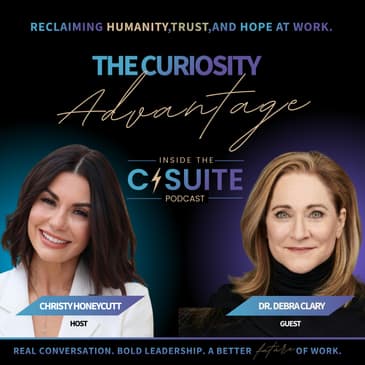
In this episode of Inside the C-Suite, Christy Honeycutt sits down with leadership researcher, author, TEDx speaker, former Fortune 500 executive, and even stand-up comedian, Dr. Debra Clary, to explore why curiosity may be the most underrated leadership skill of our time.
After a 40-year career that took her from driving a Teamster route truck to serving in executive leadership roles at Frito-Lay, Coca-Cola, Brown-Forman, and Humana, Dr. Debra became fascinated by a pattern she couldn't ignore: the more successful leaders became, the less curious they often were.
That observation sparked years of research and ultimately led to her award-winning book, The Curiosity Curve.
In a world being reshaped by AI, uncertainty, and constant disruption, Dr. Debra makes a compelling case that the leaders who thrive won't be the ones with all the answers—they'll be the ones asking better questions.
We dive into the hidden cost of certainty, how curiosity fuels innovation, trust, and engagement, and why creating space for inquiry may be one of the most important responsibilities leaders have today.
Along the way, you'll hear lessons from the boardroom, the TEDx stage, and even the comedy stage, proving that curiosity isn't just a leadership trait—it's a competitive advantage.
-
Why curiosity is a leadership superpower
-
The dangerous relationship between certainty and blind spots
-
How AI increases the value of asking better questions
-
Practical ways to build a culture of curiosity
-
The connection between curiosity, trust, and hope
-
Why vulnerability and inquiry go hand in hand
-
How great leaders create environments where better ideas emerge
If you're leading through change, navigating uncertainty, or simply trying to stay relevant in a rapidly evolving world, this conversation will challenge the way you think about leadership—and the questions you're asking.
Because the future doesn't belong to those who know the most.
It belongs to those willing to keep learning.
Follow Debra Clary:
LinkedIn – https://www.linkedin.com/in/debraclary/
Company Page – https://www.linkedin.com/company/theclarygroup/
Facebook – https://www.facebook.com/drdebraclary/
Instagram – https://www.instagram.com/drdebraclary/
Website – https://www.debraclary.com
(Dr. Debra Clary is a leadership researcher, author, speaker, and former Fortune 500 executive whose career spans leadership roles at Frito-Lay, Coca-Cola, Brown-Forman, and Humana. After earning her doctorate in leader development and organizational design, she dedicated her work to helping organizations build stronger leaders during times of transformation. She is the author of The Curiosity Curve, a research-backed exploration of how curiosity drives performance, innovation, and organizational success.)
Follow Inside the C-Suite:
LinkedIn – https://www.linkedin.com/in/christyhoneycutt/
Subscribe on Spotify – https://open.spotify.com/show/2gk39EvNtXLVHuAbp7tr6b
Subscribe on Apple – https://podcasts.apple.com/us/podcast/inside-the-c-suite/id1739883160
Want to be on the show or know someone who would be a great guest?
Contact Form – https://docs.google.com/forms/d/e/1FAIpQLSdDZmt0CV92OihiJO1kS62SolgHvetZ0rzjJDMfO9YEILWu0g/viewform?usp=send_form
Powered by the WRKdefined Podcast Network.
[00:00:00] Something Crazy Happened. So I was leaving Humana to go write my book that said, I got the data, I've got all the analysis, here we go. And a couple of girlfriends came to town and they said, we have something to celebrate. And I was like, let's celebrate. And they said, we pitched your idea for a one woman show off Broadway and you're booked. And I'm like, no, I'm not doing that. And they go, you said this is your lifelong dream. And I go, but not now.
[00:00:26] And so the point of this is sometimes you have to borrow others believe in you before you own it yourself. And so I did a one woman show off Broadway. It was called The Curious Woman. And essence of it is, how does a teamster route driver go to the corporate boardroom? And a comedy about all the things that happen as a teamster driver and in corporate America. And it was a huge hit.
[00:01:05] Hi, I'm Christy Honeycutt, your host for Inside the C-Suite, where execs get real about leadership, impact, and what truly drives high stake decisions. Today, we're talking about something most leaders think they have, but very few actually practice, curiosity. My guest is Dr. Deborah Clary, a curiosity scientist, leadership strategist, TEDx speaker, and sold out comedian, and someone who
[00:01:28] has spent more than 40 years inside some of the biggest boardrooms in America, including the Coca-Cola company, Frito-Lay, Jack Daniels, and Humana. But here's where it gets interesting. After decades of watching leaders operate at the highest levels, she noticed a pattern. The more authority leaders gained, the less curious they became. So naturally, she commissioned researchers from MIT to prove it.
[00:01:53] Her work became the curiosity curve, an award-winning framework helping leaders understand that curiosity isn't personality trait. It's a strategic advantage. And honestly, in a world moving this fast, certainty may be the thing holding leaders back the most. This conversation is smart, human, hilarious, and imparts a real wake-up call for leaders who think they already have all the answers, but they don't. Let's get into it. Deborah, hi. I am so excited to have you on the show today.
[00:02:23] I know that my introduction did not do you justice. I would love it if you would tell the audience who you are and what you do. Fantastic. Well, thank you, Christy, for having me on the show today. My background has been really an adventure. Right out of business school, I went to interview at Frito Lea, and I thought I was going to have my first manager's job. Like this was, and I was making it, and I did get a job offer, but it wasn't for the manager role. It was for a route driver. I actually
[00:02:49] started as a teamster for Frito-Lay in the city of Detroit. And my parents are like, wait, what? Wait, six years of schooling and you're a teamster. But that truck became my classroom. It's really how I learned to manage a P&L, how to manage relationships, how to manage my time. And I spent nine months on a route truck and then was promoted into being a district sales manager. And then my
[00:03:15] career moved from there. But I spent 10 years at Frito Lea in various sales and marketing and operating roles. And then I went to Coca-Cola. I spent a decade at Coca-Cola again in sales and marketing type roles. I had moved to Atlanta and was managing a global account, which was really cool to get all that international experience and understand how business is done around the world. And then I moved to Louisville where I worked for Jack Daniel's. The name of the company is Brown
[00:03:42] Foreman, but their main brand is Jack Daniels. And while I was there, I got wildly interested in human behavior. It was the first time in my career where I could take a step back, take a breath and begin to say, what are we doing as humans? Like, what are we doing in terms of leadership? And I'd had the pleasure of working with really amazing leaders and then some that weren't so amazing. And I'd probably
[00:04:05] been both of those myself. And so I decided to go back and deeply study leadership in the context of organizations. And so I went back for my doctorate in leader development and org design. And then when I graduated, I went to work for Humana, a hundred billion dollar healthcare company, very large healthcare company. And I spent the rest of those, my career running a leadership institute. Wow. There was a lot in that introduction. So many things I want to pick through. First of all,
[00:04:33] I barely can drive a tractor in a truck. So I'm really impressed. What's the, what tips do you have for those of us that aren't that great with truck driving? So the first thing I learned is there's something called a blind spot. Oh, is it different than when you're in your car? Yes, because the vehicle is so much longer and, and it's actually a metaphor for life as well, because in life we have blind spots about who we are as people, or we have blind spots about other
[00:05:03] people. But that was one of the key things is you think the lane is clear, but it not, might not be. Well, I try to stick to the simulators. It's much safer for everyone involved. That, that is such an incredible origination story to kind of come up that way. And, and I'm sure you learned a lot as an individual contributor and then rolling into a manager role. And you said something that resonates with me, because I say this all the time is that most people are thrust into leadership roles.
[00:05:32] As a first time manager, and all they know is what they don't want to be and what they aspire to be. And they fall miserably somewhere down the middle. And there's so many organizations that lack the learning development or coaching within the organizations. And I always tell organizations that say, Oh, let's build a coaching program. It's great, but not everybody in the organization wants coaching. It's those hypo individuals that want coaching. And you specialize in this, the curiosity, I believe is a high potential candidate. Can you share a little bit about that?
[00:06:01] Because you have a book, I believe it's sitting right behind you, the curiosity curve, but share a little bit about that, because I think that's what grounds your message. Yes. And so this interest I had when I was at Jack Daniels and trying to really understanding human behavior, and I thought I had mastered it. I had figured it all out. And then I spent the next almost two decades running a leadership institute, really focused on the development of leaders, especially in times of transformation. And something happened to me within a two week time
[00:06:31] period that gave me the wonder if curiosity was missing an organization. So it first started with the question. I'm sitting next to my CEO. It's a hundred billion dollar company. We're in the boardroom and somebody is presenting at the front of the room. And he quietly asked me, do you think curiosity can be learned or is it innate? I don't know, but let me find that out. Well, that Friday I was flying to Rome. I was taking a little bit of a holiday and I was on a
[00:06:58] train from Rome to Florence. And I'm sitting next to a very handsome Italian man. And he says to me, are you American? And I say, well, yes, I am American. And he said, I have the best American joke. What do you get when you ask an American a question, an answer? He laughed. He thought it was the funniest thing. I didn't get it, but I was a polite American and I nodded and smiled. But when I got to Florence, I began to observe European conversations and I began to notice like,
[00:07:28] wow, they're in different conversations. They are definitely in different conversations than Americans. So that's kind of interesting. I flew back home and Gallup had just released their engagement report and never in the history of measuring engagement had they seen it so low. So I began to wonder, could curiosity be what's missing? Right. And it was just this hypothesis. So I asked a group of researchers to go study it, to do some primary research on the relatedness
[00:07:57] between leadership, performance and curiosity. Because if there was nothing to it, there was nothing that was going to drive performance. Then it was just a nice to have. And three months later, they came back and said, how'd you know? Ding, ding, ding. And I'm like three decades navigating complex systems. And so from there, we began to do more primary research than we started pulling on other people's research. And then we just decided that,
[00:08:23] gosh, there is enough evidence here that it's important that organizations know that there is a solution to what they're feeling inside their culture. That's interesting that you're connecting that because it all comes back to culture. So did you go back to the CEO and share those findings that they helped you kind of set on path to uncover? I did. And to him, it wasn't surprising because he himself is an incredibly curious person. And
[00:08:52] I think he became more surprised when I said, I feel called to go do this work and I'm going to leave to write this book. And he's like, you're going to give all this up? You give it all? I go, I'm going to give it all up because it's so compelling to me that this is what organizations need right now. And so I started writing. He created a curiosity monster. I really love it. It's fantastic.
[00:09:22] And he cited in my book as well. He's on the back cover. So I acknowledge that he was the spark to the flame. Oh, that's so beautiful. What patterns in leadership, Deborah, have you seen that become impossible to ignore? Yes. So the book came out, well, a year ago. So the research was done two years ago. So the book was published in October. So as you can imagine, we continue to do our own research. And so since this time, we've had over a thousand people take, I have a curiosity
[00:09:51] curve assessment. So you have the opportunity to go in and find out what's my current level of curiosity. And what we have found is that with seniority comes certainty. Meaning, think about this. I know what I'm doing. I'm confident. I keep getting promoted. And unfortunately, as our certainty climbs, our curiosity narrows. So if you think about it, our brains are wired for speed and
[00:10:20] efficiency. Our brains are wired to keep us safe. And so when something new comes in, your brain says, let's match it. It's called fast pass matching. I'm going to pull from my past. I'm going to speed forward to the future. And when we do that, we are missing out on opportunities. We're missing out on expanding conversations. We're missing out on how we grow our businesses in a different way. That is incredible. So since you've been doing this work, and I know, you know, AI has taken front
[00:10:49] stage and all the leaders that I know and are talking to are trying to figure out how do we embed AI? How do we keep it human for our people? And how do we stay profitable? Are you finding that there's some challenges around AI right now in the workforce within leadership? This is how I position it with the executives that I work with. So it used to be the people that were noticed in the room were those that had the best answers. So when you would ask something and someone would come up with a solution
[00:11:18] and everyone would move forward. Well, now with AI, the playing field is equal. Everybody has answers, right? If you want to really extend your competitive edge, you want to be the one that stands out in the room. It's have the best question. Oh, I love that. That is quotable right there. I've just seen a little bit of freeze or fear in the age of AI within leadership. And I'm watching, I actually just had a conversation
[00:11:43] before we jumped on with Matt Alder, who is a big podcast host in the HR space. And we were talking about how we're seeing some senior leaders freeze in the moment of which way do we go with this? And they're trying to be risk averse. They're trying to lead with intention. There's just all the different reasons as to why they're doing that. Do you think curiosity ties into the organizations that are activating the AI options within their business? Or how do you think that plays in?
[00:12:11] Because this is live, right? We've got different C-suites that are kind of going up against each other. And it's coming down to who's determining what technologies, tools are going to go into the organization and how will that ultimately impact culture overall. And we've seen the recent layoffs and just the fear from an organizational standpoint. Do you think curiosity plays into decisions around AI on who's successful and who's not?
[00:12:37] I believe so. It's similar to the story I told earlier about the research we're doing around certainty, right? So if you have executives that have been in their roles for a long period of time and they are certain of how to succeed in the future and they're not considering other technologies, I think they're going to be left behind. Yeah. Do you think that plays into ego? So I haven't thought about that. So I'm going to think and speak at the same time. So forgive me
[00:13:03] here. But I would think that overconfidence and certainty in ego are siblings. Well put. And I love what you said about AI is leveling the playing field because we've all been in large rooms with different stakeholders and it does feel like the squeaky wheel or the noisy one or the first person to speak up sucks the air out of the room or gets the attention or gets the assignment for the next great thing when there might be other individuals in the room that just
[00:13:32] aren't built the same way, that have the curiosity, that have the bandwidth and the mindfulness to move the organization forward. So I love that we have technology in organizations today that can level that for people. Absolutely. So if we look at your curiosity framework, do you have like three or four pointers for somebody that's watching the show that says, Hey, I'm going to go take Dr. Clay's test and I'm going to see how
[00:13:58] curious I am. What are some pointers that you would give somebody to identify beside your test that they're high or low on the curiosity scale? Yeah. So the first thing I would say is the reason that you are in curious is not your fault. And we are taught to be in curious as children. Curiosity killed the cat. Don't open Pandora's box. Sit in your chair, raise your hand. There's these, we become in curious as children. We ask 298
[00:14:26] questions a day. I mean, that might be, we're pointing at something. And as adults, we might ask five. When we speak, we tend to speak in statements as adults versus questions as children tend to lead with questions, right? So we are taught to be in curious. And then you go into the workplace and you're rewarded for that expertise. And, you know, by the time you have, you have these time constraints. So I don't really have time to be curious. Those are all the things that we say to each other. So first off,
[00:14:54] you're off the hook. It is not your fault. But now that you know better, now that you know that leadership and performance and curiosity are directly related. So now let's focus on how do we get back to being more curious? And so it begins with your own mindset, the way in which you operate throughout the day and asking yourself, hmm, how many questions did I ask today? How interested was
[00:15:20] I in other people's opinion? Who else did I bring into this conversation that might have a different perspective? So it begins with me. Even if you're the CEO, it begins with me and my own mindset and my own intentions to say curiosity can drive performance. Curiosity can build relationships. Curiosity is the foundation of a culture, right? So you begin with that. And then as a leader,
[00:15:45] you have the opportunity to role model it. So for example, you're in a team meeting and somebody asks you a question. Best thing you can say is, I don't know, but I want to find out. So let's explore this together. Who has a thought about this, right? So you're showing that you have this vulnerability of he or she doesn't know everything. No, I don't know everything. I have some ideas, but it's only my ideas. I would love to hear about what other people have to say, right? So it's like
[00:16:12] modeling that. And then when somebody asks a question, deeply explore it. Don't brush it off or say, we don't have time to get to that, which leads to when you have an agenda, you're creating an agenda. Think about how do I leave space for questions? How do I leave space for discussions? Actually put it on the agenda of this is our discussion time, or this is the time that we are going to explore new ways of
[00:16:39] doing things or new ideas. So those are the ways in which I encourage my CEOs and executive team to begin to go down this path. Really, really like that. It's very tactical and basic. And I think a lot of leaders miss it because they are so tied to an agenda and a timeline and an output. And I've experienced this very same thing that you're talking about. I was in a room trying to bring two organizations together, trying to save 50% of the individuals in the room's jobs. And a team
[00:17:08] member had a golden share. It was amazing. It was in the last five minutes of the meeting, we were wrapping up, everybody's getting ready to go hop on planes. And in that moment, Debra, I killed her hope because I said, I just kind of squashed it. I said, we'll catch up later. Had I done what you'd mentioned, like planned it out to make sure we had those last minute questions. Or if I had simply just said, that's a really great idea. We're closing the meeting in three minutes. I want to spend some time with you. Why don't we take this offline, have a discussion, bring it back to the
[00:17:37] team. But in the moment of pressure, and that goes back to like, when you become a leader, you don't always know everything until you experience it. But I had that humbling moment where I had to go to her and say, Hey, I didn't show up in a way that I felt good about. And I really want to give you this space. And I really want to hear your idea. And so I recovered the relationship. But I think what you're talking about is really helping, you know, Gallup did a survey on what people want
[00:18:03] from at work, the followers. And I'm going to ask you this question. I've asked it a couple of times, but it's, it's hope or trust. Which one do you think they wanted the most? I got it wrong. Let's say hope. You got it right. So, so I said trust because immediately I was like, well, yeah, but you have to, you have to have trust to hope. No, no, no, no. You can hope and not have a trust. And so I think the important thing is what you're talking about is instilling a culture where people can have hope
[00:18:32] and then they'll share and you'll get that curiosity factor because they're allowed to have freedom of thought and express themselves is what I'm hearing, but correct me if I'm wrong. Yeah, that sounds right. And the reason that I picked hope is because when we feel hopeful, we get a dopamine hit in the brain. And so that's like a reward of, oh, it's possible. Something might happen. Something could change here. Yeah. Well, especially if you think about the environment
[00:18:59] we're in and we've been in like from COVID to coming back to the office, to AI, you name it, war, whatever we've got going on. I think leaders are in a very uncertain area where they feel like they have to be perceived as certain. And I think we're on the cusp of a change. I feel it. And your book expresses it where we do want our leaders to be more vulnerable and show up. And, and it's okay
[00:19:25] that you don't know everything. And I love that you're bringing that out through way of curiosity. It's kudos to you. I cannot wait to get my hands on the book and read that. So you're so much more than just a book and a, and a leadership guru. And I want to ask you a couple of questions. So I know you do some TEDx talking. I did. Yes. Okay. How did that go? It was scary. You're, you are 14 minutes
[00:19:51] and you have to get your message across in 14 minutes with no notes, no slides. It's just, you are, you are on that stage having a conversation. It went viral. So I'm really, really proud of that. But, but I think more than anything, people are just hungry for this message around curiosity. I love that. If you guys have been listening to this interview, you can probably pick it up that Debra's got quite a personality. So what's this comedian thing I'm hearing?
[00:20:17] Yes. Yes. So I have done standup comedy and I got into standup comedy because I wanted to be a better speaker. And I, early in my career, I had done some research and it said, if, if you can make somebody laugh and then deliver your point, there's a higher, probably they're going to remember your point. So I got into comedy so that I could put it into my, my presentations. And I'm speaking mostly inside of my own corporations. And then something crazy happened. So I was leaving Humana
[00:20:45] to go write my book. This said, I got the data. I've got all the analysis. Here we go. And a couple of girlfriends came to town and they said, we have something to celebrate. And I, let's celebrate. And they said, we pitched your idea for a one woman show off Broadway and you're booked. You're booked. And I'm like, no, I'm not doing that. And they go, you said this is your lifelong dream. And I go, but not now. And so the point of this is sometimes you have to borrow others'
[00:21:13] belief in you before you own it yourself. And so I did a one woman show off Broadway. It was called Curious Woman. And essence of it is how does a teamster route driver go to the corporate boardroom and a comedy about all the things that happen as a, as a teamster driver and in corporate America. And it was, it was a huge hit. Oh my goodness. I, I'm so enthralled. I went to my first Broadway
[00:21:40] two months ago in New York. Oh, what'd you think? I loved it. I saw Death Becomes Her, which is one of my favorite, like late eighties, early nineties movies. It was, it was fantastic. So is there somewhere we can stream this, uh, this show that you did? If you go to my website, which is deborahclary.com, there are, there is a clip there and you can see part of that, that clip there. The full show is too long to post on YouTube, but there are clips out
[00:22:08] there. So what did you learn from that experience? So what I learned is, um, I, I started writing a friend of mine said, I have a dear friend that writes for Broadway. He said he would look at your script, give you some pointers. I'd never done this. And so he read it and he was very, very gracious. But what I heard was this sucks. He goes, you wrote a keynote. I go, yeah, that's what I do.
[00:22:35] And he said, he's like, you need to find someone that can adapt this to stage. And I had never heard those words. And just through connections and relationships, I found somebody, she was brilliant. She was an actor and a director, a writer. She knew what she was doing. And so my point of that is, you know, sometimes you got to get help. You've got to get help when you don't know how to do something. And so, uh, and then of course, then she brought in, oh, we need a sound engineer. I never
[00:23:03] heard of that. We need a stage manager. Never heard of that. So this, this sense of when you don't know things, you got to ask questions and you got to find help. Well, it can be overwhelming when you're faced with so much that you're, you're stepping into for the first time. And I hear a lot of leaders and inspirational coaches talk about just do it, just start, right? Because you're going to learn along the way. And I think that some of us have that perfectionism mechanism built
[00:23:29] into our brain where we can't do it until it's, it looks a certain way, sounds a certain way, feels a certain way. So kudos to you for like leaning in and, and leveraging your tribe to kind of get where you were going. And those girlfriends around you sounds like a really tight knit circle. Who are the, who are like the, the top circle around you that helped you get to where you are? I mean, it's true. I think my, my parents had very high aspirations for us. Even when I came out of
[00:23:54] business school to become a teamster, they still had hope for me. They were the ones that were so encouraging to me in terms of go out there, do what you want to do. And they always celebrated failure. Like you're not going to be CEO tomorrow. You're going to be the best route driver you can be. So I think that they were some of my most incredible cheerleaders, if you will. And then just, just surrounded myself by people that I always held an aspiration of like, wow, they've already
[00:24:20] done that. I want to do that. And I would just tap into people that had done things well that I wanted to do. Yeah. That's, that's very smart advice from a smart lady for sure. So if I may, everybody has a time that just really resonated with them, a struggle that they overcame a time they failed and they learned something significant. What was yours? I have so many. And that's a leadership answer. Right. If you, if you watch my show, they all come out there. This is one of the failures in
[00:24:49] the sense of when I started writing the book, I turned over, I thought a beautiful manuscript to the editor, the publisher, Fast Company Press. And I'm like, let's get it to press. And they're like, not so fast. And this sense of having to rewrite, rework the words on the page. It was humbling, very humbling. And at the same time, having to meet deadlines. So
[00:25:14] it wasn't a failure as much as it was. I don't know everything. It's like, I thought it was perfect. I spent a year. It's perfect. They're like, yeah, no, it's not. So perfect. That's beautiful. Well, what advice do you have for emerging leaders, executive leaders, current C-suite, as far as looking at curiosity within their team and their organization? Where should they start first?
[00:25:41] The first thing is, is, is just knowing that curiosity is a strategic advantage. If you want to extend your lead, create a culture of curiosity. And of course, in order to be curious, you have to be in its presence, right? As a leader, really begin to roam all that. And I want to remind them that curiosity is not a trait. It's a state, which leads to that curiosity is contagious. So if you are
[00:26:09] around curious people, if you are around people that ask questions and their questions are welcome, that's creating a culture of curiosity and curiosity can be learned. That is powerful. What you just said, curiosity can be learned. And then what I also heard is leaders have space for the, for your organization to be curious because you get here at eight and you leave at five and you might have 30 minutes for a break, like build that in. How would you recommend organizations build in those safe spaces for curiosity exercises?
[00:26:39] You have to be incredibly intentional, right? In your work that you do, you talk about culture and how to change culture. It's no different in the sense of that change occurs in increments. The best changes happen in increments. And so it's set one intention, master it, and then go on to the next. So the first one would be is when I create the agenda, I'm going to leave space and time for questions or discussions. Just, just start there. And then when somebody asks a question,
[00:27:08] you got to honor that and lean into it versus we don't have time for that, right? So begin to change that. So the brain loves increments. And when, when things happen in increments, the brain is boosted. So you get that dopamine hit and then it says, Oh, I can do more. So that's how I'd recommend they start. I love that. And I think you got to tap on people too, because when, uh, IBM used to do a great job with this, if they had a project and they wanted some thought leadership around it, they would tap on
[00:27:38] certain individuals. But I think you've got to pay attention to the ones raising their hand too, or quietly speaking up in enclosed doors, because there's some magic behind your quieter, soft-spoken employees. I found anyway, some of the best resources have come from the ones that didn't feel comfortable speaking up in front of a group and really caused a lot of momentum changes. Yeah, absolutely. I was with a C-suite last week and the CEO had this amazing idea. They were getting
[00:28:07] ready to go to a town hall. So all their associates were going to be in a town hall. And typically at the end of the town hall, what do you do? You can ask us questions. She goes, we're not going to do that. We are going to ask them questions. Wow. They're going to ask the audience questions about things that are on their mind or issues that they're having or challenges. I thought that was brilliant because they too are the experts. Yeah. I know a lot of leaders that would be scared of that. I've encountered a
[00:28:34] lot of leaders that didn't want to go that method because they were, I think, fearful of what might be spoken out loud in front of everyone. So that's bold. It's vulnerable. Yes. It's very vulnerable. Yeah. And so do you have any insight on the output yet? Not yet, but I just sent her a note before this session to hear how did it turn out. Isn't it funny when you're helping your clients, I don't know about you, but I'm just as invested as they are. I want them to win so much. And it's
[00:29:03] really a purposeful career to be able to help others, right? And help them find peace and hope and all the things that I think we've been lacking for so long. I feel like I'm the teacher and the student because I'm taking all kinds of notes. Even when I'm facilitating, I have to tip my pen and hang on, let me write that down. I'm wanting to remember it so that I can share it with others. But it's just when you're open to learning, there's just so much that can come through.
[00:29:32] I get so excited when I learn new things. I just, like, I want to tell everybody about it. If I hear a new quote from a leader and you dropped a couple today, by the way, so audience get ready. But I just get so excited because if it, if it inspired me, it's got to inspire somebody else. I'm not that unique, you know, but I love it. Well, Debra, this has been so incredibly enjoyable. Thank you so much for the work you're doing. And before we close, is there anything that we missed that you might want
[00:30:01] to share? I encourage the listeners to take curiosity seriously. I know when we think about curiosity, we're thinking about Curious George, or we're thinking about going down a rabbit hole, or we're looking over our neighbor's fence and that's curious. And I want you to understand that this is a serious discipline that can be measured and learn and it drives performance. So dig in.
[00:30:27] Curiosity isn't soft. It's a leadership skill for sure. All right. Well, how can this wonderful audience get ahold of you if they are curious about you and your curiosity test? Yes. So you can go to my website, which is Debra, D-E-B-R-A-C-L-A-R-Y, by debraclary.com. And you can also check me out by the same time on LinkedIn, but there's a lot of resources on my website. There are many other little clips and articles that I've written.
[00:30:55] And so I think that if you are curious and you want to grow it, that's the place to be. I love it. Well, again, thank you so much for holding space and guys go like, follow, subscribe, all of the things and buy Debra's book because I'm going to. Curiosity curve is right behind her. Bye.
Sponsors
