
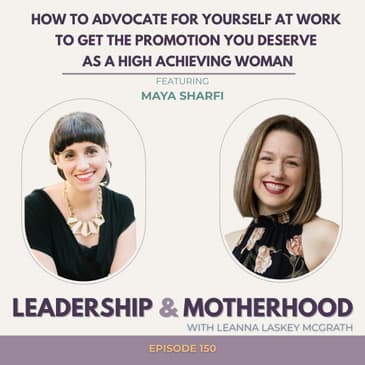
In this episode, Leanna Laskey McGrath sits down with career and executive coach Maya Sharfi to explore what it truly means to grow your career in alignment with your life, not at the expense of it.
Maya shares how she supports high-achieving women, from manager to executive levels, in navigating promotions, career pivots, and redefining success. Drawing on her unique background in design and women’s empowerment, she brings a powerful blend of analytical thinking and deep personal insight to her coaching.
Together, they discuss how to advocate for yourself at work, recognize your value, and make intentional career decisions that increase fulfillment. This conversation is especially relevant for ambitious women who feel the tension between professional growth and personal alignment.
If you’re ready to stop climbing the ladder on autopilot and start building a career that actually supports your life, this episode will give you both perspective and practical direction.
Take advantage of Maya’s special gift for Leadership & Motherhood listeners, a 5-minute assessment to identify what is standing between you and your next career level!
Sign up for the Leadership & Motherhood mailing list.
Powered by the WRKdefined Podcast Network.
[00:00:02] Welcome to Leadership in Motherhood, the podcast for ambitious, high-achieving women navigating leadership in the boardroom and at home. I'm your host, Leanna Lasky-McGrath, business leader, mom, and certified executive coach. I believe that every woman deserves to create a life and career on her own terms, one that she truly loves. This podcast is here to help you do just that. Let's get started.
[00:00:32] Hi, everyone. Welcome back to the show. Thank you so much for being here today. Today's conversation is a really powerful one, especially if you're in a season of growth, ambition, and maybe even a little bit of questioning what's next. I'm joined today by Maya Sharfi, a career and executive coach who works with women rising through the ranks. And what I love about this conversation is that we go beyond the typical career strategy advice and talk about what's next.
[00:01:02] Fulfillment, identity, self-advocacy, and what it really means to create a career that supports you, not just one where you succeed on paper. Maya shares some really helpful practical advice as well as mindset work that high-achieving women will definitely find helpful. So if you have been wondering how to take the next step in your career while staying true to yourself, you are going to find this episode so helpful. Maya Sharfi is the founder of Build Yourself.
[00:01:32] where she helps women's career. into director, VP, and C-suite roles without overworking or second-guessing themselves. Her clients have landed roles with $40,000 to $100,000 salary bumps, gotten tapped to lead organizations, and built the confidence to lead at the next level, all while having more time for their personal lives. Maya has seen again and again that once women learn how to approach their careers differently, everything changes. I hope you enjoy this conversation.
[00:02:05] Maya, welcome. Hi, so glad to be here. I am so glad to have you and I'm so excited for this conversation. To start off, could you just tell us a little bit about you? Let us get to know you a little bit, your story, your background, where you are, and how you came to be there.
[00:02:20] Sure. I'm a coach. I'm a career and executive coach. And I work with women who are rising in their industries. So I like to work with women at the manager level, all the way up to the VP level, who are trying to get to the next level, or who are trying to shift their role so that they increase fulfillment or increase the match between the job they have and the life that they want to live and how it supports their life and their lifestyle.
[00:02:44] My background is that I actually have, I kind of have a funny, almost dual training. So I have my background in design and a lot of what I use in my coaching is that same analytic pattern matching. I was actually just on a call with a client who's making a career pivot and we were analyzing her background and what drives her and figuring out where to go next. But I also have been involved with women's work probably since I was in high school, women's empowerment work.
[00:03:11] And so pretty early on, I started launching workshops for women in my industry, teaching them how to advocate for themselves more and go after what they wanted and really see their own value and eventually turned into a coaching practice. So that's what I do now. I love it. So when you say design, you mean digital, you mean like interior?
[00:03:32] Yeah, I came from the architecture and landscape architecture world, but I would say that I was probably less interested in the actual physical making versus the thinking process, the kind of analysis and creative problem solving. That's so interesting. So then how do you apply that to your work now in coaching? Yeah. So a big thing when you're a designer is someone will give you a problem and they'll give you an existing situation. And then you'll look at with all the assets I have and what else can I bring in?
[00:04:01] And how do I organize this into something that solves the problem and delights people? And so, for example, I had a friend in school who made this incredible project where there was a park and it was a native ecosystem and there was a walking path that turned into an ice skating rink that like instead of a circle just was a path that wove around this beautiful landscape. And so the idea of figuring out what you have and then figuring out where can we go with this.
[00:04:24] And so when I work with clients, especially when we're working on pitching their promotion or career repositioning or pivoting, we're looking at what are their previous experiences? What drives them? What do they do really well? And what do they do really well that they actually like doing versus that they're just good at doing? And so from there, then we figure out, oh, we can match it either with a business case of a promotion that they could propose or an existing role in their company, or we can match it with a potential career reposition or even the kind of visibility that they want in their industry.
[00:04:55] It's almost kind of like branding in a way. Yeah, that's so interesting. I think what's so cool about probably any profession, but obviously I know coaching best since that's our current profession now, is that there are people with all different kinds of backgrounds like of how we came to the work. So therefore, we're going to approach it differently. You know, we're going to have our own unique ways of bringing what we know and how we have been trained to think about things, how we have, you know, decided we want to think about things.
[00:05:24] And then we bring that to our coaching. So I love that because design is like nowhere, anywhere near my background. But, you know, but we both kind of came to a similar place in working with high achieving women in career and executive, but from very different paths. So you kind of talked macro about your experience. Could you give us a little bit more insight into your journey?
[00:05:48] Yeah, I think there's a particular moment that I think would actually be such a great story and also relates to this idea of taking the jump, making the jump, taking the leap. And so, yeah, I had been teaching. I pitched the dean of students at my grad school. I went to Harvard Design School. And so I pitched the dean of students that she should hire me to start a feminist boot camp at school. And she said, OK. And so she did. And I ran it there. This was right when I was graduating and I loved it. That's awesome.
[00:06:15] And then she said, OK, well, this has been great, but I want my discretionary fund back. And so thanks so much. Right. And I just knew that there was a mission here. And in the meantime, I was working. I was a professional. But I just and I was dating someone at the time who was very, very young and he had inherited a startup that was failing. And he had to go pitch doctors. So people who are probably twice, if not more his age. And he was pitching doctors on being part of this. It was basically like an alternative model for affordable primary care for people.
[00:06:42] And he was pitching these doctors. And I wanted to bring my workshop to the local professional organization. And I couldn't get a meeting with the decision maker there. He said, you've got to call up, call their office and talk to their admin person and act like you're just a really important person. And your admin would be calling if only she weren't sick today. And you don't say any of this, but this is all in your dynamic. And, you know, you're calling to get a meeting on Eric's calendar.
[00:07:09] And I was so nervous because I, I'm sure we'll talk about this, but I very much socialized as the good girl and the role follower and waiting a little bit for other people's permission. But I just really believed in this workshop and I wanted a platform for it. So I called up and I just remember they picked up the phone and they're like, hello. And I was like, hi, this is Maya Sharfi calling to get a meeting on Eric's calendar to discuss blah, blah, blah. And they were like, oh, okay. And then they just put me on his calendar.
[00:07:35] And then a couple of weeks later, he found himself with me. He invited a couple of his colleagues. He's like, what is this meeting about? And I ended up teaching the workshop there for years until I started to do independent coaching. But it was, it was just going after it. Yeah. Not waiting for permission, doing something that made me want to throw up at my mouth a little bit, but I'm so thankful for it. Yeah. Well, I love that because I think it's like the person you were dating at the time was like your mindset coach. He was. Yeah. Because that's what you need to do, right?
[00:08:05] Like you need to believe that you're important enough to be on the calendar and you need to have those thoughts to show up in that way, right? You're going to show up much differently if you believe that you deserve to be there, if you believe that this is important, if you have the story in your mind that your assistant would be calling if they weren't sick that day. So I love that because that probably very much changed your energy and how you approach that conversation instead of like,
[00:08:32] can you please schedule me asking for permission rather than just assuming like, yeah, I need to be on Eric's calendar. So I love that. I think it's not an accident that that ex-partner, he was male, right? So that ex-partner was male and boys are socialized so much more than girls to take risks. Absolutely. You see this, I'm sure, I'm sure you know the study and maybe some of your listeners have as well, but the study around people, men and women applying for jobs and men are more likely than women to say, oh, I meet three out of five.
[00:09:01] I'm so great at this job. And women are more likely than men to say, oh, four out of five, I can't apply. And so I think about that all the time. What are the opportunities we're not going after because we're following the rules a little bit too much or it feels risky and we've been socialized less too. I mean, it's even things like, again, there's studies that show that when girls speak without raising their hand, they get reprimanded more than boys in the classroom. And so all of that little socialization, right?
[00:09:29] You know, so my man, my mindset coach was a boy, a man. I mean, he's pretty young at the time, a young man who had been steeped at a lifetime of that being more okay for him. Right. So I think it's interesting that that's where the advice came from. That's right. You know, it's interesting because I remember when I joined my first tech startup, I was the only woman. And one of the things I noticed, the word that best describes it is like entitlement, where, you know, we would go into every hotel.
[00:09:59] We traveled all the time together for, you know, pitching our company and our product and teaching people how to use it. And we would walk into a hotel and they would just like, in their minds, they believe that they deserved an upgrade. Right. And so they would like go to the front desk with that assumption and that's how they would approach it. And the majority of the time they got an upgrade. And if they didn't, they would just like throw a fit and then move on.
[00:10:28] And sometimes the fit would get them the manager and, you know, and then they would get the upgrade anyway. And I just thought like, man, that's so interesting because I had never walked into a hotel assuming that I should have an upgrade. Right. That it was like my right or even considering it really. And so then I started asking for upgrades because, you know, like why not? And I found, you know, I approached it differently than they did, but I found that when I asked,
[00:10:58] sometimes I got an upgrade, right? Sometimes I got the free upgrade, but I never would have gotten that had I not asked for it. So I feel like everything we're talking about here is like exactly what you do, right? You help women to go for the promotion and to kind of like take it to that next level. So how does all of that kind of tie in to what you're doing now? Yeah. So one of the biggest things I work on is getting women promoted and growing to the next level
[00:11:23] in their company or sometimes pitching or proposing their own role that is an up level, but also aligns better with what drives them and what the impacts they want to make or where they see that there's value to add or the problem that they want to work on. I also work with women on job searching and I work with them on improving their leadership skills and getting out of the weeds, delegate. I know this is a big thing you work on delegating more. There's so much that we're talking about here. I think there's this term I've heard called honest entitlement, which is,
[00:11:52] it doesn't have that negative connotation of I'm going to throw a fit, but it's also, I expect more everywhere I go. And oftentimes it just comes to me because when I, when I bring that expectation, it just happens. Right. And so I think sometimes with delegating that shows up, being able to pull out of the weeds in terms of your time management and lead more strategically. So I think the first piece of the puzzle is deciding that you want more, that it's okay
[00:12:17] to want more, that you, what you're doing right now, you have more potential and not always knowing exactly how that can unfold, but it starts with having that first instinct that you want more, you want to grow in your job. You want more alignment. Yeah. Well, you called it honest entitlement. Yeah. I feel like that's a term I picked up maybe from a book I must've read like 12 years ago, so I could be getting it slightly wrong, but. Yeah. Well, I love that concept though, because, and to me, it's a little bit more in integrity
[00:12:47] because I think sometimes one option that I would have had watching those guys request an upgrade everywhere, sometimes throwing a fit, because sometimes I did feel kind of embarrassed, like, oh my God, I can't believe they're acting like this. Like they have no right to even think that they should have this upgrade. Like they didn't pay for it, you know, why? And so I think that when we've experienced that kind of behavior in our lives, we could say, oh, I don't want to be like that.
[00:13:14] So anytime that I think I should go for more, I'm going to come off that way. And I don't want to come off that way. Whereas I think in what you're talking about, it's more like, no, there's a way to actually believe that you could have more and to show up in a way that is authentic to you. Like when I asked for an upgrade, I do it in a very different way than in the way that I saw modeled, because that wasn't authentic to me. And, you know, I could try it, but like, it wouldn't feel right.
[00:13:44] It would feel really icky to me. I think that that's an important distinction for women who are probably looking for a promotion or looking for an upgrade in some way, in some area of their life that it doesn't have to be maybe in the way that we've seen it modeled. Yeah. Yeah. Maybe a term for it is assurance, right? Being assured and being assured doesn't mean that you're attached, right? If you don't get the upgrade, you weren't going to throw a fit, right? But it's always worth asking.
[00:14:10] And I think sometimes some of these concepts that can feel so hard for us to implement, or it feels like that's icky. When we think about what we'd want to teach our children, it makes so much sense, right? I have a three and a half year old. And when I think about what I want her to do, I want her to go after what she wants as if it's going to happen for her. And then I want her to be able to handle any emotions of disappointment, right? If she fails at it, I don't want her thinking that something has gone wrong, but I want her going after it, knowing that she's not going to get it some of the time, but she's
[00:14:39] going to go so much farther having asked for it. Like, that's what I want for her, right? And I think sometimes it's so clear with our kids, but then because of the way that we've been socialized, it feels a lot harder to implement for ourselves. That's right. Yeah. And the way we've been socialized and what we make it mean when we are told no, you know, we could make it mean like, oh, great. That like, glad I tried. That wasn't for me. Now's not the right time. Whatever kind of story that we want to tell.
[00:15:07] But I think often we make it like, I'm not good enough. That little voice that was telling me like, don't do it was right. I should have listened to that. And then maybe it discourages us from going for the upgrade next time. But yeah, I love that. I have a seven-year-old daughter and same. I'm always telling her like, you can raise your hand and be wrong. It's okay. Because she's like, well, I didn't raise my hand because I didn't know the answer. And I was like, but did you have a guess?
[00:15:32] But I think it's like the fear of that feeling of embarrassment or of appearing to not know everything is really challenging for us. And how do we instill in our girls and our young children that that's not something to be afraid of? I'm curious. I know she's only three and a half at this point, but how's it going so far? Yeah, I think, you know, it's the two things. I'm sure these are things you also think about, but what we say and how we frame things, right?
[00:16:01] If things don't go the way they want, how do we talk about it? Right. This is interesting. So this is a little bit of a story, but I recently went through a challenge that my coach was running in one of her programs. And one of the ideas was to set a really, really high goal. And one of the things we had to do is we had to look at how are we going to talk to ourselves on the other side of it if we didn't achieve it? But it's very subtle because sometimes we start preparing for not achieving a goal before we get started because we're afraid we're going to be disappointed.
[00:16:30] And then we're not going all out for the goal. That's right. And what we really want to do is we want to go all out for it. And then we want to have a commitment to how we're going to treat ourselves on the other side. And I was like, don't blame myself. Be nice to myself. It's felt so abstract. And then there was a kid in my neighborhood. He was going out for the football team for the second time in a row. He failed last year and he was practicing so much. And his name is Jonah. And I was thinking, he's actually a good friend of mine's son. And I was thinking, if Jonah didn't get on the football team, what would I say to him?
[00:17:00] And I realized I wouldn't just be like, oh, you tried. Oh, don't be sad. I'd be like, oh, it's okay to be sad. And look at you. You're the kind of person who went after this with all your might. I saw you practicing all of these nights. No matter what happened with the football team, number one, you've made yourself a better player. Number two, you have shown yourself that you're someone who's willing to show up for something. Number three, it's okay to be sad. And you're also very strong and powerful and sad. And the things I would have said to him, I was like, oh, it's not like, there, there, Maya.
[00:17:30] I didn't achieve it. It was a 30-day challenge. I didn't achieve it, but I achieved it in 47 days. And on day 30, I looked at myself and I let myself be sad and disappointed. And then I just was so in honor of what I had achieved. Just even if I hadn't achieved it, just that I really showed up and went all out. And I think it's what we say to them. And then I also think it's us modeling it, right? It's us. Do we let them... One of the things I've been thinking about with my daughter is, am I letting her see we're
[00:17:57] working on feelings and it being okay to feel mad and sad? And I was realizing I don't ever show her when I'm mad or sad unless it's inadvertent. And so I started saying, okay, I'm feeling really mad right now. I'm going to take some breaths. I'm feeling really mad at you. And I also love you and nothing that you ever could do would make me love you less. And I'm feeling very mad right now, right? And I'm realizing, oh, I have to live it because otherwise I'm just saying it. That's right. Yeah.
[00:18:23] The narration is really important and helpful to model it. Like you said, I think that we certainly can't expect more of our little children with partially developed brains than we expect of ourselves, right? That they should be able to be nice to themselves or they should be able to know what to do in disappointment whenever we maybe don't always treat ourselves as well in disappointment as we wish that they did. So I love that. I love that story.
[00:18:51] And I also think it's like with so many women I coach, they're like, yeah, I can be nice to my kids. I can be nice to my employees. I can have compassion for them. It's just really hard for me to do that for myself. Do you find that as well? Well, my gosh, yes. This is my number one thing that I work on in my coaching. It is very hard and it's kind of like, I don't know, the way I think about it in my better days is I just keep working on it, right?
[00:19:19] My coach talked recently about this idea that shame and self-disgust and judging yourself and being negative towards yourself is actually a way for your brain to avoid other hard things because if you're incapable, then you're weak, you're powerless, you don't have to try. And so I've been playing with this idea that it might actually be a distraction and it's a way that my brain keeps me safe. It's like, no, don't go after this thing because you're going to fail and get disappointed or
[00:19:45] you're going to get rejected or you're going to have to deal with uncertainty and you'd like being in control. So instead, you're just a terrible, incapable person and now you don't have to, it's a distraction. So I've been playing a little bit with that and not being mad at my brain for offering that up, but more like, oh, it makes sense. It's like, you know, you're doing your job of trying to protect me. And it used to be that I would say, oh, how do I start treating myself better? And now I'm like, look at that. Like, that's normal that your brain is doing that, but it is a little bit like, what else
[00:20:14] am I not looking at here? Yeah. I think that's such a good point because it is when we're like beating ourselves up, it feels terrible, but also it might be that we're avoiding something else, taking action on something else. I'm curious, do you have any self-compassion tricks in the bag? I don't know if I would say tricks.
[00:20:38] I would say that it's a journey to get to a place where self-compassion becomes an option, even an option. And then eventually the default. And I think that in my really good days, it's more of the default. In my okay days, it's an option. And in my not great days, it's like, what's that? We forget.
[00:21:03] But I don't know if it's like tricks or six years of therapy and coaching and thinking about it. Because I do think it's like, I think about, you've talked about socialization a lot. And I think it's like, we're all socialized. We're all trained within the society and the culture that we grow up in. And that's like how our brain is formed. It's in our formative years that that's happening.
[00:21:32] And so, you know, then we get into adulthood. And at some point we come into this work and we're like, oh, I need to kind of like undo some of that. Or I want to change how I'm thinking about it. I want to change my default patterns and reactions to things and where my brain goes. You know, whenever I was thinking about when we were talking about like the hotel example, I think a lot of times like if a woman was told no in that example, like I would think,
[00:22:01] oh, I didn't say it right. Or like, oh, I should have approached it differently. But like the men in my life of my former colleagues were like, something's wrong with this hotel. Or like that person doesn't know how customer service. And so we're trained that way, you know, while our brains are developing. And then we get to a point where we're like, I want to undo it. I want to change it. But like, it doesn't just happen. Like our brains are malleable. And also they're fully developed by the time we're 25 with all that stuff in there.
[00:22:32] And so I think it's like, I mean, it's kind of meta, but it's like we have to be patient with ourselves and compassionate with ourselves as we're learning self-compassion, as we're learning, you know, all these different things of like ways that we want to operate differently. Because to your point, it's like, yeah, that's how human brains work. And I think as we study more, and I know you've studied this a lot too, of like how the brain actually works, then it's like, oh, I get it.
[00:22:59] And so I guess to me, like self-compassion has come from understanding. Like I need to cognitively understand first why it's happening. And then that opens the window a little bit. And then I can start to like practice it and be like, yeah, remember, that's why. Remember you're human. Remember you have a human brain. Remember it was programmed this way. The two things I like to hold at the same time are things take time. It's like water dripping on a rock, right? Things take time. And I'm very impatient.
[00:23:28] So I sometimes have to teach myself and remind myself that's okay. Right. And then I look back at things that took a long time to change. And then I, but they did change, right? So things take time, hold your horses. And on the other hand, you know, there's more and more research about just how neuroplastic adults' brains are, that there's so much more neuroplastic than we thought that they were. And I was just reading a book about this, that there's some kind of chemical in my daughter's brain, which means that she can be doing something. And if people were speaking French in the background, she would eventually learn how to speak French,
[00:23:58] right? Like it's like they can absorb so much in their brains because they're growing so rapidly. But just because we're not like that doesn't mean that we can't change. And one of the things that I think happens sometimes for adults is that we get very comfortable being good at what we're already good at. But then I know that there's a sense of dissatisfaction when you're not growing and growing doesn't feel easy. It doesn't always feel good. Like the feeling of growth, having done growth feels great.
[00:24:27] Being in growth does not always feel great, but. Absolutely. But just, I think about the idea that, yeah, my brain is literally changing because I'm deciding to keep growing and it might take a long time to see it, but it's 100% happening. Yeah, absolutely. I think also, well, two things. One, it's like we can hold both of these things at the same time that change can happen instantaneously and also change can take a long time, right?
[00:24:51] It's like both are true because I can like have a realization in a moment and that changes how I'm looking at things. And also like it doesn't mean that now every single moment that I see that it's, I have to pattern it, right? I have to like repattern it. So there's that. And then I think the other thing about patience, I think it's like as high achieving women, we're not patient. We're like, get me to the goal.
[00:25:18] I want to get that feeling of having achieved the goal. Get me there as soon as possible. And, and I agree. It's kind of like, we want that feeling now, but the process of getting to it, it doesn't feel good. And certainly not trying something new. That's one of the things, I think it was my 100th podcast episode where I talked about the growth opportunity of starting a podcast or of doing anything new, right? It's like, you don't know if you're going to be good at it.
[00:25:48] You don't know how it's going to go and you have to be willing to be really bad at it. And to your point, how are you going to talk to yourself when you are really bad at it? Like expecting that it's not going to be this perfect thing that you had in your mind, like knowing that that's a possibility and then taking care of yourself after the fact. Yeah. I recently realized that my anxiety dream, the dream that I have when I'm anxious is me,
[00:26:14] not necessarily giving a presentation, but explaining something to somebody in a very knowledgeable way where I'm like such the expert. Yeah. And I realized that it's my brain's coping mechanism when things are feeling uncertain. I'm like, well, let me, at least I know what I'm talking about. I'm just going to talk, you know, and it's just so funny. It's like, it is very uncomfortable to be not in a place of stability on seeing success, but it's also the way we frame it. Would you rather be the person who achieved so much more because she went after it and
[00:26:44] maybe five of the 10 things she went after didn't work out, but the five things she did go after were really big, bold, vibrant, like fully alive, or would you rather be satisfied having not gone after them, not having lost, but not having gone after it? Right. Yeah. And not having gained. Yeah. Well, tell me, I know you coach a lot of women who want to get promoted, who want to kind of get to the next level in their careers.
[00:27:09] So how does this tie into that and what advice do you have? Yeah. So I think we've been talking a lot about this idea of how women are patterned versus men. So one of the things that can happen for women is that we can excel in school and early in our career where rules are very clear, there's clear authority structures, and then we can struggle and hit a point where what God is here doesn't get us there.
[00:27:34] And there's a couple of ways that this shows up, but I would say overall, there's more of a dynamic of seeking permission rather than proposing or being in that assured, almost like riskier, like risk-taking energy. So there's some subtle ways it shows up in how we are being in our jobs, which makes people not see us as a match for the next level, which is things like being too much in the weeds, being really, really diligent about all the details, and then losing the big picture and
[00:28:04] not being seen as a strategic leader. We're not delegating as a big part of that. We're so worried about messing up, or we don't think other people can do things the way that we do, or we can struggle to delegate. It keeps us stuck in the weeds. And again, we're not looking like that high-level leader. I think also it's so subtle, but where do we put out the first idea or here's how I think it should be done and pitch and propose versus waiting for the person who's our authority figure to tell us how it should be done.
[00:28:30] So for example, I coached a woman who was brought into a role that was meant to be a stepping stone to C-suite. And there was this idea that she would be promoted, but she was in her job for about six months, maybe even a year. And there were no discussions. And finally, she finally asked her boss, right? She was trying to prove herself really well. And her boss was like, oh, he seemed pretty distracted. So she said, is he still engaged or involved in my promotion? He said, oh yeah, write up something.
[00:29:00] As a coach, what I see happening here is that he's saying to her, you've gone in here, you followed all the rules, you've done everything right, but I don't see you as a leader. So give me your ideas, pitch, propose. I want to see that part of you. That's a match for that C-suite role. But what she heard was, uh-oh, he doesn't have ideas. He doesn't know what to do. He doesn't have my back. I don't really know what I should pitch. Maybe I should understand the landscape better. And it really was almost a subtle test, but she was waiting for the right guidance from
[00:29:29] on high. And he was like, no, if you're a match for this role, of course there'll be things that you get wrong. I'll give you feedback, but I don't want to give you that guidance. So it's really subtle, but a lot of the ways that we're socialized, I think it shows up in us just not even being the person who someone else could see in the role. Yeah. As you were saying that, I was thinking about those same guys and they would always say, like, ask for forgiveness, not permission. Again, it's kind of like, we don't necessarily want to operate like them.
[00:29:57] I remember when I entered the workforce, my sister gave me this book called Seducing the Boys Club. And it was all about how to get into the boys club, like how to be more like them, be liked by them, how to be seen as part of it. And that's how I started out in my career. And then as I grew and I was like, you know, this isn't the way that I want to operate. I want to show up differently as a leader. And that's part of one of the things I coach on is authentic leadership.
[00:30:27] But I think that it was challenging because I felt like this is the way that I'm supposed to do it because in a male dominated industry of tech, those were the only models that I saw, but I want to do it differently. I'm thinking about things differently. So I'm curious in that process, right? What advice or thoughts do you have about that of how can I be myself and get the promotion? Yeah. I mean, the way that I see it, I think men are underdeveloped on one component of leadership,
[00:30:57] right? They lean too heavily on authority, whereas women are also underdeveloped, right? They lean. I mean, and I think it makes a lot of sense when you look at our historic roles. Tara Moore, she has this quote in her book, Playing Big, where she talks about how for centuries, women did not have any financial power, economic power, political power. I even heard that a woman couldn't get a credit application for her business in her own name until the 1980s. And so we developed people-pleasing, tentative speech, basically influencing other people
[00:31:26] to act on our behalf because we didn't have power. And so I actually think we're both underdeveloped. And the key, I think, is to actually to have a full toolkit. And so, for example, when it comes to promotion, it's not just that you want to pitch and propose. That's one of the things that's missing for women, but there also needs to be collaboration. So I'll give you an example. So one of the number one mistakes that many women make when they're trying to get promoted is they go to their boss and they say, oh, what are the steps I need to do to get to the next level? What am I missing?
[00:31:56] What are my gaps between this and the role? What's the path, right? They ask those questions, which are they're questions that come from a permission-seeking mindset and a mindset of someone who operates in a world where there are rules and they're following the rules. But again, that's not a match for being a leader where there's a lot of ambiguity and uncertainty and you're the one who has to figure out which way do we go given this complexity. And so- And write the rules. Exactly, right? So what your boss is often thinking, and they usually won't tell you, is, oh, if you want
[00:32:25] to ask me for the steps, then you're not really promotion material. There are no steps and there actually are steps. So there's unwritten rules at every company. They're just not articulated. And so instead, what we want to do is we want to go in saying, here's what I'm thinking, like being proactive, but then we want to be collaborative about it because we don't necessarily see that higher level business landscape. We don't know what division is closing, what's opening, what are the business cases that
[00:32:51] are actually relevant, that actually matter here versus don't. Like there's a lot that we don't know. And there's also a lot we don't know about how people actually get promoted or don't, right? There's the, I'll give an example of the unwritten rules, but I mean, there's things we don't know. And so we want to put out our idea and then we want to say, meet your thoughts. What's your feedback? Almost as if we're collaborators, right? Which is that more collaborative part. You need both of them because nobody wants to promote someone who's just aggressive.
[00:33:18] And especially, you know, we expect women to be more nurturing and connected, but also nobody wants to promote somebody who isn't taking the lead, right? So it's a little bit of a dance. So I think if you're kicking yourself, cause you're like, oh, I asked for the steps. It's okay. Right. It makes sense. It makes sense given how career progression happens earlier in our careers. It was almost a very different market for talent when it comes to the higher levels of organizations. So there's different, there's unwritten rules.
[00:33:47] There's different mores and patterns there. Yeah, absolutely. I remember being on a plane and I sat next to a woman, she's a professor at either Pitt or Carnegie Mellon. And she recommended a book written by a professor at the other school. I can't remember which one's which, but it's a book called Women Don't Ask by Linda Babcock. Have you read this one? I love it. And that might be where honest entitlement came from actually. So, yeah, I loved it because criticisms of it were very much that like you, you painted
[00:34:16] this picture that was very dismal about how women don't ask how we, you know, we don't tend to ask for promotions. And like you said, you know, we need to meet all the criteria in order to, in order to apply for a job or a promotion and men look at that differently. But like, what do we do about it? And so then they wrote the sequel, the follow-up that was asked for it. And I remember that was one of the things they talked about in there was about how like
[00:34:42] there are certain societal expectations of women of, you know, how we show up. And so we can't necessarily, even if we wanted to show up exactly like a man does and go in and like demand the promotion and pound our fist on the table because, you know, while that may work for our counterpart who is male, that probably isn't going to work for us. And I think if you think about the idea that we're each underdeveloped and it's helpful
[00:35:10] to be more well-balanced in terms of your leadership skills, right? If you think about it, there's probably things that the man is missing out on because of his pounding on the table. And so the key isn't to be, it's like mixing, you know, proactive and collaborative. It's like, if you mix red and blue, you get like a purple, right? Like a washed out in the middle, right? Purple is actually not washed out. It's very vibrant, but like you get right. You're like, you don't want to be the like middle compromise. You want to be proactive and collaborative.
[00:35:37] It's similar to some of the advice I've heard about being a parent is that it's not about spending endless hours with your kid. It can even be as small as five minutes, but really being fully there with them, being all in, right? So being all in on proactivity and then being all in on being collaborative, right? But that, that I think is actually how you make an epic leader. And I think both men and women are held back by the ways that we're, we're socialized. Yeah, I would agree with that. One of the things we haven't talked about is overworking.
[00:36:07] And I think that this is something I see all the time in my clients. I'm sure you do as well. So can you talk a little bit about like how that shows up and how that can be a detriment potentially when we think it's a positive? Yeah. So I think the issue with overworking is, is twofold. So first of all, when we overwork, we actually start to pull back a little bit from our career, even though we're working really hard.
[00:36:33] So for example, I work with a lot of women who struggle with overworking and they will hesitate to go to the next level, to try to go get the next level, the next promotion, progress their career, because they think I'm so full now. How will I ever handle having more responsibility? But the thing that they don't realize is that, especially as you're moving from manager to kind of director level and above, you might be carrying more responsibility, but you're actually not doing as much because you're, you're, it's not as much about like there's
[00:37:02] details and responsibility in the weeds that you have at the manager and senior manager level. And you don't have that same level of responsibility at director. So you may actually have more spaciousness, even as you have more responsibility, but because sometimes we can think again, Oh, what got me here is going to get me there, which is just not true. We can think, Oh, if I rise, there's just going to be more. And I, I'm already at my max, so I can't handle it. And so I think that that's the first impact and issue.
[00:37:29] But the second is that in addition to what it actually does to our personal lives and it sucks up our vibrancy and it leads to burnout and all this stuff that we always talk about. But I think the second piece is it's not a match for the person who's at that higher level. And so one of the things that I do with my clients is we look at the core drivers of the overwork and the, and the three that we talk about most are overproving over perfecting and over pleasing. And so over pleasing is feeling like we have to keep other people happy, people pleasing, taking on the extra thing.
[00:37:59] Cause we don't feel like we can say no, not setting boundaries over perfecting, which I struggled with for a long time is thinking that everything has to be at some, like some perfect level when the reality is actually that there's a level is good, that is good enough. And if you're not operating at that level, you're actually misapplying your attention because you're focusing your energy on something that really you've gotten it to the level that is good enough. And beyond that it is unnecessary.
[00:38:26] And that's such a hard mental shift to make, but then finally overproving is very insidious because you don't always realize you're doing it, but especially I have a lot of clients in male dominated industries and you can just grow up through those industries, constantly being questioned, constantly having your ideas questioned, constantly being talked over. And you can develop a set of habits that either look defensive or I'll give an example. I had a client who had been trying to get promoted to director. It didn't happen.
[00:38:54] Our last company didn't happen at this one. And so I had her go have what I call leadership conversations, which are proactive yet collaborative conversations with your leadership about how to get promoted. And you create enough psychological safety for them to find out any gaps that really are there. And what she heard was that she and her style, her communication style came off as very didactic and top down and telling people what to do. And it was for her a coping mechanism from being in this industry.
[00:39:23] It was in construction, like building a construction and just having being questioned so often that she developed this tendency to project her authority by over explaining, but it actually made people feel belittled. And so it was painful for her to hear, oh, this is what I'm doing. And it was kind of embarrassing. But once she learned it, then we could work on, okay, what are you thinking that's making you react that way? Can we change the way you think about it? How do we change the way we think about other people, right?
[00:39:51] How do we expect, if we go in expecting them to question us, then we actually invite it more because, you know, we're being overly didactic and they're like, what's up with this power dynamic, right? And so she cleaned it up. And within six months, she got promoted to director. That's amazing. Well, yeah, it's that same concept of like when you call and ask to be a put on Eric's calendar. It's like, if you were expecting them to say no, you're going to show up with a much different energy.
[00:40:15] And similarly, if you're expecting people to talk down to you or people to push back, then you're going to show up with a very different energy. And also it makes total sense if that's been your experience this entire time. So I think it's funny when you were talking about the over-perfecting, I always call myself a recovering perfectionist because it's like, I don't think it'll ever go fully away, maybe someday.
[00:40:39] But I remember at my last corporate job, my boss, the CEO said, I expect 80-20. And he talked about this 80-20 rule. And I'm like, I've never heard of this in my life, right? Like, isn't 100% the default? Aren't we supposed to go all the way? Like, shouldn't we be striving for that? And the way he talked about it, it was like, your goal is to get to 80% and stop. And the last 20% is like diminishing returns. It's not useful.
[00:41:09] It's not productive. I don't want you spending your time there. And I think one of the themes that we talked about on this podcast in April, we talk a lot about what is enough. And it can be very, very challenging to embrace this kind of mindset of like, I can do B-minus work or I can take something just to 80% and be done. Like that feels so uncomfortable in our bodies whenever we even consider that, right?
[00:41:37] Because like we're taught we should get straight A's. We should always go 100%. We should always do it really well. So we actually have a power habit, which are these little practices that we use to rewire our brains around over-proving, over-perfecting, over-pleasing. This is the one that I probably use the most. It's called 80% perfection. And it's funny that you talk about the 80-20 rule because the idea is that every day before a task, you sit down and you think about, well, what's the 100% version?
[00:42:07] Okay. Given that that's 100%, what would be the 80% version? And you define that, right? And this can happen in 30 seconds, right? It's like, okay, the 80% version of researching for this upcoming meeting is this, or so that 100% is this. So therefore the 80% version is I would just do this. And then you do that instead. And there's something about, instead of don't do 100%, which just feels really hard, framing it as a positive, which is find the 80% as an action item. Now do the 80%.
[00:42:36] Now come back and report to the group or your coach that you did the 80% that actually can rewire your brain around it and make it not feel like, oh, I'm being a bad girl. Yes, I love it. Well, Maya, I feel like we could talk about this all day. Is there anything I haven't asked you or anything that you feel like is really important for people to know as they are wanting to advance in their careers, as they're thinking about this?
[00:43:04] The thing I just want to leave people with is that it's easier than you think up there. It might be more spacious, more like there'll be more responsibility, but there's also, it'll allow you to be the next version of yourself, right? More of the CEO of that endeavor, right? Than you were at your last role, right? So that's what I want you to think about. And also that you wouldn't be listening to this podcast if you weren't someone who wanted to keep growing. So even though growth sometimes is uncomfortable, it's also very alive.
[00:43:32] And I think it's one of the best examples that we could give to our kids. I love that. Well, Maya, where can people find you and how can people work with you? Yeah. So the best place to catch me is on LinkedIn. I'm on there pretty much almost every day. So Maya Sharfee, just under my name. And if you've listened, reach out to me. I would love to hear from you. I'd love to hear any takeaways or what you've connected with. And I have a special gift for your listeners, which is I have a five minute assessment where
[00:43:59] I'll ask you a couple of questions and I will help you identify and pinpoint the exact thing between you and the next level of your career. And so it'll give you your answer and you can get it at buildyourselfworkshop.com slash Leanna. Amazing. Wonderful. Wow. My name's in a URL. You're famous. I'm famous. All right. Well, that sounds like an amazing quiz that everyone should go check out.
[00:44:26] So Maya, thank you so, so much for sharing your wisdom, for being here, for having this conversation. I've really loved talking with you. And I always love meeting people who are doing similar work in the world in different ways and different approaches. And so, you know, I know that there are so many people that can benefit from your work. So thank you. My pleasure. All right, everyone. Thank you so, so much for being here today. And we will see you all next week. Bye-bye. Thank you so much for listening to Leadership in Motherhood.
[00:44:55] I genuinely hope you're walking away with something helpful that will positively impact your life. If this podcast resonates with you, it would mean the world to me if you'd support the show by leaving a five-star rating on Apple or Spotify, sharing an episode you love with someone you care about, and or by following the show. I hope you'll join me again next week. And until then, I'm wishing you all the best in this season of your one and only Precious Life.
Sponsors
