
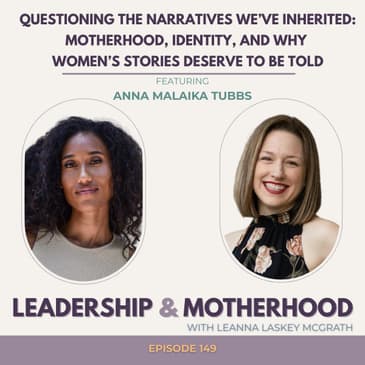
In this powerful and perspective-shifting episode, Leanna Laskey McGrath sits down with Anna Malaika Tubbs, renowned author, speaker, and advocate for examining the narratives that shape how we see ourselves and each other.
Anna shares her global upbringing and how it shaped her understanding of identity, belonging, and cultural storytelling. Together, they explore the importance of elevating voices and histories that have been overlooked or erased (particularly women’s and mother’s stories), and how storytelling can be a tool for connection, healing, and change.
This conversation goes beyond theory and into real life, touching on motherhood, raising children with awareness, and the responsibility we carry as leaders, parents, and individuals to question inherited narratives.
For high-achieving women, executive leaders, and mothers, this episode is both grounding and expansive, an invitation to think more critically, lead more intentionally, and bring more awareness to what stories are shaping our beliefs.
In This Episode, We Discuss:
- How our upbringing shapes the way we see the world
-
The impact of inherited narratives and cultural conditioning
-
Why storytelling matters in leadership, motherhood, and identity
-
Raising children with awareness, empathy, and intentionality
-
The importance of questioning systems and assumptions
-
How curiosity and compassion can create deeper human connection
-
What it means to lead and parent with greater consciousness
Connect with Anna Malaika Tubbs:
Anna Malaika Tubbs Official Website
@annamalaikatubbs on Instagram
Read New York Times Bestseller The Three Mothers: How the Mothers of MLK Jr., Malcolm X, and James Brown Shaped a Nation
Read instant New York Times Bestseller and USA Today National Bestseller Erased: What American Patriarchy Has Hidden From Us
Connect with Leanna Laskey McGrath:
Powered by the WRKdefined Podcast Network.
[00:00:00] The stories that featured women, especially women of color, were erased. We weren't hearing those in our history classes. Most of us were hearing about old white men, and then we were told that they were the only ones who had made any contributions. It was kind of a rare thing if a woman showed up in our texts, especially women of color, anybody who was non-binary. All of these different spectrums of our identity were not represented in our history classes.
[00:00:28] And so I can't blame anybody for saying we didn't like history, especially for the way it was taught in our schools. Welcome to Leadership in Motherhood, the podcast for ambitious, high-achieving women navigating leadership in the boardroom and at home. I'm your host, Leanna Lasky-McGrath, business leader, mom, and certified executive coach.
[00:00:52] I believe that every woman deserves to create a life and career on her own terms, one that she truly loves. This podcast is here to help you do just that. Let's get started. Hi, everyone. Welcome back to the show. Thank you so much for being here today. I have so been looking forward to this conversation, and I'm so excited for you to hear it.
[00:01:18] As someone who is a champion for women and mothers, I often grapple with the fact that we are asking women to take on the burden of investing in ourselves with our own time and money and energy to undo a lot of the damaging narratives that hold us back, like imposter syndrome, mom guilt, people-pleasing, fear of speaking our truths, hesitancy to put ourselves first.
[00:01:45] When those messages have been woven into us by our systems and our societal conditioning. And so I am extremely supportive of the organizations that are doing work to lift up women's voices and mothers' voices and advocate day in and day out to make things better for all women and mothers in a system that was not set up for us. And one of the organizations that I support is Moms First.
[00:02:14] And they had a call a few months back that featured so many inspiring women, some of my heroes like Gloria Steinem and Reshma Sajani. And I left feeling so inspired. And one of the standout speakers for me was Ana Malika Tubbs. And when Ana spoke, I was so moved. And I thought, oh my gosh, I wonder if she would come on the podcast because I have to get her on the podcast.
[00:02:38] So I reached out to her and asked her to come on the show because I started listening to her podcast, Revolution Resolution. I also started reading her second book, Erased. And in both, I was so incredibly impressed with how she is so knowledgeable. She clearly knows so much about this topic and she breaks it down in such a way that it is easy to comprehend.
[00:03:02] And it's also really helpful in better understanding why things are the way they are and the challenges that we're up against and also what we can do about it. I truly believe that this is information that we all should have. Every woman should learn this information. Every human, really, to understand the how and the why behind our systems that were set up by our ancestors centuries ago. And continue to be upheld and maintained.
[00:03:30] Because when it feels like the system's failing us, at least we have some context as to why. As to how the system was built and why it is the way it is. I am so honored that Ana agreed to have this conversation with me. She's working on her third book right now and I absolutely love this conversation and I learned so much and I know that you will too. Ana Malika Tubbs is one of the youngest academics and women in history to hit the New York Times nonfiction list.
[00:03:59] Not just once, but twice. Ana Malika Tubbs is one of the most famous people in history.
[00:04:37] Her second book, Erased What American Patriarchy Has Hidden From Us, came out in May of 2025. Her cultural impact extends across both print and broadcast media. She has been featured on The View, CBS This Morning, and Good Morning America. And her articles have been published by Time Magazine, New York Magazine, Newsweek, and The Guardian. Ana's storytelling also takes form in her talks, including her TED Talk that has been viewed 2 million times,
[00:05:04] as well as the scripted and unscripted screen projects she has in development. She lives in Los Angeles with her husband and their three kids. Welcome, Ana. Thank you so much for having me. It's such an honor to be here. Yeah, it's so great to have you. So great to be talking with you. Thank you so much for being here. Tell us about you. Give us a little bit of your story. We'd love to just get to know you a little bit. Absolutely. So hi, everybody.
[00:05:34] Thank you all for listening to this episode. I'm Ana. I would describe my work as highlighting the stories that others try to bury or erase. I am really passionate about bringing more people together in celebration of our differences and really using the power of the storyteller in a way that is positive. I spent most of my life abroad, growing up abroad nomadically because of my parents' jobs.
[00:06:03] They were both lawyers. They wanted us to see the world as much as we could and to really experience things firsthand. And so they prioritized that. So we grew up, my siblings and I, we grew up in Dubai, Estonia, Sweden, Azerbaijan, Mexico. We moved back and forth visiting Ghana where my dad was from. And then we also spent time in Laramie, Wyoming. I'm in Indiana. And then I came to California for college.
[00:06:32] And so all of those experiences just really, one, exposed me to so many different ways of living and different ways of organizing societies, different cultures, of course. But also made me very, very aware of how powerful stories are and how whole nations are being run and organized by stories and who gets to tell those stories. That's why I became really excited to be somebody who could have that influence,
[00:07:02] but hopefully from a perspective that says who's being left out and how can we correct that? And how does that contribute to a larger conversation about equity and justice? I love that. That is what I get from everything I've heard you say is like, who's telling our stories? What stories are not being told? It's like we're taking so much action and building so many things because of those stories, forming our opinions because of those stories.
[00:07:32] And the way that we are in the world or the way the world is because of those stories. So I think it's so fascinating. And so is this what you always wanted to do when you grew up? I think I've always been a storyteller. My wife used to tell me that I would tell stories about this imaginary friend that I had, but she didn't think that I actually have the imaginary friend. She thought that I just liked to tell the stories that, you know, my siblings and come up with
[00:08:00] these grandiose kind of adventures. If I think back to that, I think I've always liked to entertain people and engage people with storytelling. I always think it's interesting, depending on where we grew up, what kinds of stories we think we can tell. And I say that because I've always been fascinated by film and TV as well. But if you don't live in L.A., if you don't grow up in L.A., for example, or maybe even New York, that seems so kind of far away.
[00:08:28] It seems like this like extraordinary world, right? These creators to screen. And what was more familiar to me was academia because my parents were lawyers. So they had these advanced degrees. There were always these big textbooks in our house. They read a lot. They watched the news a lot. They engaged in conversation a lot. So I think I knew I wanted to tell stories, but the path that made the most sense to me was, OK, I go and get these degrees at school. And that's how I can be a public storyteller.
[00:08:57] And that's why I pursued, of course, my bachelor's and then my master's and then my PhD. And knowing always that it wasn't because I wanted to become a professor right away, but because I wanted to tell people stories about how the world works. And so it's interesting now that we've moved to L.A. We've been here for about five years. My husband and our kids, two of them were born here. I see how my passion for TV and film actually are very possible as well.
[00:09:27] In meeting all these amazing storytellers who do it through this other vehicle, I am now starting to pick that up as well. So it's been really cool to see the trajectory of my storytelling when I was a little kid, really then taking that into my degrees and my pursuit of education and how I was wanting to just learn more about culture and people and how society works, particularly around gender.
[00:09:53] And then now in this kind of next chapter to continue to do my books, but also I'm exploring the role of storytelling on screen as well. Oh, that's so interesting. What made you start with books? Do you love writing or like, what was it about writing and authoring books? Yeah, I do love books. I love writing. I love research. I'm a very proud nerd. School always felt like that opportunity to really hone in on this skill of writing,
[00:10:23] this skill of communicating with people. But what was interesting is that although I'm a proud nerd, and yes, I'm an academic, my bachelor's is in anthropology, my master's is in gender studies, my PhD is in sociology, I've always felt that the way we traditionally communicate in academia is really boring. And really is kind of exclusive, not kind of, very intentionally exclusive.
[00:10:49] And I knew that my style of writing was coming into conflict with what was traditionally accepted in academia. Although I performed very well in school and, you know, I Phi Beta Kappa and I graduated with honors and I did all the things, I was always having to have conversations with my advisors and professors who felt that my work was, quote, too understandable. They wanted me to write in more of this academic jargon.
[00:11:19] And so I also, while knowing I was going to get these degrees in order to write these trade books, I also had to really remind myself what I was there to do in those institutions. And that I didn't want to just replicate what we had always been told was, this is how smart people communicate. I actually find it much more interesting and a much more useful skill when you can take something
[00:11:44] that seems really complicated, that has been filled with jargon, and instead make it something that anybody could understand. And for me, that's following in the tradition of Audre Lorde and Bell Hooks, who were taking these, you know, concepts of race and gender and giving us tools for our survival and for thriving and finding love. And that is what I was much more passionate about. So yes, I've always been interested in that.
[00:12:14] And I think I went to books first because of, yeah, that academic path and the possibility that felt like, okay, I know the steps to get there. Yeah, that is an excellent characterization of how I interpret your work, at least, is that it's very relatable. Like, I'm not a history buff. Like, history was not my favorite subject in school by any means. I was a math nerd. But when I read your writing, I'm like, this is so interesting. Like, how did I never learn this?
[00:12:43] Wait, did I learn this? And I just didn't like history? No, I probably didn't learn this version. Yeah, that's what it is. And that's why so many of us, I mean, I talk to so many, especially women, who will say, I hated history. You know, like, I'm just not a history person. You know, we say that a lot. And the reality is, of course, what we were being taught was history. You know, going back to the storyteller and the power of the storyteller didn't relate to us. And it's largely because the stories that featured women, especially women of color,
[00:13:12] were erased. We weren't hearing those in our history classes. Most of us were hearing about old white men. And then we were told that they were the only ones who had made any contributions. It was kind of a rare thing if a woman showed up in our texts, especially women of color, anybody who was non-binary. You know, all of these different spectrums of our identity were not represented in our history classes. And so I can't blame anybody for saying we didn't like history, especially for the way
[00:13:42] it was taught in our schools. But when we seek the stories that are more representative of all of us, history is fascinating and it's really engaging and it solves a lot of the mysteries. And I think one of the strategies of making women feel like we don't like history was to never see ourselves represented in it and therefore to not seek.
[00:14:07] The people who were constantly, you know, fighting against the things that were still fighting, they didn't want us to have access to those stories. That makes so much sense. I look at now my daughter's in grade school. She hasn't really gotten to like history yet. But when I see some of the things, you know, just like videos for kids and things like that, I think about the stories that are being told. It's very much like, well, this man went and conquered. It's like very violent, but celebratory of the violence.
[00:14:36] And it's not something I enjoy learning about. So that makes so much sense. Yeah, we're not really learning women's stories. And if we are, they're really kind of in more of like supporting roles, right? They're not the main character of the stories. Yeah, very rarely. And I would say that so many scholars, this is the reason they have fought for access to education and having materials available in schools, especially in public schools.
[00:15:05] But this is where that battle comes in and why there is such an attack on books, why book bans are a strategy, why teachers who might be saying, actually, let's tell this story differently, let's include more voices of color, let's include more voices of women, then are seeing consequences, maybe are being reported by other teachers. So all of it is this larger strategy. And that's one of the biggest things that I always want my readers to walk away with is these aren't accidents.
[00:15:35] They're not happening by mistake that we're only hearing these particular stories. It is strategy. So anybody who comes in contact with us, you know, any of these, especially authority figures or however they're seen, it's a part of maintaining a larger system. So we often find ourselves kind of blaming ourselves, even in that statement of I've never liked history. Like it's just a meeting. I wasn't good at history.
[00:16:01] It wasn't designed for us to learn or to thrive in that environment. And that was on purpose. Yeah. As you were saying that, I was just thinking about how that relates to motherhood, especially here in America. It feels like even though we are the ones doing it, we are set up for success, right? It's not designed for us. No. I'm curious what your thoughts are.
[00:16:25] So you wrote a book about three very important mothers whose stories were pretty much not told, pretty much erased from history. So I'd love to hear your take on that and maybe a little bit about like what led you to that work? Because I think that it's so fascinating because no one has ever done it before. Thank you so much. Yes. My first book, my, one of my favorite things to talk about. It's called The Three Mothers, How the Mothers of MLK Jr., Malcolm X, and James Baldwin
[00:16:54] shaped a Nation. And the mother's names are Alberta King, Louise Little, and Burtis Baldwin. Incredible women who all did what their sons later became famous for long before their sons existed. And when I started this project, I, one, was very inspired by my own mom. She was a lawyer. Like I said, she advocated for women's rights in the U.S. as well as abroad, largely why we traveled so much.
[00:17:21] And she always commented on how mothers were treated in the different places that we lived. And she would have these conversations very openly with us. She was very feminist. She was always, you know, calling patriarchy out and specifically how policies supported people differently in each of the countries that we lived. And her theory was that everything could come back to the treatment of mothering.
[00:17:46] And if you lived in a place where mothers were supported and mothers were respected and mothers were honored, you would see really positive ripple effects in terms of health, wellness, happiness, all of these things. But if the country did not honor mothers or protect mothers, and I'm talking about policy here as well as culture, if they didn't appreciate mothers, that you would see kind of opposite
[00:18:12] effects where you would have these kind of cycles of poverty and pain and violence. And really, if you look at nations across the world, my mom's theory really holds. And this may hopefully, I mean, it'll probably come as a surprise to most, but she did not think the United States supported mothers well enough. So we were one of the countries that fell into that second group and that second category.
[00:18:39] And so all that to say, when I was starting my PhD, I knew I was going to do something around this powerful and influential role of mothering. I also was really inspired by Margot Lee Shutterly's book, Hidden Figures, that went out to become this amazing film. It showed how strategic the erasure of Black women's contributions had been. And again, this wasn't a mistake.
[00:19:05] It wasn't an accident that we lost the stories of Black mathematicians who made NASA's missions possible. That was by design. It was left out of history so that we were not aware of the contributions and the intelligence of these Black women. And so I knew I was going to combine my passion for telling the stories of mothers, all mothers generally, with this Hidden Figures project.
[00:19:31] I'm always thinking of how I can connect with the most people and bring the most people to my work, especially around celebrating Black women. And so I'm not the kind of writer who just writes for the sake of the art. I respect the artists who are like that and the creatives who are like that. I'm not that person. I'm always thinking of, okay, this is going to be big and I can really bring a lot of people to this conversation.
[00:19:55] And so it felt like a perfect entry point could be somebody that would feel so obvious to us and then we would feel so shocked that nobody had asked this question before. And we celebrate his birthday, right? Every January around his birthday is January 15th. So that's where our holiday lands. And it's interesting that nobody else had thought of who else was in the room the day that he was born. Yeah. Perhaps the woman who birthed him was there.
[00:20:25] And maybe we should be curious about who she was. And so that was the first part. And then I really wanted to expand that conversation and think about how we would learn even more about her if she was in some kind of conversation with other mothers. So then my next kind of second natural thought was Malcolm X because they're so often put in conversation with each other, these two men.
[00:20:48] And then I decided on James Baldwin's mother because there was this film called I Am Not Your Negro that was based off of James Baldwin's writings. And he said that he was a witness to the lives of his friends, Martin, Malcolm, and Medgar Evers. And then it just felt like this beautiful synchronicity, the fact that all of the mothers of these men were born within five years of each other.
[00:21:15] And then these men, the famous sons, were born also within five years of each other. And I just felt like their conversation was meant to be, that their stories were happening simultaneously, even though the mothers never met each other. But the sons meet some of the mothers, the sons meet each other. So they're intertwined in this really beautiful way. And that's why I chose to write about the three of them. Yeah. We look at these men and we celebrate them, like you said, in January for MLK.
[00:21:45] And there are lots of stories about them. We know lots about them. But their mother is like, why? There's nothing, right? How do you go about when you're researching, because you said you love research, like how do you find anything? Yeah, it was really hard. Yeah. There were two books that I was trying to replicate. And I could give this to my advisor at Cambridge saying, you know, this is what I'm going to do. And these are the two books I'm trying to replicate. One was Hidden Figures, as I mentioned.
[00:22:13] The second one was The Warmth of Other Suns by Isabel Wilkerson. In both, they're talking about three individuals. They're telling these beautiful kind of triple biography stories. And that's what I was trying to replicate. However, in those two books, they were able to interview the people who they are featuring. And my advisor said, so how do you plan to replicate this? You're not interviewing these women. Right. What are you going to do? And I said, okay, I will go step by step.
[00:22:42] I will really dive fully into this in terms of recovering their stories. Because before my book, if you tried to Google these three women, there was virtually nothing out there about them. We can see the day that their sons were born, right? Because, well, we all cared about the sons, but not them. But this is an important part of their timeline, too. We also see when their sons die. And all of the sons die before their mothers do in these cases. And then outside of that, there was just sort of guesses as to when they were born.
[00:23:12] So it was only their lives were only marked by the men in their lives. So I started with that. I kind of put on my walls these kind of timelines where I needed to fill in as many blanks as possible. Then I started with the sons' works. And anything they'd written, anything they'd said, I pulled any mention of their mothers. And the sons did mention their mothers, actually. Not a ton, but they gave me enough to fill in some of the blanks. The sons often were giving credit to their mothers.
[00:23:40] But other scholars were kind of ignoring those parts of the story. Then I talked to academics who had studied the sons and asked if they had any letters or archival data I could use. And several of them did. And they mentioned to me that I was one of the first to ask to see it. Nobody had asked before to see evidence of the mother's lives. So it existed, but no one was asking the question. So they sent me these letters, sent me the archives that I could go through.
[00:24:09] I partnered with historians in the different places that the women lived throughout their lives. They helped me find land deeds, birth certificates, death certificates. Then I partnered with different museums and research centers like the Schomburg. They allowed me to go through their data as well. And then the National Museum of African American Culture in D.C., they have an online database
[00:24:34] where if I couldn't find something specific about the women, I could find something contextually about what was happening during that time. And then my final step was interviewing the family members who were alive, of course. And some of them were very willing to hop on interviews. And others said, no, but I'll share something else with you, a letter or a contact. And I flew to some of the places where the women lived. I flew to Atlanta to interview a couple.
[00:25:03] And then when I got there, they had to answer the phone. Oh, no. That's part of the research process. So then I walked around Atlanta and I visited the home where Alberta birthed her children. And it was her childhood home as well. And where her husband moved in with them when they got married. So it really was me piecing together from scratch. There was one other scholar, Eric McDuffie, who had written an article about Louise Little, Malcolm X's mother. So his work was incredibly helpful.
[00:25:33] And then Jessica Russell had written something about Louise Little as well. But Bertus Baldwin was the least researched of all of them. Alberta had data with the King Center. So I was able to use some of their files. But most of it had never been published. So the book is 90% my original research. Wow. That's amazing. I'm so grateful to you for creating that.
[00:25:59] Because like what an amazing legacy that you've created documenting history that it was documented, but not in any kind of way that anyone could have consumed. That's amazing. Thank you so much. That means a lot to me. Because when we talk about erasure, I experienced it a lot in my own work. Because I'm a Black woman, because I'm young, because I like to take things that feel complicated and communicate them in ways that are accessible. And the book, when you read The Three Mothers, it's similar to Erased, but especially in The Three Mothers,
[00:26:29] because there's these three women that we're getting to know throughout their lives. It can read like a novel, right? And it's one of the biggest compliments I receive is that it flows so beautifully that I think people will often forget that this was my original research. So it, you know, it seems, I think, easy to people now because you can just read the story and it flows. But each paragraph of that book required multiple sources. And so I think quite often people forget the academic that I am and the work that it took for me to produce that.
[00:26:58] So I really appreciate you highlighting it. Thank you. Yeah, my goodness. I'm curious, like, as you're writing that book, or maybe, I'm not sure at what point you had your three children, but now as a mother, how did that impact you? Or like, how do you see parallels in your own experience of motherhood? Yeah. So I started writing the book before I was a mother myself. So I think it's so important, really, that all of us care about motherhood studies,
[00:27:27] highlighting the role of mothers and the policy that we need for mothers, whether we're mothers or not, or ever want to become mothers or not. I think it's really crucial. So in my experience, yes, I had started the research before I became a mom. But while I was writing the book, I was expecting my firstborn. And then the project took on an even deeper meaning in this personal meaning where it felt like everything I was finding,
[00:27:52] this information that I was gathering and recovering the stories of these incredible women, felt like they were also kind of guiding me through my own motherhood journey. And as I was getting closer to him being born. And so I felt like it was all sort of meant to be. And so my motherhood journey is completely intertwined with my research. And it always has been and now always will be.
[00:28:18] Because I was very aware, as you mentioned earlier, some of that violence, I was very aware of how difficult it could be to be a Black mother in the United States. I knew about the maternity crisis. I knew about attacks against Black children. I'd written about mothers who had mourned the loss of their children to police violence. So I was very aware of a lot of the pain.
[00:28:43] But Alberta, Bertis and Louise's lives also taught me that we cannot allow the pain to rob us of the joy and the love and the magic and the transformative and revolutionary power of Black mothering. And I became very aware of the history of Black mothers reclaiming their mothering.
[00:29:08] Because American history has shown us so many examples of attacks against Black motherhood. If we look at times of slavery, this removal of mothers from their children and children from their mothers. Fannie Lou Hamer has this quote where she said, Black women are the only ones whose babies have been separated from them and mothers have been separated from babies. I'm paraphrasing. It's not verbatim. But she talks about how this is a very unique experience for Black women in the United States.
[00:29:38] And therefore, how Black women have always reclaimed that, had to fight for changes in our nation so that their mothering could be protected, that it would be acknowledged and respected as well. And so it felt like I was also joining that legacy of being a mother who was not going to allow pain
[00:30:03] and other attacks to define my life nor my children's life. So yeah, there's so much I could say. It's entirely intertwined. And I'll maybe wrap that part by saying it made me very aware of the strategies against not only Black women, very particularly Black women, but also all mothers in the United States.
[00:30:27] So I knew going into my mothering how strategic it was for mothers to not have support in the United States. There was not policy in place. How strategic it was for us to be exhausted, for us to be blamed for anything that went wrong, but never celebrated for the things that went right. And so I was never fooled by any of that.
[00:30:50] And I also really sought the supports that I needed to make sure that I was going to be as okay as possible. So I looked for doulas. I had home births with my second and third babies because I was just aware of the statistics. I was aware of what was needed for me being as a human being to reduce risk as much as possible. Yeah. And you've talked a few times about the strategic erasure, the strategy behind not having support. So I'd love to hear more about that.
[00:31:20] And that probably leads us into your next book. Yes, exactly. So Erased really came out of, and if I forgot the first part of the question, please do remind me. I started to go on. Erased definitely came out of the three mothers because one, everybody kept asking me, how is it possible that these women were erased? How is it possible that after everything that's been written about these famous sons,
[00:31:45] it took you in 2021 telling us, hey, we've missed a really big piece of this puzzle. And actually, surprise, the men did not pop out of nowhere fully informed. They actually were walking in the footsteps of their mothers. This was so revelatory for people. But really, when we're coming up against that erasure in history and everything we've talked about, that really did feel like so groundbreaking for people for me to show that evidence.
[00:32:13] And so when people would ask me how it was possible that they were erased, I would always say, oh, because of patriarchy? And then I realized, oh, it's because one, I grew up in so many different places that I can see things always from sort of this outside of the fishbowl perspective, no matter where I am. And in the U.S., we really live in this fishbowl. And so people were not aware, really, of the extent of the patriarchy that we experience here.
[00:32:42] So that was one part of it. But the second part of it is, of course, because in that book, I'm talking about motherhood outcomes and how different mothers are treated and how all mothers are being disrespected. There were so many people who felt themselves seen after they'd been erased in their own lives. So many women would talk to me about this and say, this has helped me change the way I'm talking about my legacy with my children,
[00:33:11] the way I see myself and my contributions. And again, you know, why is this happening to us? Why was this so commonplace to make sure that our contributions were not acknowledged and that we weren't supported? That's when I realized, OK, I really need to help people understand the makeup of the United States and how it was formed and why it was formed in this way
[00:33:37] and really do what I do best, which is remove the mystery and make it very clear and obvious to all of us. So that's why I wrote Erased. In Erased, I'm explaining what American patriarchy is, what U.S. American patriarchy is, and really removing that veil that's over a lot of our eyes and also keeping us from getting so distracted by the strategy of telling us, hey, look at all these other patriarchies across the world.
[00:34:07] As Americans, we love to talk about other patriarchies. It's really one of our favorite topics to talk about. Oh, it's so bad for women over there. And I'm not minimizing how bad it is in other places. Patriarchies across the world are not good. I'm not ranking them. I'm not interested in ranking them. They're all bad. But one of the things that's happened in the U.S. is the strategy of telling us, well, at least you're not over there. So we don't really pay that much attention to how we are being oppressed here.
[00:34:35] And I remember even as a teenager coming back to the United States and realizing, wow, everyone's really tricked here into thinking that we're so progressive and we've made it so far. And we really haven't. And I could see it very clearly. So I'll give you my definition of American patriarchy and why that relates to mothering. In the U.S., when the Founding Fathers won the Revolutionary War, they were the underdogs. Nobody was expecting this to happen.
[00:35:05] There are about 10 years that passed between the Revolutionary War and the writing of the Constitution. And in those 10 years, there's all kinds of rebellions. There's slave revolts. There's women are fighting for their rights to vote. They're asking the Founding Fathers to pay more attention to them. And then you also have poor people, particularly Shays' Rebellion is an example of this. There's poor farmers who are rebelling and saying we need to be treated more fairly in this new nation.
[00:35:33] These rebellions actually cause a lot of fear for the Founding Fathers. They do not want to lose power in the country that they had just fought for and won in this epic war. And so instead of saying let's kind of lean into the fact that rebellions are maybe good to keep us hearing the people, they want to silence them. And they want to make sure that power is kept in their hands. And this is not a controversial statement.
[00:36:02] This is not honest opinions. This is well documented. They go into the convention saying we need to define who gets to have power here. And so in the Constitution, they are defining that men get to have power. Men get to vote. Men get to own land. And then they say, women, we are ignoring you on purpose. We are building a republic of men. And they tell the women in their lives via letters that they are not supposed to vote.
[00:36:30] They are not supposed to participate politically. They shouldn't even voice their political opinions. But instead, all they can do is reproduce the power of men through children. So it's not even, wow, this is an honorable thing. It's just more so that's all you're supposed to do. So just get used to that. And that's the role you're supposed to play. So we define this binary in the United States based off the Constitution. Who's man? Who's woman? We're leaving out anybody who doesn't fit the gender binary.
[00:36:57] But we're also leaving out people who are enslaved. The Constitution protects slavery. So people who are enslaved are not counted in this gendered hierarchy. We're leaving out indigenous people. There's writing about how indigenous people are a part of some other country and they're not a part of this country, nor are they protected by this country. And the founding fathers were invested in leaving out poor people. So they had states decide if men who didn't own land would be able to vote.
[00:37:26] So all of that is just fact. This is American patriarchy. That two groups are acknowledged, but one is suppressed. So it's white elite men are acknowledged. White women are suppressed. But they're at least seen in American patriarchy. Everybody else is seen as less than human. But they're told if you assimilate to American patriarchy and if you do your part in protecting this made-up hierarchy,
[00:37:56] then maybe someday you'll have access to what it means to be human, what it means to have rights in this nation. And that is where all of our systems emerged from, all of our laws emerged from. So we're still experiencing it to this day because our country is only 250 years old. That's not very old when you look at the grand scheme of nations across the world. We're a pretty young country.
[00:38:23] So all of our history is recent history. And that's why mothering has become and has always been so controlled in the United States. It was not supposed to be for women to be honored or protected. It was simply for women to reproduce the power of men through children. This is why a fetus has more power in the United States than a woman carrying that child.
[00:38:53] Because the power is the child, not the woman carrying it. And so it comes into all of our policies. And that doesn't negate the progress that we've made, those who have fought against this notion of American patriarchy. But that, I'll leave it there for now, is the foundation of this nation. That original social order is what the founding fathers intended. I really appreciate that explanation.
[00:39:21] And I think one of the things that when we were on that mom's first call that you said that really, really just made so much sense to me was that there has always been a group of people who are committed to upholding. Yes. That and like believe that that is the way it should be and we should continue that. And there's always been a group of people who disagree and are fighting for progressing and evolving beyond that. Definitely.
[00:39:49] So the way I summarize so much of American history, because truly it is that simple. You know, there's some people like, it can't be that simple. And I say, give me an example that denies what I just said, that doesn't fit into what I just said. Because it all can be summarized by this tug of war that you're mentioning. There has been a group of people who always wanted to maintain that original social order. We understand the social order now. Okay. You know, white men, elite, they get to have rights. White women reproduce that power.
[00:40:19] Everyone else is less than human. That's the simple social order. But then there's this group of people who said, you're calling that democracy, but that isn't democracy. Because democracy means that power is vested in the people, all of the people of a nation. And so in order to get to an actual democracy, we need to all be acknowledged as people here who have the same rights.
[00:40:45] So if the Constitution uses the language person, but you're defining person in this limited way, we on this other side are saying we are all people. So what would it look like if our Constitution actually included every single person in the United States? And that is what we've been fighting for.
[00:41:07] And so progress in the U.S. has never come because the group that wanted the original social order to stay in place decided out of nowhere, now we're going to include more people. Today, I'm changing my mind.
[00:41:48] Black people getting the right to vote. Slavery ending in the United States. It's been because it was fought for and people bled for that. And they claimed that with their hands. And all of our history comes back to this tug of war. Whenever there was progress, whenever there were more people who were going to be included in that vision, those who wanted to return to the original social order respond.
[00:42:16] And we go back and forth throughout American history in this way. So we actually don't experience linear progress in the United States. Linear would mean you get a win and then it's guaranteed and it stays there. That's never been the case. It's actually been we get a win. Someone tries to pull us back. We get a win. Someone tries to pull us back. Roe v. Wade is an example of this. Even if that wasn't, you know, what we still needed more than Roe v. Wade always.
[00:42:45] But it was a win. And then there's this response to pull it back. It wasn't ever going to be guaranteed. So what's happening really is trending. More people are seeing that that original social order didn't serve them, even if they thought at one point that it did. So we're seeing more people identifying as being part of the second group, saying, actually, all of us are being hurt by that original social order that was made up.
[00:43:15] And that kept all of us from being fully human. Even if we were given power in it, it requires those with power to dehumanize others around them. It requires them to dominate in order to be seen as successful. It requires them to engage in really weird and violent practices. Right. We're seeing this with the Epstein files as an example.
[00:43:38] So those who are realizing that's not what it is to be human are also then also moving over to this other side. And that's why the response has been so aggressive in these recent years, because the side for progress and actual democracy is getting stronger every year. I love the idea of that. And then why did we have our current election results? Right. Like where we are now?
[00:44:05] Because I remember in Erased, you talked about that it was no surprise to you kind of what happened there. But if more people are really seeing themselves outside of this social order and wanting to progress and move our society forward, why aren't they voting that way? Honestly, my theory is on a national level, there are more people that fall in this second group of we are going to fight for an actual democracy.
[00:44:31] But we have to acknowledge that we don't live in a nation where like voting is mandatory, for example. So we're not actually seeing the real representation of what people want. We also live in a nation where the Electoral College exists. We live in a representative democracy. It's not actually a people's democracy. The way it was set up has been there was these kind of regulations put in place to make it so that groups of people, a majority actually couldn't win.
[00:45:00] It was going to come down to numbers that meant still power for that original social order. So first and foremost, I actually think most people in the United States do fall on this side, even when we're seeing election results that would say differently, because the way it is currently set up, our voices are not accurately being represented. That is even without thinking of all of the restrictions that are in place.
[00:45:28] And whether it's gerrymandering, redlining, et cetera, whether it's telling people in Georgia, if you give somebody water while they're in line to vote, you've committed a crime. That's when we get to the next level of we are being kept from being hurt. But then we get into those who should see themselves as being part of the second group, but who still don't.
[00:45:51] And this is when coming back to the original social order is really important, because one of the biggest questions we come out of these elections with, especially around President Trump, is why are white women voting for him? Why? But if you remember that the original social order, while it does suppress white women, it puts them proximate to white men. It actually isn't always the case that white women see it as voting against their own interests if they're voting for him.
[00:46:21] In many ways, they see it as protecting their interests and protecting their children and their place in the social order. So there's a lot of layers for why that's happening, even though this other side is getting much stronger, in my opinion. It's that we have barriers to voting. We are in a representative democracy because of the Electoral College.
[00:46:43] So we've seen that multiple times where the majority voted differently, but the Electoral College results go to the candidate that the people did not want. And then you have many people who should eventually see themselves on the other side, but who still see themselves as wanting to protect it. The last thing I'll say, and this is a complete theory, I have no science or research behind this.
[00:47:04] But I do think, especially while there are so many positives of mail-in voting, and I am an advocate for it, I think a lot of white women are not filling out their own ballots by any means. I think that their husbands take those ballots and fill them out. So I don't think actually those women are even, whether they would vote differently or not, I don't think they're even voting, if I'm being completely honest.
[00:47:30] I think it makes it really easy in those situations for that white man to have two votes. Yeah. Well, I like that theory much better than that we're voting against our own interests. But some people are. That's still part of my theory. I'm sure it's a bit of both. Yeah. Why is it advantageous to not support mothers? Why is it advantageous to the current social order to keep mothers exhausted and blamed but not celebrated and, you know, those kinds of things?
[00:47:59] Like, why is that? Yes. So first, I will always say sexism, racism. It's never because they're logical, really, right? It's not because it's what will help us all progress as a nation to keep many of us handicapped. It's not, you know, it's not like that kind of level of strategy. Yeah. But more so the strategy of how do you maintain a social order that was based off of insecurity and fear.
[00:48:28] So if we're trying to maintain the social order that says we, this particular group of men, need to maintain power. But you know you actually can't exist without women birthing you. Then you need to make sure that those who actually have the power are completely unaware of it. And you need to start that as soon as they're born in order to control them.
[00:48:55] So the power control and power grab over mothers doesn't begin when a woman is pregnant. It begins when a girl is born. And she's told, nope, you don't get to do the same things that boys get to do. And your natural place in this world is to be submissive, right? So this is when religion becomes really important as a tool in so many households of patriarchy. I don't think religion caused patriarchy personally.
[00:49:24] I think that patriarchy uses religion. And telling them once they have their period, for example, this statement of, you know, I can reproduce life. That really is what menstruation tells us to make it seem gross, make it seem like something they have to hide. Don't tell us any of these things. And certainly don't let us know if you're in any pain because we don't care. We're going to delay any care for you, right? Just endure this.
[00:49:53] This is what you're supposed to do. And then it continues. I mean, even, you know, in what we're allowed to be educated in and telling girls, for example, if we go back to Hidden Figures, women aren't scientists. Women aren't mathematicians. You don't know. Can you find a story? Can you find an example in history? We didn't think so. Right? Like that's the strategy. And then, so once we get into finally, okay, now I'm expecting a child.
[00:50:19] You're going into a system that was based off of, in the United States, men wanting to enter something that didn't previously include them. So in Erased, I have a whole section about obstetrics and gynecology and the erasure of the midwife and the vilifying of the midwife so that men could control women's bodies.
[00:50:41] Men who believed that the process of pregnancy and birth were actually damaging and were hurting the baby and were hurting the mother and that they wanted to take over that process. So I talk about the Twilight Method in the book and how there was this period of time in the United States where women were told the best way for you to deliver is for you to be drugged, unconscious, and to not remember what happened to you.
[00:51:09] And so they were being drugged. And it later comes out that while they're in labor, they're moving all over the place. They're thrashing all over the place. They have bruises over their bodies. Their babies are born in a drugged state. And it's not revealed till later when some nurses decide, actually, this shouldn't be happening. So that's control. And we're told then as women, make sure you listen to the authorities in your life. You don't know what's best for you. Your intuition is wrong.
[00:51:38] Your body is ours to control, not yours. And again, this baby has more power than you do. So it doesn't serve us in terms of health, wellness, right? We have mothers dying in the United States. Black mothers disproportionately. All mothers of all backgrounds dying. Preventable deaths. So it doesn't make sense for us in that logical way.
[00:52:05] It doesn't make sense in terms of protecting this original social order. And the answer is yes, it does. Yes. So as we're talking about birthing and children, I think one of the quotes that I heard you say, so powerful, you quoted someone else and you said, every time a child is born, the world begins again. And I think about that as hopeful.
[00:52:29] Because I think whenever I am hearing about, oh, our society actually wasn't set up for me to thrive. Right. And as a mother, like there are actual reasons why our culture and society doesn't support us. And so to me, it's like, oh man, that feels a bit disheartening because it's like there's more that we're fighting against that we maybe didn't even realize.
[00:52:56] But whenever I hear you say about like every time a child is born, the world begins again, I think about hope. And so I'd love to hear your thoughts about like, where is there hope here? How can we make it better than what it is? And also love to hear because you've lived in so many different places, what it looks like in other countries. Because I think it makes so much sense when you said like you came in in high school and, you know, it's like the fishbowl. You don't realize you're in the water.
[00:53:24] We don't always know what we don't know or what we haven't seen. And you have such an interesting viewpoint and an interesting lens. So like, what could it look like? What is possible? Yeah. Give us some hope, Anna. Well, first I'll say that quote is from June Jordan. I always paraphrase it. And then when I look it up, I'm like, okay, I'm going to remember it. But basically the concept is every time a child is born, the world begins again.
[00:53:52] And I'll also say I'm an extremely hopeful person. Everyone always feels like, especially in my talks and in person, I get this question of how are you so energetic and still so happy when you know how horrible all of this is. That's exactly why I actually am still really hopeful is because I'm very aware of how made up it is. It's made up. It's all made up. And so we can always live differently.
[00:54:17] And I'll say, too, that when I talked about Black women and mothering in the United States and how it's been attacked from the foundation and before when the monarchy was here, even when the law says something like you are not human and your children are not human. They are somebody else's property. Black women never said, oh, well, if the law says it, it must be true.
[00:54:42] Like, no, in that case, Black women say, well, that is BS. And I will not bow down to that. I won't accept that. And I will fight for my right to live with joy and love and celebration.
[00:55:00] And when you see throughout Black history, you always see these moments of incredible resilience, beauty, strength, happiness, creating things out of nothing, making the best recipes out of the scraps, making the best music out of the rhythms that they remember from their homes.
[00:55:21] Those song, all the things that still inspire so much of our American culture and world culture come from the joy and the refusal to accept what is made up in the United States. So that is what I'm infused with is this notion of, well, it's all made up and we need more people to feel this way.
[00:55:43] So that first and foremost, when these rules are in place, and especially with our current administration, when they're throwing more things out there, I'm not minimizing the dangers. I'm not minimizing the consequences because that's a part of this fight. That's a part of them maintaining this made up thing. In order to make something that is made up seem real and seem divine and seem like the natural order, you have to erase evidence of anything else and do it very viciously.
[00:56:11] You have to punish those who can see things very clearly. All of that is a part of the strategy. However, it doesn't mean that in our own minds, in our own lives, we have to every single day live confined by it, actually. We have to really be able to liberate our thought to say, it's made up and I need to fight against it. And I need to be a participant in making this country one that includes all of us.
[00:56:41] One that will someday respect the role of mothers. One that will someday have policy in place that protects us. The only way we get to that progress is by people believing that these rules are malleable and they can be changed and that they were man-made, meaning we can shift them. They're not the natural order. They are not divine.
[00:57:07] We can do something about it that we have to first and foremost have that resolve. And that kind of resolve is hope. Because without hope, you won't believe that those things can change. Pessimism is saying, well, I guess we're stuck here. Pessimism is like a crazy person saying, oh, my kid is property. Well, I guess that is what it is. Right? So those who have pessimism, it's because they've had privilege. It's because the rule as it's written, even if it causes some hurt, isn't so bad.
[00:57:37] That's privilege. Those who have hope always, it's because that doesn't serve me at all. I am in danger every day. My child is in danger every day. So we need those who are maybe close enough to some of the comfort of it to really shift their minds into, I have to believe that we will one day and one day soon get close to that progress.
[00:58:00] And I'll say that one example of how we find hope right now, and I think I would recommend the three mothers as where to start if you're really like, how do I find hope in all of this? Because these three women were born between 1897 and 1902.
[00:58:19] They were Black women who were alive when Jim Crow is the law of the land, where lynchings are commonplace, where there are two world wars that take place. The Great Depression takes place. They have their children during the Great Depression. They are participating in their own civil rights movement in their own ways. They're all activists in their own ways.
[00:58:46] They inspire their children to participate in arguably the most famous civil rights movement in world history. They become the leaders of it, some of the leaders alongside their female counterparts, of course. They fight for the right for Black people to vote and for so many others in the civil rights movement to get the protections that they deserve to be seen as human beings. They live long enough. Two of them live long enough to see the first episodes of the Oprah Winfrey Show.
[00:59:13] One of them lives long enough to maybe hear about an Illinois state senator named Barack Obama. So on one hand, Burtis Baldwin, for example, her life overlaps with Harriet Tubman. And on the other hand, her life overlaps with me. That is the hope, right? They had to fight for that. It didn't just happen. It's because they participated in getting there.
[00:59:40] Things that would have seemed impossible when they were little girls. They had to believe we can do it. We can get there. So that's why I'm always hopeful. We absolutely can do this. And in fact, we must. We must do this. And right now, when so many people are saying things like, this is the worst it's ever been. We don't know what to do. In the United States, how is this happening?
[01:00:08] Okay, guys, we need more of you to study history. Okay, because again, we're not minimizing how horrible a lot of the tactics are right now. But these are being recycled. This is not the worst we've ever seen in American history. It may be in your very privileged, wonderful life. You know, for readers, I'm not saying you directly, for a lot of people. If that's the case, well, you know, congratulations. You've lived a really comfortable life.
[01:00:36] But now we need you to do some research and understand how we've come out of these moments before. And we need you to take your side in the tug of war and do what you're going to do to pull on the road. I love it. A great place to start is by reading your books. Thank you. Listening to your podcast. Because I think, you know, like we talked about before, I think that you break it down so well and so eloquently.
[01:01:00] And so, like, it's so consumable, right, for us to understand why this is so important to all of us and to our future and to our children. Yes. All of the things that are coming out, particularly around the Epstein files. If people don't understand yet, if people don't understand yet how pressing this fight against patriarchy is.
[01:01:21] But they're still shocked by the results of the system that treat women and girls as property, that take their bodies as objects. This is not random. So when you're not participating, that's what you're helping to maintain. That's not separate of this. That is the direct result of that original social order that says some men get power and control over others.
[01:01:51] Versus we all have rights. We all have power. We all get to make choices that work for us. So I think a lot of people feel like they can be neutral or they don't have to be involved. But if that's what you're choosing, you are saying, this is okay. It's okay by me. Yeah. There's no problem with the status quo. So let's just keep it as it is. Yeah. Is there anything else that you would like to share that I haven't asked you?
[01:02:21] I feel like we could just talk for hours. Yeah. You asked so many amazing questions. I would say I started to handle a little bit about what I'm writing about next. But it really does come from this notion of so many people right now saying, we've never been here before. We don't know what to do. So I'm writing a book about strategies of oppression in the U.S. and how they're being recycled. I'm particularly going to be talking about ICE.
[01:02:46] But then I'm also going to be talking about strategies of resistance and how we fight and how people have fought in the past, particularly by highlighting a group of women who were formerly incarcerated and were able to fight for their freedom and who have known that they've been up against this monster since they were little girls. And they're very aware of the strategies. So we're going to learn from them while also taking ICE as an example of something that is not brand new,
[01:03:15] but is a direct result, again, of a social order that needs to police some people in order to maintain itself. Yeah. And when? It's supposed to come on 27. Okay. Is there anything that you know that you could tell us right now that would be something that would be helpful for us? I think a lot of times it's like, well, what can I do? What should I do if I disagree with the current social order? What do I do? Yeah. I always bring it down into different levels.
[01:03:44] So first, and not that these levels have to happen in an order. They can always be happening simultaneously. In fact, I think that's kind of what we should be doing in our whole life, actually, is for all four of these levels to take place. But the first one is on an individual level. And I talk a lot about it in the book, how we're telling ourselves what we're supposed to do. Are we supposed to be silent? Do we think we're supposed to be in the background? Do I think I'm supposed to serve the men in my life as men? Do they think they're supposed to dominate?
[01:04:14] And why have they been taught this? And why aren't they comfortable with women's voices? And why aren't we acknowledging people outside of the binary? So that's very like a personal work of, you know, therapy, healing, trying to reclaim maybe sort of ancestral practices, etc. There's a lot you can do personally. On the second level, it's interpersonally in our relationships. Are we replicating hierarchy and domination?
[01:04:37] Or are we trying to make sure that those who are in relationship with us have equal representation in that relationship? That's with parenting. That's in our romantic relationships and our friendships. Really making sure that how we interact with others is anti this status quo. The third part is on a community level.
[01:05:01] And in a lot of ways, this is kind of the most important one because we don't see epic changes happen first on national levels ever. That's never how it works. It's always that we first see it on a community level. So if we think of rainbow coalitions in American history and people meeting each other's needs before the country does.
[01:05:23] So if, for example, we have a problem with child care in the United States and it's not provided, you see groups of people coming together in their communities saying, hey, I'll take all of our kids on Monday. Community solutions. Having a giving table in the middle of a neighborhood where people can put food and can exchange with each other without money being involved, without any questions being involved. So anytime we're thinking of how could we live differently, always been examples of that.
[01:05:50] So always there's been people who have known it was made up so they find other ways to meet each other's needs, right? The Black Panther Party, bringing in free health care for their members, making sure all children had breakfast in the morning for their members. So that can always happen. You don't have to wait for the country to shift. You can see what it is that you think would be a part of a new nation that is more democratic and more representative of all of us. You can bring that to your community.
[01:06:19] It's where a lot of the best nonprofits have come from. It's like that idea that something is missing. So I'm just going to provide it before it becomes national policy. And then is the national level. The question of what are you voting for? Who are you voting for? What policies are you advocating for? Are you running for office? That's awesome. We absolutely need more people to run for office who see themselves as a part of this second group. And that's when we see it.
[01:06:44] So when, for instance, let's take Reshma as an example, since she's the one that brought us together through that amazing event. And she recognizes in her own life that child care is an issue in the United States. That in other countries, this is different. That you have some countries where you have two years of paid leave and then you have affordable child care for all, quality child care for all.
[01:07:07] And how much of a difference that would make for our ability as mothers to provide for our children with even our love and energy because we're not exhausted and to continue to pursue our passions. Right. And so then she has all these people she's organizing and bringing together and the influence she's had now on even what we're seeing different state levels where New Mexico now is child care for all, where we're seeing it in New York.
[01:07:34] So her and all those voices that have been advocating for this, that have been organizing for this, we're seeing those results. And eventually we will see them on a national level so long as we participate in fighting for them. Yeah, I love that. That's so helpful. I remember being on a call and someone said, the thing that keeps us from making any change is the myth of inevitability.
[01:08:00] That, you know, we just believe like, well, this is what's going to happen is going to happen. And it's, you know, there's this train moving and I can't do anything about it. And so I love not thinking that way. Yeah. I mean, and the thing is, sadly, even those who do think that way, who are like, oh, well, it's never going to happen. And then they benefit from the people who didn't give up. You know, so hopefully more people can just say, let me just be part of claiming it. Right.
[01:08:28] We always just have to think we've had so many examples throughout history where, of course, a lot of people probably said, that's not going to happen. That's never going to happen. Right. Oh, it's not going to happen. And then when it happens, they are still able to participate in the benefit of that. So, you know, one example in American history would be, we're never going to see a black president. That's a perfect example of it. But of course, we did.
[01:08:53] All the things that I want to see happen, I have to believe they can. And I have the advantage of having seen that operate in so many places abroad. So it actually doesn't feel like this made up. No one's ever seen that before. It's just, we catch up as a nation. That's right. Yeah, you have to believe it before it can ever be possible. Yeah. Oh my gosh, Anna. I have loved this conversation so much. Thank you so, so much for being here.
[01:09:22] Thank you so much for your work. And I just think it's amazing that you're pulling all this together, that you're doing all this work and that you're sharing it with the world. And so I wish you all the best. And I hope that everyone goes out and reads your books. Tell us where we can find you. Tell us about your podcast and how people can interact with you. Thank you so much for highlighting my work and having me and taking the time and for all the amazing questions. I appreciate it so much. All my stuff is just my name.
[01:09:49] So on Instagram, Anna Malika Tubbs. And then my website is annamalikatubbs.com. If you don't know how to spell that, you can just look up Erased or The Three Mothers. And you'll see my name. I started this podcast called The Revolution Resolution for January and just for this year of 2026 as we're getting close to celebrating the 250th of the Declaration of Independence.
[01:10:11] Because I really wanted to give people another opportunity to go through this material, but to break it down in five-minute chunks twice a week.
[01:10:23] Because even though I communicate in a way that is so purposefully accessible, the kinds of things I talk about have traditionally been so inaccessible that you have folks who might not open the book because they're worried about the word patriarchy, right?
[01:10:44] Or they're worried that it's going to be too academic or too pessimistic or it's not going to give them the hope and they don't want to engage in something, you know, that's heavy like that. And so the podcast gives us that opportunity to just break it down.
[01:11:02] You see the kind of style in which I communicate and also why I'm doing it so that we can take it one step at a time and have this kind of personal transformation that leads us to understanding that there is so much hope so long as we know what we're up against and we're willing to fight it. I love it. Yeah, I started listening to your podcast and then I sent it to everyone I know. Oh, thank you so much. Go listen to Anna's podcast and read her books. Thank you again so much for being here, Anna.
[01:11:32] And thank you so much to everyone for tuning in today. And we will see you all next week. Thank you so much for listening to Leadership in Motherhood. I genuinely hope you're walking away with something helpful that will positively impact your life. If this podcast resonates with you, it would mean the world to me if you'd support the show by leaving a five-star rating on Apple or Spotify, sharing an episode you love with someone you care about and or by following the show. I hope you'll join me again next week.
[01:12:02] And until then, I'm wishing you all the best in this season of your one and only precious life.
Sponsors
