
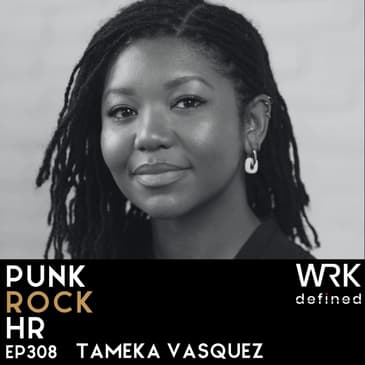
Tameka Vasquez grew up in tech, where moving fast and breaking things was gospel. Then she started working with leaders outside that world and realized the gospel didn't travel. Most leaders, she found, are only equipped for change they've already seen. Everything else gets met with fear.
That's the gap she has spent her career trying to close. Not by predicting the future, but by changing how leaders relate to it. Her framework, SHIFT™, treats the future as a verb. Something you do, not somewhere you arrive. The goal isn't certainty. The goal is building enough capacity to lead when nothing is certain.
If you're tired of the inevitability narrative, the one that says the future is already decided and your job is just to comply, this conversation is for you.
In this episode, you'll hear:
-
How growing up in tech shaped Tameka's assumptions about change, and what working in slower-moving industries taught her about how rare those assumptions are
-
The story of her Guyanese heritage and why multigenerational survival in precarious conditions is the personal foundation underneath all of her professional work
-
Why she no longer tries to clear a credentials bar that keeps moving, and what she says instead when someone asks what qualifies her
-
A full walkthrough of the SHIFT™ framework and why she calls it a practice rather than a program
-
The false binary between being first and getting left behind, and why the whole spectrum in between is where most real strategy lives
-
Her argument that discomfort with inevitability is a more honest starting point than certainty, and why she works with that discomfort rather than around it
-
Why outsourcing critical thinking to institutions and thought leaders is cultural laziness, and what leaders actually need to do instead
Powered by the WRKdefined Podcast Network.
[00:00:00] Hey everybody, breaking news about Intuit QuickBooks Payroll. They've evolved into QuickBooks Workforce. And it matters if you run a business or you're the person managing payroll and HR. It's no surprise that owners and HR leaders like you spend half their week playing detective. QuickBooks Workforce gets you out of that mess. It's an all-in-one command center that pulls HR, time, benefits, and workforce data into one connected dashboard fully integrated with QuickBooks Accounting.
[00:00:30] You can automate the routine stuff without losing control. Spend less time reconciling and more time acting. Turn workforce data into clear business insights and stay ahead of compliance and labor costs. Move from reactive to proactive. Make the switch today to QuickBooks Workforce at quickbooks.com forward slash workforce. That's quickbooks.com forward slash workforce.
[00:00:53] RepCap is proud to support Punk Rock HR. We're B2B content marketing consultants that combine a journalist curiosity with a marketer's creativity to tell clear human stories that connect. From strategy to execution, we partner with brands to turn ideas into thought leadership and get real results. Want to learn more? Head over to RepCap.com.
[00:01:17] We just don't collectively have a capacity in much of Western culture to think about the future without fear. And so a lot of what I care about professionally is, yeah, I do strategy work. Of course, I'm going to help us think about what's the path forward and what do we do next?
[00:01:35] But what I really care about is, like, do you have the capacity to lead when it's unknown? And do you have a desire to look at the uncertainties that are just part of the human experience as a space of possibility? Hey, everybody. I'm Lori Rudiman. Welcome to Punk Rock HR.
[00:01:57] My guest today is Tamika Vasquez. She's a futurist and advisor, and she works with leaders like you who are shaping the next era of work. But those leaders she works with, they're doing it purposely. Tamika is a really great guest today because she's showing leaders different ways to think, decide, and communicate in this crazy and disruptive world. And she's doing it without buzzwords and with a lot of humanity.
[00:02:25] I met Tamika at a conference, and I immediately just fell in love with her energy and her big ideas. We had a terrific conversation. And at the end of it, I said, you ought to be a guest on Punk Rock HR. And ladies and gentlemen, that's what we're doing today. So if you want to learn from someone new, someone who may not be in your network, but has a really interesting take on what leaders ought to be thinking and doing in just uncertain times,
[00:02:51] well, sit back and enjoy my conversation with Tamika Vasquez on this week's Punk Rock HR. Tamika, welcome to the podcast. Thank you so much, Lori. I'm so happy to have you here. You know, we met in a suburb of Philly, and you had big ideas, big energy, and a real passion about the future of work.
[00:03:20] And we're going to cover all of that today. But before we get started, can you tell everybody who you are and what you're all about? I'm Tamika Vasquez. I am all about how we shape our visions for the future and what that means for what we choose to do with our lives every day. There are so many reasons for that, but that is what I'm all about, is how we are going to lead ourselves into the next era, the next world. I love it. Well, we can go a lot of different ways.
[00:03:49] Why don't we talk about why you do what you do? I'd like to get started there because I think it informs the conversation about your really meaty and interesting body of work. So why did you pick this? You could do anything. I could do almost anything. I mean, there are so many reasons, but I'll dissect it into two major categories. There's professionally why I do it. It's because I grew up in the tech industry.
[00:04:17] And that is an industry that believes in this ethos of moving fast and breaking things and not waiting for permission. And I thought that's how work operated. I thought that's how the world of business operated. And I had no idea that that is rare and that that is not necessarily an ethos that carries us in a healthy way into new futures. And so because I grew up in that industry, that was my point of reference.
[00:04:46] And when I started my practice and I started working with leaders that were outside of tech industries that move slowly, where there are bigger consequences, where people are very tethered to the status quo in many ways. It gave me a lot of empathy for the fact that change is very hard and that leaders are equipped as long as they've seen it before, as long as it mirrors things that they've already experienced.
[00:05:15] They're equipped as long as there's no real fuzziness about the future. And I think a lot of what I realize is like, we just don't collectively have a capacity in much of Western culture to think about the future without fear. And so a lot of what I care about professionally is, yeah, I do strategy work. Of course, I'm going to help us think about what's the path forward and what do we do next?
[00:05:42] But what I really care about is like, do you have the capacity to lead when it's unknown? And do you have a desire to look at the uncertainties that are just part of the human experience as a space of possibility?
[00:05:57] So professionally, I took everything I learned from tech, you know, being a good strategist, being a good marketer, being a good storyteller, and just tried to bring it to industries where I feel like there's some real structural futuring happening in spaces like real estate, like finance, like manufacturing. There are lots of industries that I've worked with outside of tech that have really just given me a perspective.
[00:06:25] Well, Tamika, that's really interesting because I can hear your professional commitment to really reshaping and rethinking the future of work and guaranteeing different outcomes as well. And we can talk about all that. But I want to talk about why you do what you do personally, because you indicated there's a personal component here. So what's that all about? Yeah, I mean, personally, I have a very romanticized view of my culture and my upbringing. So my family is from a country called Guyana.
[00:06:53] It's in South America, wedged between Venezuela and Suriname. And it's an interesting country because it's the only English-speaking country in South America. And a lot of people just don't know about it. So when I look at a very high level, the history of a country like that, what you have are people who are coming from so many different walks of life and are being forced to coexist in a country.
[00:07:18] So you had people come from South Asia as indentured servants. You had people come from West African tribes as who were enslaved through the transatlantic slave trade. You have people who were native to that land. So we had probably 10 indigenous tribes that were native to the land. You have folks coming in from China as farmers and a whole consortium of other people along the way.
[00:07:43] And so when I think about the way I'm even able to exist in the world, a lot of it is grounded in this idea that people had to figure things out. And they had to make things happen in very precarious situations. But you have all of these people that have coexisted on this land for generations. And so I think about how they were able to do that.
[00:08:07] And I can't pretend that, you know, I could relate to any of it or that I could even fathom what that must have been like. Just the degree of struggle that held over the course of generations. But what I do understand and what I value very closely is they work towards an outcome that was bigger than themselves. And collectively, they were able to shape what I know is my country, my culture, my heritage and upbringing.
[00:08:35] And that stuff doesn't happen without real intentional work. And it doesn't happen without real intentional leadership at varying levels. So it's my story, but it fully intersects as well with so much of what I care about in the professional context as well. Well, I'm really glad you shared your professional and your personal drivers to do the work. Now, let's talk about the work exactly that you do. You know, I have a lot of consultants who come on who are like you that are adjacent to the HR space.
[00:09:05] And I ask them what they do and they give me a litany of buzzwords. And I'm like, how do you make money? So like, what do you do? What do you do? And I guess I'm asking, like, how do you pay your bills? How I pay my bills? That is a continually difficult question. But the cool thing about being a practitioner who leans towards like creative approaches is there are a variety of ways that I'm able to just be of service to leaders who are trying to figure out
[00:09:32] what on earth to do in this period of time that we live in. Like this era in human history is a blip in time, but it's our blip. And so many of us are just trying to create a meaningful experience for ourselves, for people who are working under us in organizations, for the industries that we're part of. And so a lot of what my work is tied to are basically how do we create a path forward?
[00:09:56] And sometimes that looks like me facilitating conversations between stakeholders who maybe share a vision for the future, but maybe they don't agree exactly on how to get there. Sometimes that looks like strategy work where we're trying to figure out, okay, you just went through all of this crazy change. And now you are sitting at the cusp of something new, but it requires a bit of tending and a bit of care.
[00:10:22] Like how do we actually put things in place so that what is shaping on the other side of a lot of change is as close to what you intend as possible. A lot of the times it also looks like speaking and showing up to educate people on this verb of futuring. I think of the future as a verb. It's a thing we're alive to do. We get to do. And so a lot of people don't necessarily know that, you know, foresight is a practice of how we look ahead,
[00:10:52] how we anticipate change. We certainly can't predict, but you can start to actually gain a skill set around how to sense what's emerging and then how to position the work that you do to really be at the forefront of where the world is heading in many ways. And so my work shows up in many different ways. And I'm grateful for that because variety is good for my brain, but it's also necessary for where we are.
[00:11:18] Like so much of what I thought I knew about strategy got put to the test when you're in a situation where, you know, you're sort of at the end of one set of norms and you're kind of looking at the leader with hope that maybe they have some context, some answers, some things that we can play with. But what you realize more and more is the strategy that you're working in is a set of unknowns. And if you're okay with that ambiguity, and if you know how to hold that complexity,
[00:11:45] then you can really show up for clients in the situations they find themselves in. So that's what I do. And it's all in service ultimately of, you know, how we shape paths forward, how we shape new perspectives, new visions, how we can build new kinds of businesses, how we can lead in different ways. It's all in service of that, but tactically, that ebbs and flows in different formats.
[00:12:11] Hi, I'm Cole Knapper, host of Directionally Correct, the number one people analytics podcast in the world. Come check out our podcast that dives deep into topics like people analytics, workforce planning and talent intelligence, helping leaders across the globe navigate the future of work with insight and a little bit of fun. You know, Tamika, a lot of people do consulting work because they hit an inflection point, and their job is terrible. And they decide, okay, I want to stay adjacent to the field that I'm in, but I don't want to work there anymore.
[00:12:40] So I'm going to hang a shingle and become a consultant. Or they just feel like I've hit the limit of what I can do internally, but I'm interested in consulting, right? So they go on this journey of trying to be helpful to corporate America, and they may not necessarily even have the credentials to do it. And I just want to ask you a question that I think you could take a lot of different ways. Like what makes you qualified to do the work that you do?
[00:13:06] Yeah, I mean, the easy way to respond to that would be to give you a list of all these credentials and certifications and degrees and experience. And while that holds weight, like my real qualification is I believe this is my life's work. Like this is what I was put on the planet to do. It's a message that I have been holding for a long time.
[00:13:27] And I have the utmost empathy of what it means to lead in a time like this in large part because that is my history and my culture. But also that is how I've come to learn what this human experience comprises of.
[00:13:42] And it is so important to me that leaders feel a sense of agency and a sense of power over how our collective world is unfolding and creating something that we could just be prouder of. You know, I asked it lovingly, knowing that I was stepping into a landmine because so many women and women of color are asked, what are your credentials? What are your qualifications?
[00:14:10] And it's never enough. Do you have a reaction to that? Yeah, I mean, the goalpost is always going to move. And it's I'm not here on a planet to convince anyone of the worthiness of my existence. I know why I'm here.
[00:14:29] So I think so much of this also correlates so many ways to the future of work itself, because to the extent that we are always going to be upheld by impossible standards or to the extent that we subscribe our own self-worth and our own self-authorship to external validation, it's always going to get in the way of brilliance.
[00:15:50] And I think so. And I think so much of this. And I think so much of this. And I think so much of this is going to be able to do that.
[00:16:19] And I think so much of this is going to be able to do that. And so I'm choosing the latter.
[00:16:49] There's inflection point in my own life where I'm like, I'm not going to fix shit. There's some really broken systems out there. And I don't know that I feel driven to fix it. But I feel like I need to stay true to my values. I need to operate out of integrity. A job worth doing. It's a job worth doing well. And if I can't do that at the enterprise level, and I don't know that I can anymore, maybe I could just do it with kittens and puppies or a local nonprofit that's fighting human trafficking, right?
[00:17:19] Which is where I volunteer, like doing stuff like that. I don't know. I just, I'm tired. But I'm also optimistic locally. I'm both. It's not a binary. Do you get that? It's not a binary. Thank you. You get it. It's not a binary. And I mean, look, I'm a systems thinker, but I'm not trying to fix a system. I'm trying to work through people who feel exactly the way you feel, who are fed up. They're at their own place of just like, yeah, I'm done with the pretenses. I'm done holding up a mask.
[00:17:48] Like, I know there's more out there. I know we can do better. Like, I'm not here to, I don't tell anyone what to think or how to think or what to do or any of that. I'm simply here to facilitate you once you're ready. And I think that's really my version of what you just said, because I agree. I'm not going to change the entire world, but the world exists through people.
[00:18:09] And so to the extent that I walk out of this life and I have a handful of those stories and I can feel a sense of connection to what I said, what I did on the planet and who I am. Amazing. That's a life well lived. And I'm okay with that. I have this theory about work that if we're lucky enough, if we actually have privilege enough to do it, the work that we do is actually figuring out ourselves.
[00:18:34] And I see this proven out time and time again for people who are working in positions of excellence and doing really great work in the world. They're really trying to figure out who they are, what makes them tick, and maybe even trying to rewrite in a very positive way their own stories. And so it's interesting that you were probably playing with this long before you knew you needed to play with it. So I'm endlessly fascinated by that. And you brought up the fact that you have a framework for the work that you do.
[00:19:03] And if I understand it correctly, it's called Shift. Am I right? It is. Yeah. It's called Shift. It has been transpiring for probably my entire career subconsciously. And the reason I kind of realize that now is because I have been looking through the archive of voice notes and little tidbits that I've written to myself over the course of years.
[00:19:29] And I realized the root cause of a lot of my frustration with work was always like it felt like there was already a script. And my success depended on my ability to memorize the script and to just like show up and perform according to what, you know, the role as it was written. But that felt completely at odds with what I actually learned and how I've sort of understood myself through work as a professional, as a person, as a leader, as a contributor.
[00:19:59] So much of it is unscripted. So much of it has nothing to do with, you know, what was written on a job description. It's your ability to show up consistently and it's your ability to keep shifting. And for me, it was so interesting to look back on just points of frustration, points of feeling inadequate, places where I felt like, you know, I did everything right and yet it's not enough.
[00:20:26] And I realized a lot of that is grounded in the fact that we uphold this sort of status quo because it's familiar, but not because it's effective. And I've had to learn what is effective for me. You know, I'm so glad you brought that up because I think about the world of work and how so many people hit that status quo, right? And they get so frustrated with it.
[00:20:50] And instead of learning to shift or pivot or work with it differently, which I assume your framework helps us to do, we quit, which is my own story. You know, like I hit a limit where I'm like, well, the system is toxic and I can no longer participate in it. And instead of kind of trying to figure out my own philosophy or my own way or thinking through this in a way that gave me some time between my feeling and my reaction, I was just like, you know what, I'm done.
[00:21:16] And so I'm glad you've got a framework out there that can help us with it. Can you tell us more about it? Yeah, I mean, I think the interesting thing about having a framework is it's not fixed. And so much of what I'm coming to appreciate is that my framework is a practice. So it's something that we collectively have to live together. And it really speaks to, one, everybody's fascinated with the future.
[00:21:42] Like it's such a part of human civilization to be fascinated with like, what's coming next? What lies ahead of us? Right. So it's like, if you think of the future as a fixed time and place, then you're going to be stuck trying to figure out like, well, what's the perfect equation to get me towards this future? But if you think of the future as a space of possibility, if you think of the future as, you know, a verb like we talked about earlier, then it changes your relationship to it.
[00:22:12] And so shift really is a practice in many ways of how do we future? How do we shape, you know, a new perspective on what could be? How do we untether ourselves from the status quo? And then shift is also how you lead in many ways. So it's an acronym. And at a super high level, that acronym S-H-I-F-T is what do you see?
[00:22:40] What is actually shaping your vision for the future? For a lot of us, it's fear. It's uncertainty. It's doubt. A lot of the times it's sort of an indoctrination of images that have been fed to us over a long period of time that get in the way of us actually seeing something for ourselves. And age is here. So what do you actually listen to?
[00:23:02] There was a moment where I met someone who had been through like all of the varying degrees of leadership, private sector, public sector. And he was a board member for a company I was working for. And he basically told me that all of life happens between your ears. And so I've been holding on to this idea of, well, how do things get between your ears? You're hearing them. You are literally oversaturated with other people's opinions and information and headlines and buzzwords all the time.
[00:23:32] But we don't think about it. So if you are mindful of what you hear, you can discern better and you can understand a little bit more of like what's actually emerging in the world that's buzzing beneath the surface. Because by the time it's loud and obvious, everybody's in reaction mode. So what happens if it's a bit quieter, if it's imperceptible? How does that then position you to basically be ahead of the curve of how things are evolving? I is the idea of illuminating.
[00:24:01] So how do you cast a light on people who are impacted by your decisions? And it's important to me to do that, particularly when you're talking about HR folks, because, you know, the once a year survey is not going to cut it. The, you know, waiting for the exit interview. I mean, again, by then it's too late. So how do we start to put a spotlight on different voices, different points of view? How do you welcome that complexity and maybe that conflict as scary as that might be?
[00:24:29] But how do you invite that so that you have a point of view that's enriched by more than just whoever the highest paid person is in the room? Does work feel like a show lately? That's because it is. Everything's changing. Jobs, skills, tech, expectations. And somehow you're just supposed to keep up and stay positive and not forget to fill out your 47th engagement survey. I'm Rachel Bourne, host of The Shift Show, where we stop pretending work makes sense
[00:24:57] and we start figuring out how to thrive in the middle of this madness. No fluff, no buzzwords, just real talk about AI, leadership, burnout, and what the hell is actually happening at work. If you've ever thought, is it just me or did things just get weird? It's not you. It's all of us. Listen to The Shift Show wherever you find your podcast. Find me on LinkedIn, YouTube, or theshiftshow.net. When you say illuminating, I also think about recognition as a component of that.
[00:25:25] There is so much that we do allow ourselves to hear that is healthy and we fail to acknowledge where it comes from. And we fail to kind of highlight the beauty of other people's ideas. Sometimes I know even just subconsciously, I'm like picking and choosing ideas out there. And I'm like, wait a second. I have to catch myself. I didn't come up with that. Like, let me cite the beauty and the brilliance of what's actually resonating between my ears, right? So when you said illuminating, it really drove my thought process to recognition.
[00:25:55] I don't know. What's your reaction to that? I think that's spot on because we don't realize how much of an echo chamber we live in sometimes. And, you know, I empathize with that because leaders, like their calendars are filled with meetings upon meetings. I get it. But for me, it's more about how do we carve out space to intentionally invite other points of view and other perspectives. And again, that's a practice. That's not something you can just do once a year. That is like an intentional part of how you show up. So yeah, what you just said definitely resonates for me as well.
[00:26:24] Well, you've got the F and the T left. So give us the F and the T from shift. So F is framing. Framing is really about the lens through which you see new possibilities. And it's also about how you communicate. So one of the things I think about a lot is we're very rational as a society. Like we're driven by this very formulaic, very like heady and cognitive. We default to the cognitive. What do you think? What do you know?
[00:26:54] And we don't really give any space to what do you feel? You know, what is true for you? And I think we find ourselves in a very weird spot where there is now a split between the head and the heart. And when it comes to leadership, at least, you know, the proximity I've had these last few years, so much of what I understand about how leaders lead is many times it is through the heart. They start there, but then the rationalizing takes over and they completely sacrifice the heart.
[00:27:24] So framing for me is how do we create a bridge between the head and the heart, which is really using your voice. And really about telling stories, putting a point of view, shifting the frame. Because if I get you to see this differently, if I can even move just an inch of your point of view, that is going to change your ability as my partner, my stakeholder, my employee to believe in a different outcome.
[00:27:49] But it requires me shifting the frame itself, like the mindset that goes into why we don't think that's possible or why we think this won't work because we've never done it before. It's entirely dependent on the story we've already told ourselves. And so I like to get in this practice of like, how do we just express and use that voice? And that might not necessarily be public speaking, for example, but that just would be any opportunity where you have a chance
[00:28:16] to let the heart speak sometimes too, or to be thoughtful about, have we just been fixated on one way of looking at things? What if? Why not? Why? Like when you start to ask those questions intentionally, for me, it just moves the way you see the bigger picture. All right. So we're at the shift. What about the T? So the T is not a separate step. The T is actually what brings the entire thing together. The T stands for try.
[00:28:45] And for me, trying is like, I do strength training. And at this point, it's more for my mental health than it is for aesthetics, if I'm being honest. But strength training for me is a continual exercise in, it's this mindset of like, I have no idea if I will get into an accident. I hope not. Or, you know, if I lose some type of mobility or what I'm going to be like when I'm a lot older. I have no idea.
[00:29:13] But all I can do is strengthen my capacity. All I can do is just work on making sure that my body can sustain different conditions over the extent of a lifetime. And I think of it the same with like leadership. And I think of it the same with, you know, when you're building new ideas, when you're launching new businesses, like all of these different scenarios still come down to how much are you willing to try without yet knowing the outcome? Like, are you even considerate of this as an experiment?
[00:29:42] So if we're talking about a pivot that has to be made, I think part of how I try to quell some of the fear around that is to just break it down into a series of smaller experiments where we're at least being able to answer tinier questions within the bigger question of like, what's the future? You know, it's more just like, well, what are we doing today? What are we doing right now? You know, the future really, again, is not this destination. You're not going to get to a future.
[00:30:11] Future-ing is part of how we live. And so if every day I'm doing something in service of new outcomes, new possibilities, new businesses, new products, new ideas, then ultimately I'm always in this continual space of creating something that doesn't yet exist or of shaping different outcomes. So trying is the point. Trying is how you shift. So it doesn't stand alone.
[00:30:37] It's as we work through things that are really uncomfortable, we make the commitment to try. Such a beautiful way to kind of wrap that framework. And embedded in trying is not being so certain about the future, but having, I think, a positive perspective that if you do the work, things are probably going to work out, right? And I have been around long enough to hear people talk about the future of work. They used to say, like, this is what work is going to be like in 2020.
[00:31:05] And boy, they were really wrong about that. Thanks to a little something called the pandemic, right? You know? And now we hear all about futuring as a verb for the workforce of 2030. It's like, that's an active thing. And 2030 is three and a half years away. And I mean, imagine trying to predict three and a half years from now because the past 18 months have just upended us.
[00:31:26] But your framework really gives us the space and freedom to be a little bit uncomfortable with the future, be a little bit uncomfortable with failure, and then try in like these little beta steps, right? These little beta projects. So I love it. It really resonates with me. I just wonder when you think about the future of work, you know, how are people getting it wrong? What myths are out there? I mean, I think the pendulum keeps swinging back and forth.
[00:31:56] And it keeps swinging back and forth between false binaries that we've created. So for example, when I came into my career, there was the false binary that either you're going to be technical or you're going to be social. And so the pendulum kept swinging.
[00:32:13] I mean, when I was teaching in business schools, all of the push from, I would say, probably like 2015 or so when I started teaching part-time to like 2021, just about the time that I stopped. For five years, like the entire push was how do we veer more towards these technical skills? And how do we make them tangible? How do we make them transactional so that students can see an ROI on their education?
[00:32:41] Meanwhile, if you ask most people, what did you get out of college? Most of it were things like relationships, things like, oh, I discovered things about myself. That socialization cannot be taken for granted. And we're like beating it out of young people from the onset. So when they come into the work world, it also creates this false dichotomy where, for example, there's this dissection between, well, are you a leader or are you like part of a team?
[00:33:09] You know, it's like this split and it's this constant like dissecting between whether it's our skill sets, our capacity, the positions that we are in, the roles that we play. And I think that is one of the biggest myths that we just have to dismantle because more and more we're stepping into a reality of a yes and like, yeah, you got to be technical. You also have to be really social.
[00:33:32] Like you have to know, you have to understand humanity and the humanities, which requires you being okay with questions that don't yet have answers, for example. So there are so many things like that, that I just think to the extent that leaders are uncomfortable with ambiguity. And when I say leaders in this case, I mean those in positional authority. They're not going to be able to really imagine or reimagine what work could comprise of.
[00:34:01] So, for example, if work is not a series of tasks, what is it? You know, or if work is not the execution of the successful execution of projects, then what is it? Or if work is not an assembly line, what is it? Well, and the question of does work even exist in 2030 is a good one, right?
[00:34:21] You know, with the way the world has gone in devaluing human labor, do we set ourselves up for a discussion around universal basic income or guaranteed minimum incomes? There are a lot of different ways that conversation can go, but there's just like this weird certainty in leadership right now. And it's existed forever, right? You know, they're so certain because they read a report or they heard from an academic that this is the future and this is the way things are going.
[00:34:49] And sometimes I feel like we're marching towards a certainty that seems inevitable, but it's also kind of lazy. Like the future of work as it is described out there seems a little lazy to me. I don't know. Do you have a reaction to that? Yeah. If I already know the end of the movie, why am I even sitting down and watching it? Like it completely takes the journey and the quest and the creativity and the curiosity out of the equation.
[00:35:15] I don't believe in certainty. Like just as a, that is my disposition to the human experience. It is fundamentally uncertain. But markets demand certainty. That's the weird tension. There's no slack in the workforce anymore, at least in corporate structures, to allow for some of the creativity that we need actually to beat shareholder expectations, right? So I worry about all of this inevitable march to mediocrity and productivity because that's the thing that's stifling us.
[00:35:45] Well, that's the thing that's going to kick humanity in the butt, actually. Completely. Completely. And that's what I mean by the quest. It's like, if I, if we build a completely transactional world where, okay, well, I'm just going to type a question, get an answer. It takes the quest out of me seeking an answer in the first place. Like, and I get it when it comes to, all right, we, as human beings, we create things. We invent things.
[00:36:12] We design and develop technology for the purposes of making our lives a smidge easier generation over generation. But I think we've completely lost the plot because at this point, it feels like it's tech for the sake of tech. It is a self-fulfilling prophecy of an industry that is not necessarily incentivized to put humanity at its core. And so I'm not saying like, you know, all the tech folks are bad people.
[00:36:41] I'm just saying they're not incentivized to be good. So ultimately we, as people that are using technology and we, as people that are thinking about the role it plays in our lives, like we have to be considerate. And particularly as you're leading organizations, you're leading teams, you're leading societies. Like you have to be more mindful of like, all right, I hear this is where it's all going. But is that true? Who actually holds certainty? Like that doesn't exist. So who actually holds it?
[00:37:11] You know, and I think a lot of it is just, it's our, I do agree with you. I do think there's a bit of laziness there, but I think it's cultural. I think it's easier to just outsource critical thinking.
[00:37:25] And I think it's easier to default to, you know, whatever a thought leader says or whoever the highest paid person in the room is or whatever institutions that have earned their credibility through other means who are now inserting themselves in this conversation.
[00:38:11] I think it's just easier to do that. This inevitability narrative. This idea that like, well, this is the future. Full stop, period, no, no space for debate or dissent. There's a deep discomfort there. So I rather work with discomfort as a source of truth than default to this narrative that the future is somehow already decided. I love that you say that.
[00:38:35] One of the conversations I'm having over and over again with product leaders, HR leaders, executives is why don't you let somebody else go first? How would that feel? Just even as a thought experiment. Like why do you have to be first to market with implementation of this new thing? Why do you have to be first in the acquisition of this product, right? I mean, going first is brave and it's bold.
[00:39:01] But in this really weird world of uncertainty, let's play with the idea that someone else might go first and we can learn lessons from them. I don't know. Like everybody hates that. But once you get them weird enough to get on board with that, it's kind of a fun conversation. I think it could be a super fun conversation because that's another example of a pendulum swing that I notice a lot where the pendulum swings between either I have to be first or I'm a total laggard and I'm left behind and like going to be made obsolete. And again, it's this false binary.
[00:39:31] It's the zero sum thinking that makes you forget there is a whole spectrum of things in the middle. It's a big part of why I believe in experimentation, for example, because, OK, if you believe this is the future and it's done and it's decided. All right. Well, let's break that down into some smaller things that you can start to toy with and experiment with and test and just see like does that hypothesis hold true for your organization, for your team?
[00:39:58] Because that's really all that matters here, ultimately. So I rather break it down to even, you know, smaller experiments just to test if what you say with certainty actually holds any certainty. That's right. And I think the false binary on the opposite side of that is sitting something out. And just because you're not first to your point doesn't mean you're sitting out and you can take those small little bites or you can look at the market differently. You can go slow ultimately to go fast.
[00:40:27] Like I'm not telling people to close their eyes to, you know, work tech and AI innovation. But I'm also telling them that people who bought the first generation of Model T cars would not have those for a very long period of time. Right. And there were new and more interesting things that came down the road. So do we need to be first and buy what's coming off the factory line right away? Or can we learn from what's being put out there and what's being tested by other people? So I'm glad we're having this conversation.
[00:40:57] I feel like there are so many HR leaders out there who could use your wisdom, who could use your counsel, who could use your framework and your approach, your practice. When you work with HR teams, how do you work with them? I mean, I think typically it would start with us just acknowledging that we are at some kind of inflection point. Because there are really only two times I'm typically talking to HR people. Either a lot of things already happened and they're trying to figure out what to do.
[00:41:26] Or in some cases, they're actually trying to tangibly make something happen. And so either way, you're at this inflection point where it's like whatever was working before, whatever carried you to this point is not going to suffice to move forward. And so that's where our work begins is acknowledging like what does it mean to sit in this particular space? And just working through that.
[00:41:51] Because I think just that conversation alone gives me a lot of insight into, you know, what's their leadership style? And I can't ask you that because if I ask you that, maybe you'll give me an answer that you think you're supposed to give me. But I rather just get to the truth of it because I'm not here to judge it at all. I'm here to work with it. And I think we start there and then we try to figure out like what is actually emerging and what are some opportunity spaces that maybe are right in front of you. Or in some cases, they're just totally new divergent opportunities.
[00:42:21] But what I find is they can create some real inspiration when you start to see like, wow, there's a whole spectrum of stuff happening out there. Maybe it's not directly in your industry. But I like to bring in those insights to just show there are possibilities that are emerging that maybe you can borrow from another sector that can really probe some new thinking for you. And then it's just a matter of figuring out like what are some of those outcomes and really being intentional because we can't do everything.
[00:42:48] So I like to just get to a place where we start wide, we start with this broader vision, we start with understanding what possibilities are emerging that can shape future of work for you and your organization. But then ultimately landing on what is actually within our control and what are the opportunities that are awaiting us to start to socialize some of these other ideas that still might have a little bit of fuzziness.
[00:43:15] So I work a lot on how do we communicate, you know, a variety of ideas that are not battle tested yet. You know, they have, they have some ambiguity to them, they require alignment, they require a willingness from your stakeholders to engage. So I work a lot on things like that as well. So it's really just a broader spectrum of like, figure out what some ideas are, figure out how do we actually test them? Who do we bring them to? How do we make it happen? What's in our control? Well, Tamika, we had such a great conversation today.
[00:43:45] I loved it. I actually learned a little bit, which I really appreciate. So thank you for that. If people want to connect with you, learn more about what you do and how you help and how you're in service of these big ideas, where should they go? Yeah, I'm always happy to talk to strangers, reach out on LinkedIn. And I also write a sub stack newsletter called Between Shifts.
[00:44:07] This idea of how do we lead when it's clear that we're at the end of one world, but the next world is still emerging, still fuzzy. So how do we navigate that in between? So either one of those is great. And I'm always happy to talk to people who have a commitment to figuring this thing out, too. Amazing. Well, we'll put all the links in our show notes. And it was just such a joy to connect with you again. Thanks again for being a guest on Punk Rock HR. Thanks, Lori.
[00:44:39] Hey, everybody. Welcome back. I hope you enjoyed my conversation with Tamika Vasquez. Here are three things that really stuck out to me. The first is that inevitability is a lie. You know, we are being told right now that we are marching towards a future, specifically with work and with technology. And I'm reminded of the old saying that when man plans, God laughs.
[00:45:04] And there's real opportunity, not only on being on the side of God, but being on the side of people who sit back and question what's happening and don't assume that outcomes are certain. And that's the advantage that you have right now. And that's the advantage that Tamika sees. The second thing that sticks with me in this conversation is that you could be the most credentialed person in the world and totally prepared to do the work. And some people won't see it.
[00:45:33] And for Tamika, she's done proving her worthiness. And instead, she's looking for partners, for clients who are really thinking about the future of work and the future of the world differently and are making a commitment to do that work. I think it was really beautiful the way she talked about credentials. And if you get a chance, go back and listen to that part of the conversation. The third thing about this conversation is that her framework, SHIFT, is so interesting and it ends with the word TRY.
[00:46:03] And if you get anything out of this conversation at all, it's that nothing happens in the world if we don't TRY. And there are ways to do that, to mitigate the risk, to take little baby steps towards the future that we want, towards the progress that we need, and really the lives that we deserve. Punk Rock HR is produced by RepCap. They're a B2B content marketing agency who help organizations tell clear human stories that connect.
[00:46:32] Whether you need strategy, customer interviews, or full production support, RepCap turns complex ideas into compelling content that moves business forward. Learn more at RepCap.com. PunkRock HR can also be found on the Work Defined podcast network, along with hundreds of other work-focused shows. To listen or learn how to advertise, head on over to WorkDefined.com.
[00:46:58] That's W-R-K-Defined.com. And finally, if you enjoyed this episode, please leave us a five-star review wherever you stream it. It really helps the show. Now that's all for today. I've got some advice for you. Be safe, be kind, and don't sell out.
Sponsors
