
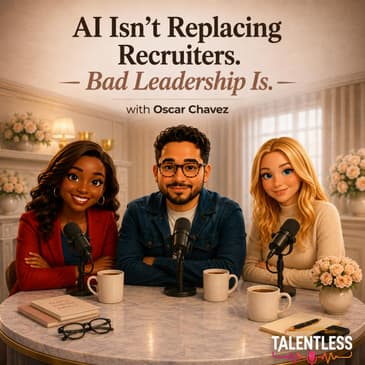
Recruiting isn’t broken because of AI. It’s broken because too many companies reduced recruiting to speed, admin work, and “paper pushing” long before AI entered the conversation.
In this episode of Talentless, Desiree Goldey, Ashley King, and Oscar Chavez unpack the real issue behind modern hiring dysfunction: leadership decisions that stripped recruiting of strategy, empathy, and human judgment.
Oscar shares what 20+ years in recruiting from agency to in-house to AI startup environments taught him about hiring systems, recruiter enablement, and why technology cannot fix a broken process without people who know how to lead it.
The conversation dives into:
-
Why AI should amplify recruiters, not replace them
-
How companies accidentally trained recruiters to become “inbox managers”
-
The dangerous obsession with speed over quality
-
Why empathy is still the most underrated recruiting skill
-
The truth behind “beating the ATS”
-
What leadership gets wrong about hiring technology
-
How recruiters lost their seat at the strategic table
-
Why passive sourcing and relationship building still matter more than ever
Oscar also shares one of the most powerful recruiting stories we’ve ever heard on the podcast a reminder that recruiting is not administrative work. It changes lives.
If you’ve ever wondered whether AI is the problem… or just exposing problems that already existed, this episode is for you.
Key Takeaways:
-
“If you speed up a broken process, you’re just going to break it faster.”
-
Recruiting was reduced from strategic partnership to administrative support and leadership decisions drove that shift.
-
AI is most effective as an enablement tool, not a replacement for human judgment.
-
Empathy is still one of the strongest predictors of recruiting success.
-
The best recruiters build relationships, not just pipelines.
-
Hiring leaders often want control, not partnership and recruiting suffers because of it.
-
“Your company is only as good as the people in it.
Notable Quotes
“AI isn’t replacing recruiters. Poor leadership is.” - Oscar Chavez
“If your presence adds no value, your absence makes no difference.” -Ashley King
“Empathy should be your first strategy.” - Desiree Goldey
“We went from being quarterbacks in the hiring process to being ball boys.” — Oscar Chavez
“You’re not fixing hiring by removing the humans. You’re just automating dysfunction.” — Talentless Podcast
Connect with Oscar Chavez
-
LinkedIn: Oscar Chavez (“Oscar from LinkedIn”)
-
Resume Audit Tool: The Six Second Test
-
Powered by the WRKdefined Podcast Network.
[00:00:06] Just for our listeners, I want everybody to know that Ashley keeps me updated on the lizards. Just so everybody's aware. Do you know that an article came out and they said, they were like, did you know that lizards will get bigger because of global warming? And I was like, bitch, if I'm not a scientist. I told y'all. It's ridiculous. I said it. It's nonsense. And it's copywritten. So like. Everybody, welcome back to Talentist Podcast.
[00:00:32] We talk about recruiting, hiring, leadership, all the things involved in the world of work and things people try to oversimplify on LinkedIn. Today, we're joined by Oscar Chavez. We're getting into a conversation that I think most people will set up a little straighter, right? AI isn't replacing recruiters. Poor leadership is because, listen, AI has become the easiest thing in the world to blame. It's replacing jobs, ruining hiring, doing all these crazy things.
[00:00:58] But I think that poor leadership really is the dysfunction sometimes. But that's what a lot of recruiters and we deal with every day. Oscar, welcome to the show. Please introduce yourself. Yeah. Thanks so much for having me, Desiree and Ashley, both. It's really an honor to be here. So I, as you mentioned, I'm Oscar Chavez. I am a recruiter. I've been a recruiter for over 20 years at this point, which is kind of bizarre for even say out loud. But here we are. I began my career on the agency side of recruitment.
[00:01:28] I eventually transitioned into the corporate in-house side, saw a little bit of the madness and dysfunction in both of those approaches and kind of meshed them together into a style that really suited me best. I've taken a lot of that conversation to my LinkedIn platform where I really try to deploy empathy and give guidance and clarity to the hiring and recruitment process. There's a lot of misinformation out there. And so I do my best to try to demystify it as much as possible.
[00:01:57] So I have been doing this again for about 20 years. I've also started my own LLC where I do some recruitment on the side. And it is all things recruiting for me all the time. And I love talking about this stuff, especially the topic at large being AI and everything that's happening in the space. So I'm looking forward to today's chat with you all. Yay! I love it. I love it so much. You are a founding recruiter currently, aren't you? At a startup? I am, yeah. Yeah. For an AI startup. That's pretty cool.
[00:02:25] So you get to dive into this from the real side of being a founding recruiter at an AI startup, which is... So, you know, I really want to talk about at a high level when we talk about this, about AI just placing recruiters, the kind of poor leadership that we've had over time and is. So, Oscar, what are your feelings about that when I say that? Yeah. I mean, I have a lot of feelings about it as a recruiter because I think that the AI revolution
[00:02:55] is a very exciting prospect for a lot of people. I do think that there is a lot of it that is over-promised, under-delivered in many ways. I think one of the fundamental things, though, at least from the very foundational perspective, is that a lot of hiring systems are currently broken. And so the idea that introducing AI is going to magically solve and fix all of that is just false. It's not there.
[00:03:23] Not that it won't eventually be there, but you also need to have individuals in place to guide it appropriately to fix those problems. And I think from what we see a lot of times is that people get set in those ways of how it's always been done and there's a resistance to changing up the process. We just want to make it faster. Well, if you speed up a broken process, you're just going to break it faster. So I think that's where I land with it.
[00:03:49] I love the idea of simplifying and bringing a level of speed to an extent, but also making sure that it's being used as a resource as opposed to a replacement. And I think that's where a lot of companies have gotten themselves or getting themselves in trouble in that it's just the quick fix that, oh, we can eliminate an entire recruiting team and this magical software is going to do it all for us.
[00:04:17] And then it doesn't deliver and there's no recruiters left to blame. And I don't think that executives want to take the blame for it. So it's like, well, it's just not there yet. So we're going to keep refining it and eventually it will be. And we're just not seeing that. Yeah. Yeah. This is one of the things that drives me crazy is like, you know, I mean, I think we've been saying the same spiel in recruiting for like 20 years, right? Like your system's broken, right? Like go fix your system, go fix the problem, go fix the broken thing.
[00:04:46] And then to think we're going to introduce this thing and it's going to magically solve all the, you know, be like Lucky Charms cereal and come in and, you know, give us all our wishes. It's just ridiculous. You know, Ashley and I talk about this all the time about, you know, I'm glad for AI to be here to make me more efficient, more productive, you know, and do I'm even good with the first round being done in AI. What I'm not okay with is you thinking you can replace the human in the loop.
[00:05:13] And the more we get away from that and I see more of it, more of it every day. It's scary, man. It really is. Especially with the number of companies that are popping up that are developing this type of solution, if you will. Hey, like replace your recruiting team. And honestly, no shade to the founders who are starting these companies. But I always kind of hearken back to a quote from a movie that I enjoy. It's with George Clooney and Anna Kendrick up in the air where he drops a line of her and
[00:05:43] says, before you decide to revolutionize my business, I want to be sure you understand my business. And I think that's where a lot of non-recruiter, non-hiring HR people are coming into the space. Oh, we can solve this administrative task that companies are doing. So that's already getting off on the wrong foot. Recruiting is not an administrative task. And I have a lot of feelings about how that has come about as well, if we have time to dig into it as well. I'm glad that you get into that one.
[00:06:12] I think it is scary to look at that and say, hey, we're a startup. We have several rounds of funding. We're building this thing. It's going to eliminate your recruiting team. And that's a positive. It's not. Yeah, I think one. So it's all about how talent has always been postured. It has always been the little sister at the tiny table. That's the little task that we could push off because HR doesn't need it. It's just an administrative paper pushing, phone caller, question getting, info. Swapping.
[00:06:42] And that's all we do besides coordination. And so because of that posturing, it has given people the ability to give us Matthew McConaughey at conferences and to give us AI that can quickly replace them because just us and ZipRecruiter combined can handle it all. And I'll say full shade to the startup people. How silly of you. I don't think I would ever go be like, you know what?
[00:07:12] I had a really bad time at the hospital and I'm going to create a whole entire medical device for this and revolutionize all of health care. It would be like, can you even spell health care three times fast, girl? Like, no. Like, that's the silliest thing. But for some reason, there is an audacity whenever it comes to talent because of the way that we're postured. And I think that that is the most significant downplay that we could do in our industry because
[00:07:37] there is no other department that gatekeeps society like we do. No IT, no marketing, no banking, whatever industry you want to pick on the planet. None of them get to say, OK, this will be your title and status and this will be how your salary is done. And they actually shape the narrative of how that actually works. Yeah. So silliness completely. Full shade. I love it. I totally agree.
[00:08:06] I think that I have a tendency to really talk about recruiting, at least today, in terms of pre-COVID, post-COVID. Because I have been in the game long enough to really see that there wasn't all. I mean, it wasn't that we were always, always had that seat at the table. But there was a time in the heyday when recruiters were the individuals who were able to speak truth
[00:08:32] to power, to push back on bias, to really identify red flags in interview questions and hiring processes and collaborate with hiring leaders or management to resolve those. I think that over time, fragile egos in leadership really caused individuals to say, I just want a yes person, somebody who's going to manage, post a job, manage an inbox and push every
[00:08:58] single resume to me so that I, the subject matter expert, can make the decision. Because the you don't know how to do my job, so how can you hire for my job is always the excuse. And I think that, you know, we're in a position to say, OK, but you don't know how to do my job. So how can you do my job? Have you ever developed interview questions? Have you been trained on recruiting? Are you using interview questions from your predecessors, predecessors, predecessor that have been used for 10 years?
[00:09:25] And so I think that that shift happened when all of a sudden hiring recruiters became a popular type of a title or they needed that influx of them, like over hire to an extent. And so a lot of these recruiters never really had to recruit in the traditional sense. And again, I will I will go back to my statement on this one. No shade to those new recruiters because they were never taught how to be recruiters. They were taught how to manage an inbox as opposed to individuals who had to source from
[00:09:52] scratch, develop those pipelines, build relationships with leaders and candidates and facilitate that that partnering of them. Once hiring kind of hit the fan and all of a sudden recruiters had to the market was flooded and you had to start looking for passive candidate or building pipelines. A lot of recruiters didn't know what to do. No one's applying to my niche role. So now what? You know, and so when you don't have the tools to actually do the job, then you start
[00:10:18] seeing how vital and how crucial the recruitment function actually is. I think a lot of companies are now starting to say, OK, let's revert back to that or at least a lot of recruiters saying, hey, I'm going to start digging into the passive, the passive, I'm going to do my sourcing. I'm not going to just post a job and get 500 applications. I'm going to find a strong group of, you know, five to 10 individuals I can reach out to directly, have a conversation and bring through this process to start filling these roles because it's it's madness out there.
[00:10:45] And it's unfortunate, but that's that's the skill set that recruiting requires. I think it's often overlooked. And I think this like I agree with you wholeheartedly about the recruiters that entered the market like in that pandemic. The 2020, they were like, baby. Like you even know how to source or like, you know what a buoyant string is? No, like no, they don't know any of that stuff. And it's not their fault. Right. They were they were set up for success in the best way because they were just kind of pushing
[00:11:15] paper. But I think it's talent leadership. We failed those people. Right. That's what they wanted. They wanted individuals to come in. And, you know, we we know as as recruiters from the kind of running joke is, oh, just send me everyone who applied. Like, no, I'm not doing that. Like, I'm not going to send you, you know, 100 applications. I'm going to I'm going to screen and identify the top a top batch and we'll work from there and keep, you know, iterating as we go. But yeah, the egos didn't like that.
[00:11:44] They didn't like having the control over it. So I want a paper pusher. I want an administrative professional to just do this. Yeah. Aspect of the work that I can make this decision. And I can tell you there are so many recruiters who do not know how to finessly push back. And it is because of this. And that is why whenever we've eliminated our role as a strategic partner, once you eliminate
[00:12:12] your voice or you eliminate your opportunity for the voice, you are now removing yourself like you are a A.I. What is the difference? There isn't one. And if your presence adds no value, then your absence will make no difference. And that's the logic that they have. That's the logic that's being adopted and accepted. And it's just like, hey, it's the same thing as talking to Claude. It's not. I mean, I always throw I throw an analogy out there, a sports analogy out there the other day to someone.
[00:12:41] I was like, look, we went from from being a quarterback in this process to being a ball boy. And that was by design. No, no leader wanted necessarily you to push back or even call out their bias. I mean, I've had to do those things. And it's an uncomfortable conversation. But that's what I'm that's what I exist for is to make sure that you're not stepping in it and that you're not hiring a mirror image of yourself for your entire team like that.
[00:13:06] Your lack of diversity and your lack of varied experiences and skill sets and capabilities is not helping your department. It's just fueling your ego. And so having to have that that conversation in a tactful way, to your point, actually, is something that is an acquired skill over time. But if that is if they want to remove that from the process and from the individuals in this role, then they've successfully done that. No, you're you're here to be a yes person. You need that. That hiring leader is above you.
[00:13:35] And so who are you to question them? That's completely bogus to me. Yeah, it is. And I think what's interesting, they do that like what other role do they make you like sit in compliance like a little doobie? I also think that it's interesting that you have this 2020 wave. We needed all these recruiters. They were flying off the wall. You couldn't hold them down for a second. And then we have these massive waves of layoffs.
[00:14:00] And they always went for one diversity, but two, usually the most tenured, senior or highest paid and then they kept the yeses. Yeah. But I'm not going to say that out loud because people will hear the crunch of my tinfoil hat and then they won't listen anymore. Yeah. Yeah. No conspiracy here. But no, I mean, I remember whenever it was happening and me and my best friends were calling each other and I was like, listen, design, design, design, baby. These people aren't dumb. Oh, I but that's. Yeah.
[00:14:30] I clocked it immediately. And I've posted about it several times on LinkedIn. It's just like because I mean, when it started to happen, it started not the layoffs, but when the when the need to have experienced recruiters started to really spike, I was seeing recruiters posts like, what do I do? I'm like, what do you mean? You're a recruiter. And so I started to dig into that. I was like, oh, you were never you were never given the skill set.
[00:14:56] You didn't go to the traditional I mean, a recruiter because nobody wants that anymore. They want somebody to just push paper. And so it's it's it's really unfortunate because I mean, I do this work because I love it. I've always I mean, we're again, we're we're of the group that, you know, fell into recruiting because it wasn't a college course. It wasn't a certification. It wasn't highly advertised organically stumbled into it some way, somehow. And then we say, well, I can I can really make a difference here.
[00:15:25] I'm really impacting people's lives. And I think that's, you know, it's not hyperbole for me to say to say that I think people sometimes think it's over exaggerating. But we know that, you know, when when you're making that phone call to somebody who has been on the job market or got laid off or got fired and, you know, they haven't gotten their second chance, you know, somebody who's worked in a way to, like, you know, get them through the door and get them the opportunity. You know, you get the people crying on the phone. You get the people screaming and hollering and shouting and they're so excited.
[00:15:55] And so I think that that's, you know, that that's something is the work is very meaningful to me. And so I look at it as so much more than just, you know, an admin role because we're literally changing people's lives. And I have I have like a personal story about like that kind of change that again, we can we can say for later. But it's something that really just like has stuck with me from very early on to today. Let's hear it. Bring it. I started my career in the health care space. And that's where a majority of my recruitment work was done.
[00:16:25] And I had hiring registered nurses and I had one individual who was I was speaking with and she was he was very particular about my means of contacting her. And I think that today's recruiters would be like this person is high maintenance. Like I'm not calling the unit phone to talk to you because you don't want to give me your cell phone or your home phone. And that was just her need. And so to deploy empathy, because I'm always deploying empathy. That was my thing that my mentors taught me is that you don't understand what anyone else is going through.
[00:16:54] So if what they're asking of you within is within reason, then then why not just accommodate that? And so I contacted her on the unit phone to speak to the charge nurse and eventually get to her. And that's how we had our conversation back and forth of really navigating interview set up and negotiating the offer and the salary. And it eventually went through and it was a done deal. And I was like, great. Like she's she's relocating from another state. We're giving her a nice sign on bonus and salary. And that was it for six or seven years.
[00:17:23] I started working for another health care system. Her name came across my desk again. I reached out to her. I had forgotten. And she I don't know if you remember me, but I was so into the nurse that you talked to so and so on this time. And I said, oh, my gosh, that is that is you. I remember that. She's like, I just want to tell you that you saved my life because I was I was fleeing an abusive relationship and you couldn't you couldn't call my cell phone. You couldn't call me at home.
[00:17:52] You couldn't email me because they checked everything. And so you could only call the unit phone and that's the only place I could speak to you. And you got me out of there with a great sign on bonus and relocation support. So I fled in the night and it was just like I had gone all those years without even knowing that this person happened for this person. And so she's like, you saved my life. Like, honestly, it's like, honestly, God, you saved my life. And I had to sit with that for a couple of minutes.
[00:18:21] And like, we were both crying because I was like, I had no idea. But that's the gravity of the situation and the gravity of the work. And that's to understand, like, you could be doing that for somebody at any given time in their role. And so that for me was like, I fell into the right thing because, you know, that that's the kind of that's the kind of moment that, you know, it took all those years. But the payoff was just so like, oh, my gosh, like, what if I what if I was somebody
[00:18:49] who's just like, forget that I'm going to go with the next person because, you know, I didn't have empathy or I wasn't understanding. I just refused to take the time that I needed to to get this person to do because they were a stellar candidate and I wasn't going to sacrifice them. But, you know, it's it's it's all about speed now. Right. It's like, you know, that's too much to ask for some people. And it's like, no, I'm just going to move on to the person who's going to who's going to text me and not I am nothing against texting. Get in contact any way you can, but deploy that empathy and make sure that you're doing it the right way.
[00:19:18] And you can have moments like that. I talk about empathy being a strategy all the time should be. Yeah. Empathy should be your first thing. Right. I think whenever you look at the recruiters who are genuinely the best and I mean the best, not only in data and and performance, but I mean, in candidate experience and all. Empathy is the different like it is the key ingredient that whenever you go back and you read, because sometimes we'll deploy surveys and stuff after whenever you go back and read those,
[00:19:48] the ones that made the difference were the ones who just did that little whatever it was that they needed and didn't didn't mention it, didn't say anything about it, just moved right on and took on the task. And it's kind of just this it's this teensy teensy show of effort. Yeah. That makes the difference. And speaking of how recruiters actually aren't educated as much anymore, that was one of the things that they taught us. They sent us to a two week boot camp. I realize how rare that is nowadays. This is how and I started in staffing.
[00:20:18] So years ago. But one of the things that they taught us, they were like, if someone needs like a salary increase, they were like, even if you only get it up like forty seven dollars and it's a rounded off weird amount, even just something tiny to show that you made any form of effort will increase them wanting to actually accept the offer, even if it was less than a different offer that they had with them, because they see the difference in the effort that you've
[00:20:44] put forth to where it was actually a closing strategy for us that no matter what, if they countered, we gave them an odd number like it ended in a forty eight or a forty nine or something because it was to show them we're trying the best we can. And of course, regardless of the morality and validity of that vendor, but it was something to where it is true, like it is something to where if you can really just meet someone
[00:21:10] where they are kindly and with unconditional compassion, they will follow. This episode of the Talentless Podcast is brought to you by Do Better Consulting. Hiring is broken. Job searches are broken. And honestly, most career advice out there is just recycled nonsense. Do Better Consulting exists for people who are done guessing. They work with mid to senior leaders, founders and talent teens to get clear on their signal,
[00:21:38] how they show up in the market, how they hire and how decisions actually get made. No fluff, no templates just to say you have them. Just strategy, structure and honest feedback that actually works. If you're tired of spinning, it might be time to do better. Head to do better consulting dot net. That sometimes more than they'll follow money, at least back then. Now we're in 2026. Those are those are the moments.
[00:22:04] So that's just to call it that one small piece of it is because I think that so much of the mentality today is like, oh, well, they have a competing offer. That's more so that's done. And when you've actually had those experiences like, no, I've had people accept an offer that was less than a competing offer because of the extra effort or the initiative or just the kindness. Life is too short not to work on solving cool problems with interesting people. And recruiting allows us to do both.
[00:22:33] I'm Brando, host of the Rebel TA podcast, a show where we share stories with people and talent leaders who are on a mission to empower the candidate employer relationship in the future of work that you deployed because you didn't just look at them as like, hey, you're going to take mine because it's five dollars more an hour. So like get in here. I think that is there's so much there's so much there from just a human to human perspective.
[00:23:01] But a lot of it is lost today. It's like, hey, I'm not good. I can't match that offer. So like they're done. But you didn't even try to salvage them. And what was that? What was the lead up to that? Like, you know, obviously you're going to get candidates who are who are going to play employers off of one another. That's that's the name of the game, too. And like you should have options as a job. So good for you. Yeah. Yeah. I'm not here to tell you that we're the best thing. You're the best thing for you is the best thing for you based off of your individual circumstances. Right. So who am I? I'm going to give you the best offer that I can. I'm going to fight for the best offer I can for you.
[00:23:30] But at the end of the day, I'm not going to win them all. And that's the name of the game. That's the way it goes. Maybe I'll get you the next time around and build that relationship. That's another piece of it is like you have talent rediscovery. If you can dig into a pipeline of people you've spoken to in the past and say, hey, I know it didn't work out a year ago, but what about now? Actually, I am looking. What do you have? So those are just the differences that come with not having to start with a fresh batch of people for every single job posting. Like that's exhausting for a lot of recruiters nowadays.
[00:23:59] And it's just like but if you have a strong ability to develop relationships and you have people who are in your network, in your pipeline, you're engaged, congratulating them on LinkedIn, you're staying in touch, you're reaching out, you know, every couple of months or whatever, just as a touch face like, hey, how's it going? How'd that work out for you? Those things can come back to you. And I've seen it happen for myself, too. So I think that's again, these are the lost kind of arts in a lot of ways for recruiting. But it's all about just like go, go, go next person, next person, new people always never
[00:24:28] recycling. And I'm like, you're missing out on so many people. And this is where I think AI can be helpful, to be honest. I think it gave a lot of the task off my play that are mundane, the admin stuff and give me the ability to have build better relationships. Yes. Right? Yes. Then I don't have to do some of the scheduling or whatever it is that that AI thing does. And I can sit with a candidate longer.
[00:24:54] I can do all these other things because I don't have three hours of admin to do. Right? That's what I mean as a restart. It's a mentality shift, right? I mean, we'll look at it in that way. But a newer recruit will look at it and it's just like, well, I don't need the relationship. I just need to get through all these applications ASAP. And it's just like the difference in the usage of that is profound because you're like, well, there's one group that's taking the time to say, hey, it gives me more back time to the people. This one's like, no, it gets all these people off of my plate. Yeah.
[00:25:24] Yeah. And that's a different mentality. It's a total thing. But I think talent leaders who are leading teams, right? You're leading yourself. I'm sorry if you're a solo team. But if you have a talent team, you need to be impressing upon. This is what we're bringing in the AI so you can do these other things. But I'm sure that even some of these talent leaders don't even know what they're supposed to do with that time back. Right? They don't know. Hey, now we have all this time.
[00:25:54] I guess I need to cut a head count. No, you needed to be better to the business. You needed to teach your team how the business works. You needed to teach them relationship building skills. I will say. But no, your first thing is to cut head count. And it does. It's not even necessarily entirely on that talent leaders, you know, on them to own it completely. Because I think that the idea for a lot of executive teams is to reduce recruiting down to one metric and that's being speed.
[00:26:22] And so sometimes their north start is like get there as quickly as possible, which translates into telling your people, hey, just use it to get through everything so that we can get the applicants down to zero and have a billion people plugged into interviews and just make sure that hiring leaders are happy. It's just like pushing all of this. So it all made sense to an executive team and a presentation from a vendor and then it gets deployed to the rest of the internal team. And it's just like, OK, so just go fast. Right. Forget the relationships.
[00:26:52] Forget the quality. Forget the candidate experience. Just get there first. And everything could be fine. And we're seeing that that's not the case. I feel like we've definitely moved from like a consultative practice. But then talking about this kind of wave of new recruiters, I will say we went from like consultative practice to like mentally meatpacking, which I feel like is an old school staffing where it's like button seat, button seat, button seat.
[00:27:18] And most of the time people go to staffers is because of that. Because they'll do button seat. And so it's like specifically if you are in corporate, it is to be consultative. It is to maintain compliance for the business. It is to be that thought partner and occasionally a sparring partner that is going to say, hey, because talent is an essential business function. Your company is only as good as the people in it.
[00:27:46] If you're hiring Einstein or if you're hiring goofball in a box, like there's very two different outcomes that you'll see from that. And the only difference is how you hired and what the outcome was of that. Like that's what brings you those. You think you think that, you know, executives or leaders or teams think that they're being faster by implementing this, whether consciously or subconsciously, there's still that fear of making the wrong decision. So what do you do? You introduce a seven step interview process. Yeah.
[00:28:16] And then nobody has accountability on the call. Nobody wants to be the one to make the bad call. So everyone grills the candidate extremely to make sure, hey, I put them through the ringer. So if they made it through me, they're worthy to move on to the second, third, fourth, fifth, sixth round. And so it just becomes this interrogation of an interview process as opposed to finding an ideal fit for you because nobody wants to be the one to say, I said yes when everyone else said no. I had to make sure that I put them through it.
[00:28:44] And so you're still wasting time and you're making a poor candidate experience to boot. So why would you adopt this process? That's the thing that makes, it doesn't make sense to us from our perspective, but a leadership and executive team is like, well, we're getting through all the applications so fast. We're getting all these interviews in, but yeah, all the people are leaving with a bad taste in their mouth or they're not qualified to begin with. And who do you blame? So it's easy for all around just say, yeah, let's just do this thing. And if, you know, push comes to shove, get a new recruiter because obviously these aren't cutting it.
[00:29:13] And so that's the problem I have with it. It's like we still have found a way to make recruiters to skate bill, even though you're trying to replace them with an AI process. So it just, it just defeats the entire purpose for me. And maybe that's what we need. Sorry to interrupt you, Des. But maybe, maybe we need to let them play a little bit with AI. Get a little burn. Well, I mean, they've already crashed and burned a couple of times. I've seen companies bring people back because they do the AI just doesn't do what they're supposed to do.
[00:29:40] I mean, you saw in the last couple of months where, you know, Amazon did all their layoffs and then I saw, you know, the next week talent acquisition job postings. I saw it too. Yeah. Yeah. Because it's the truth. You can't do the job without a human. Right. Only that, but I don't ever think the customers would ever want that. I don't think humans want decisions of hiring being held by AI. I don't, I don't want to be evaluated and juxtaposed.
[00:30:10] And why? Because nine times out of 10, I don't put, we have to keep everything to one page. Social norm says weird things. And if it's going to be a search bot, well, then I'm going to put in a book. Like there's so many things that change and nuances to the candidate experience that it's like, you can't make this decision. And I truly hope that humans, especially if you're listening today, can we hold the line on this? Maybe.
[00:30:34] I think that's what sometimes the conversation I really want to have is, is like we as the recipients of the processes that we oversee, adhere to and create need to be the ones who are like, hey, rioting and saying no, because why? Like it's one thing to do the Taco Bell order. It's another thing to change my whole income and occupation. Like those are two very different scenarios. Sheesh. You're crazy. This job market is a little crazy deal. I will tell you.
[00:31:10] Over time, and they're getting like 500, 600, 700 applications right now because the job market is so crazy. Does AI serve a purpose in there? It is. Yeah. Right. Like I think it serves some purpose. I just don't know what purpose right now. I feel like there's no way one recruiter is getting to 700. 700 applications in my inbox, you know, or in my ATS. What purposes AI serve in that? How do we filter it? What's the responsible thing to filter it?
[00:31:39] I think so two things. One, AI scrapes. And so that may pump up your volume by getting it posted on a whole bunch of different places. However, quality, quantity, we already know two very different things. And now we're inducing a time crunch because we're having to expand how many applications that we're looking at. So my thought is if you use AI somewhere in that realm to pump it up, it's okay to use automation to bring it down.
[00:32:09] Meaning have thorough knockout questions, have good yes and no ease in there. Really do a lot of that talent infrastructure to have that preliminary work on the front end. So that way AI can scrape and caboodle whatever it needs to do on those interwebs or however, you know, the people from my hometown would say it. But at our end, regardless of that, we're only seeing quality going forward because we put up
[00:32:36] those parameters through automation, not artificial intelligence. We're using human intelligence to knockouts. Knockouts. The knockout questions have a way of fueling the ATS is auto-rejecting you. Myth that's perpetuated by a lot of nefarious characters on LinkedIn. Beat the ATS. I cannot stand it. It's a... That's my favorite soapbox to stand on. It's a daily battle to just dispel that myth. And it's just like, man, I really can't. I think we've been talking about it for like five years.
[00:33:06] Literally. It kind of ebbs and flows and it just like takes over. Obviously, the job market we're in is fueling it, you know, extremely. Look, recruiters are... 75% of applications are being auto-rejected. No human's ever seen. You're like, stop. Just stop. There's no truth to this whatsoever. And so, yeah, but a lot of it is really just fueled by that. I will say on the point of kind of managing this process, one thing, something I've started
[00:33:32] to do with AI is to really give it as much context, my intake session notes, my job description, my own personal ideas. And that way I start to really develop my own type of review. And what I'll do is I'll go through and find my individuals and say, hey, here's a group of five that I think are a good fit for this. Then I'll run it through the kind of context and agent that I created and say, hey, like, here's my selections. Give me your thoughts on it. It's like, you know, yes, yes, yes. No, no, no.
[00:34:01] Here's them kind of ranked based off particular software, particular uses, experience, skill set, years of service, experience, and so on to say, okay, so I'm not having to pick my batches, but I'm saying like re-check my batch to make sure that based on all the context I gave them, what we're looking for, what's successful in this role, what skills are necessary or what are nice to have and so on. And so I use it as kind of a collaborative partner in that way, just to kind of keep me
[00:34:27] honest and say, hey, like I'm looking for the things that I said. And, you know, here's what stood out to me. Are they fitting into the context that we discussed with the hiring team? And so that's really what has been a use case for me. Again, it's not drastically chopping into like the hundreds of applications off the get-go, but I just don't want it to, I don't want to release it on the ATS and say, hey, just review everyone and score everyone and kind of give credence to that AI is auto-rejecting and reviewing everyone before a human being.
[00:34:56] I don't want it to replace me. I don't want it to replace my process. And I still want to be able to look at those applications and say, I still got it. Like if the AI agreed with me, it's like, okay, yeah, I know. That's why I picked them, Claude. You know, they stood out to me and you're confirming that I made the right choice based on the context. And so, I mean, that's something that I will, I definitely utilize it for. Yeah, that's a great point.
[00:35:21] I will say as a talent leader, that is one of the things that I typically ask my employees all the time. What are things that you love to do, would want to do more? And what are tasks that you want to give away? And then, of course, what are things that you're doing more? Three or four times a week. And then creating that type of agentic, whether it be a bot, whether it be, you know, prompts, whether it be whatever it is to kind of help that. So as a talent leader, that is always something that you can suggest to actually help your recruiters
[00:35:51] kind of streamline and create efficiencies within themselves is to suggest those things and to be able to create those patterns as well within technology. Yeah, it's not about being anti-AI. And that's a misconception a lot of times. It's just like, oh, you just don't want to like get in. You're going to get left behind. No, it's not that I don't want to adopt it. I just want to adopt it responsibly. Exactly. I want to make sure that we are still doing right by the human being that's on the other side of the application. Yeah. Because at some point it's going to be us.
[00:36:21] And so that's where the empathy comes in is like something that you need to be kind of viewing everything through the lens of because there's going to come a time when it's your turn to be up to bat. And, you know, if you can't actually get to a human being in that process until several steps, several layers of just automated AI, then you feel defeated and you feel like, well, now I'm having to perform as if this is social media to appease an algorithm as opposed to appeal to a human being.
[00:36:49] And there's no, you know, there's not, that's not an ideal system to me. And so I think that that's where I mean, I come down on, you know, again, it's not about being anti-guy. It's just about being a responsible user of it and deploying it in the right way so that you can still maintain a sense of humanity and empathy and compassion in your process as opposed to just being on autopilot. Yeah. And I definitely think that like where the empathetic leaders will win most is because right
[00:37:18] now we do not have like a system or any judicial anything laws keeping us like in check, in order, creating any form of direction or even privacy around some of these things. Like you put all their stuff in AI, then what, honey? Like, I mean, we've never have, are we going to discuss that sometime soon? That now Claude knows my address because it was on my resume. Like, you know, just different things that did we allow that? So there's so much that comes with it, but I do agree.
[00:37:48] And I think that whenever you go with an empathetic lens and you start from that umbrella, a lot of natural compliance actually tends to flow. And what I mean by that is kind of like whenever you are an empathetic person, you would know that you wouldn't want to use it for outcomes because you know that would remove the humanity of the decision, you know, that that would remove the objectivity.
[00:38:14] And so there's a piece of this where if you can use AI much more as an enablement, much more as a strategic enablement partner, essentially to assist you, to maximize you, to make you better. If you like, that's where like all this human in the loop, like, no, no, no, like the human is the loop. So we need to just use little AI to maybe make it into the loop. Yeah. Yeah. Yeah. Just like come chill. But yeah, that's it.
[00:38:43] The word you may, the word you may be looking for is the word I use with it. I call it. It needs to be a multiplier. It should be used to make your top performers better as opposed to just replacing them. Hey, teach the AI how to do what you do and then it'll just do it for you. I mean, no, I don't want to do that. Can we talk about how much water these things use? Sorry to interrupt you, but just the moment I thought about it, I was like, and you know what, we're using a lot of water to do all this too. Yeah. So I think one of the great things, really what kind of drew me to my current company as,
[00:39:12] so we call ourselves an AI company. My company is called MindBeam. We don't have an actual AI model. We deploy what our founder had created is really his own algorithm that allows these LLMs, these large language models to reduce the time it takes to train them. So you train them much quickly, much more quickly, utilizing less of the resources.
[00:39:37] It's really appealing to that green approach of like, look, we shouldn't have to take thousands of hours to train up these models. And so this helps to reduce the training time significantly, which reduces the energy and water usage of it because AI is, I mean, it's not going anywhere. I mean, for all intents and purposes, it's kind of here to stay. But that's where this like, what's the responsible way about going about getting it implemented? And so while we're not an AI company in the traditional sense, that's what we're trying
[00:40:07] to is essentially being able to bring that capability to train those models to more people in a more responsible way. Okay. So tell me actually a little bit more about the company though, because I am kind of curious in that. So if we have recruiters on the line and they want to better, you know, let's say they want to see about kind of what you were talking about using a assessment tool to gut check what you're doing. How would they, is that something that they would use your tool for?
[00:40:33] So it's, it's been helpful for me because I certainly, I mean, I, I've leaned into the utilization of AI just in terms of like vibe coding to build out like my website for my LLC that I'm, I'm currently working on. Yeah. I recently built a tool that is a resume audit tool because I got so, I really reached my breaking point with the ATS is auto rejecting your resume. And I just, I'm going to build something. And so it's not a resume rewrite.
[00:41:00] It's literally an audit tool that gives you clarity and still encourages you to write your resume yourself as opposed to hand it over completely to AI. Just use it collaboratively to kind of, you know, spell check and context and make sure tone and voice all those things there, but this just gives you a score on like, Hey, like I call it the six second test because you know, that's, it's making sure that your, your resume is clear and concise and is not just stuffed with keywords is not just, you know, a list of job descriptions or responsibilities that you do.
[00:41:29] It's, it's really like, are you giving outcomes? Are you giving context? Are you giving metrics? Are you delivering, you know, are you showing, highlighting the accomplishments as opposed to just listing the responsibilities. And so I built that in using AI. I kind of put it out there and I advertise it sometimes on LinkedIn to say, Hey, if you, if you're looking for, you know, a resume audit, as opposed to a rewrite or a keyword stuffer, or, you know, beat the ATS resume template, you know, just look at this. You still have to write your resume, you know, at least it's going to guide you in a way
[00:41:58] that gives you, make sure you're bringing clarity to that document. Blindly throwing an ATI, AI template up there. That's cool. Yeah. So I developed that and again, I'm building my website for my business. And so I'm, you know, utilizing it, you know, to, to an extent, I'm not a proficient at it. I mean, that there was a time when I could do a little bit of coding here and there, but this thankfully kind of takes over and makes you a little bit more of a seamless transition into it.
[00:42:28] But yeah, I'm very much an AI adopter. It's just a matter of the conversation starts to get to the extreme, how we were talking about of just, just like replacing humans period. Yeah. And I don't support that. Yeah, no, absolutely. And, and again, I think it all comes back to the audacious of, you know, you clearly don't know what it takes to do these things, at least to the level that they're expecting.
[00:42:54] I think anyone can toss your resumes and do hot word searches. And, and it's a shame that that is what recruiters have been reduced to. And I think with the 2020 wave population of proof points came walking through for that. And so that makes it a little bit more difficult for us to climb, but it is. It's so true. They brought up a really good point. One kind of one final point if we're at time. I posted about it recently. It was just like, like the, uh, an unfortunate, another unfortunate, you know, occurrence after
[00:43:24] the mass layoffs was that the market being flooded, uh, allowed in some ways for like those very niche swing for the fences type of candidates to be found. And so leaders were just like, boom, my unrealistic job description is now realistic. And so I'm not settling for, I want to see everyone because I know they're out there. And so I think that was, that's also just kind of in their minds proved, oh, look, they're available. Yeah, they're available now, but like, they're not traditionally because they're working because
[00:43:53] they're being held on to. And if you don't have a recruiter who knows how to, you know, source passive candidates, then you're just always going to be relying on people on the job market. And so I think that there's just, yeah, there was just. That's actually a beautiful point because there's an automation engineer who is like Reddit famous, like all these big things. And I actually got him on the phone and we chatted a few times and I will never forget whenever they had the openings, I was pre-pipelining.
[00:44:19] I had told one of the manager that I had that person that I would bring them in so we could chat with them. And one of the peer interviewers just flipped. They were like, what do you mean we're going to talk to them? What do you mean they know who we are? Like they were just, and I didn't even know who this person was. I'm not going to lie to you. So I didn't even, like, I knew they had the experience we needed. I knew that, you know, all these different things, but I didn't know they were like some big deal on something, something. And it was just fascinating because it is so true.
[00:44:48] The money that was piling in at that time, like it was something to where people in the deep dark of you would never get their contact info and ever have interest in whatever. They were like popping up just like little gophers in the market. Yeah. They're like, what are you doing? Like as fast as they could. Yeah. I don't know. What do you got? You know, it's like, yeah, no, that's what a time to be alive though. I will say that was, that was peak. Yeah.
[00:45:15] I mean, it's, it's really wild, especially because now having, being on like on the technical side, you, you definitely come across of like people who are local celebrities in the engineering community. Just like they, like they developed the algorithm or the code for this. And like, that's, that's cool. Like, that's amazing. I didn't know, like, they're not a celebrity in my world, but if they're a huge deal, like thanks for the heads up, you know what I mean? Right. Really? It's really fun to come across those types of, those types of individuals.
[00:45:41] It reminds me of so long ago where we're dating ourselves now, but there was a very funny, there's a very funny commercial. I don't remember if it was for, it was one of the tech companies. It might've been HP or somebody, but it's just like the abnormal looking like guy walking through the office that people were just like, oh my God, you know, because like in real life, it was the guy who like helped create the USB drive. But in the industry, they were like, oh my God, he's, you know, walking on water because of what he did. It's like nobody else outside of tech, like knew like who that person was.
[00:46:11] Yeah. So I think that's just kind of that very, like in that inner circle of the industry or just, there are like local celebrities. Just walking around like mere mortals. Actually probably walking around like they're homeless because there is no way to tell the difference between a startup founder and someone who lives in a box. Yeah. I can't tell the difference, but then one gets into a Lamborghini and you know, then you can tell. So we can go on and on about like billionaires and tech. Yeah, just on and on.
[00:46:38] Too funny. Well, okay, Oscar, please plug yourself all the places that people can find you, get your stuff. Absolutely. Thank you so much for having me. First and foremost, I really appreciated the invite and also enjoyed our chat. The easiest place for this audience to find me would be on LinkedIn. That's where I spend most of my time. So Oscar Chavez on LinkedIn. You'll see my banner.
[00:47:07] I've taken on the moniker of Oscar from LinkedIn. It's something that developed over time with the network I created and people started referring to me as it at conferences and things like that. It took on a, it was a very organic approach to it, but I just leaned into it very heavily. And so I am Oscar from LinkedIn. As I mentioned a little earlier, I also recently built out a resume audit tool called the six second test.
[00:47:32] You can find it at all spelled out six hyphen second hyphen test.com. It is a recruiter calibrated resume audit. So it's not a rewrite. It's not a keyword stuffer. It's not going to tell you you're going to beat the ATS. It's just helping you bring clarity back to your resume while still encouraging you to be the author of your resume. So those are my two plugs that I have. And I will look forward to connecting with anyone and everyone on LinkedIn.
[00:48:01] I post pretty, pretty much on a daily basis. The reason isn't quite what it has been given LinkedIn is a new algorithm. And so that's a, that's a whole other issue to discuss, but I enjoyed my time. I enjoy connecting with as many people on LinkedIn as possible and any events I go to the opportunity to connect in person or even appear on other podcast appearances. I opened all those things. So please reach out and connect with me. Awesome. Well, Oscar, thank you so, so much for being with us today.
[00:48:31] All right, everyone have a good time. I don't know how to end this. Bye.
Sponsors
