
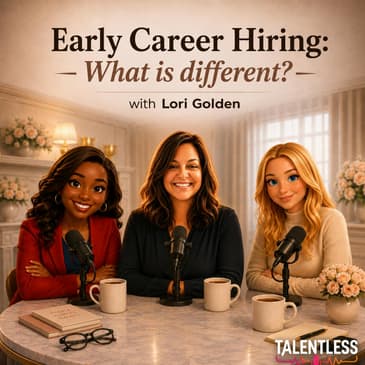
Early career hiring didn’t suddenly “break.” Companies changed the rules.
In this episode of Talentless, Desiree Goldey, Ashley King, and Lori Golden unpack why the hiring market feels so disconnected for Gen Z candidates, recruiters, and employers alike, and why companies quietly pulled back from investing in early career talent.
Lori brings over 27 years of recruiting experience across agency, startup, and corporate environments to a conversation that goes far beyond campus recruiting. Together, the team explores how hiring expectations shifted after the pandemic, why “entry-level” jobs now demand years of experience, and how AI, social media, and modern work culture are reshaping the future of employment.
The conversation dives into:
-
Why companies reduced internship and early career hiring programs
-
How “entry-level” became “2–3 years required”
-
The disconnect between Gen Z and corporate work culture
-
Why recruiters need more transparency in hiring processes
-
How AI is amplifying distrust in recruiting
-
The role social media plays in burnout and workplace expectations
-
Why recruiters are struggling to balance efficiency with empathy
-
The hidden problem with treating early career hiring as “cheap labor”
-
Why soft skills and adaptability matter more than ever
-
How companies lost the long-term strategy around workforce development
Lori also shares her perspective on what younger generations are actually asking for: fairness, honesty, mentorship, and a system that feels human again.
If you’ve been wondering why early career hiring feels harder than ever — this episode explains why.
-
Companies didn’t stop wanting young talent — they stopped wanting to train it.
-
“Entry-level” hiring now often requires experience because organizations want to avoid investing in development.
-
AI is exposing communication problems in recruiting, not solving them.
-
Transparency matters more than automation in the hiring process.
-
Gen Z isn’t rejecting work — they’re rejecting exploitation.
-
Recruiters cannot build strong pipelines without trust.
-
Soft skills, adaptability, and communication are becoming more valuable than technical credentials alone.
-
The future of hiring requires mentorship, not just technology.
“You cannot build a future workforce while refusing to train future workers.” — Lori Golden
“The early career pipeline isn’t broken. Companies just stopped investing in it.” — Lori Golden
“If you want to change the game, you still have to learn how to play it.” — Lori Golden
“Gen Z isn’t rejecting work. They’re rejecting systems that feel exploitative.” — Talentless Podcast
“We automated communication, but not transparency.” — Lori Golden
Connect with Lori Golden:
-
LinkedIn: Lori Golden on LinkedIn
-
Community: Rebel HR
-
Early Career Program: Hire You
Powered by the WRKdefined Podcast Network.
[00:00:06] Oh my god, Ash. I have to tell you about this weird thing that happened to me today. Do you want to hear about it? Tell me everything weird. Yeah, if you didn't tell me, it was going to be on podcast. Okay. So, I met this girl. Her name is Lori. Oh snap. And she's amazing. Really? And then I said, how can we continue our relationship? And we've been doing it since then. It's amazing. Lori is amazing.
[00:00:32] You know, I think I've actually met this Lori once and it was at breakfast. I was nine months pregnant waddling around and she was one of the kindest souls on that fifth floor bar. You were. You were. I remember the waddle, which was good. Yeah. Never forget it. I had purpose. I was out there. Welcome and this is part time joining. Thank you for being here. Thank you for being a supporter. If you're not new, please sign up for some stuff.
[00:01:00] I got all the things. But today we're going to talk about nobody taught them that and early career hiring. And I am going to talk about, it's so funny about how companies don't figure out early career talent. And I think it's really important for this conversation for recruiters because recruiters actually don't know how to do this. I believe this. I believe this is a real thing.
[00:01:27] So I'm going to let my guest today, our guest today is Lori Golden. She's the Rebel HR. She has a community. She has all the things. But Lori, please introduce yourself. Okay. So I'm Lori Golden. I've been recruiting in, well, I've been in the recruiting world for 27 years. I've been on the agency side. I've been in-house in corporate, mostly in and around tech startups and fast scaling companies.
[00:01:55] So some of my perspectives are a little unique. But I'm also the founder of Hire You, which is an early career program to help bridge the gap between being a student and being an employee. And I'm also building a couple other things in the Rebel HR community. So that's me. I'm just out here to argue with people and help them too. First of all, I love that you just want to argue with people because that's my energy. I just want to argue with people.
[00:02:24] I want to argue with you as well. Also, Ashley does the same things. Listen, if they're wrong, they're wrong. I mean, who are we to not tell them? Right. You know, the universe is going to let them know soon enough. We were just giving them a little heads up. I'm all about, I'd rather the ugly lie than the, I mean, the ugly truth and the pretty lies. Right. And there's plenty of pretty lies out here. So I feel like I'm serving the ugly truth.
[00:02:50] I'm not, it's no, I'm not appreciated. It's very much a shoot the messenger kind of thing. Also, there's no distinction between being able to share transparency and advocating. So like, yeah, I can tell you about a thing I don't like in detail so that you have the knowledge. And from that knowledge, you can strategize your job search or whatever it is we're talking about.
[00:03:13] But like the moment I start explaining a thing like AI one way interviewing, we won't go there. But like when I start explaining what it actually is about, why it's happening, what it may or may not do kind of a thing. It's, it's automatically perceived as though I'm advocating for this thing, even though I say I'm not advocating for this. And I've personally never added this specific step to a formal interview process. However, I think it's important to reframe the perspective.
[00:03:42] I'm one of those people who wants to hear all the perspectives on any topic. My metacognition is key. Also, I, one of the success factors for me in my life has been poking holes in my own beliefs, like over and over and on, ongoing all the time. So I just, I'm here for the people who want that. Of course, I get a lot of reactions from the people who don't want that and don't like discomfort.
[00:04:10] What you've seen for me. Now we're talking about early career hiring and in 2024 or 2023, I think it was very different than we were in 2026. Can you explain to the audience, like what is different? What's happening now? Like how can we contribute? Like all of those things.
[00:04:33] Yeah. I mean, it's a huge conversation and there are so many factors and it's hard to address the topic without all the factors. I mean, we have to look at some things that are outside of the conversation. Like there's an entire generation of people addicted to this and like it's a dopamine cycling situation.
[00:04:55] And there's, I'm in HR forums where we're talking about how do you write policy around ensuring people don't disappear in the stall for 45 minutes scrolling. Like I never would have thought that would be an HR forum discussion five years ago. It wasn't. Yeah. But that's where we're at. So we have to like, I think it's important to talk about this without there being blame. Right. Because I think there are a lot of problems.
[00:05:21] And when I talk about the problems, they can be perceived as blame. But I don't think in terms of blame. I just, I don't function that way. I think in terms of accountability, meaning what can you impact versus all that's wrong that you can't. Okay. So that's the frame. I've got to give the frame.
[00:05:40] I love it. I think that one, one of the main things that has happened is that there were problems when this Gen Z was hired a couple of years ago out of college. Companies reacted to the problems and a lot of companies reacted to those. It's not anyone's fault. It's not Gen Z's bad. That's an absurdity.
[00:06:00] Like I don't believe in any of this generalization type thing, especially around generations. It's all manufactured division as far as I'm concerned. But what I will say is there were challenges regardless of why, how, and whether or not it's all stuff we created and is intended or whatever.
[00:06:19] But like the challenge, the response to the challenges companies started pulling back on their internship hiring. They started reducing their early career hiring. They started shifting entry level roles to, you have to have at least two to three years of experience. Why? Because we want to ensure you've already been through all the hiccups, right? It's like, like updating your iOS. I don't ever update my iOS right away. I wait for them to figure out the buzz.
[00:06:48] Me too, girl. I'm going to wait for three new updates. Exactly. And I think that that's the perception around early career hiring. Well, we still want to hire young. Two years out of college is still an early career hire. But somebody else dealt with the first two years and making sure they weren't sitting in the bathroom for an hour scrolling and all that stuff, right? So I think that's what's happened.
[00:07:15] It's always so funny to me because I was never a university recruiter, but obviously I've been in a university and like, it's like a, you know, and the campus recruiting and all of that. I think that's a different beast. Like it's a whole different energy that you have to bring to the table. And now we're in Gen Z that is like, they don't even want to work for you.
[00:07:41] You have to come from their mindset and perspective. If you don't start from the frame of understanding what the gripe is or what the energy is or what the concerns are, there's a general discontent with the exploitative nature of employment as a baseline. Ding, ding, bear it starts. Which is fair, accurate, valid, all the things, right? Like we can't, it's not that it ever hasn't been exploitative.
[00:08:07] It's just that like maybe this is the first generation that's been like, hey, this is ridiculous. Why are we doing this? This isn't right. Like how are you, how can you connect survival to jobs, but then also it's like, you know, there's so much wrong with it. So you can't, I respect that perspective, right? That foundational perspective they're coming to the table with. The issue though is that we need to have a bigger conversation about, you know, and even with them, it's like, okay, I get it.
[00:08:35] You think things are unfair, but you have to learn to play the game and navigate it if you are to change it. So I think our biggest, I love it. They just want to burn it all down. And I'm like, that's what AI, they are going to enable the AI, like, which is why I believe this is intentional. I believe we're here based on a series of, you know, like short game plays and intentions by companies. Nobody, if you look around, nobody's playing the long game anymore.
[00:09:05] That's why reputation no longer matters. Employer brand, nobody seems to care. There is no long game. Never in the 27 years I've been doing this, did a company have the, excuse my, gonads to come out after a top profit year, a top profit growth year and lay off 20% of their workforce.
[00:09:26] That would be, we would have vilified them in like the, you know, court of public opinion and it's become normalized. That's not on, that's unintentional. A hundred percent. I said this in 2022 when it first started happening. I was like, oh my, girl, my pattern recognition. On your team. I was like. The moment they started doing layoffs because they way over hired in 2021. Yes, they did.
[00:09:55] Because, and not only that, but it was a candidate's market. You could name your price. We were all getting overpaid in the best of flipping ways. We actually had a decent ratio from CEO to lowest paid employee for the very first time. Yep. And that stuff lasted like 90 days until they caught on. And then they said, no. And we were making demands. We were making demands. That was a wonderful period of time. I'm kidding. I'm going to blame it. Hold on. And then they're like, well, wait a minute.
[00:10:25] How did the power dynamic flip? So, right. Yep. We have to get things back to where they were. But also, and also. So the narratives that Gen Z, I mean, there is a lot of propaganda. Like, let's get real here. There's a lot of stuff going on. And a lot of things. I agree. Narratives being fed to them on Instagram and TikTok. And it's like, it's also not serving them at all. It's not supportive. So much. So we got to look at all these things, right?
[00:10:54] And I just think there's a general misunderstanding. But if you look at the narratives and line them up to the actions of the companies, that's how you know this is not a flaw. It's a feature working exactly as designed. And the contraction of jobs overall is going to start with the younger generation. This is the first generation that won't fight a universal basic income idea in this country. Everyone else prior doesn't want to.
[00:11:22] It's not that we don't like the idea of not having to work for a living or not. We want less exploitative systems and processes. But we don't not want to work. I don't want the government to pay me to exist because then they can control me. And, like, that's also not okay. Yeah. There's something else between, you know, totally defunct greedy capitalism and complete lack of control socialism.
[00:11:49] There's something in the middle that we haven't yet kind of devised, I believe. Anyway, I don't want to get too much into the politics of it because it gets murky. No, no, no. But I think it's really – it goes to my question about, like, how we think about early career. Because, I mean, I have Gen Z in my family and they're like, I'm not having a baby. I'm not doing any career. Well, that's a narrative that's being tossed out there. They're not doing anything. Right?
[00:12:17] And, well, I think we – well, Ashley, you want to talk to me about – I mean, so here's a few things. Here's a few things. This is what I'll say. Our generation – and I'm not Gen Z, just to be clear. I am a millennial. She's a millennial. Yeah. And – I know. Even on a mentally elderly millennial, if we're going to really get there. Right. But the one thing that I will say is there is a part of the end of millennials and the Gen Z group that I'm damn proud of. And I mean it. And I mean it. Yeah.
[00:12:47] And I mean it in the sense of they do not want to be the best at capitalism. And they see the design. They see how it's working. And they're like, no, not for me. I'll be overemployed. I'll go do all these other – so they have the grit. They have the ability. They will vibe code. They will automate the crap out of anything you want. Yeah. They can take you to that next level, but they ain't going to do it if it's not equitable. And they're not going to do it if the foundation and the design – Good for them. I kind of agree.
[00:13:17] I agree, yeah. It's such a – it's a weird space. It's also perceptional. But there's also perception, right? So like when you hear a 25-year-old say Gen Z, we're burnt out. As somebody who's 50, been working since 11, I'm like, are you though? Is it burnout? You know what I mean? Like with all due respect. Like I get it. But I also think we have a perception challenge.
[00:13:40] So like I think there's a cognitive burnout from this instant gratification, dopamine, dopamine, dopamine, dopamine, more dopamine. I mean, I think that's exhausting. And I think they're feeling it. I think there's a lot of – I mean, we're experiencing actual cognitive decline as a result of what we're ingesting. I agree. I lost my phone. Like that's an issue. For two days. And I'm going to say – Probably best two days of your life. It probably was. The most amazing two days of my entire life.
[00:14:10] Like please let me lose my phone again. Right? Isn't it crazy that we can't just put it down – we can't just like turn it off? You know, I'm on LinkedIn all the time. I know. I can't stop. That's hard. I might miss one conversation about AI or auto-rejecting people. Cool. But this is how I know I'm a weird – because I'm someone that I'm like take the phone away. Like I actually do it as a challenge to be like look, nothing changed.
[00:14:38] I haven't had my phone for two days and absolutely nothing changed with this world. It's still just as heavy as it was. Well, it happened to me. Like literally it happened to me. I lost my phone for two days and I was like I'm going to miss all the world. Please take it. Just take it away. Literally take it away. Yeah. I don't want it. I know this is kind of side subject, but it does go into this. There is such this real world, fake world feel of even just all of the technology bits and even in the workplace.
[00:15:08] There is – I can't even explain to you how weird it is that there are people who are actually terrible employees, but they're great on social media so people let them stay employed there. And it kills me just because they have a social media presence. We're going to entertain all this drama. And that's where I feel companies aren't acting right. That's where it's like, okay, they're losing the plot and they have a good challenger in Gen Z to say,
[00:15:32] ah, but we're not really – we're doing everything we can to not actually make this equitable. We'll do any other design. They don't want it. Right? That's what I'm saying. If companies wanted to make things equitable, they would have started listening to Gen Z six years ago, and we'd already be down the road on implementing those shifts, but it's actually the exact opposite. Yeah. Right?
[00:15:57] But again, people who aren't going to fight against universal basic income as jobs contract, if that's the long play. I don't know. Look, this is all – we're all guessing as to what's going to happen, but my pattern recognition is awfully good. I'm like – there's no such thing as unintended consequences at the billionaire level. Sorry. It doesn't exist. Tell them, Lori. Tell them. Keep it going. Keep it going. You are so accurate.
[00:16:24] I can't tell you how many times I've had to have conversations, and they're like, and think about this and think about this. And I'm like, y'all, this is all by design. It has to be. It's the fact that I could actually figure out how we could do this, and I am not the smartest person in this room. I didn't graduate from Harvard. I didn't go to Yale. And you're telling me all these people – Which that does not make for the smartest in the room. Well, I mean, on paper, according to the system, right? The system that evaluates us. Pedigree that protects certain people's jobs and levels. Yes, I get it.
[00:16:54] The mode of privilege is what I would call it. But it's just – it's one of those things where it's just like, I know I'm not the smartest person in the room, and if I could figure this out – Could figure it out. Then that lets me know – same thing with the government. I didn't say that. Unroll the 10th wheel half. I'll roll it back up real quick. Okay, we're not going to do it. Never mind. Desiree told me no. No, I mean, don't get me – let me get mine out, but it is the same thing. Me and AI have built an entire new political party because there is no – our whole political system is a sham. Oh.
[00:17:24] And I've created new – Desiree's got us off until it's after hours. AI, I've created new models for all the models that I think are defunct. Of course, working as design. But, like, what – if the – you know, like, if you could pull the smartest regular people and put them in a think tank, not millionaires, billionaires, trillionaires, but, like, regular folks, what would we come up with with creativity and design and AI at our –
[00:17:54] It would be a magical world. I don't even know what to say, but it's not hard to create these things. Because this is – yeah. It's – Go for it. It's real. Yeah. So, do you – Are we diving in? Are we allowed – Oh, we're doing it. Come on. We have two questions. I have two questions. One of them is are you on that plane that sends everybody – the smartest people in the room? Are you that person that sits on that plane? I don't think I am personally, but –
[00:18:24] This episode of the Talentless Podcast is brought to you by Do Better Consulting. Hiring is broken. Job searches are broken. And honestly, most career advice out there is just recycled nonsense. Do Better Consulting exists for people who are done guessing. They work with mid-to-senior leaders, founders, and talent teens to get clear on their signal, how they show up in the market, how they hire, and how decisions actually get made.
[00:18:52] No fluff, no templates just to say you have them. Just strategy, structure, and honest feedback that actually works. If you're tired of spinning, it might be time to do better. Head to dobetterconsulting.net. It's the high metacognition, high agency people. It's not necessarily the highest IQ people by itself. It's not – definitely not the most highly educated people. My word.
[00:19:19] I mean, like, there's entire swaths of highly educated people who've been also taught not to question certain things. And this goes on all ends of worldview spectrum. Like, you have to understand, I am so agnostic to politics.
[00:19:37] Like, I can take any single issue on its face and apply the same level of questioning, thinking, metacognition to it as – and it doesn't matter how – in fact, the more emotionally connected I am to the topic, the more I challenge myself. That's what's missing. It's what's missing. And, I mean, it's missing amongst the most educated and the most this and the most that.
[00:20:02] I don't like the word detached, but there is a level of detachment from things that allows you to look at them from a different level of logic and reason. Because I'm not emotionally attached to the outcome. I'm not bringing that emotional trigger to my thought process.
[00:20:19] So – and it's why we are at an impasse on everything in society is because we're so divided, subdivided, and taught to react to our triggers. You know what I coach people to do when they're triggered? Quickly. Stop focusing on what triggered you and start looking at the thing inside of you that was triggered. Now, that sounds like blame, but it's accountability. And the difference is empowerment.
[00:20:46] You cannot be an empowered human being without a level of personal accountability. Meaning no matter what caused the trauma, it's only I can heal it. So you can focus out there on the cause of it, and you should eventually, but not until after you go here. Yeah. Find it, heal it, then go do something about it out there.
[00:21:11] But, like, trying to make change from an emotional reaction, which is all you see all day long, every day, everywhere, it doesn't work. And it's why none of it's working, right? Is because it's – I'm sure – I know we went way off the question, but – No, no, but – No, I wouldn't be in the room. That was a really good answer to my question. So I'm going to follow up with one. Okay. So Gen Z loves AI, right? We bring it back to early career hiring.
[00:21:39] They love it to some degree. So I don't know. I'm seeing less and less – I'm seeing collectively that they're rejecting it. Oh, really? Because – See, this is my question. What are they not adopting? Where are they adopting? And how we can be better at AI to make sure that they're embracing it? What does that energy look like? Tell me what they're not looking for.
[00:22:06] So I think right now what they're reacting to – and I don't think they're rejecting the tech itself or the tools. I don't think any of us really are. I think what I'm rejecting or what others might be – and I'm not rejecting the tools. I'm rejecting the idea that there's this thing, this complete shift of systematic everything that is being – it's being forced on us.
[00:22:31] But what I mean by that is no other time in history has a change been introduced without a whole lot of narrative – like a whole lot of this is going to be good for you. This is going to be great. Like here's how you're going to benefit from this. We've mastered the art of psychological manipulation around consumerism. AI coming at us, but it's coming at us without a positive spin. What it says to me is this is a closed-loop circuit,
[00:23:00] and we and our opinions about it are not in the loop. They don't care what we think about it, what we say, what our demands are. If they cared what we thought about it, they wouldn't be optimizing creativity and porn before optimizing cancer research. Yeah. But they're going after the things that make the most money, but simultaneously also add degradation to just humanity in general.
[00:23:29] Like there's no benefit to using AI for creative endeavors. Humans have mastered creativity. Look at the Renaissance period of history. Look at like our history. There's a lot of a million reasons why we shouldn't use AI. Right. And then our children aren't safe, and I think that the younger generation also realizes they're being marketed to aggressively. The worst.
[00:23:55] And it's not positive things that will improve the quality of their lives at all. Absolutely. It's a little negative. It's all more places to spin out. If I'm a recruiter sitting in the seat right now, I've been assessed an AI tool. How do I do that for early career? How do I speak to the next generation of what we're doing, Laurie? I would love to educate. Transparency, I think, is the key.
[00:24:25] I think most things, if they make some modicum of sense to a process, can be accepted if there's clarity around it. The thing that people are, and we know this because we're always, especially Desiree, you and I are always in the AI top of funnel screening conversation. Right. And it's like, the thing is that you know that there's a lack of communication
[00:24:52] and transparency from companies based on how people are talking about it. So there's this off-the-bat perception that this AI one-way screen is instead of me going directly to talk to a recruiter. And it's not. It's instead of you getting rejected without being considered. And that is the part that is, like, missing. Yeah, no, we work together on a partnership where I believe human in the loop, right? And Ash can talk to this more intelligently than I can. It's not replace humans.
[00:25:23] Right. It's important to help. There has to be an objective screen. There has to be a way to screen down and filter down. There's this idea that, like, we love rejecting people. Hey, it's Bob Pulver, host of you, podcast. Human-centric AI, AI-driven transformation, hiring for skills and potential, dynamic workforce ecosystems, responsible innovation. These are some of the themes my expert guests and I chat about, and we certainly geek out on the details. Nothing too technical. I hope you check it out.
[00:25:53] We don't love rejecting people. Do you think that Jen D appreciates that, though? Do you think, Lauren, that Jen D appreciates that a little bit? Like I said, I think if you just explain it to them, right, like, we have to stop. We have to just talk to them. I think there's just this lack of communication in processes. Like, we're automating all these communications. Why not automate the thing that says, like, hey, here's what the process looks like. Like, here's exactly what's going to happen next. Here's why we do it this way.
[00:26:22] It's not because we don't care. There's a perception that sending the AI screener to the top of funnel means the company doesn't care. Like, they don't care about your time. That they think their time matters more than yours. That's not it at all. It's bandwidth, and we want to give more people an opportunity to add context to their 2D resume and application. And there's really not many ways to do that other than at the very top of the funnel.
[00:26:46] And again, in a market where 50% of people are still opting out whether they've ever tried it or not, whether they know if they're good at it or not, whether – there's also this assumption that all neurodivergent people will automatically struggle with that. I'm extremely neurodivergent, and that isn't necessarily true. Neurodivergence is divergent. Like, there is no, like, I'm – these people – this entire spectrum of people is going to struggle with this one thing. Like, I think we're – Not a monolith.
[00:27:16] We make these generalizations, and we just categorize people, and it's part of the problem, right? It's like we're not dealing with individuals on an individual, unique basis anymore. Ashley, I wish you were alive 50 years ago. It was very different. I mean, hey, I used to do recruitment where we actually – I used to have to do CDL drivers, and I'd have to go to the truck stops. I'd have to go hang my own posters. I still did paper resumes and all those things. So I – That's a lot of work.
[00:27:45] I'm not – it sure was. You're an old millennial. I'm an old – I really am. Yeah. If you knew my life story, you'd be like, oh, this makes a lot more sense as to why you started working whenever you were, like, two years old. Yeah, yeah, yeah. Yeah. Yeah. But I will say, and kind of to one of the points that you were making in there, and you were talking about how most of the movements in history, there is a positive narrative. And with AI, it really isn't. And it really isn't from even a structural means.
[00:28:15] Like, the companies that are profiting off of AI are using municipal water supply. So, like, we as citizens are losing our water. There is no trust with any legislative – any body currently in the United States, which means if I know that you're recording me on AI, how do I not know that you're not going to make a video of me saying something wonka-doodle? You don't. Three years? You don't. And we don't have any legislation or any type of parameters or anything that's actually holding us accountable at all.
[00:28:42] And so right now, really, one, it's a weird goldmine rush that if you're in the AI, if you're a vibe coder, cash in, cash out, honey, because it's going to be short and it's about to pop. So step two is once it does pop, we are all going to be left with the remnants of everything left around us for this fictional world that never existed and costed us everything. They're betting the global economy on AI. Literally. Literally. And all it is – They want fake human intelligence, and y'all have real humans, but they're doing this so they don't have to pay you.
[00:29:12] Y'all pay attention. Right. That's all this is. Right now. But then what are they going to do with us? We're just greedy eater. They don't need. Exactly. Right. So then my very dystopian – You and I are too in your own difference in this conversation. We both know where we're headed. My dystopian mindset is like, well, then that's why they're spraying crap in the air, and that's why they're killing us with the water in the ground. Because they can fly off to go anywhere. It makes sense that they put your data centers here. You're going to work them. It makes sense that they're going to get rid of your money.
[00:29:41] You can work for that too. There's nothing uglier – I don't think this podcast will get posted. Probably not. There's nothing uglier in the world than a data center. It is the literal opposite than the beautiful architecture. And like we have gone so far from like the best parts of humanity. And I think that we had maybe some good intentions in it, but I think that our good intentions were hijacked for an agenda. By design. By design. We wanted to create fun.
[00:30:09] And they took what they could profit off of and ripped off the rest and said, thank you for your service, sent you on your way, and now you got sent home to tell your kids why your job didn't work. And guess what? You raised a Gen Z kid who said, middle finger to capitalism. You screwed my mom, and I'm not doing it anymore. And that is how – like this generational impact and effect – you even see it with people from the Great Depression who raised other people. They have more hoarding tendencies just because of the reaction of their parents that we're going to have the same things.
[00:30:39] Anyway, sorry, I didn't mean to interrupt. You keep going. No, no, no. But those are the spirals that – like, man, I wish we could do like a six-hour rabbit hole dive. Like, I really do think a lot of these things are solvable, but they're not solvable from the lens of working with what is, but rather over – out around it. Like, we've got to create other containers for people to connect.
[00:31:05] First of all, they – whatever the – whoever you define your they as, we all have a they, right? They, the powerful they, are actively disconnecting us. With all these means of connection and platforms to connect, we've never been more disconnected in history than we are. Yeah, I agree. Think about that. Before the internet and social media where you could literally chat with somebody in China, before that we were more connected. Yeah. It's crazy. And it was more real.
[00:31:35] It's insane for me. But I know that you built the Rebel HR for one reason. I feel like it's connection that you're trying to do there. Can you talk to me about what Rebel HR does? Totally. Well, first, I just want to say anything and everything I will build or be a part of has to either empower people or connect them or some version of both. So I only will work on things that those two are the factors, okay? Because that's my rebellion.
[00:32:02] So the Rebel HR, I actually started it on LinkedIn before there was any purpose. I just started it. Just – I had no idea what I was doing. I was just – it's time to shapeshift, clearly. I better adapt and stay relevant. So I just created this thing. But what I really recently have shifted it to is there is an entire machine behind peddling misinformation to cause confusion and fear to make money. It's a whole grift, okay? It's profitable. Yeah. And it's very profitable.
[00:32:31] And the reason they're winning is because they're putting the full machine of a revenue-generating concept behind it. One thing I've learned, whether I like – I hate this version of capitalism. I don't hate capitalism on paper. Like, I – so I don't want to go there. But the point is that – I mean, late stage is pretty crappy, but keep going. Late stage of everything is – late stage of everything is crappy. But again, why is it the late stage? Because we're coming up to the – Because we let it be. Late stage arrives.
[00:33:01] Yep, yep. You're right. But yeah, it's – if you don't put the full weight of a revenue-generating machine behind something, even with social good intent, it won't go anywhere. Look at the nonprofit landscape. Oh, my God. I can talk about that all day. We could do a whole separate thing on this. I've worked in multiple nonprofits in my life already, and I've been part of the effective altruism community and gotten involved in the 80,000 hours and all kinds of things.
[00:33:30] The problem is that more money is spent on administration, overhead, operations, nefarious corruption, laundering, whatever. But, like, very little actual good happens. And I'm not saying the people aren't good at well-intended. Like, it's like this much. I'm saying good intentions get hijacked for agendas of people who are more powerful than the people with the good intentions.
[00:33:58] They've become expert level at seeing what we care about and grabbing it, hijacking it, leveraging it, and then making us believe that they want to help us accomplish it. And it's just another nonsensical thing. So the way I've – the reason Hire You, for example, is not nonprofit because it's an education program, and everyone's like, well, it should be nonprofit. Yeah, but then it won't help anybody. How about if we make it a revenue generator that scales, and then we can impact a lot of people?
[00:34:27] I want to empower people at scale, not 20 every three months. And I'm only one human, so I'm going to have to – so that's basically the concept of Rebel HR was. The grifters are using the system to peddle their wares, to peddle their snake oil. So we, the ones who care, the ones who have good information and can actually help people, have to use similar systems to get our information to land. Or even for it to be heard, right?
[00:34:57] There's a lot of noise. I said this like 10 years ago when social media really first took off, and even more than 10 years ago. But like when everyone has a voice, no one has a voice. No one has a voice. Yeah, I love it. And that's what we're up against. Where's the leadership? Yeah. I mean anybody and their mother who's got some charisma can get on a podcast.
[00:35:16] And the cute ones – what really kills me is please if I see one more cute young female on a video talking about things they don't understand, I might lose my shit. Excuse my friends. Oops. Oh, please. We don't care about you on this show. Please do the thing. Yeah. Speak as much friends as you'd like. We would. No, no. We would never mute you out. But the other thing I would say, and just to one of your points, just to the – so two things.
[00:35:43] One, number one point she made, and she made it in the beginning, you have to play the game. You want to change the game, you're going to have to play the game. You can't be on the sidelines and be like, I'm going to change this game that you've never ever played before. So you're going to have to get your hands dirty, and it sucks. It is the part of capitalism. But if you do it and you do it well, you can do great things. And that's the fight that we put towards. That's the point. Well, the whole – like when you live in a world where the proof is in the pudding that the darker your intentions, the more successful you'll be.
[00:36:13] The more nefarious you are. I can't believe that in full part of you. The more safe. So being that's the reality, it's like we have to cut – we can't – I have left so much money on the table over – like that's not in my values wheelhouse. I can't really do that. I can't go work for a defense contractor where they're making an autonomous army story. I just can't be part of it because like I have to – that's part of my body of work forever.
[00:36:37] I think if I'm going to hold Gen Z – I do want to hold Gen Z's feet to the fire because like there's so much that they have been born into and that so much has been done to them. But I also want them to hear this if they hear anything, if they are watching this. Yeah, they will be. One thing that was advantageous to us is we clowned the older generations, but we still respected their wisdom.
[00:37:03] We respected their wisdom enough to learn from them, to be able to learn how to navigate the machine we don't fully – like they understand stuff isn't fair, but they don't understand why or the inner workings or how we've gotten here, anything else. So we want to help you guys, and the only way we can do that – if you are just like, okay, boomer to anybody who's like more than 10 years older than you, I don't know. We can't help if that's the scenario is that you've decided that none of us know what we're talking about.
[00:37:32] We are all the cause of this problem. First of all, that's how I know they're not clued into what's actually going on because they believe it's the generations ahead of them that caused this versus the elite, powerful few that have control who have created everything. We are all subject to the same nonsense. It's not – but we do have wisdom and we have experience.
[00:37:55] And we know that if you focus on what you can change and not focus on what you can't change, right? It's like the serenity prayer. But like if you focus on what you actually can move, the needle you can move. Yeah. But you can't just sit there and complain about all of the unfair systems. Your complaint is part of the agenda. It is. I love it. So stop. Can we – someone highlight that, put it on a reel? We can make it a short.
[00:38:24] That to me is so real. Your disgruntlement, your inactivity to change the system and to just put your hands up and say burn it down or I have nothing to do with it, which I get. I get it. And I get how some people have gotten there, but I agree with exactly what you said. Yeah. If we stopped fighting amongst races and genders and religions, we might start realizing that the color that's really like causing us pain is green. I'm sure. I'm sure you.
[00:38:54] It's not our skin color. It's green. And then if we start – if we focus on who the very few people are that actually are oppressing all of us, then we'd stop fighting. You know the red ants and the black ants in the jar fighting each other? Yeah. We're that. And we need to start looking at who's shaking our damn jar. Right? Thank you. Shaking the damn jar. I'm going to clean that one.
[00:39:19] Well, and just one last thing that I'll add that you hit on that I think is super important. One thing that I always say is whenever you're good at what you do, you don't just do it for anybody. And the reason that I say that quote is exactly for what you were saying before, that you can create the most innovative and most amazing and coolest things with the best intent on the planet. And if you're a person, theirs will always be profitability. And they will strip it for everything that it's worth. And how do I know this? Look at our medical system.
[00:39:49] Right. If you think that there aren't people who have created – We're incentivizing – Who created treatments and discovered cures and all these different things. And guess what, Jack? And we killed them. Everything got ripped out from it. Silenced them. Killed them. And the only thing that was left was profitability. And now you had to buy your way back to a cure that someone else already created for you. And to me – What if we created systems that incentivize the outcome we actually want? Could you fathom?
[00:40:17] I mean, this is what I do – this is what I do in my spare time is I fathom all of these things. I'm about to spend my spare time with you. I can't stop. I wake up at 3 in the morning having to write down – I had a – I set up a franchise model for a nonprofit that would help people get property and start their own dog rescues. I'm like, we have all these dogs. We don't have anywhere for them to go.
[00:40:42] And we also have people who want to create little homesteads and they need – so I'm like, we could just – but it's like all these things in the same models that profitable systems were built on. It's what I call innovating by infiltrating. It's how I built – everything I'm building is based on that. It's using the systems I don't like to create something that's going to empower and connect people because that's the only way it's going to do that at scale. Yeah. Yeah.
[00:41:12] I love it, Lori. I want to thank you so much for being part of this energy. Is it off time already? Because I could keep going for like another hour. What? Girl, don't tip this with a good time. I could keep going for another hour. This is the part of the – You don't understand. I love this stuff. Podcast that we talk about the cognitive psychological sign of what we've been talking about. That is Ashley King. Go for it, Ash. That is. And today we're going to talk about the differences that Gen Z faces.
[00:41:42] So a lot of us, depending on what generation you were in, whenever you went to school, you went for your degree. And there was usually a high chance that you would get a job in that degree plan. And nowadays, depending on what degree plan you get, it looks like studies have shown that it's an average of anywhere from 30 to 40 percent chance that you may stay in that field. After dedicating how much in student loans, holding on everything else that you could have been making money on so you could attend school to go get a job.
[00:42:11] And then that job being something completely different, it lets you know the system by design was for the paper stamp that you needed versus the actual skills that you acquired. Which is why there is such a large disconnect from whenever you step foot in an employer that they're like, whoa, what's happening? You're like, whoa, what's happening? And it's all by design. Love it. Yeah. That's amazing. That's a good stat. 30 to 40 percent. Crazy stats in there. Yeah.
[00:42:39] We used to hire any degree. Like we didn't even specify. Yeah. Like just you have a degree. Awesome. Yeah. Amazing. You have a degree and can fog up a mirror. Let's hire you. That was it. I love it so much. I love it. Lori, I want you to do the plug party for yourself. So where can people find you? How can they contribute to the system by design? We are doing it right now.
[00:43:08] How does that happen for you? I'd love everybody to come join me in the Rebel HR community. It's on school. It's pinned to the top of my LinkedIn profile. I'm also on YouTube, but I have zero followers there. So feel free to go follow me or subscribe there. I don't even know what. It's not even a follow. It's a subscribe. I don't know. I'm new to the whole thing. On Wednesdays, I'm doing and I did one this morning and ask me anything for an hour. Anybody can join and just ask questions.
[00:43:36] I also have a bunch of veteran recruiters who join and answer with more spin in the comments. So it's an interesting conversation. My community is never just focused on one group of people, even though that's easier from a marketing perspective. I want job seekers who want transparent truth and Rebel HR approved veteran recruiters, leaders, resume writers and coaches who really know what's happening on this side of the table.
[00:44:02] And I mean, like if you got your career coaching like eight years ago and you don't talk to recruiters, you probably don't know what's going on out here. I just, you know, they're saying negotiate on every offer. Like, no, no, don't negotiate on every offer in this market. But anyway, you know, so many things. But come into the community. You can ask me anything any day of the week. It doesn't have to be Wednesday morning and I'll answer. And so will other people. Also, Hire You is a really great program for early career folks.
[00:44:32] I don't think it's a skills disconnect. I think it's a soft skills disconnect. It's a mindset, you know, and I want to help you be fully empowered in this market by understanding the reality of a lot of things. And that's what that program is about. I love it. I am part of the Rebel HR community. Join. Yes, you are. I am part of that. And it's important for early career, but also job seekers, all the things. Please do the thing. Please sign up.
[00:45:02] I would love it. And I just want people to remind themselves that early career hiring is not a pipeline problem. It's kind of a priorities problem. How we get into it. Stop treating early career as a cheaper version of how you get something done. Let's treat it as something real. And how we can mentor them, empathy for them, and move them through the pipeline and move them in our organizations.
[00:45:29] I think I want to say kids, college isn't the only option. And it's definitely no longer the sacred blueprint that you were sold. And sorry, mom, dad, that I'm telling them this. But, like, it's not the only path. My son has a wonderful career in the trades. I absolutely believe the ones who are most AI proof are the ones who are going into work that can be done with your hands. I should have been a plumber.
[00:45:57] I should have been an electrician. The fastest growing class of millionaires in the United States is in the trades. Yeah. It's owners of trades. It's not what we're doing. It's not here. I should have been all the things. So, you know, explore all the options. Look at your ikigai. Like, it doesn't have to necessarily be university. It doesn't necessarily have to yield six figures of debt. No. No. It's not. And thank you for saying that.
[00:46:27] I think that's really important for people to hear. It is. Yeah. Well, team, this is the most amazing time. Lori has been an amazing guest. Please follow her. Follow Rebel HR. Do all the things. Please, please, please. Sorry, dogs. Yeah. Anyway, she probably had time. We're a little over time. That's fine. I want everybody to follow us. You can follow us on talentlesspodcast.com.
[00:46:55] Anywhere you get your podcasts. Anything. You can do anything. We're showing up in Google. So let's do it right now. We also just started a new Beehive newsletter. So please also subscribe to that. Gotta sign up. Thank you so much. Thanks.
Sponsors
