
"People-first" is the most overused, underutilized phrase on LinkedIn. Everyone says it. Almost nobody does it.
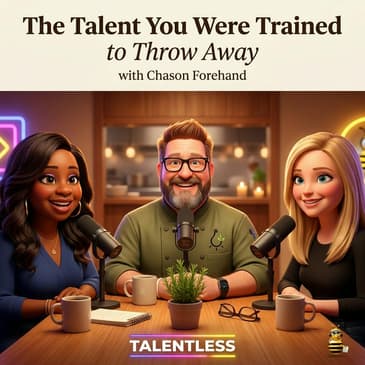
This week, Des and Ashley sit down with Chason Forehand — chef with 45+ years in the culinary world, founder of HR-4U Inc. (a four-time Platinum Seal of Transparency nonprofit), creator of Transformation Kitchen™ (now operating in Nicaragua with locations coming to New York, Beacon, and Australia), and co-host of the Time2CHANGE podcast.
But before all of that, Chason was a kid in an abusive home. A drug addict hiding in plain sight. Homeless. Incarcerated. Food-insecure. Until a Michelin-track chef put three piles in front of him and decided to pay it forward.
This episode is what happens when someone who has lived on every side of "unhireable" sits down with two recruiters who believe they can change the wealth gap without a single piece of legislation. It's a conversation about action over words, profits versus people, and the responsibility that sits in every job description, salary band, and "culture fit" decision recruiters make.
This is one to listen to twice.
What You'll Learn
-
Why "people-first" is the most performative phrase in HR — and what it actually looks like in action
-
How 44% of U.S. workers below a living wage is a recruiter and HR problem (and how to start fixing it Monday morning)
-
The truth about the CEO-to-lowest-employee pay ratio and why HR holds the cap key
-
What other countries (Australia, Nicaragua) get right that the U.S. gets disgustingly wrong about workforce development
-
The story of the chef who saved Chason's life with three piles on a counter
-
Why resume gaps are skills — and why recruiters need to stop treating maternity, caregiving, and recovery as disqualifiers
-
How the Juneteenth General Order #3 quietly shaped the employer-employee dynamic we still live under today
Best Quotes
"The problem isn't the word. The problem is that it's overused and underutilized. People are talking, but there's no action behind their words." — Chason
"We could change the wealth gap in America without a single piece of legislation, and the only group in the United States that can do that is HR and recruiters. Period." — Ashley
"How much is enough? Because we have enough in the United States that there should not be a single person who goes without a home, a hot meal, a shower — all the things." — Chason
"If you are the human resource, that is basically a hat that says 'I'm always picking people, never picking profit.' That's my job." — Ashley
"I'm here today because someone else cared enough about me as a human being. And now I'm gonna pour into you. Action over words." — Chason (quoting the chef who saved his life)
"People-first is an action. It's not a value statement. Please remember that at all times." — Desiree
Talent Outside the Box
Ashley takes us back to June 19, 1865 — General Order Number Three, read in Galveston, Texas, twenty miles from where she sits today. The order that legally ended slavery in Texas also legally transitioned the master-slave dynamic into "employer and hired labor." She walks us through how that linguistic and structural shift still shapes how we think about employment in America today — and why every recruiter and HR pro should know this history.
Where to Find Chason
-
LinkedIn: linkedin.com/in/chason-forehand-rcf1222
-
All links + donate: linktr.ee/chasonforehand
-
HR-4U Inc. + Transformation Kitchen™: TKNicaragua, TKBeacon, TKAustralia
-
Podcast: Time2CHANGE (everywhere you listen)
Connect with Talentless
Subscribe wherever you get your podcasts Instagram • LinkedIn • TikTok • YouTube • BlueSky Newsletter: talentless.beehiiv.com Join the Discord community via talentlesspodcast.com Got a #DumDumTalent story? Email desiree@talentlesspodcast.com
Powered by the WRKdefined Podcast Network.
[00:00:07] Welcome everybody back to the Talentless Podcast where you know what we do. We talk recruiting and talent and HR leadership, culture, fit, all these things that you talk about in your daily workday. We're so excited to be here today with one of my favorite people on the planet, people. Favorite people on the planet. He is a chef with 45 years in the culinary world. He is the founder of HR4U, a nonprofit that's won the Platinum Seal of Transparency.
[00:00:34] Platinum Seal of Transparency. He got Candid GuideStar for four years running. He created Transformation Kitchen, a workforce development program that's now running in Nicaragua. Oh, I can't say that word. With plans for New York, Beacon, New York, Australia. I mean, this just goes on and on. He's the co-host of the Time to Change podcast and he is also the founder of HR Consultations. I bet those of you that know Chason did not really realize that. It's a fractional HR consulting firm.
[00:01:02] You know, I talk about Chason Forehand in so many ways, but I could not wait to have him on this show. I could not wait to talk about his history and talent in HR and how that connects to the work he decided to do. I'm just so glad you're here, Chason. Did I miss anything? No, that was incredible. Come on. That was fantastic. Thank you. I actually, and I'm silly for not knowing this. I didn't know you were a chef for that long. That's amazing.
[00:01:31] Yeah, since I was 15. 15. Wow. That's incredible. What's your favorite meal to make? It was my very first job. I was super excited for that $3.10 an hour that I got. I thought I'd hit the lottery. Amazing. So what we're talking about today, and the title of this episode is going to be The Talent You Were Trained to Throw Away. And it's kind of a show about who hiring leaves behind, the people-first statements we always say but don't really mean,
[00:02:00] and what recruiters and HR professionals can really do to change that. And I thought that was a great topic for Chason as he runs an organization that thinks about these things all the time. And so let's kind of get into it. I think we'll be able to talk about this for hours, but I think we only have a certain amount of time, so I want to get it going. Chason, you know, throughout all of your history and journey, if you don't know Chason's story, I'll help you share it a little bit here.
[00:02:28] But what made you say, like, you know what? I'm going to do the hardest thing out there there is to do. I'm going to start a nonprofit. How did that, how did we get there? Well, it's a long journey, but it starts with my background and the things that I went through as a kid and the trauma and being someone that was in my drug addiction, in the middle of culinary where I was hiding and wearing masks and ended up being homeless, being incarcerated, being food insecure,
[00:02:58] and seeing how systems treated me, how the world treated me, and also what was available. And even the people that meant well, the people that are there to try to help break cycles and how instead some of them were really perpetuating the cycle. And so understanding that I wanted to do better is just like your consulting company. I want to do better and I want to move the needle forward.
[00:03:24] And I think it all for me wraps around living wages, how we pour into people, what we pay people, and the means by which companies, organizations, hiring managers, everybody looks at living wages. And so that's where it stemmed from. That's how we started. And yeah, it's a lot of work. It's a constant daily thing.
[00:03:49] But I look at the entire pattern through my life from 15 to 61 and go, these are the things that I know work. And I believe this is the answer forward, at least part of the answer. And we learn as we grow. I have to ask, all that lived experience and all that you've been through is so much more than most people have ever had to experience. And you walked into the world of HR, were you like, what the hell is going on?
[00:04:19] Or were you just shocked? Or were you like, what did you see kind of in the profession that other people missed? Well, I fell into it like a lot of people. It's because I was the guy that was friendly in the restaurant world and I was kind and I had empathy. And because I was trying to navigate a grace for myself.
[00:04:42] So I was giving, you know, I'm navigating my addiction and journey and trying to work out who I was as a human being and peel off the layers of the onion as to who Chason Forehand really is. And in that process, I got asked to be the guy who has courageous conversations, who does hiring, who does firing, who does workforce development and planning. And I wanted to do better. So I'm a constant student.
[00:05:08] I believe that Einstein was really on to something when he said, you're either constantly learning or you're beginning to die. And I think that even now in all the stuff that we're doing, I don't care that there's only four organizations that do what we do and the breadth of what we do. I want to constantly be learning and tweaking and perfecting because there is no real perfection. There's only lessons.
[00:05:33] And so on that journey, I made a lot of mistakes, but then I had a lot of victories. We have, I have a ton of stories where that revolving door in the culinary world in service industry in general, we shut it down. Like won awards for being a place that you could go to and that didn't exist.
[00:05:57] Like completely stopped the flow of people out the door by doing some simple things, some very simple things that poured into people. And one of them was paying living wages long before it was a hot button, long before it was a topic because it felt right. And because I did the research and it worked.
[00:06:19] So in the restaurant industry, in the service industry in general, it is not an unusual thing to have HR associated with having a come to Jesus meeting out by the dumpsters and back. That, I mean, I wanted to do better than that. So, you know. It came from the service industry before I even started my career. It's where I started. I started in bars. I was a bartender for a very long time through college and all of that. And so I get it.
[00:06:48] I've had so many conversations by a dumpster. I cannot even. What? Yeah. Those are the stinkiest conversations too, literally. People are uncomfortable. You want to leave. So, you know, this thing about these quote unquote people first moments that we talk about on LinkedIn. I swear if I see it like one more time, even when I write it myself, I'm like, what are you doing? Like, you gotta stop. Right? Writing that.
[00:07:16] What in your mind, it may be, I shouldn't even use the word people force, but people forward. What does, what does that look like in practice? You know, what does that look like for an organization? What does that look like for HR for you right now? You know, how do you put people forward in those situations? Oh, first thing above everything else, it's about action. So the problem is not the word. The problem is, is that it's overused and underutilized.
[00:07:46] It's the fact that people are talking, but there's no action behind their words. And so people are, people involved in it are going, really? And then the people that are being affected by it in the workforce are going, yeah, I don't know what that means. Cause I don't see that. And so it becomes watered down, dumbed down.
[00:08:07] And instead, let's talk about the simple steps we can take to make real changes in your workforce and in your workplace that are going to impact your team and make real differences. Because they're not going to just impact your bottom line, which is what ever allow the directors and the board and the people that are investing. That's all they really care about.
[00:08:35] But if they do really, truly want to see that thrive and we can do these simple steps, it's going to have a rippling effect on our people, their families, communities. And that comes back around to bolstering up the bottom line for the business. Because now the community is like, yeah, they really treat people well. And look at these things that they do. They get known for being a brand that cares.
[00:09:03] They get known for not just winning awards, but really doing hard work. Because it takes intentionality and hard work. It takes daily effort. It's not a monthly ERG or something. We've got to really do this. Map it out and have it from top to bottom, from bottom to top, that we're all going to be flowing down the river in the same way. And that's when magic starts to happen.
[00:09:31] And you start to see it really impact your team, your management, the leaders everywhere, and the bottom line. We'll say personally, and this is probably going to be upsetting spaghetti to a lot of people. I have never worked for a business that has said people first and actually meant it. And what I mean by that is all people.
[00:09:52] Because there will be recruiters who, if we're people first and we're hiring people, they may find out, you know, similar to your background. They did a whole bunch of different things, things like that. And now all of a sudden, they're not for all people, I feel, most of the time. And so like this whole people first, it's like, no, it's who you want to be first. You'll go for those types, the one who are the fit, who are the XYZ. So it's not all people first. It's who we prefer first.
[00:10:21] And then once the people are actually in there, it is kind of that weird gaslight of like, I thought this was people first. So why don't we have IVF covered in insurance? Why don't we have? This episode of the Talentless Podcast is brought to you by Do Better Consulting. Hiring is broken. Job searches are broken. And honestly, most career advice out there is just recycled nonsense. Do Better Consulting exists for people who are done guessing.
[00:10:49] They work with mid to senior leaders, founders, and talent teens to get clear on their signal, how they show up in the market, how they hire, and how decisions actually get made. No fluff, no templates just to say you have them. Just strategy, structure, and honest feedback that actually works. If you're tired of spinning, it might be time to do better. Head to dobetterconsulting.net.
[00:11:14] These different things that adhere to different communities because we're for getting top talent first. We're not actually for the people that are the top talented ones to get their needs met because then that means we'll have to do awkward things. We'll have to make sure that, you know, if we do adoption coverage, it covers our LGBTQ community.
[00:11:36] Like, those are the things to me where it's like these little, what you're talking about, those tiny changes that just show that we're paying attention, that we notice that even though you're different than us, we're still going to make sure that that is captured here because we care. And that's something that I feel there are so many companies that say, we're people first. Show me your equity and salary transparency. Show me your benefits package honoring every different protected class that we have. Show me. And like, and they can't.
[00:12:06] And so to me, that's always something that I've always found interesting is there's a way to actually observe this in the writing, right? Like, there's a way to actually see are these people people first outside of their words? And companies are so silly to think that we can't do that. That's the gaslight where I'm like, what are y'all even talking about? We can look up and see that you don't have like what people are first because it's not all people. I can tell you that. So that's where I kind of get off on the people first. I don't mind it. I'm okay with it.
[00:12:35] But show it to me in your pudding. Don't shove it down my throat. And let's see. Like during the DEI phase, right? Of things where everybody was saying all the DEI things, right? And then you go to the website and there's one black person in the whole company or like one black person on leadership or, you know, no people of color really in the thing. And you're like, what are you talking about? How are you doing? You are so performative that I can't stand it.
[00:13:04] Like it's just, it's just, I just wrote about this today about Juneteenth. And I just, for me, it is more frustrating as time goes by. We lost DEI and DEI wasn't perfect. We've said that a million times on this show. But, you know, what we have now is more baffling and more frustrating to me than anything. So these people first moments that we keep saying, I mean, they might as well be in the toilet right now. Show me, don't tell me, honey.
[00:13:34] That's the only rule I have with that. That's it. Yeah. Yeah, absolutely. This is why Desiree's on our board. So I can go and say, all right, Desiree, we're going to write all this. And when I say we're going to write all this, I'm going to need you to write all this so that we can make sure that I'm not throwing bias into the wind. Well, I think you do it naturally. I think that, you know, you as a person, I would never be concerned how you speak or talk about the organization and being people forward or people first.
[00:14:03] I wouldn't have joined the board if I thought that. But I also, I think that you put thought into that of bringing me on and whether I was going to do that and represent that correctly. And I think that's the thought process that a lot of people aren't going through as they hire people. They talk about culture fit, but I don't know if that means that they're evaluating people first or people forward, even though they put in their value statement.
[00:14:29] Or if it's more like what Ashley was saying, it's culture forward, but it's our culture, not the culture we want to try to build. And you know the best way to evaluate this, something I was just thinking, if they are people first for all people, then they're going to count your maternity leave. Then they're going to count the time that you left work to take care of your mother because those are skills. Those are times like the gaps on your resume, the experiences that you have that may not overtly contribute to things.
[00:14:59] There will be some grace, I guess we could say, given to that, unlike the rest of the market at all times. Because right now the market's so saturated, you see someone with gaps on their resume, you're like, bye, don't need to have it. But if we are people first, then that means that we're going to take a step to say, wait, why was this person out? They were having to manage three kids at home under five. Like, sorry, that's a skill set. Like, I just had to deal with that this week with my two children.
[00:15:25] And I'm here to tell you, working is so much easier. Sorry to the rest of the world. But to me, these things, this whole people first can be evaluated from a 100-mile scan. And it is in their processes. Do they value people stepping out of the workforce, having to live their life in a way that's different, and saying you can still gain skills and attributes and lessons through this? Or are they just going to say, no, it's not applicable?
[00:15:53] Because we don't also have people over here who are needy, wanting, need managed. So to me, it is something to where everybody's people first until it means all people. And you can compare that based off of are they going to, you know, evaluate and give earnest to experience that maybe isn't traditional. And then once we've gotten past the is it all people, it's like, okay, again, show me in your bylines. Like, what is it that you're doing? Show me, don't tell me.
[00:16:22] So again, for me, I feel like I can see it a million miles away if you're someone who's going to completely say, nope, they can't count because they took, after their 10 years of experience in Fortune 200s, they took two years off to be with their kids. Then I'm going to say, no, you're probably not people first. Because the one time that person was a person, you're discounting them for that. So, nah, try again. So Jason, 44% of U.S. workers make below a living wage. We talk about this all the time.
[00:16:50] Listen, on this show, we talk about recruiters and HR pros, you know, kind of being the front line to changing this and fixing the wealth gap, right? So we're literally the people writing those job descriptions and posting those salary bans. You know, how much of the 44% lives in this world, right? How much of it is on us that we're not doing the right things from the start? I think, well, I think there's a lot of thoughts around this.
[00:17:20] But I think a lot of where the 44% is driven is straight out of greed. And it is how much is enough. And so you look at individuals and corporations and leadership that are driving the force within their organization to say exactly some of the things that we've been talking about. Those things don't care. These people don't matter.
[00:17:47] What matters is us making money, making board members happy, getting back to the people that have invested. And so this is where we live. And we have these great big pyramids where you have this 1% type going on where all these people up here are making a ton of money. Your middle managers are struggling and then everybody below that are they are not making enough to put food on the table. And we're creating cycles. We're perpetuating the problem.
[00:18:16] And we don't care because as long as the wheels are turning and the company's making money in their minds, everything's good. Because we can always replace you, you know, and that still exists in 2026. We don't care as a general rule. There are tons of companies that do care. There are a lot of places out there. I can name places like Bombas and other companies that are literally certified B Corps. And you don't have to be a certified B Corp to care.
[00:18:46] But there are organizations that are doing work and they're they're caring about their people and they're taking care. And they're they're being intentional each day. And they're making profits and they're winning awards and they're doing stuff and they're giving back. And to me, it's what is it that you want to accomplish?
[00:19:05] And if it's all if answering that question is just how much money I can make because I want to sell this company off in a couple of years and retire in Aruba. Well, that answers the question. You're perpetuating the cycle because all you care about is you, yourself and I. And how many boats and how many cars and how many homes and how many closets of clothes is enough? I ask that question all the time. How much is enough?
[00:19:33] Because we have enough in the United States to where there should not be a single person that goes without a home, a hot meal, a shower, all the things. We have enough wealth in this country, one of the wealthiest countries in the world, that there shouldn't be the situations that we have. Yet it happens every single day. But we have a trillion dollar defense budget. So that's. Yeah. And we have our first trillionaire in the world. So we're really holding it down. We're doing the things.
[00:20:01] And once he decides that he has enough closets, then he'll pass the money back down and it'll trickle. It'll be an economic trickle, Jason. He did. He did give. You know, I'm not a huge fan, but he did give payouts to a lot of SpaceX people that made it. Oh, that's so funny. Maybe he doesn't even know it. He takes his station to the moon and gives himself a pat on the back up there. Let me tell you something about Elon. And that's all I'm going to say about him on this show. Thank you very much.
[00:20:31] I'm going to ask you the same question, Ashley, that I just asked Jason because I'd love to hear your opinion on it. How much of that 44 percent is on recruiters and HR pros? How can we change it? Well, as you know me, the number one thing that I want to be known for is that one talent acquisition lady who said over and over and over that we could change the wealth gap in America without a single piece of legislation. And the only group in the United States that can do that is HR and recruiters, period. And that is 100 percent my stance.
[00:21:00] So we are the creators and consumers of this whole entire sport. If we are allowing three thousand to one in salary payments when it comes to CEO versus your lowest employee paid, which is honestly what it is. And can I just say this real quick? I guess this is our podcast. I'm allowed to. But like, y'all, the easiest way to fix all of this isn't which granted you can do a legislative livable wage, you know, stamp and handle it.
[00:21:28] But the real best way is to legislate CEOs can only make a certain ratio 250 to one. Cap it. Let it be done. If they want to sit there and go try to be a billionaire, trillionaire, they're going to have to have multiple companies open. So that way they can hire multiple people and keep circulating this economy with their little business vessels. In my opinion, that's what we should be doing. And HR should be holding the neck of these executives and saying, no, you are not worth 300 to one of our lowest employee. Like, to me, that's my thing.
[00:21:58] Do y'all know that Elon makes like, I don't know, like $11,000 to one? And I'm like, can you fathom? You could have 11,000 Ashley Kings, which fun. Or you could have one Elon. And it's like, wow. Like, he is not even worth that. Sorry. I don't think 11,000 of me would probably be that fun. It would be very loud. But it would be something to where it's just like, how can we actually rationalize that? You could have 11,000 hires or you could have one Elon. Like, what world would you not take the 11,000 hires?
[00:22:27] Like, it's just something to where to me, it very much is evident that we are the creators of our own demise in this. We are taught that we are admins, paper pushing. We're not a business function. We just need to do what we're told. And the more that we are growing up and elevating, and especially after 2020, where we got to see how many salaries we could actually influence on behalf of candidates to change full markets and full salary bands because of the demand.
[00:22:56] It let us know businesses can do this. They just don't want to. And if I want them to actually be able to do something that creates that top talent coming to our door or things like that, then I can actually push for that. That's what 2020 taught us is we actually have more keys to this kingdom than we thought. And now we're, you know, six years down the road and the waves starting to, you know, fall out.
[00:23:20] So to answer your question, I think our whole job right now is to keep people remembering we can change this. Start today. Like, if everyone, if all your CDL drivers only make $15 an hour, you're going to H, we're doing 16 minimum, 16 minimum, and just stick with it. I don't know. They may fire you. They may keep you. They may promote you. I don't know what's going to happen next. But I can tell you that there's going to be a lot of beneficiaries of that one awkward conversation that you have, including children who get food on the table.
[00:23:47] Because right now, in a world where you can get paid $11,000 to one, we have trillionaires who do not give a damn if there are kids hungry right outside of their house. They don't care. And so we have to be the ones to care because we are the resources to the human. We are not the resources to the profit. We're not the resources to Elon, and we're not the resources to, I don't know, whatever else, but to the human themselves. And so that's why whenever it's people first, it needs to be all people. And whenever we're saying people first, it needs to be what we're really competing with here is profits at all times.
[00:24:17] It's people versus profits. Those are the two decision lines everyone's picking every single second of every single day. And if you are the human resource, that is basically you get a hat that says, boop, for free. I'm always picking people, never picking profit. That's my job. Which I know people, again, are like, but HR is supposed to protect the company. The company is the people. What are you without people? Amen. You're an algorithm. You're a situation ship that doesn't get to go anywhere without people operating it. Like, it's just, it's silly.
[00:24:45] We are people first because we should be. Hey, y'all, I'm Lee Cage Jr. And I'd like to invite you to listen in to my podcast, 15 Minutes With. 15 Minutes With rising stars and seasoned disruptors, thought leaders and change agents who are sharing how they're reshaping work, rethinking worth, and reimagining what's possible. This is fast-paced, hard-filled, and unfiltered. These aren't just conversations. They're catalysts.
[00:25:11] So tune in, elevate, share the shift, 15 Minutes With, wherever you get your podcasts. But again, the two conditions. All people at all times. That's where it falls apart. I agree. And, you know, if nobody else remembers this podcast. They may have never. Like, when I'm getting gone and they're like, who are those crazy ladies who ran a cartoon podcast?
[00:25:35] I want to remember this conversation right here because I believe that I wholeheartedly got into recruiting because I believed I could make a change. And that change is why you should be doing your job. Changing people's lives. Changing how people get paid. Changing the process of that. Changing the outcomes of that. Changing the salary bands. Changing all of that. All of that should be about changing something.
[00:26:04] And if you see yourself as a change agent in this, you will reward yourself every day and it will be fantastic for the rest of the world. And if you don't remember anything else, remember that. Remember you have the ability to change something. So. And, well. Okay, never mind. I was about to say something. Oh, no. We could have passed it. Worst. I wish I had the ability to press on my pad here my applause button and it just kept going off.
[00:26:31] Because I would have just been hitting it over and over again. But it doesn't work on Riverside. Jason, so you're building like HR for you is expanding across globally. I mean, it's like insane, right? We're in Nicaragua. God, I got it out. Yeah. Nicaragua. Nicaragua. We're going to have a geography class. Australia is coming up soon. I mean, what are the difference of working in those countries versus working in the U.S.?
[00:27:00] And what can we learn from some of those systems? Or what shouldn't we learn from some of those systems? The first thing that we should learn is get out of the way. Because I say this every single time. It is much more difficult to raise money, to get people excited, to get local government and organizations like health departments and everybody else to help you versus being a hindrance. And I'm going to tell this story because she's never going to see this.
[00:27:28] I have a friend who runs a local organization and literally the city, instead of doing what they're supposed to do when you are getting ready to get your CO, that last bit before you can actually open the doors and do the work. You're supposed to get a punch list. And these are all the things that you need to get done. I'm going to schedule a time with you and I'm going to come back. And if you've got all those things done, I'll give you your CO and you're on your way. Nope.
[00:27:56] These guys, because she is a person of color and she's a tiny, she's no bigger than a minute. And she's running a organization that helps underprivileged kids. So they wouldn't give her a punch list. They just kept making her reschedule. And every time they came back, they found one more thing and one more thing and one more thing. It cost her $10,000 a day.
[00:28:23] Not on top of which that thanks to our lovely leader, she lost $250,000 in grant money because he shut down some organizations that they were, that were funding her. So now she's out of a quarter of a million dollars. And we've got local government that just won't cut her slack because they don't like her. And now it's costing her thousands of dollars a day.
[00:28:49] And the last thing that they made her do, which I thought I was like, let me go talk to them myself. Let me go talk to them on your behalf. I already feel that. I was going to say, send them to me. Can I just go speak to somebody? Because I will. I will go. They made her, instead of having a panic bar on the last door that goes out to the roof, which everybody does. You just have a panic bar. Nobody can get out without setting out alarms. And it's locked.
[00:29:17] No, they made her put a fence around the top of the building as if anybody's going to go out there. But it had to get people and contractors and build a fence, a metal fence on the roof. Where are we at? And they didn't see that absent metal fence like the first trip or the second? Where are we at in the U.S. where we do these things to organizations that are trying to do good in the world? In Nicaragua?
[00:29:46] Now, they're not beyond their scope of problems. They had a whole thing with a coup and threw out like 60% of the nonprofits that were running in the company. And Rio de Sole happened to survive that because of their connections, because they stayed under the radar, because they had their own building. And they've got people that live in the town and the work that they're doing with schools. I don't know what the combination was that made it happen. But they're doing good.
[00:30:16] And you could see a video where some of the local government people are watching me and are at my table when I'm in Nicaragua doing a demonstration. They're at my table. And you can see them in the video watching and being part of what's going on. I can't pick up the phone here and get a congressman or somebody to show up and get them to endorse what we're doing, even though it's a workforce development. We're helping people. We're helping.
[00:30:46] We're creating jobs. We're taking people that are a tax burden, if you view it that way. And now they're not going to be. And yet it's so difficult. When we go to Australia, when we finally sign with the two organizations that we're going to be working with, there's already grants and monies in place from the federal government there. It's already like literally Kylie's already on top of it. We know where to go. It'll pay for my travel.
[00:31:15] It'll pay for the whole thing. Pay for me staying there for a couple months and building out multiple locations all at one time, including all the things that we need. Why? Because it's an organization. It's a company. It's a country that believes in we've got an initiative. We've got to make this happen. We have 44. We're a wealthy country that believes in creating more wealth.
[00:31:37] We've got to start believing in our people and we've got to start breaking down those 11,000 to one organizations and making it to where people can thrive. So it's tough here in the United States. We're doing it here in Beacon. But we're doing it. We're being creative. And I found a couple chefs that live in the area in Beacon and have their own connections and whatnot. We're just going around. We're being creative. We're thinking way outside the box.
[00:32:07] I don't even see a box. And we're just going to do what we do and we're going to make it happen. And then in the other countries, we've got built-in things. It's like magic. So I think here we've got a lot of work to do to really step up and start caring about people and make them a priority. Really, truly do the work to make people a priority. That is so sad to hear. I don't know. That just struck me hard. It's so America, isn't it?
[00:32:38] Systemically, like through our systems. Like even if you do everything right, our systems are created again. They're not people first. America, and I know I talk about this a lot on our podcast, but I don't think people understand. Whenever your society is a capitalism society, that means that our whole number one goal is capital. Always, always, always, always. And so sometimes I think we forget what that actually looks like in real play.
[00:33:02] And whenever you go to other places where maybe they're not, maybe they're social, like any other type of thing, now the origin, the goal, the motivation is all very different to where the systems in place reflect that. And so to me, I see the difference in systems just based off of who's actually people first or who is capital first. And that's reflected in all of this.
[00:33:27] And so I almost wonder, had her facility been a, I don't know, for-profit tech startup with a data center, like would they just be like, yeah, baby? Yeah. I will tell you this. I sat in the back of the room, I'm at a chamber meeting, and it's a sea of white people. And we're in a casino opening up a restaurant, and every single official is white.
[00:33:54] And they come up, and every single one, one after one, we're so glad that we hot-footed this. We brought this to the front of the line. We made this happen. From pandemic on, they made it happen to not only get a casino and a defunct mall, but also to get all the things they needed to make it happen and get a restaurant open with another white chef that came up and was like, hey, I'm going to, look, here I am. And here we are. And we did this thing.
[00:34:23] And we hot-footed this through. Meanwhile, my buddy over here that's helping underprivileged kids, because I live in a city that's African-American and it's black and brown and 30% poverty and 5 out of 10 people don't make a living wage.
[00:34:37] But let's build this casino, and let's make sure that this fancy restaurant in this casino is up and running, because that matters more than helping kids in the neighborhood not become gang members, not become drug addicts, get an education, have arts and music and everything else they need so that they will actually have a life worth living and can thrive. Let's do that. Build a casino. I think it was good.
[00:35:05] I think it was really good. That and the excitement with Elon, I think the people are going to be really mixed up here and be like, wait. They're going to be like, I don't like that guy. I don't know what he does, but I don't like that guy at all. Disagree with that. You're going to get five people to watch this. I want to give you some time before we go to Talent Outside the Box for you to talk about Transformation Kitchen. This is not part of your plug party, but I want to give you the space to talk about that and talk about how it helps, how it serves.
[00:35:35] And how people can help you. So, Jason, why don't you go ahead and do that for us? Well, thank you. You guys are awesome. I love the show. So it's an honor to be on here. I will tell you that I was a broken kid. I came from abuse. My biological mother and my stepmother were very abusive, and I spent the first 16 years of my life in a household that was really dysfunctional. And my father, God bless him, we all have flaws.
[00:36:02] And he traveled to put food on the table, did the best job he could, but he turned a blind eye because he couldn't deal with the things that he knew were happening. And I ended up in the culinary realm, and I ended up a drug addict not very long after that, actually, right at the same time. And I was on a journey and a path, and it's easy to hide in the culinary field because there's a lot of addictions going on, especially in the early 80s.
[00:36:31] And so I was a mess and a wreck, and I went from couch surfing to being on the streets to being someone that was in a trap house because of my addiction. And I woke up one day, I had been at a high and a place where I really was okay. Like, I'm managing my addiction. I'm still taking drugs, but I'm taking combinations of stuff, whether that was because that was all I could afford at the time,
[00:36:59] or whatever the case may be, I was at a place where I was taking drugs that I was still functioning. And I have some natural gifts in the culinary realm, and I'm uber creative in the kitchen. And so I was at this place that closed down, and the head chef really liked me. And so he told the sous chef at this place that was thriving, like that the people were, the head chef was getting all these accolades,
[00:37:27] and it was all over the place, and winning all kinds of awards. And so they do this thing in the culinary realm called a stage. It is short for stagiaire. It means a tryout. You come in, usually on a Friday, Saturday night, like in the heat of battle, and you either sink or swim. You either get on the line and be productive and hold your own and do your thing, or they say, thanks a lot, here's your check, have a nice life.
[00:37:52] So you either come out of that with a job and on the payroll, or you come out of that with a check and have a nice life. Well, I made the team. I'm good at making the team, getting myself cleaned up, showing up, and being on the team. And I did. And as time went on, I earned my stripes, and I did my thing, and I paid attention, and I kept my head down until I didn't, because I'm an addict. And I fell, and I woke up in a trap house. I didn't know what day it was. I didn't know who these people were around me. I didn't know how I got there. I couldn't remember anything.
[00:38:22] I was struggling to find my few possessions that I have in a backpack. I made my way outside, and I realized I had missed Friday night service, Saturday night service, and Sunday brunch. The three busiest shifts. I had let my team down. I know what's coming. I had been fired before because of my drug addictions, because of my failings, and I made it there.
[00:38:44] And the chef had three piles in front of me, and I've seen the power of three, not just because of three is a magic number on Schoolhouse Rock, but I am a huge believer in the power of three. And he had three piles in front of me, and he asked me, why are you here? And I'm just trying not to cry, and I'm trying to keep it together. And I don't even realize what he's asking me. It's like going in and out of my ears. And he says, you are here.
[00:39:13] Ten years ago, someone paid it forward to me, and I'm ten years clean and sober because of them. I'm here today because someone else cared enough about me as a human being, and now I'm going to pour into you. Pouring into people. Action. Overwards. I'm going to pour into you because I see you, and I want you to know you're valuable, and I'm going to be your mentor and your sponsor.
[00:39:37] And then he starts going through the three piles, and he's gotten me in with a place where I can be in a group home with other men, and I have a place to stay. I'm getting showers. I'm going to have food. He's going to help me. I got NA meetings. I got therapy. All this. He's made phone calls. Now, this guy is going towards his Michelin star. He doesn't need me. He didn't know me from Adam other than what he's seen. But when you pay it forward to people, it is about intentionality.
[00:40:07] So Transformation Kitchen is very personal to me because it's my way in the fourth quarter of my life to pay it forward to as many people as possible. It's my way to give back because I got in the worst spot of my life when someone could have kicked me when I was down, they gave to this man. So now I can give to as many people as possible. My goal is to be in as many states, as many cities, and as many countries before I die.
[00:40:36] While this body still holds up, while these knees still go, while these hands can hold a knife without shaking, and I can do the work and my brain still works, I will continue to do this because I don't believe in retirement. I believe in doing things that you are passionate about, that light up your cup, that pour into people, and that give to others in a way that we change the world. I don't care if anyone knows who Chasen Forehand is.
[00:41:05] I want to be that guy that's sitting in a booth in a diner, and the people on either side of me are cheering because they're excited that we're opening up in Beacon, New York, or in their town, and they're talking about it. They have no idea who I am, and it doesn't matter who I am. It matters because that building, that place, that TK is going to change lives long after I'm gone, and that's why I do what I do, and that is what TK is all about.
[00:41:34] There's only four organizations in the entire United States that have the breadth of services that we do. We talk about the mental and physical wellness of humans. We talk about being holistically sound and ready to do the work because a lot's going to be thrown at you.
[00:41:50] Whether you're working through your addiction, whether you're a mom that's now facing going into the workforce, whether you're a person of color or someone who has been underemployed because of who you are as a human, whether you have been formerly incarcerated and now the whole world looks at you differently. I understand some of that. I don't understand all of it, but I understand that I can make a difference, and so I put the most powerful people in and around me like Desiree.
[00:42:17] And it's incredible right now that if you look at my life, a guy that despised women and had terrible relationships, now only women can tell me what to do. And I am surrounded by the most powerful, intelligent, incredible women in the world. I wouldn't have it any other way. So I made it through all that without blubbering. That was beautiful. Great. That was just great. All right. I got to get myself together. This is the part of this. I know.
[00:42:47] How do we... Didn't we just say though real quick? That gentleman, that was people first. He didn't ever have to say it once. He didn't have to wear a t-shirt with it. He didn't have to put it on his LinkedIn. None of those things occurred. And that was one of the most people first stories that I have heard on this podcast throughout all the people that we have talked to. Because that is what it is. It is going that extra oomph without any expectation of anything in return.
[00:43:14] For no other reason than for the sake of the person that's standing in front of you. That is people first. Because it's not me motivating it. It's nothing else. Then that human right there has a need and I have the capacity, the willingness, and the ability to do it. That's it. That is people first. That was... Thank you for sharing that with us. That was beautiful. Thank you. Yeah. Ashley, it's your turn. It's telling outside the box, friends. This is where we talk about the cognitive and psychological side about the topic we've been talking about. Ashley, turn it over to you.
[00:43:43] No, I'm not going to lie. I honestly wanted this for a long time to be an episode and I still think that it should be. But we're going to talk about it today because I think it's important. And it is what Ashley believes and has worked with a few professors to really narrow down, creates an American society and within employment. What actually creates that profit first culture?
[00:44:05] What actually creates it to where we as humans that live in the American society live our whole lives to go to school and to get all of these things all so we can get up in the morning and go work for someone else and have a good paying job that helps take care of everything. How did we get to a place to where we have lived our lives so much centered around work? And today is also an interesting day because today is Juneteenth.
[00:44:33] And one of the connections that I made while I was in graduate school and again, have worked with a few professors to really, history professors to really narrow this down. One of them is from Harvard and he's awesome, by the way. But we're not going to go there because that's really, really cool. It's the Who Are We Project and you all should totally look into it, not the point. Okay, moving on. So here's the thing. On June 19th in 1865, that was three years after slavery had already quote unquote ended. And Texas and Galveston, Texas, which is only 20 miles from where I'm sitting right now. They decided to keep it going.
[00:45:03] They just, everywhere was keeping it going until this one general came down to Galveston, which is where the last shackle is dropped. They still have it here on the island. And that individual read something that's called General Order Number Three. And I'm going to read it to all here just real quick so they can see what was given on Juneteenth. And it is this. It's the Emancipation Proclamation and it declared that, and I quote, All enslaved people in Texas were free, established absolute equality of personal and property rights,
[00:45:31] and they transitioned the former master-slave relationship into one of employer and hired labor. That was the general order that was given on June 19th, 1865 that freed people. And what we noticed from whenever there was slavery, there was sharecropping, there were all these things where you had to invest money in order to get a job and to get your basic needs met.
[00:45:58] And from the day that Juneteenth happens, we see that MO, that same ideology of employment, begin to force itself into all aspects of employment. To where now, like 150 years later, we are now still putting forth our dues, our payments, our education, whatever we can to then gain employment. And so this is just something for you all to percolate on your minds and think, how do we get to where we are today?
[00:46:27] What are the things that have happened in our past that have actually accumulated and created these different atmospheres that we have today? And one of the most least examined ones is what happened on Juneteenth and what that did to our employment structure going here on out. Because from that point on, no longer was employment known as, I hate using these words, master-slave, but it was now known as employer and employee. And those thematical elements have stayed with us ever since.
[00:46:57] Deep, dark. Sorry, world. I don't know if I should have given that one today. Maybe that's too deep. Maybe we cut too deep. No, it was good. It's Juneteenth. People need a history lesson. But they need, people think these things don't affect them just because they're not X, Y. And it's like, no, y'all, like we're living in the perpetuation of it all. Like we're perpetuating ourselves if we don't know. So it might be weird for y'all to hear this from a little Becky, but it's the truth. It's what it is. It's very true. Chafin. Please find them. Donate.
[00:47:27] I put my link up all the time if you see it. Five dollars means something, people. And I know times are hard for people, but think about other people that really don't have anything. So donate, donate, donate. I can't say enough. I want to thank you so much. I want this episode to really sit with people. I hope they listen to it maybe a couple of times to really hear the framing that we put ahead. People first is an action. It is not a value statement. Please remember that.
[00:47:57] All any and all times. I want to thank you for joining us today, and we will see you next time. Bye-bye. Bye. Bye. Bye.
Sponsors
