
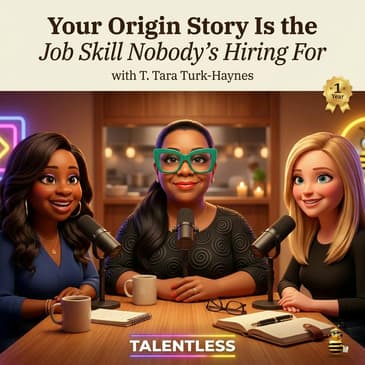
This one's special, it's Talentless's 1-Year Anniversary Episode. Thank you for listening, sharing, and showing up for us this year.
For our anniversary episode, Des and Ashley sit down with T. Tara Turk-Haynes, founder of Equity Activations, creator of The Origin Arc framework, first-generation college grad and first-generation corporate worker, and 15+ years deep in talent acquisition and people operations.
She's been featured in Lars Schmidt's Redefining HR, profiled by Business Insider, and spoken at RecFest, Culture Amp, and Living Corporate.This conversation went deeper than we expected and harder. Tara doesn't dance around the DEI rollback. She tells us why it failed (spoiler: we put icing over a crumbling cake), what The Origin Arc actually unlocks for hiring managers and recruiters, why feedback is the talent acquisition crisis nobody is naming, and why she will not spend her therapy sessions trying to convert the immovable middle of corporate America.
If you've ever sat in an intake meeting that lasted 12 minutes, ghosted a candidate after seven rounds, or wondered why your DEI work didn't stick this episode is your wake-up call.
What You'll Learn
The Origin Arc - what it is, where it came from, and how to use it in intake meetings, interviews, and one-on-onesWhy DEI failed the way it did (and the icing-on-a-crumbling-cake metaphor you won't unsee).
Why business leaders have "the attention span of goldfish" and how to embed real work into operations so it actually sticks
The feedback crisis in talent acquisition and why candidates have very long memoriesWhy "bringing your whole self to work" is a lie and what to bring instead
How to interview hiring managers in an intake using journalism-style reverse-engineered questions
Why education births empathy and what that means for managers leading diverse teamsTara's "don't care more than the people who get paid the most" mic-drop moment
AI as the great amplifier of both the best and worst of TA
Where to Find T. Tara
Website: equityactivations.com
Free download: Small business hiring checklist (for new and small businesses building their first hiring practice)
Newsletter: Linked at equityactivations.com
Instagram & Threads: @ttaraturkhaynes (where the spicy takes live)
YouTube: Job seeker advice and TA insight
LinkedIn: https://www.linkedin.com/in/ttaraturkhaynes/
Email for senior People & TA leadership roles: ttarahaynes@gmail.com
Connect with Talentless
Subscribe wherever you get your podcasts Instagram • LinkedIn • TikTok • YouTube • BlueSky • Threads
Newsletter: talentless.beehiiv.com
1-Year Anniversary Giveaway: Talentless Anniversary Giveaway 2026
Got a #DumDumTalent story? Email desiree@talentlesspodcast.com
Powered by the WRKdefined Podcast Network.
[00:00:00] Oh my gosh, people, we are back. Talentless doing the thing. And if you didn't know, we just hit our one-year anniversary and we're so excited that this is the first episode for our one-year anniversary. I cannot believe we made it so exciting, but today's going to be an exciting one. And I know you're like, where is Ashley? She's coming, but we're going to start this conversation all without her, which is going to be interesting because she talks a lot.
[00:00:29] Anyway, today we are joined by Tara Turk-Haynes. And Tara's bringing something to the show that no one else has brought yet for us. Tara is the founder of Equity Activations, a people and talent practice. She's built on 15 plus years in talent acquisition and people operations. I mean, you've been in talent that long, you got to be tired. She's a first-generation college grad and first-generation corporate worker. Also very interesting.
[00:00:58] She's been recognized by the LA Business Journal, featured in Lars Schmidt's Redefining HR, profiled by Business Insider, spoken at Wreckfest, Culture Amp, Living Corporate. I mean, it goes on. And this is the part I'm most excited about. She's the creator of the Origin Arc, which is a framework about how your story shapes everything about how you work. And we're going to focus a lot there because there's so much to unpack there.
[00:01:27] Corporate America spent the last five years saying this doesn't matter, right? You know, it says values, authenticity, bring your whole self to work. And then 2023 happened and now it's not really true, right? Right. You don't do any of that. Right. Just stop. Just kidding. So what do you think about what was the, you know, the spark of the change? Let's delve into your thoughts about all of that first. Yeah.
[00:01:55] I mean, I think there's a couple of things, right? I think one of the things is when the diversity, equity, inclusion and belonging have been around much longer than people realize. When I got my job in-house overseeing DE&I in 2020 after the murder of George Floyd, I had mentors who had been doing it for 20 years. So it's not like it's this brand new thing. It just heightened when we were all at home and being able to see images and sitting with ourselves and all of these other different things.
[00:02:24] To actually embed and make these things attached to systems, we were, one, expected to do it very quickly after decades, almost 100 years of work being not equitable. And we were expected to do it in like, what, two years, right? We were like, hey, we're going to do everything immediately. So we had a finish line when we should have never had a finish line. Yeah. In addition, we also thought, we didn't share definitions about what this work meant.
[00:02:53] We thought it was, you know, and I'm not saying we because I did not, but there are people out there who were practitioners and business leaders who were like, if we just bring in Desiree to speak about her experience as being a Black woman in corporate America, then we've done our job, right? We're talking about systemic issues and we're talking about pay audits. We're talking about biases and performance reviews. We're talking about microaggressions and talent acquisition. We're talking about all of these different things.
[00:03:21] And that's truly what diversity, equity, inclusion was supposed to be fixing is how do we remove these barriers of underrepresented people in the office or in a workplace so that they can be successful? And that means veterans, means caregivers. That means, you know, this idea of intersectionality from Kimberly Crenshaw is such a good framework to think about because not one person is just one social identity.
[00:03:50] We all have very different things. We, you know, I'm a Black woman from the Midwest. First time, you know, college graduate in my family. First time corporate worker. You know, English is my first language. I'm thinking about all the different things that make me up. And so there are parts of that that were stunted for a lot of people, right, in the workplace. And so in this move to kind of fix things, we just kind of put icing over a cake that was already crumbling.
[00:04:18] It was like, here, eat this. It's delicious. And then we bite into it and we're like, oh, but the cake's not done. You know what I mean? And so the last part I will say is, you know, God bless our business leaders, but they have the attention span of like goldfish. We'll be like, they'll be like inclusion, longing, AI, technology. You know, they just, it's so split focus that they'll move off of something. And I just wrote a newsletter about it on Juneteenth.
[00:04:48] We can talk about my newsletter later, but I said it's almost like my favorite scene in The Wiz where Richard Pryor just like goes from the color gold to red to green. Like we just, we can't even keep up. And so the cause of that now is inclusion work became something that we moved off of very quickly. And we've left it in shambles and people are trying to figure out why. And it's because these business leaders have moved on already.
[00:05:16] We didn't set up a solid foundation and we really need to embed the work into operations so that we can have sustaining impact. And that's essentially what my business is all about. Yeah. I always talk about business leaders as the dog and the squirrel. My dogs go outside and they see a squirrel and they're like, squirrel, squirrel. You know what I mean? And it's like, it is complete attention deficit disorder to like what's supposed to be.
[00:05:43] You're supposed to be focusing on it and stay focused until the job is done. And I agree with you. I think, you know, first of all, the systemic part for me is the part people really never understood and really getting to the root cause of some of the things that were happening. We were very surface level, not every practitioner, but, you know, most practitioners were just trying to fix the immediate and that it doesn't work. And it's why it's in shambles now to me.
[00:06:13] And so I struggle right now to figure out why no one's, I should say no one. When I use say no one people, please don't write me comments about, I'm doing the work. When I say no one, I mean just the general. Yeah. Have just completely stopped. Right? So it obviously was never true to begin with.
[00:06:35] If you were able to pull the plug that quickly with no effect to your organization except to go back to what you were doing before, it is really, really frightening about all the work we put in for since 2020. Like it just went nowhere. And it's sad to watch. But I think this also wraps back into the question I had for you about the origin arc. You know, did it come from this knowledge that things weren't working?
[00:07:04] Like how did you get to it? Where did it come from? And what does it kind of unlock that wasn't happening? So the origin arc actually originated because I am a writer. I'm a playwright. And I have kept those worlds very separate for so long that lately they've been sort of merging. And I've been, and I started to think about how, you know, this, this influx of the new storytelling in businesses.
[00:07:32] And when I saw like one of the first articles I saw is there's like someone starts paying six figures for a storyteller in this corporate. And I was like, what? You know how many out of work playwrights do I know who could like totally revamp your entire business structure? And you're paying six figures for that. We can barely get like plays put up because ours is being slashed as a budget. But I started thinking about how my worlds collide. And so how important storytelling is in terms of embedding who you are.
[00:08:00] And so like every time I go someplace, like already what you know about me is I'm a first generation corporate worker. I'm a first generation college graduate. But I told you that I'm from the Midwest and I'm a black woman, that English is my first. Like I fold these little things into who I am in every room because you're getting a bigger picture of me. And I feel like once we start talking about, you know, I was thinking about managers and how like managers sometimes like I did.
[00:08:26] I did an inclusion workshop and it was about 1300 managers. And 78% of them said they got no training when they became a manager. And I was like, how terrifying is that? You barely know how to manage yourself. And then all of a sudden they're like, hey, congratulations. Now you have three people. I need to figure out how to do your job and make them better. And you're like, excuse me. I don't even know what that is. How do I do that? And managers basically model the behavior of people before them. So we have had managers where we don't know anything about our manager or we may know too much. Right.
[00:08:55] And so a lot of that is just learned behavior rather than structural. And I said, how about when I think about creating a character for one of my plays, how do I build that character? And one thing you cannot do in a play is talk it through. You can't over explain because somebody will sit in that and be like, back when I was, you know, 15 and living in Detroit. And I used to say that audience will be lost. They'll be like, why are you explaining everything?
[00:09:23] You have to be able to fold things into a way where people are grasping the details of you. And there come in little drops how you show up. So, for example, the origin arc would help a manager in their one-on-ones or their team meetings. How do I expose some of myself in a way that allows you to connect to the business, to my philosophy, like how I manage you, what I care about? You know, it's not just like, you know, spending that time guessing about what your manager wants.
[00:09:52] Your manager is giving that to you. If a manager comes in and says, hey, so I'm taking Rosh Hashanah off and, you know, how work, you know, people are afraid to even say why they're taking certain holidays off or anything. Like they just don't. They think it's just too. I don't know if it's like this idea that the workplace is not where you share who you are, but people will follow you if they know what you care about, what you're about. And that you have a plan, right?
[00:10:18] And so how best to do that than using the origin arc to sort of reveal yourself as a whole person and as a business leader and be able to get people to trust you to be on board with whatever you're trying to get to. You know what I mean? Yeah. Yeah. You know, it's funny. We talk about, I must say it every other show, if not every show, that middle managers are the worst.
[00:10:41] You know, you promote a high performer, you sit them in a seat and you're like, go, you know, and it's like, it's trash. And they're like, oh, where? What are you talking about? Where am I going? Like, what am I supposed to be doing here? Right. I have no idea. No idea. They're proper tested because they get it from the top of the business and they get it from their direct reports. Like there is no, a middle manager has, I just do not envy. And they usually are under-resourced. Right.
[00:11:09] And they don't get, they don't get the kind of support that allows them to have difficult conversations, that allows them to do conflict resolution. Like none of that really is something that people focus on. As if those things don't help the business move along. If I'm spending time trying to make these people get along on a project, I'm not doing my other stuff. Right. If I'm doing it badly, at some point I'm getting to HR. But I could have gotten the skills to be able to resolve that and do my job.
[00:11:38] So we treat these things as though they're like nice to haves when they're actually must haves if you want a business to run smoothly. This episode of the Talentless Podcast is brought to you by Do Better Consulting. Hiring is broken. Job searches are broken. And honestly, most career advice out there is just recycled nonsense. Do Better Consulting exists for people who are done guessing. They work with mid to senior leaders, founders, and talent teens to get clear on their signal.
[00:12:08] How they show up in the market. How they hire. And how decisions actually get made. No fluff. No templates just to say you have them. Just strategy, structure, and honest feedback that actually works. If you're tired of spinning, it might be time to do better. Head to dobetterconsulting.net. Welcome, Ashley. Ashley's here, folks. Hi, everyone. So, so sorry. I do agree, though.
[00:12:36] I do think that there are so many managers that have never. Because managing is truly teaching. Like, can you articulate what you're doing enough to impact and, like, have the agility to meet people where they are and help them develop that? And so a lot of it is teaching. And that is just not a skill set. Just like what Des said. Like, they hire the best performer. And then a lot of their managing technique is whenever everything goes bad, just hop in, get their hands dirty, and, you know, do it.
[00:13:05] And it's like, you need to teach. You've got to delegate, honey. And that's not something that is taught, like, at all. No, yeah. I think in the idea that you don't have, like, one of the exercises they do in the origin arc is take a moment in your work history that was pivotal for you and write a monologue about it. And write a monologue from your perspective and then the other person's perspective as well. Because we don't take time to reflect, right, impact of things that happened to us and then,
[00:13:34] like, what we learned from them at all. Like, because we're not taught to do that in the workplace when actually could benefit you. Because think about how many mistakes you would avoid if you actually were just like, let me just kind of think about what just happened here, right? Like, we're just moving on to the next thing. And we don't treat that in performance reviews either. Like, if you're, well, I won't say we don't. I think there are really good performance review managers and leaders who do take a moment of reflection. Let's talk about, like, how did you think that went? What do you feel?
[00:14:03] But a lot of managers and leaders don't know how to conduct a great performance review that actually is impactful for everybody involved. It's more like, are you going to get promoted and are you going to get your bonus? Yeah, I want to get a little tactical. This is a show about recruiting and because of your experience, I want to, like, tie it in. So if I'm using the origin art and I've done the work, how does that show up in, like, an intake meeting? Or how does it show up there?
[00:14:31] So I've done a million intakes in my life. Everyone thinks that it's very logistical. No one ever brings up how they work as a manager, what's important to them in terms of communication. We shorten it to culture fit, but if we want to break that down, what does culture fit actually mean to you? Does that mean that people are communicative in a specific way to be on your team in order to be successful?
[00:14:58] What kind of manager do you think you are, right? Because that helps us understand what kind of candidates we should be putting in front of you. And if it's a mismatch, then how much time have we lost, right? So we're getting these hiring managers to reveal things about themselves and how they show up and what's really important to them in the intake meeting if we don't know them that well. But even then, if we do know them well, things change. People evolve. You know, like, you could be, like, one way last year and you're like, I had a revelation.
[00:15:26] I think that I'm actually no longer an afternoon person. I'm a morning person now. So, you know what I mean? Like, we're infusing the things that are really sort of going to make a big difference by the time we get to final decisions. And then for the recruiter, hopefully when you go through the origin arc, you start thinking about better questions to ask candidates for them, for those candidates to reveal who they are, right? What's important to you? How do you like to be recognized, right?
[00:15:53] What's a pivotal moment in your career that really, like, sort of changed how you think about, you know, collaboration or innovation? Like, how do we ask better questions for people to reveal things of themselves that really will make a difference in the workplace? Yeah. I know Ashley's really, and I'm not saying I'm not, but Ashley's really big on the intake meeting. And so for me, and I think it should be for all recruiters, I think we do a really horrible job. Yeah.
[00:16:20] Because hiring managers rush us through it or whatever, and I think there's some stand your ground moments you need to have with intakes, right? You know, you need to say, this is important, and we're going to go through every question I have. And so we come up with the right solution or right candidate profile. Anything to add on that intake part? Because I know that's your, like, really a good spot for you. Oh, like 100%. Yeah.
[00:16:45] I actually just had one not too long ago that went really, really interestingly. And so many of the intakes start with the manager being like, don't you have the JD? Can't you just pull up the JD? And that, I know, I always take a deep breath. I'm like, that's not what this is. Yes, I can read. Thank you so much. Yeah.
[00:17:06] But I will definitely say that an intake along with an interview, along with any form of dialogue at all, is really an exchange of information. That is what the whole activity is. And so the better the questions you have, the better of the interaction that this is as far as the data points that we've collected that are relevant, right?
[00:17:31] And so that is essentially where I think it starts with the intake. It starts with, sure. Are there a little bit of logistics of just ensuring that everything we got in that rec request is accurate? We're all on our, you know, you know, all the things. I was going to say P's and Q's, but I don't know if that's a bad thing to say. I need to Google it before I say it. And I just said it. I thought you were going to say it. I said it in my own brain. I was going to, but then I was like, I actually don't know if that's a bad term. I need to look that up.
[00:18:00] But so once you're on all those, now I don't even know where I was headed. I lost the caboose of the spot, which hasn't happened in so long. But essentially, yeah, I lost it completely. No, I can't stop thinking about P's and Q's. Because it is the better the questions for the intake. And for using the origin arc for me, I also have a journalism background. So when I started in talent acquisition, you know, I didn't, I did not go to college to be a talent acquisition person. I actually didn't, you know, like how many, how many people did, right?
[00:18:29] So when I fell into it and I was just like, okay, so an intake. And I just use, this is the thing that I think I love about people with different backgrounds going into, into certain industries is we bring our background and our creativity into it and we figure something out. And I was just like, well, I've been a journalist and I know the great questions if I'm interviewing somebody, what I'm trying to get at. So I brought journalism questions to the intake and I would just be like,
[00:18:56] because I'd reverse engineer, like what do I need to leave this room knowing? And so then let me just reverse engineer these questions so that I'm actually getting to those, to that information that I need. So I think it's a matter of, do you treat the intake meeting as if it's just like something to do on the checklist, right? Check done, intake done, whatever. Or do you treat it as if it's an integral part of your talent process to find the right people?
[00:19:25] Like I can't find the right people without this meeting and here's why. And then can you translate that to the hiring team and say, here's why this meeting is actually important. Because I think you might have a different definition of an intake meet. And you may have because other people have come into this room and they've asked you this and whatever. I'm a little different, right? This is how I do it. And this is why I do it. And at the end of the day, the data is the quality of the candidates you're putting through, right?
[00:19:51] I'm not wasting your time putting people through that you basically said, well, our communication styles don't even match. Like, why am I even talking to this person? Right? Waste of candidate time, your time, hiring team's time. It's not necessary. Yeah. Oh, yeah. Yeah, absolutely. On the flip side of this, just as you were talking, I think about the candidates that have to leave their kind of origin story at the door. Right there, you know, I don't know.
[00:20:18] They could be neurodiversion, immigrants, formerly incarcerated. I don't know what their story is, right? But there's some origin story that's a big part of them that they're not able to bring to the table. And so that's an interesting dilemma in its own, isn't it? It is. It's an iceberg. Well, it's the thing, right? Yeah, the iceberg exercise is something I do all the time with my inclusion workshops. But here's the thing is that you don't always – I don't believe in bringing your whole self to work.
[00:20:47] I believe in bringing the self that you feel the most comfortable bringing. Like, because I'm not going to tell you all my business because I don't know who you are, right? And I don't even know if you value it. I don't know if this is a safe space. Same with candidates. They're just meeting a recruiter for the first time. So when I say the origin story, I'm not saying completely show the above the waterline and below the waterline.
[00:21:12] I'm saying how do you make sure that the person that is the most important to represent in this room is getting that space and that airtime? For example, if you are formerly incarcerated, what are some lessons that really were impactful for you being formerly incarcerated? It's about, like, change. Like, I had a massive life change when, you know, I was 23. That really made me change how I do outlook. It made me change how I live my life.
[00:21:38] You don't have to reveal what that is, but you can say, and then here's the result of that, right? You relearned this thing. I learned this tool, this trade, and it really made an impact on me. So we don't have to just sit with the word. We can dive into the definition or get some details of how we got there. You know what I mean? And help that story come through so people get a bigger picture of who we are. I like that answer. That's a good one. And I agree with you.
[00:22:04] I don't know that I'm a different person in the world of work, but I'm definitely not my full self because I think they'd be a little overwhelmed by that nonsense. Well, and I think- I mean, historically, it's just not been safe for a lot of underrepresented people in order to do that. And again, you know, as I talked about before, you know, 2020, everyone was like, solve all these DEIB problems in two years, and we didn't. Obviously, so we're not- we're still not there.
[00:22:34] You're- you know, it's still- it's a- it's a long marathon, y'all. Like, we're still, like, trial and error, figuring things out, what feels good for you. The one thing we do know is that we can't compartmentalize ourselves at work. Like, you can't- you know, it's just severance. Like, we're literally- you know, the body are definitely the same person. We just need to figure out, like, which details can I safely reveal in this environment, right? And it's not up to you to create that psychological safety if you're an employee.
[00:23:03] That's the company and the employer work through that, and they can't be mad at you for not feeling like, I would like to- everyone's a family here. I just don't believe in that either, right? Like, we all have very complicated definitions of what family means. Using this blanket statement isn't always helpful for people. I also don't think, unless you're making exactly as much as the CEO, the workplace doesn't deserve all of you. Like, they don't- they shouldn't. And in a weird way, once I started having that concept of, like, you actually don't even deserve all of me.
[00:23:32] You're only renting based on the pay that you're giving me. You're renting this much of me, which severance mindset. But it was something that did help me start setting healthy boundaries because I can start pursuing work, like, a passion like it's my own. And sacrificing my own things to get things done because I just want them done. Like, I'm more psychotic about that than what the actual impact is that's being made for this business. Right.
[00:23:59] But it's something to where I did eventually, after going through a layoff of a company that I had put in 100 hours a week at minimum, probably for over a year. And we had to do layoffs. And I was like, not only was- because I'm talent acquisition- was every hour of those hours now all for naught. But it made me realize, like, there is no company on the planet unless the CEO is paying you exactly how much they are. And everything's split and even. And you're just a co-founder without the title. No, they don't deserve it.
[00:24:29] I have yet to meet a company that does, at least, I guess I could say. So preserve yourself, like all people. Because they just don't. I get that advice all the time. I just did that at a conference where, on a DEIB panel, I was just- because people were like, what do I do if my leadership doesn't care about DEIB? I was like, take that as a data point. Don't care more than they do. You know what I mean? You can't care more than the person who gets paid the most in the company.
[00:24:54] So it's always just about sort of you're making sure it's fractional, like, to what you get paid. Yeah. For bad burnout. You know what I mean? Also, like, you can't care more than the person who is leading the company. Hey, this is William Tinca. Listen, we did a series for iSolved called Heroes of HR where we talked to HR practitioners.
[00:25:16] And these are just your run-of-the-mill, everyday, slogging it out, 300 employees, and Cedar Rapids, HR pros. Mostly, it's centered around iSolved, and they're what they do with iSolved. But also, they talk a lot about kind of the day-to-day rigor of HR. If you're curious about that, search for Heroes of HR wherever you get your podcasts. Thank you. Yeah. It's impossible. Yeah.
[00:25:43] So companies, you know, for the last, I don't know, five years, were telling us that, you know, tell us who you are. We're all about inclusion, blah, blah, blah. And now we're removing equity from job descriptions and relabeling stuff and belonging to, I don't even know. I saw some crazy stuff yesterday, and I was like, what is happening here? Okay. Oh, I know. Now you need with some other thing. It's bizarre to me. But what do you think, what story do you think America is telling candidates?
[00:26:13] And this goes back to being able to tell your story, right? I think that one of the things that probably saddens me the most is that we're in a time frame where if people didn't experience it, then they don't actually quite understand the concept of it. Like, we are literally eliminating the concept of history and civics. And you know what I mean? Like, and critical thinking is actually on the decline. And reading comprehension levels are on the decline. These are all the studies that are coming out.
[00:26:42] Like, this isn't, this is exactly where we are. I'm not just saying what my feelings are. Right. So how do we actually just address this idea that critical thinking is on the decline? Because everything else kind of stems from that. Do people know actually the history of where they are right now? Like, do you understand? I've been studying reconstruction lately. Like, because, you know, for reasons. But we've been here before, right? And so history does actually just sort of repeat itself.
[00:27:07] And I think social media, which I live and breathe on because I just find it so fascinating to kind of see what other people are thinking, specifically from a talent acquisition perspective. Because one of my missions is to kind of bridge the gap between the talent community and candidates, job seekers, because it's very wide right now. But also just to see how people think. And, like, the discovery alone of people just, like, things that I'm like, how did you not know this? And people are just revealing things where they're just like, oh, my goodness.
[00:27:35] And it could be as simple as, like, did you know Killing Me Softly is like a remake? And I'm like, oh, my God, we are cooks, y'all. Like, I don't even, like, where are we? Like, what's happening? Where are we? These are just, like, the surface level things. So my expectation of people understanding, like, deeper concepts, maybe my bar needs to go a little bit lower. Maybe I need to figure out, like, one of the things I did when I got my DEI job in-house, I led with education.
[00:28:02] Because education is not uniform across the country. The things that I learned in Detroit, Michigan as a little black girl of a city that's predominantly black are vastly different than my contemporaries who grew up maybe, say, in Iowa or Oklahoma or something like that. We don't have uniform education. And so knowing that, I was like, okay, I'm not going to always, like, critique somebody who doesn't know certain things because I learned it or vice versa. How do we bridge this gap?
[00:28:30] Like, how do I do this organically as well, right? So dropping in little sort of bits of just, like, and, hey, did you know, like, this is, you know, I'm trying to think of something, you know, that I learned, you know, in Detroit. And thinking about, like, black history, for example. Not every, you know, background is learning my history as hard as I am. Like, a lot of people don't know who Grace Lee Boggs is or, you know, you know what I mean?
[00:28:54] Like, how do I just inform people in a way that doesn't shame them so that they kind of can access it and then kind of help them connect the dots from there? It's a much longer journey and you have to have a lot more patience. So that's the lesson for me because I am not a very patient person in general, but I've been learning to be. But I'm just like, okay, let me just flow this in, right? I just like, like, put this thing out there.
[00:29:19] You know, one of the programs that we did when I was in-house is we had a black history virtual event. And I always would put, like, an expert, a famous person, and, like, one of our employees on the panel because I always thought that it would just be kind of interesting to have that dialogue. One of the employees that I put on our panel was not African American. And he was like, so the funny thing is, hey, I don't celebrate black history because I'm not from here. I am actually from Nigeria and this is my, and I'm not even religious.
[00:29:49] And here's what, I mean, I believe in Yoruba. And people were sitting there going, wow, I never knew all this stuff about him. So, like, but I put him on the panel because there's a thing where people just think if you are black, then you must celebrate, like, black history. You must know what Juneteenth is, right? If we back out Juneteenth, I didn't grow up celebrating Juneteenth in Detroit. I did not, but I learned about it later. And so, you know, now we're starting to get into the details of what experiences and lived experiences look like.
[00:30:17] Yeah, I lived in Kansas for six months. And I'm going to tell you, that was eye-opening. Like, wait, you don't know what? You know, you don't know what the emancipation problem is. I mean, it's crazy. And I don't think this should be on black people or any of them. We shouldn't have to walk around teaching our history. But I do think there needs to be that education because so many people do not know.
[00:30:43] I mean, you can read LinkedIn posts on Juneteenth and know the education is vastly different about that medium. I'll take it even a step further, Desiree, and say that I think that if you're a manager that has a very diverse team, it is incumbent on you to understand the background of your team from a cultural. I teach this sometimes, a cultural fluency. If you're a manager, you need to have cultural fluency of your team.
[00:31:11] You need to understand what matters to all of them and their different backgrounds. And you never know. Like, I'm not even saying visually. You don't know. They can all look the same, but they come from different places, and you don't even know that, right? So, like, how do you have that cultural fluency? And the only way to do that is have deep air one-on-ones, doing things in the origin arc that allow people to reveal parts of themselves so that they can advocate for themselves in a psychologically safe environment and building that trust over time.
[00:31:39] That way you can understand, like, hey, you know, Ashley can't do 2 o'clock meetings because she's got child care pickup. And so all of our important meetings, if Ashley has to be part of them, we're not doing them at 2 o'clock, right? Like, I don't want to have to Ashley come to me and tell me that. I would just know, like, yeah, so, you know, what does your afternoons look like? As a caregiver, like, what's important to you as a caregiver? What should I know about you? You know, like, we need to have better conversations or we're wasting our time at work. We're just, like, going through the motions.
[00:32:07] And I think that nobody has money to float a business that's just, you know, going through the motions. It's bad business practice. Yeah, and I do want to say, I think we forget that these tie right to revenue and profits at the end of the day. Like, if your whole thing is profit, then you should be doing some of these things because it's just proven that they increase profits and revenue. Sorry, I'm a revenue profits person.
[00:32:31] And so, like, just stop for a second and know that happier people generate more productivity, more innovation. I'm all for doing the right thing, but you know what? Doing the right thing is I'm relying on you and your character, which I don't know anything about, right? I am all about, like, this is how this ties to a better functioning, healthy company. And so this is the reason why I invest in these things so that everybody can then help. Like, I mean, we live in a capitalist society. Like, we can't ignore that, right?
[00:33:00] Like, there's a reason why you have a business. You want to make sure the business is successful because everybody benefits from a successful company, especially if you have equitable pay practices. Yes, absolutely. The one thing that I will say that everything that you were saying reminded me of. So literally, I made up this quote. The only thing I ever made up, but I don't even know if it's cool. I'm about to say it a lot. But anyway, the point is, is I used to say there's a quote that always said, all that evil men need in order to succeed is that good men do nothing.
[00:33:30] And I call cuckoo bananas on that quote. And I actually think it's that all evil men need in order to succeed is that good men be uneducated. Because then not only will they do nothing, they will work for you doing the bad things. And so I think that education, whenever it comes to American history, whenever it comes to understanding so many different things,
[00:33:55] if you want to prevent and minimize harm as a manager, then that means that you're going to need to know these things. And I also feel like education births and grows empathy, which I honestly truly feel is half of the indoctrination logic as to why it is so inconsistent in learning. Yes.
[00:34:17] I lived like 30 miles away from Galveston and never even heard of Freedom Day, of Juneteenth, anything like that until I was in graduate school. I didn't even know that the rebel flag, sorry to have to say that out loud, trigger warning to the world. But what that even was, I had no idea. And I was like in graduate school finding it out in class because I was Googling it because someone in front of me was talking about it. And I was like, huh? I was like, I've never heard that in my life. I don't know if that's true.
[00:34:46] And I looked it up and I was like, I started crying. I was like, oh my gosh. Because I realized I was like so many people in our hometown have that sticker on their truck and have it. It's like people are driving behind us the whole time. I'm like, because the people in front of me, I was like, I cannot believe this. And they were like, oh, do you want to learn more? And so that for me, graduate school was my breakdown where I had my own kind of personal reconstruction and kind of got to gain a little bit of that cultural fluency.
[00:35:10] But taking this back to managers, what you said is so key because if you do not take the time to educate yourself, like I had a few employees that were from Egypt. And I didn't know what Ramadan was or how it moved and different things like that. So even just having meetings where it's like, hey, sometimes you have snacks on meetings if they're on this call because they're in Ramadan. We're going to take it off camera or whatever.
[00:35:33] Like just courtesy tiny things that we could learn from them or change or alter to better benefit. And it truly did too because they don't really celebrate like Thanksgiving and a lot of other things that we had.
[00:35:47] So we were able to trade like just things that were so cohesive and good for the business and produced good productivity because we were willing to ask the question, get educated, grow in empathy, and then actually practice that cultural fluency aspect as well. So, no, I think that you completely nailed it. I also think that this is all 100% by design and it sucks that we have to re-educate absolutely every single person that walks into corporate America because holy smokes, y'all.
[00:36:16] And I co-sign on everything that you said. And I just feel like one caveat I will say, and one of the things I think a lot of DEI practitioners learned in 2020, 2021, is there are going to be people who are resolutely, unabashedly not going to move. You know, I use employee engagement and I use sort of that employee engagement framework.
[00:36:40] When you ask a question and you're like, how, you know, are you likely to recommend this company to other people? And when you get the results back, there's like a red where it's like, no. And then there's like the green and it's like, yes. And in the middle, there's the gray. I'm like, my efforts stop at the gray and I go forward.
[00:36:58] Because if you're so dug your heels into believing that this work does not matter, I have no magic wand or magic powers that are going to change your insides to make you the kind of person that will actually make your life larger. Because I tell you, our goal is to make our lived experiences wider instead of more narrow. So if you like living in the narrow, then this work will never be for you and I will not spend time trying to bring you over to this side.
[00:37:25] I don't have that power and I'm not going to burn myself out in order to do that. I've done that. I would like to use my therapy sessions for better things than to talk about like why somebody pissed me off because they thought like, what do you mean? It's a neurodivergent issue of people don't turn their cameras on for a meeting. And I literally happened at work and I was like, I think I'm having a heart attack. This is trying to make me crazy. And I don't understand how you can't make that connection. Right.
[00:37:51] And it's because like we just pour into the wrong places sometimes. Yeah, we do. Absolutely. Well, you know, I can't get off of this call show without talking about AI. And I was like, no, I got to go there. Tell me your actual thoughts about it, how it affects the work that you're doing, how it affects people and their stories, whether it flattens them, helps them, all this stuff.
[00:38:19] So early on, I was lucky enough to take an AI ethics course with Dr. Jade Singleton because I wanted to know more about it. And like that's what I do before I start running my mouth off about something. I just try to figure out how much information can I get. And then this is when I started thinking more in-depthly about like climate change, obviously. And I also am very practical. We can't put a genie back in the bottle. Like it's here, right? And it's been around for 100 years at this point.
[00:38:45] You know, we just literally had an increase because of a couple of people who were just like, I'm just going to make this a hostile takeover of corporate America. Right. And I'm going to make a lot of money out of it. Before it was just like some chatbots that we didn't even know about. And we're just like, hey, that's fine. But now we're like, hey, it's going to take over. I think there's a lot of things. The technology is moving faster than a lot of our critical thinking. So this is one of the reasons why we're having these such interesting conversations about it. I mean, I don't know about you. I do use AI regularly.
[00:39:15] And I don't foresee it taking over my job anytime soon because there was a whole day where my AI agent thought my last name was Brown and it could not tell me why. And so I was like, well, you know what? And we fight all the time. So I think there's this idea of like the shiny PR version of AI. And then there's the actual practical thing of most of those who work in it. We know what its capability is. Yes, it learns pretty fast. There's also a lot of things we don't know about it. I think there's a lot of, you know, once we get to tokens, how much is that actually going to cost?
[00:39:45] So all these leaders who were just like, ha ha, everyone's laid off because of AI. It's going to be so great. And then they're like, wait, how much does it cost? And that's another way. It's more than Desiree's salary. Right. This is Desiree. Let me go get Desiree back. Secondly, I mean, again, we are also very conscious of the fact that the LLMs are learning what they learn. We have a lot of discrimination cases that are out there. That's because there were people behind the AI push who just rushed out and said these things are going to be better.
[00:40:14] I don't blame the AI technology itself. It's going to do only what the human is allowing it to do. Right. So I think somebody, there was a TA person early on who said, AI is going to reveal all the cracks of talent acquisition. The human part of talent acquisition. Yeah. And amplified. Right. Amplified. That's what it's going to be designed to do is like whatever process did not work, AI is going to amplify that. Whatever your philosophy was that is problematic, amplified.
[00:40:44] So I think if we take the time to learn that lesson, there's some hope behind it. Also, if we fix the climate change piece and the data centers piece, there's a lot of things. Thank you. Yeah. I feel like we're going to run out of water before it's even a real concern. We've got some things to sort out before it becomes the thing that's literally just going to change our life. Before it becomes like computer from Star Trek. Like we have some things to work out. We agree. We've said the same thing. And the climate thing is a big deal to us.
[00:41:12] And so, you know, like Ashley always says, we're going to run out of water before it takes over the world. So it's like it like runs out in two weeks. So, I mean, I don't know. But I agree with you. I agree that, you know, what it will do is in talent acquisition, it'll point out the weak spots. And we better be ready to fix them because it's here. Right. And the ones that can't fix it. I don't know, man. I don't know. You're going to get real. It goes back to that patience thing we were talking about.
[00:41:42] It's not this. We have this idea that we're fixing things overnight and we're actually not. And so if we can stay patient and actually observe and analyze what's happening real time and then start formulating our thoughts as a TA community that really is trying to change and make impact, then we're providing solutions. I don't think the answer is being like, AI is ruining the world. You all suck. Why are you doing it? It's too late. It's too late. We're here already. You know what I mean?
[00:42:09] So now we have to come together and just be analytical and be good stewards of information and then try to address things from that perspective. All right. This is my last question before we get a talent outside the box. What one thing in HR talent acquisition is a best practice right now that you think is actually damaging the people it claims to serve? We have a feedback crisis that I don't think people understand. I just did a post about this. I was on threads.
[00:42:39] And was it rage bait? Was it created? I don't know. But someone posted some feedback they got from a recruiter that was pretty detailed. And the amount of people who engaged with that post literally dying for that kind of feedback in the TA process. The way we talk about our technology and it's making us so much better and so much faster and we're getting so much more details is not translating to the candidate. Candidates are not getting any feedback. And I'm not even talking about ghosting.
[00:43:05] I'm talking about if you go through seven rounds and then they say, thank you so much, but we decided to go with a different candidate. Seven rounds and you don't get any feedback at all, but you have all the tools to be able to give them the feedback is ridiculous to me. And this is something that's human centered. This is on us. This is not our tools. We have the ability to be able to add that feedback. And somebody in my comments said something like, there's no recruiter who has time for that.
[00:43:33] I have been on the phone with crying candidates. I have written paragraphs of feedback to candidates and remembered them from jobs later. That just means this is just a reflection of your relationship to your talent pipeline in my perspective. And so I feel like this feedback crisis that we're having is going to reappear. This job market switches back. If we get back to where, you know, AI failed and now we need a bunch of people to come back and do the job, there's going to be some candidates with very long memories. Yeah.
[00:44:03] Very long memories. And they're like, I remember actually when I applied and, you know, Went through seven rounds with you or you go so many or, you know. Right. And you just said they just went somebody whose needs closely more fit the role. What does that even mean? You know what that means. I'm going to tell you, I got one of those the other day and I was like, what does that mean? You have the scorecards. You can literally just say this person actually has more experience in X, Y. You can do this. Why are you not doing this?
[00:44:33] And I will say it's kind of a perfect example of exactly what you said earlier. This is an example of AI amplifying the cracks of a recruiter because it's giving us the bandwidth, the time and the ability to automate these type of things if we so need. We know how to make a prompt that says pull out X, Y, Z and just give it to me. Reread it. Proof it. Like all these are two clicks of a button. One, this is a the recruiter was never going to do it for you anyway because this was a recruiter problem. A hundred. And that's it. It's exactly this is the whole sample.
[00:45:02] Yeah, absolutely. All right, folks. This is the time and place. You know it. Talent outside the box with Ashley King. Okay, so we're actually going to do this a little bit different because we did this with Melissa and I kind of liked it. So I the question that I would like to ask you and I'm going to answer it based off of mine, but I want yours to. But the question is this, if you wanted to make someone a better manager, a more empathetic, what would be the one or two things that you would tell them to learn?
[00:45:32] So sit with that for a second because I'm going to answer mine. But the two things I would tell them to learn and these were foundational at and are foundational at Talent Ed, but it's specifically historical context and its creation of macro systems within employment. Like that it's that connector piece of like this is why this is what this is.
[00:45:56] And so because there are people who will think they're doing great things, but actually in the macro system of it all, you're not. I.e. negotiating salary with a candidate. Right. Like we're all told saving that 5k for that company is really going to change. No, honey. Like that's one dollar, two dollars an hour at most. Company don't care about it at all. That's chump change. And you're actually better giving that 5k to the individual so they can pump their own community and take care of themselves versus. So things like that.
[00:46:22] But it's specifically the one to two things that I have is more of the historical context and its creation and correlation to macro systems. All right. Tara, what would you tell us is yours? I'm so curious. I'm dying. Oh, my God. Well, for me, I think I would ensure that they always know how to figure out their why. I think that a lot of managers go on autopilot and they don't think for themselves.
[00:46:47] And so if you are not able to articulate why you're doing something, then we need to examine that. You'll become a better manager once you can explain why you're doing something. And then I think that I mean, obviously, I think storytelling is going to be the next thing, because how do you connect what Ashley is doing to the success of the company? Right. How do you connect why this job is open? Why now? Why in this team?
[00:47:16] And ultimately, what does success look like? How do you articulate that to different people, by the way? Because how I tell that to Ashley is going to be different and how I tell that to Desiree, because you receive information differently. Right. Your cares are different. So how am I able to tell the story of why you're so important and critical to this business from a larger scale?
[00:47:38] So if you can't articulate your why and you can't tell the story of the business and the story of purpose, then it's going to be hard to be successful as a manager. Yeah. That was great. Such a great point. Such great points. That was really, really good. Tara, where can everybody find you? Sign up for the origin or tell me all the things in the newsletter. Yeah. Go for it. So you can go to my website, equityactivations.com.
[00:48:02] If you're a small business, I built a small business hiring checklist for free for small businesses. This all came because I was on threads and I saw a lot of, you know, with all the black women who've been pushed out of the corporate workplace, there's a lot of them who are becoming entrepreneurs. A lot of them who are not well-versed in hiring. A lot of people who are not well-versed in hiring. That was not their mission. They don't live and breathe it like we do.
[00:48:26] So I created a structured hiring checklist for them, just basic so that they can at least get their first one or two employees off the bat. It's free. You can download that on my website. All of my other links. I have my newsletter link there. I have a YouTube channel. I'm on Instagram. I'm reaching people from different methods. All of us pros are on LinkedIn and we're all just talking to each other. So I'm on LinkedIn. We're just talking to each other a lot of the times. I want to reach people who are not like there. And so I do spend a lot of time also on threads and I'm very spicy there.
[00:48:56] So just word of caution. But see Tara Haynes on Instagram and threads. But I think those are also linked on my website as well. So the website is the go-to for everything and you can find me in all those places. Well, it's been fantastic. Listeners, here's what I'm taking from this one. Every hire is a story. Every interview is a story. Every team is a collection of stories.
[00:49:20] And the companies that figure out how to really listen and actually listen to use origin stories as their strategy, you're going to be the ones that win. Go build your teams. Go do things right. Go get those stories. Have receipts. Do all the things. And then you build the credibility to prove it. Thank you so much for joining us. It's been fantastic. You are wonderful. And we will have you on again because this kind of conversation could have gone on for two hours.
[00:49:49] So I appreciate it. For two days. Why limit us, girl? Let's just do a conference. Yeah, a whole conference already created just now. Beep. Well, to the listeners, we will see you next time. Listen to us next time. Follow us on LinkedIn, YouTube, Blue Sky, Threads. All the things were everywhere. And if you haven't joined our giveaway yet, go to Talentless Anniversary Giveaway 2026 to win some prizes.
[00:50:19] Thank you. Bye. Bye. Bye. Bye. It's still going.
Sponsors
