
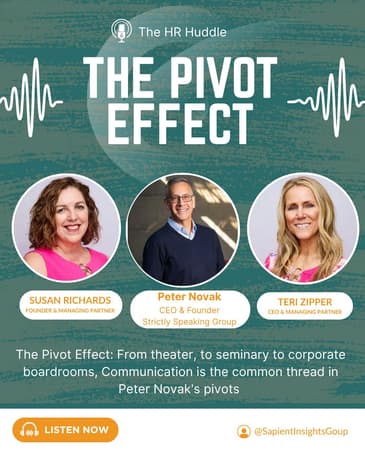
On this episode of The Pivot Effect, hosts Teri Zipper and Susan Richards sit down with Peter Novak, founder and CEO of Strictly Speaking Group, for a conversation that spans seven years in a Jesuit seminary, a rare doctorate in dramaturgy, twenty-two years teaching at the University of San Francisco, and a second career coaching some of the world's biggest corporations on high-stakes communication.
Peter shares how his winding path from theater to the priesthood to academia to executive coaching taught him that every human problem is, at its core, a communication problem. He dives into the unique challenges non-native English speakers face in the workplace from accent bias to phrasal verbs to the surprising research on what "confidence" actually sounds like in English and makes the case for keeping the human at the center of communication in an increasingly AI-driven world.
Whether you're navigating your own career pivot, leading a global team, or just curious how a Jesuit seminarian ends up coaching Fortune 500 executives, this episode is full of insight on the skills that transfer across any career and why it's never too late to pivot.
Powered by the WRKdefined Podcast Network.
[00:00:01] Welcome to the HR Huddle Podcast, presented by Sapient Insights Group, the ultimate resource for all things HR. It's time to get in the huddle.
[00:00:23] Hey everyone, welcome back to The Pivot Effect. This is the show with Susan Richards and myself, Terry Zipper. This is the show where we talk about you. We talk about you as an employee, as a leader, as a mentor, maybe a coach.
[00:00:43] What's possible in your future and how to get there. If you're feeling stuck, if you're following rather than leading, if you want to lead, or you just feel like you've outgrown what you're doing and you want more, we got you. We like to focus on the skills and abilities you need to thrive in the future of work, regardless of the work that you do, because there is always a future. Sometimes we just have to make it.
[00:01:13] Today's guest on The Pivot Effect is Peter Novak. Peter is the founder and CEO of Strictly Speaking Group, who went through seven years in a Jesuit seminary to earning a very rare doctorate degree, which we'll let him talk about. He's got a long career in theater and social justice and just a very high profile in this space.
[00:01:39] And we're excited to have him. I mean, it's just he's done a lot, done a lot of pivots. And I think our audience is really going to identify with some of the things that Peter has been doing. So welcome, Peter. Peter. Thank you so much. It's great to see you both. Thanks. We're looking forward to what you have to share with us today. Yeah, I think it's gonna be really interesting and really fun.
[00:02:06] Before we do dive into that, though, why don't you just for the listeners who don't know you, tell us a little bit about your first career. Like, what drew you to your first love, which sounds like was the seminary, but maybe there was something before that. Tell us about that. Sure. I, you know, I was, I was in undergrad and in theater and I wanted to do something more.
[00:02:31] So I applied to do my MFA in acting before I had even finished my undergrad and got accepted to the American Conservatory Theater in San Francisco. And so it was, it was in the 80s and I moved there. And as I was doing my MFA in acting, my third year was a project working for the National Theater Workshop of the Handicapped in New York City. And I, it was there and it was run by a Jesuit brother.
[00:03:01] And while I was still in acting school, I started going to a spiritual director and realized after acting class that I wanted to become a Jesuit. And so as soon as I finished my MFA, I entered the Jesuit order and it was seven years of my life from the ages of 23 to 30, you know, sort of peak years that they had me do incredible.
[00:03:29] It was an incredible, it was an incredible time of my life. And, and I really learned an enormous amount, not only in the official courses in philosophy and theology, and I did another master's degree in English literature. It's like, oh my gosh, enough school. But then I ended up doing more. And so, and so I really learned a lot about discernment, you know, a process of decision making around servant leadership that I thought was really interesting.
[00:03:57] Um, and it was in those seven years that I also was teaching at Santa Clara University. And that's where I really started to learn to love teaching. Uh, and so those first seven years, they, they had me doing so many different things from working in, um, you know, uh, the hospital as a hospital chaplain, uh, working with HIV AIDS patients at the time.
[00:04:21] Um, just doing an enormous amount of, of different experiments, they were called, um, including, um, living in Tijuana and, um, smuggling medications across the border to a, a group of nuns who ran a clinic. I had no idea we had a smuggler on our podcast. I don't know. I hope this isn't live. Um, the, it was, it was an amazing thing.
[00:04:49] We'd go to doctor's offices and pick up all their samples that they weren't using, um, you know, around in, I did, I did mention the city in, in, in Mexico, but anyway, around in, on the U S side and then would bring them into Mexico so they could use them for their clinic. Um, really smart way to use all those samples that, you know, don't often get used in a doctor's office. And, and so it was a really great, great opportunity.
[00:05:12] Anyway, that was my first career basically doing, doing that and, and teaching at Santa Clara for three years. Um, and at the end of it. That's an interesting, like, yeah, we'll have to figure out later how to apply the, um, that skill to the rest of it. Yeah. I'm sure it applied somehow. We call that missionary work. Right.
[00:05:38] Anyway, since that was the first, I mean, yeah, that's fascinating. Yeah. I mean, um, was there something about what drew you to that when you were doing theater? Like, I know you just started talking to, you know, meeting with this, this, this guy, but was there something, some spark there? Something that said, Ooh, I, this is something I got to do. There's something about the community.
[00:06:04] There's something about Jesuits who are very, um, much about education, uh, in the world and about social justice. All of those things really appealed to me. Um, and so, and so it was, it was a, it was a wonderful life for seven years. And, you know, you take vows of poverty, chastity, and obedience.
[00:06:26] And, um, you know, poverty and obedience were not as difficult, you know, as chastity was. And I, I think what happened is I decided that if I, if I couldn't live the vowed life with the authenticity that it needed to be lived, that I needed to, to leave the order. And so that's eventually why I left.
[00:06:51] And, um, and it was a very difficult decision, probably one of the most difficult decisions of my life, because for seven years, you know, you, everything you do, your daily lived existence is sort of, sort of. You know, you're taken care of and programmed and you know where you're going next and you know what you're doing next. And, and then all of a sudden I found myself, you know, at this crossroads and I decided to apply for graduate school. Yes. One more degree. It was driving. It was unbelievable. More school.
[00:07:20] More school. Exactly. Cause it's safe. It felt safe. I think, I think that was part of it, you know? Um, It was a place to land, right? Like it sounds like you hadn't quite figured out where you were going. So you needed an interim step. That's right. And so, and so that's what, um, Yale became for me. I did a degree in the most obscure field ever and no one, no one knows what it is.
[00:07:46] Um, and so I'll tell you, it's a degree in dramaturgy and dramaturgy and dramatic criticism. I know nobody knows. And the word, this is even worse. The word for, um, the role is called a dramaturgy. T-U-R-G at the end. It sounds dirty. It sounds horrible. It's a, it's, it's a horrible word. Okay. So we're talking about sex and drugs. Are you also part of a rock and roll band, Peter?
[00:08:16] I know. That's the only thing that's missing here. I can't believe I said all these things. We are going to get the explicit rating on this podcast. You really are. This is me. This is who I am. So, so that degree, um, you know, prepared me. I, I, I started working at Yale. I was teaching there and then I became dean of one of the colleges at Yale, one of the residential colleges.
[00:08:41] Um, and, you know, in between that time I met my partner, uh, who lived with me at Yale and lived in the dean's quarters and we had daily life in the college and it was amazing. Uh, great opportunity. Uh, I finished my, my doctorate by translating Shakespeare's play 12th night into American sign language for deaf audiences. Um, wow.
[00:09:03] And so did a whole, with a whole team of, of actors and, and dramaturgs and other people. We sat down for two years and we videotaped the entire 12th night play. And it was a labor of love. It was very difficult. We did a full scale production of it. And, um, and so it was a really valuable, rewarding time of my life. I learned an enormous amount.
[00:09:30] Um, so weird, weird degree choice, but, um, it, it landed us an opportunity back in San Francisco at a Jesuit university, the university of San Francisco. And so it all kind of tied in together where I started my, uh, I started the program in performing arts and social justice at USF. Um, so that was. Sounds like a lot of what you, yeah.
[00:09:56] A lot of, a lot of your past experience really prepared you for what you were doing. And it sounds like you brought a lot of that, that skill to the next thing. Like, how do I apply what I did in Jesuit, uh, you know, school into drama and theater and, uh, and teaching. And then went full circle, um, back to teaching. Interesting.
[00:10:23] So, um, tell us about that, the, the pivot from the, the teaching to what you're doing now, Peter. Um, you know, I, cause, because it seems, it seems very different and then oddly all connected at the same time. It's, it's true. I, um, so now I, so I was teaching at USF for 22 years, I think it was.
[00:10:48] Um, and, and, and I was also a university, uh, vice provost. I was in charge of student affairs. And, um, and that for me was probably the most challenging job I've ever had in my entire life. What made it, what made it so challenging, Peter? Oh my goodness. Um, first of all, the diversity under your portfolio is, I'll give you, I'll give you an example of everything that I oversaw.
[00:11:17] So I oversaw all housing and residence life. So all the things that goes on, happens in dorms, uh, and how to, you know, right. Yeah. I was in charge of academic advising. I was in charge of the police, the campus police and security. Uh, I was in charge of the student governments, both graduate and undergraduate, student disability services, counseling and psychological services. Uh, the dean's office for disciplinary things that happened, title nine for sexual assaults
[00:11:46] on, on college campuses. I mean, just, it went on and on and on. So they gave you everything that nobody else knew how to deal with. The, I, it, it, it is for any person who is in student affairs. If anyone is listening out there, um, good on you for doing this work because it is the most challenging work in a university. It is incredibly difficult. The, you know, you are dealing with parents, with students who are having challenges with
[00:12:15] faculty, everybody sort of comes to you for things and it's really challenging. Um, and that was five years. And, um, and I think I got burned out. I actually think I got burned out and went back to teaching, but only for two years, I was doing this coaching on the side. Um, I was doing speech coaching for, it started off working for a woman in Silicon Valley who was quite well known.
[00:12:45] And she reached out to the theater department and said, can you work with me? And I said, sure. Uh, and then she recommended me to someone in a corporation and then it ballooned and it started going from there. And so I started developing a company called the strictly speaking group, which does high stakes event coaching for major corporations, one-on-one coaching for executives, uh, and, and workshops.
[00:13:14] And we did workshops for a lot of companies under the DEI banner, which is sadly disappeared in corporate America. Um, and I don't think there is a structure yet to figure out how to address the gap that is there.
[00:13:35] And, um, and, and the company has sort of ballooned and now we've got, um, full-time and part-time employees and where we travel all over working on events. And it's really, really interesting. How did I get from performing arts and social justice into working with some of these major corporations? And, and for me, I think my specialty is working with non-native English speakers.
[00:14:05] And because of that, um, multilingual speakers face different challenges, I think, in the working environment and challenges that I don't think native speakers even think about. I don't think they even think about it in, in meetings, uh, when other people are presenting, they, we as native speakers don't have much consideration for non-native English speakers
[00:14:32] and what's actually happening for them in a meeting or when they're presenting, uh, and when they're, you know, in conversation with us. And so, so that's been my focus. That's fascinating. Can you say more about the experience of a non-native English speaker in some of those high stake environments? Um, because, you know, one of the things that we want to do in service to our, our clients
[00:15:01] who are listening to the pivot effect is to bring more awareness for what's happening around us. And as we become more global, a more global community, um, we, we want to heighten that awareness. So talk to us about what that, what that looks like and feels like and what they're experiencing. You bet, you know, um, for, and, and, and this is, there are a lot of global companies out there.
[00:15:27] And for many of them, English is the language of business of day in day out business, even if they're not the based in the U S. And I think we even tend to say we're an American company when, you know, working for companies when really we should be saying if we're in the U S we're a U S based company, because even the term American, um, covers North and South America and Canada and, you know, all of, you know, the Americas essentially.
[00:15:57] And so I always say U S based and, and I think, you know, I, I, I sometimes start my workshops by saying, if you're, if you speak four languages, you're quadrilingual. If you speak three, you're trilingual. If you speak two, you're bilingual. And if you speak one, you're probably born in the U S or, or Canada or Australia, because, you know, 75% of people born in those places speak only one language.
[00:16:25] And for a non-native speaker, uh, in a meeting, for example, uh, with native speakers, there is so much quickness that happens. And so that it, things move very fast and even just trying sometimes to find the place to say what you want to say can be a challenge. Uh, and then there's accent bias. Accent bias is, is huge.
[00:16:50] There's lots of, uh, really interesting research and data around, uh, people who have an out group or foreign accent often don't get promoted as quickly as native speakers. Uh, and it has nothing to do with intellect. And so one of my favorite things to say, which was from a person I was interviewing actually, is that it's not an accent.
[00:17:13] It's an identity and it carries with you your culture, your background, the places you've lived oftentimes, because sometimes it's not just one place. And so our accent changes oftentimes, and it carries that identity with us. And, and in a meeting, um, non-native speakers are, are registering tone shifts and differences in register, how formal or informal they should be.
[00:17:42] They are listening for the content and formulating for themselves what they want to say. There's so much more going on in terms of, you know, vocabulary and processing that, that native speakers take for granted. Yeah. And I've always marveled at the number of words we have and that mean the same thing, right? I mean, that must be very difficult to, to try to master. It is.
[00:18:10] And, and then as native speakers, we often speak, it's not just metaphors and it's not just idioms, you know, like knocked it out of the park and things like that. There is something called a phrasal verb. This is one of my biggest things for native speakers, because we don't know. Do you, do either of you know what a phrasal verb is? No, but I have a feeling we're going to learn.
[00:18:37] A phrasal verb is usually a verb that we use like the word take. And then we add to it a preposition like take out, take over, take off, take on, take up. And all of those mean something completely different. Not only that, but within that phrase, let's say take off, take off can have seven different meanings.
[00:19:05] Um, Oh, Susan took off her sweater. Um, Terry's flight takes off at noon. Um, the doctor took me off my antibiotics. Um, the salesperson took off 20%. Uh, it just goes on and on and on all the different examples. Right. I told him to take off. Right. Means get lost, get out of here. There's it.
[00:19:34] So, so all of the, and we, and there's thousands of them, thousands of them and native speakers use them every single day. Without it. We don't even think about it. We don't even know we're using them. And then we just pick up words too. And then we pick up words. And we use lots of sports metaphor, lots of American sports metaphor. Yes. Yes. Oh my goodness. It's exhausting for folks.
[00:20:00] And so part of it is recognizing that experience for non-native speakers. Yeah, that's interesting. I think people would, you know, if you've lived overseas and worked in that environment, in the local environment, you, you can recognize more of that, right? You start to, um, empathize with it, understand it. Um, but it's, it's not, it's not easy.
[00:20:29] And most of the time, if you're working overseas, again, you're speaking, they're generally speaking English for you because that's the, the language of business. Um, because there's other people in the room and everybody doesn't speak whatever the local language is. So. That's right. Um, yeah. And, and really interesting studies around what happens is when a native, when an, uh,
[00:20:54] an English only speaking person enters the room, the, the team before that was probably speaking some in English, some in other languages. They were code switching between them. There was more, um, space between, uh, pauses. There was more pauses. There was more questioning and answering, uh, going on. But when a native English speaker enters the room, all of a sudden, all of that sort of disappears. And so it's more competitive, uh, turn taking is faster.
[00:21:23] All of these things sort of happen. And all of that linguistic complexity goes away that they had been using to navigate so many different things. And so it's a really interesting dynamic. Um, there, there was a great study that came out from McGill university that said, um, it's a, it's a great story. And basically it went like this. Um, let's say you're in a, a, a city where you, you don't know where you are and your car
[00:21:51] has broken down and your phone has no juice. So you have to ask somebody. So you ask someone on the street, where's the local garage? And one person sends you in one direction, you ask another person. So the first person sounded like you, a native speaker, whatever that is. The second person sounded like they were foreign, not, not from here, not from wherever that country is and sends you in the opposite direction, exact opposite direction. Who do you, who do you tend to trust more?
[00:22:21] And the answer is you tend to trust the people who sound like you more, unless, unless the person who speaks with the out group accent speaks with confidence, right? And that diminishes that gap in trust. If they are very self-assured and how they're, uh, you know, giving directions to the garage, but that begs the question, what does confidence in English actually sound like?
[00:22:51] Right. What do we listen for in English that says, huh, that person is confident and you can't use phrases like self-assured because that doesn't mean anything. How do you tell someone to be self-assured when you, it's the same thing as confidence, right? And, and the study looked at elements of prosody, which is volume, pausing, uh, inflection,
[00:23:19] tone, body language, even, um, outside of prosody, all of those things matter. And so really great studies that say you do not have to change your accent at all to be more confident in English. And I think that observation has really helped me shape, uh, how I work with non-native speaking, non-native English speaking executives, uh, in the workplace.
[00:23:47] And, you know, fast forward to today, um, how, how has all of that come together and, um, and kind of written your next chapter and what makes, what makes your organization and you personally successful and passionate about the work that you're doing now? It's so fascinating.
[00:24:12] We were in a, I was doing a workshop, uh, just last week and, um, the VP of sales was, was in the workshop. It's a huge company. And afterwards he came back in with his chief of staff and said, this is really, everything we do is about theater, isn't it? That's about, about having, um, really good communication skills that are intentional. And I said, yes, that's exactly what it is.
[00:24:42] If, if corporations spent time the way a theater company does on crafting and shaping the language and on helping the people who are communicating that message really communicate more strongly, um, I really believe that every human problem is a communication problem and can be solved through communication.
[00:25:07] That's why large language models are based on language and community. It's the only way we have to actually get things done. Now, LLMs are prediction based and it's different, but, um, you get the idea. That, that really intentional focused language, uh, is an incredibly useful skill to have. And so that's when I, I do, I think all of it's theater.
[00:25:36] So my role as an actor, as a dramaturg and shaping the meaning, the content of what's happening, all the elements of production, we do all of that and help people think about how that's going to affect, uh, their message, uh, and, and how people accept them. So it's a really bizarre twist of fate that all of my experience in literature and theology
[00:26:01] and philosophy and language and sign language and, you know, communication all have come together under this umbrella, um, that I never, I never imagined my skills would be useful outside theater, never thought they would be. And then all of a sudden it's like, Oh, huh. I know some things that other people don't know that are applicable.
[00:26:27] And so really I was just, it's such a great time of life actually to be, you know, 61 and to have this new career that has been, um, really exciting. And I learned constantly different fields, different areas of business because every business needs this.
[00:26:50] So whether it's finance or med tech or pharma or insure tech or, you know, social media, whatever we, we work for, you know, major, major corporations. And I learned a lot about what's happening in the world through them. Yeah. Yeah. One of the things that really excites me about this conversation, Peter is, um, yeah, having a liberal arts background myself.
[00:27:15] Um, I, you know, I was, I was told you're never going to be able to, to find a job, much less build a career with a liberal arts degree. And, um, and, you know, kind of fast forward to today when critical thinking and the ability to weave things together and communicate are so important.
[00:27:38] Um, I, I'm excited about your story because it shows really where I, and I'm thinking maybe theater was in liberal arts or in something related. Um, it shows where, you know, no matter where you start, um, there's always a path forward and there's always a way to bring in your passions. And I would, I would love to know what kind of advice you have for those early career,
[00:28:07] mid career, even some of us who are starting our second or third careers. Um, what would you, what advice would you give them as they're kind of taking into, into consideration all these crazy things that they've done and how they could put those together into something that they're passionate about? Yeah. Yeah. I, I remember when I was young and I, you know, I said, I said to my parents, I want to do something practical like theater. My parents were like, no. What?
[00:28:38] We failed. Yeah. Right. And, and now I feel like, you know, if you want to get something done, hire a theater kid because the skills that they developed, that we developed. Are around team building, around collaboration, around structure and schedules and rehearsal and delivery. And, and they're incredibly well organized, you know, most of us.
[00:29:06] Um, and so, and so it, it really is, um, I think a skill that transfers outside into any, into any area of life. And I think that's the advice is that you've got skills, no matter what you've chosen to do and what your experience tells you, what you've lived and that you can adapt those skills. Uh, and, and sometimes it's tough to think about what those are.
[00:29:34] I honestly, I never thought that what I knew would be applicable, uh, in, in the quote unquote real world, because we worked in the world of plays and playing all my life. Um, and, and, and I think it will surprise you when you realize that your experiences have crossover benefits in so many other areas of, of whatever you choose to find passion in,
[00:30:00] whatever really ignites, you know, the, the passion word, actually the word passion is Latin for to suffer passus, uh, which means to suffer, um, you know, for your art, for your craft in some way, but, but definitely, um, you know, passion there's, there's a, there's a part of struggle in there. Um, so that's my advice. And it's all worthwhile. It is all worthwhile. Every experience is worthwhile. Every one.
[00:30:28] Um, it really helps make who you are. That's wonderful. Those are some great examples of, I think the skills that are going to be needed in the future because those, some of those, the collaboration, you know, those are things I don't see, uh, AI replacing, right? These are, these are things that as individuals, we still need people and those people, experts to be able to, to get things done. Um, how to, how to be present.
[00:30:59] Critical skills. Yeah. Exactly. Yeah. And, and how to make your, your clients or whoever you're working with feel seen and heard and understood. That's right. Um, you know, I, I don't care how good, um, our AI is. It's, I don't think it's ever going to replace that. I hope not. I don't want to live in that world. If that happens. I don't want to live in that world either. Anyway. Exactly.
[00:31:29] Um, I like to say we're putting, you know, the human in the center of communication again. Uh, and I think that's really, I think that's really important in keeping the human there. And, and I, I, you're right. I don't think AI is going to replace it. It's going to, it's going to try, um, with all of the different ways that you can create images and sound like yourself. You know, there's whole companies that do that now so that you can send an avatar of yourself that looks and sounds believable.
[00:31:57] And that's just, it's, it's going to be, it's going to be an interesting world. Sounds like that. Well, you know, keeping the, the human at the center of communication, I think is a, is a great place to kind of wrap things up around this conversation. And, um, I know that, uh, our listeners are going to want to talk to you. So how do people find you, um, outside of our podcast, Peter?
[00:32:27] Yeah. The, the website strictly speaking group.com it's way too long. Um, as a, as a website is a great place to start. And then LinkedIn, um, connect with me on LinkedIn and say that they, that you've, um, heard me on the podcast. That's a great way to do it. I can also make available a course, the two courses on LinkedIn that I have around public speaking for non-native English speakers, uh, and, um, and the other one on supporting
[00:32:56] non-native English speakers at work. Um, and so connect with me on, on LinkedIn, Peter Novak. Um, I think you'll find me easily and, uh, and then email is fine too. Peter at strictly speaking group.com. Wonderful. Peter, thank you so much for sharing your words of wisdom and, um, and, and your journey, um, around all the pivots that you've made.
[00:33:23] Um, and for our listeners for, uh, for more great content, visit our website, uh, sapientinsights.com, uh, for all things leadership, culture, change, and technology. We have information packed reports on topics, um, on all these topics in our research center and would love your feedback and suggestions for additional topics that you'd like to learn more about.
[00:33:50] Be sure to listen to our other shows, Spilling the Tea on HR Tech and HR, We Have a Problem. Um, and then, um, thank you so much, Peter, for joining us today. We, we have enjoyed this, um, this journey through, uh, all kinds of things. And, and hopefully if we earn an explicit rating on this, um, this edition, it will drive up the viewership. Um, we want, we want to do a special.
[00:34:19] I want to do a special thanks to our producer, Kelly Kuhn. And thank you to all of our listeners and viewers for tuning in. Um, please let us know what you would like to learn more about on the next Pivot Effect edition. Thanks everybody. Thanks y'all. That's all for today.
Sponsors
