
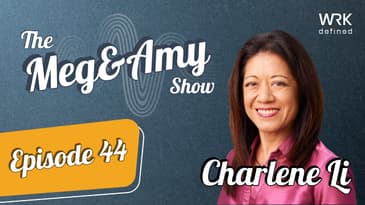
🚀 Running Pilots Is Not a Strategy: Charlene Li — three-decade authority on disruptive leadership and co-author of Winning with AI: The 90-Day Blueprint for Success — breaks down the consistent failure mode she's watched leaders repeat across the internet, social media, and now AI. Learn why "adapting" beats "adopting," why reinvention is the real AI opportunity (not efficiency), and the structural risk no one is naming: agents going to individual contributors who've never been trained as managers.
⏰ TIMESTAMPS:
00:00 Cold open — "running pilots and calling that a strategy"
00:21 Episode intro
01:14 The Altimeter years with Brian Solis: studying disruption
04:09 Three decades, one failure mode — and what's different this time
06:11 Experimentation vs. pilot purgatory
08:08 Don't run readiness assessments — name the gaps instead
11:20 Reinvention beats efficiency: the Concentrix case (130k people, +5% workforce)
16:22 Leading through vulnerability: honesty over having the answers
19:56 Who owns AI inside the org — and why it's not IT
26:26 Handing AI agents to ICs who've never been trained as managers
29:53 The 90-day blueprint: strategy in stone, plan in pencil
40:42 FOMO and FOGI: the cost of staying frozen on AI
47:46 Leadership Corner: rethinking "self-promotion"
🔑 KEY INSIGHTS:
- Running pilots is not an AI strategy. You have a business strategy — think about how AI supports it.
- The gap that matters in 2026 isn't between adopting AI and not. It's between adapting your organization and just adopting tools.
- Readiness assessments are designed to tell you you're not ready. Instead: name the gaps you need to fill to hit your strategic objectives.
- Reinvention beats efficiency. Don't 10x one person and eliminate nine — 10x everyone and 100x the business.
- You're handing AI agents to people you've never trained to manage. The IC-as-agent-manager gap is the structural risk almost no one is naming.
📚 RESOURCES:
Winning with AI: The 90-Day Blueprint for Success (Charlene Li & Dr. Katya Walsh): https://www.amazon.com/Winning-AI-90-Day-Blueprint-Success-ebook/dp/B0GQM9PD3P
Charlene Li's website: https://charleneli.com
Brian Solis on The Meg & Amy Show (referenced): https://youtu.be/ZrNWHzmWpJU?si=rIeBVrq1NcUmwZyk
🔗 CONNECT:
Charlene Li: https://www.linkedin.com/in/charleneli/
Submit Leadership Corner questions: megandamyshow@gmail.com
Instagram: https://www.instagram.com/megandamyshow/
LinkedIn: https://www.linkedin.com/company/the-meg-amy-show
#AIStrategy #BusinessTransformation #AILeadership #DigitalDisruption #WinningWithAI #CharleneLi #FutureOfWork #ExecutiveLeadership #MegAndAmyShow
Powered by the WRKdefined Podcast Network.
[00:00:00] Everyone talks about technology and the strategy. Let's have an internet strategy. Let's have a social media strategy. Let's have an AI strategy. And the thing is that you're running a bunch of pilots and calling that a strategy. That doesn't work. You have a business strategy. You should be thinking about how to use this technology to support that strategy.
[00:00:20] Charlene Li is one of the world's foremost authorities on disruptive leadership. For more than three decades, she's been on the front lines of every major shift. The early internet, social media, and now AI. Predicting what each wave would do to the way work gets done. Her latest book, Winning with AI, The 90-Day Blueprint for Success, co-written with Dr. Katya Walsh, is the prescriptive playbook for leaders.
[00:00:44] Today, Charlene talks with us about why running pilots is not an AI strategy, why reinvention beats efficiency as the real AI opportunity, and what gets missed when we hand agents to individual contributors who've never been trained as managers. Welcome Charlene. Charlene. Thank you so much for having me. Excited to be here.
[00:01:14] Oh, it's so fantastic. Thanks so much for being here. A couple weeks back, we had Brian Solis on the show, and he had some wonderful things to say about you, Charlene. You two were colleagues at Altimeter for almost a decade. So we'd love to get a little bit of your personal story of what you all saw there in the world that others weren't yet seeing. I think what we kept seeing was a disruption that was happening.
[00:01:44] And at the time, you know, we were looking at, you know, social media in particular and the dynamics that that brought. And Brian brought a very human-centered, almost anthropological perspective to it. And I looked at it more from strategy and leadership and to some degree about power dynamics being shifted because social media was one of those things. I just took all your assumptions about how power is exercised and threw them into the shredder.
[00:02:12] It was very disruptive for people because you feel disrupted when you don't know where you stand in the world. And all these changes that we were covering at Altimeter was going across a lot of different departments across industries.
[00:02:28] And so we're able to take this very broad, very systemic look at these things that were changing in the world and look at it from many different points of view, not just being limited by a role or department or industry. So that was really fun. And what we find is that we really started off why is it that some companies and organizations and leaders are able to disrupt and others aren't. And what Brian and I always agree is that it's rarely about the technology. It's always about the people. Absolutely.
[00:02:58] This is when Meg, for sure, started to become a fangirl of you guys. And our friend and colleague, Mark Bennett, used to almost daily read another book or another article and send us a summary. We spent a lot of time talking about the themes that you guys were bringing forward and your perspective. So it's just so fun to see this little circle.
[00:03:25] It feels like that was a week or two ago that this was happening. And now we're privileged to have you on The Meg and Amy Show. So thank you for joining us. This is so lovely. Yes, excited. Yeah. Again, we have history here, so it's really nice to be here. Absolutely. And, you know, you've spent more than a decade, a few decades perhaps, being a disruptor and studying disruption across, you know, the digital age, social media and now AI.
[00:03:55] And across those waves, I'm wondering what's the consistent failure mode that you keep seeing that leaders keep getting wrong every time with these disruptions? I think that there are three major ones, the Internet. I started my career in 1993 working for newspapers and I came out of Harvard Business School going to, I mean, nobody goes into newspapers out of Harvard Business School.
[00:04:20] And I went because I could see that this thing called the Internet was going to very much disrupt how newspapers work. And I'm like, oh, that that will be really interesting. That will be a really interesting problem to tackle. And I figured it would impact newspapers faster than any other industry. And it was a good bet. So I look at the Internet, the social media and now AI. And the thing that's been consistent is everyone talks about technology and the strategy. Let's have an Internet strategy. Let's have a social media strategy.
[00:04:49] Let's have an AI strategy. And the thing is that you're running a bunch of pilots and calling that a strategy. That's that doesn't work. You have a business strategy. You should be thinking about how to use this technology to support that strategy. The biggest difference this time with AI is the speed, the speed at which this gap is opening between people who get it and people who don't.
[00:05:13] It is a significant gap because people who don't get it, who don't use it, who aren't fluent with it just go, I just don't see it. I mean, why do I need to do this? I know I have to, but I don't get it. And the people who are fluent with AI and adapting their workings, it's just not just adopting AI, are running as fast as they can to get ahead. So that's what I'm saying here. I think this is the key difference, that you don't have the luxury of sitting back and waiting for things to develop when it comes to AI.
[00:05:43] One of the things that you've been talking about is this kind of idea of pilot purgatory. And you don't believe in pilots that you want people to, you know, take action right away. But on the other hand, there's experimentation. And so I'm wondering, like, how you kind of delineate between pilots and experiments and what you recommend to your clients and to the world in terms of what their approach should be.
[00:06:11] Yeah, I think experimenting is really important because that's how you learn. It's like a baby. What happens if I drop this spoon on, you know, what happens if I let go? Oh, false. Okay, now I learned that there's something called gravity. And when I drop things, it falls. And I wholeheartedly encourage experimenting because that's how you learn and that's how you get better at things. And I really encourage AI fluency in particular. And that means it flows, it's natural, you just reach for it. It just becomes second nature.
[00:06:40] I kind of think of it as learning how to eat with chopsticks. And when you have chopsticks for the first time, you're like, how on earth am I going to use two sticks to pick up food? It's awkward at first and then you figure out and then eventually you're eating without even thinking about it. And that's what we have to get to with AI. And the sooner we can do that, the sooner we can feel comfortable with it. Now, pilots are very different. Pilots say, I don't want to commit to this because I'm not sure if it's going to work or not.
[00:07:10] So let's just make it a pilot. That's the responsible, right thing to do. But what happens, the person who's leading that pilot goes to IT and says, I need access to the data. And the IT person goes, now that's going to be really hard. When you've proven that this pilot works, then we'll make that investment. In the meantime, here's some batch data. And it just doesn't work. You don't get the commitment of the organization behind that pilot to ever prove that it could work.
[00:07:35] I'm kind of seeing it a little bit as like the bifurcation of how you need to approach this. So one is at the individual level and the other is at the organizational level, right? And at the individual level, lots of experimentation, lots of attempts, lots of things to try to get to build that muscle. But at the organizational level, you need to be committed that you're going after high value things and you mean it.
[00:08:03] And it's not just a pilot. Is that kind of how you do it? Exactly. And again, you can experiment at the department level. So should we be using AI to write social media content? There's some great tools like Jasper. You can create a particular GPT or project within your LLM. So there are things that you can do where you're just trying to see if it works. And if it's better than what you're doing today, you'll just do it. This is sort of like no-brainer, quick wins, low-hanging fruit things.
[00:08:33] The things that really need the attention of your top executives are these mission-critical strategic objectives. And I encourage you to think about here are your strategic objectives. Now, how can you use AI to support it? How do you achieve those objectives better, faster, cheaper, even safer? That's going to be hard because it was obvious you just do it. And instead, what we do are these pilots. We do readiness assessments.
[00:09:01] And I also say don't do readiness assessments because I'll tell you what they're going to show. They're going to show that you're not ready. Yeah. And feasibility tests. And a feasibility test will show you it's not feasible because you don't have the people. You don't have the resources. Instead, say if this is what we want to achieve with AI, what are the gaps we have to fill? In order to achieve that. So here are the people we need and the skills we need. Here's the technology we need.
[00:09:26] These are the governance and the decision matrices that we need to be able to speed these things along. And it's a much more practical and value-driven approach to using AI. Because you know this is what we want to see, an impact on our strategic objectives. And we all agree those are important. And if they're important, then we will make it work. We'll put the data in it. We'll break down the silos to get to the people and the processes we need to.
[00:09:54] We'll clear the decks to make sure it happens. And unless that strategic incentive is there, it just won't happen. I like the idea, though, that you're talking about of focusing not only on making sure that you're doing things that help your strategy, that are tied to stuff you actually care about. But also in the point that, you know, at some point, it's sort of like when you decide to have a child or you decide, you're like, you're just never ready.
[00:10:23] You have to decide you're going to do something and then figure it out. So it makes me wonder if in today's world, maybe businesses are needing to learn to be more ambitious in the kind of things they go after. And I think it's counterintuitive because right now everybody's feeling so much pressure and so much threat and kind of vulnerability in this moment.
[00:10:50] But maybe there's a real unlock with giving yourself as a leader or your team as contributors to say, OK, let's go after something big. Let's make let's make a large bet on where the future is going to be and what that means for us as an opportunity. Do you do you see anybody that's looking at it this way? And how do you see that coming to life for companies?
[00:11:20] Well, I think it's the companies who look at AI as not making the status quo more productive and efficient, but thinking about using AI to reinvent themselves. I mean, we talk about in the book three ways to create value and efficiency or productivity is absolutely one of them. Engaging with customers and in a deeper way.
[00:11:41] But we think that reinvention is the real opportunity where, again, if you can 10x somebody, do you take that one 10x person and eliminate the other nine because you don't need them anymore to do the things that you do? Or do you 10x all of your employees? And now you can do 100x of what you did before and discover things that you couldn't have done before. And you land up in a very different place when you have that capability like, oh, the world looks really different.
[00:12:10] What else can we be doing? And I look at this one case study that we had called Connecta. They're a call center, 130,000 people global in their business. And they brought in AI to increase quality. So they reduced errors by 85 to 90 percent. They decreased the training time to get these agents up to a level. They focused on using AI to enhance the calls of the agents. So really working on customer engagement. And then once they had these capabilities, they go, wait a minute.
[00:12:40] We have all these law firms and they have non-performing loans that they're managing. And it's taking them weeks to plow through them. We can do that for them in hours. We opened up a whole new revenue line and a revenue stream with customers. So they're actually planning on increasing the workforce by 5 percent over the next two years. Whereas most organizations are like, okay, how do I save? How do I cut?
[00:13:06] They're like, oh, no, we need more people to do all the amazing things we're discovering. So I think when you take that point of view of being scarce, which most leaders have, I don't have time. I don't have resources. I have to perform. I have to execute. I can't take any risks because if I do, I'm going to lose my job. That's a terrible place to be working from. And I think it's incumbent on leaders to say, we want to do our job. We're not going to shirk away from our responsibilities to actually execute right now.
[00:13:36] But we have to think about the future. We have to be thinking about where we want to go. What are the things we have to do today to get us there? Otherwise, we'll just be sitting where we are today and the present will become the past and you're not prepared for the future. So, Charlene, I want to take just a quick step back and acknowledge your amazing book, Winning with AI, and your wonderful co-author, Katia Walsh.
[00:14:01] And I wanted to just get a quick kind of origin story of how you and Katia connected and how you fit together and how this book all came about. Katia's a dear friend. We started at Forrester in 1999, almost exactly the same time, about two months apart. And so we got to be really good friends because we were in the same cohort. We had kids at about the same time. My second, her first. And she's like, what do I do? And I go, let me show you the way.
[00:14:29] So we basically have grown up together professionally and personally. And I was visiting her in Boston in the summer of 2023. And I said to her, I'm thinking of writing this book on AI. And she goes, I should write this book with you. And she was perfect because she's been a chief AI officer for the past 15 years. But where could you ask for? She's driven these transformations. She knows what works and what doesn't. And it just has been a wonderful collaboration.
[00:14:57] I have had other co-authors, including Brian and nothing against Brian. But I mean, working with Katia was just such a joy. It was just fun and exciting. And we could just say things to each other without worrying about how the other person would take it. So that's a fantastic collaboration. That gives Meg and I hope for our future book. Yes, exactly. Well, and also a perfect moment in having someone that you care deeply about,
[00:15:25] but also who has this breadth of experience that the world needs to hear right now, because there are so many people that are a little bit frozen as to how to navigate in this moment. It's especially unique that it's hitting leadership so hard. This is the kind of transformation that every role in the company feels vulnerable,
[00:15:51] that their job may be the next one to be eliminated or to be materially changed, and that maybe they don't really have an expertise that they thought they had because the world is changing out from underneath them. What is your message to leaders who are feeling this sense of vulnerability and yet are supposed to be leading these big transformational initiatives on behalf of their businesses?
[00:16:21] Yeah, we wrote the book because people kept asking us, I know I want to create value with AI. Where do I begin? And our book was an effort to give them a step-by-step guide, a blueprint to say this is how you build your AI roadmap. And the thing that leaders kept coming to me in particular and saying, okay, what's the course I need to take? How do I stay on top of the things? I want to get caught up, stay current. And I'm like, welcome to the club.
[00:16:50] No one knows what's going on here. And I think the most important thing as a leader, we have to shift our mindset from the person who has all the answers. Because people come to us like, okay, so what do we do? And the honest answer is, I have an idea, but I'm not completely 100% sure. That's not a very satisfying answer. And you're worried that your credibility is going to be at stake here. And the reality is our employees, our teams only want two things from us. They want honesty and they want fairness.
[00:17:20] So if the honest response is, I really don't know. There's three directions this could go in. It could be any of those three. And we're going to prepare for all of those three. But you've done your homework. You've done your thinking. You've thought about the thing that you know better than anything else as a leader is your strategy. And you better know it better than anyone because people are waiting for you on that. So they're looking for you to say, what is the change we have to go at?
[00:17:47] And even if you don't know the answer, you get really good at asking the questions. And asking the questions that everyone all together have to answer. So if this is our strategic objective, the question becomes, how are we going to use AI to get to that strategic objective better and faster? I talked to one organization. They said, we have seven strategic objectives. The first six are the usual suspects. You know, grow revenues, have customer satisfaction. Number seven is use AI to accomplish the first six.
[00:18:17] And that is the right way to be thinking about it. You are an expert in your business. You are an expert on your customers. And you're an expert on your people. Take that as the foundation and then say, how do we use AI to bring out the best in all of that? To some extent, you can get it from your people. But a lot of it's going to have to come from you to say, we're going to do these things and not those things.
[00:18:42] Companies that have a long list of use cases, like a use case inventory of 60 use cases, 100 use cases, whatever. They go, look at this. Look at all these we're doing. I'm like, that's terrible. That's not a strategy. Right. That's you throwing things against the wall and hoping, crossing your fingers that something sticks. The better way to do this is to ground your efforts in that strategy the way that we talked about before. And use that as a starting point.
[00:19:08] So, Charlene, we've been talking to a lot of people kind of in the active process of going through AI transformation. And there's not a path. And there's not a path in terms of how to accomplish that from a role and organization structure perspective. We're starting to learn, like at an individual level, how to experiment.
[00:19:29] But how to organize, to do this work, to do the workflow reinvention, to figure things out is not clear at all. And I'm wondering in the 50 plus interviews that you did. And I'm wondering in the 50 plus interviews that you did, did you start to see some patterns, some clarity around who should be owning this? Who, you know, what roles are important? Anything that's starting to gel that people can take away.
[00:19:56] And again, we're going to talk about this at the enterprise level, not at the departmental or team level, because that's a little bit different. But at the enterprise level, we do think there needs to be one person who wakes up every single day. And the CEO and board can look at that person and go, how are we using AI? How are we driving value with AI? And that person is responsible for that. And again, in a smaller organization, that may be somebody's part-time job or side of desk.
[00:20:23] But there's somebody who can say, hey, are you driving this? And that person, when they run into roadblocks, can go back to the CEO and board and go like, you've tasked me with this. You want to accomplish this as your goal. These are the barriers that's standing away. I need you to clear those roadblocks. I need to get these people to work with each other. What kind of leader is that? Because you've said, like, not IT, right? Because then it becomes a technology thing, right?
[00:20:46] If you are so lucky to have an IT person who thinks very strategically and from a business perspective, fantastic. But the number one characteristic of this person is that they are a change and transformation person through and through. They know how to drive transformation because fundamentally what you're asking your organization is to change the way it works. When you bring AI, it is not just automating the existing workflow. In fact, that is probably the definition of the madness of you're just automating what you do today.
[00:21:16] AI is an opportunity to look at that workflow and say, how could we be doing this different? Just because a human did it and you're placing an AI to do it. Well, how could we look at this entire workflow from a different perspective now that we have AI and humans? What does AI do? What do humans do? What do they do together? How do we figure it out, the metrics? And that is a process of trial and error. The hardest thing that a leader has to do is to decide, do we persist on this course or do we pivot?
[00:21:46] And knowing when that is and what the timing is, and that is what people are missing. They're like, give me the manual that helps me decide that. And unfortunately, there isn't one. I mean, every startup would like to know what that is. When do you persist and when do you pivot? There is no right to answer to that. And oftentimes, the best way you could do this is to know that you're going to be very agile, very adaptable, and try a bunch of stuff. This is where experimenting works. You're going to go in a different direction.
[00:22:13] And if it's working, you see the metrics moving and changing against your strategic objectives. Okay, keep going that way. Until it doesn't, then you go, okay, that didn't work. Maybe we should try these other three things and see which of those work. But you'll be in a better place than if you were trying to stay way back at the beginning line, at the starting line, and try to analyze your way into figuring out what that world could look like without taking a step forward.
[00:22:37] And do you see that person having a team themselves or really more having connected individuals across the company that are subject matter experts and relevant to different workflows and come and go? So how do you see that operationalized? Yeah, I think that person has to work with other people because that person can't be the only person driving it. But they're guiding.
[00:23:06] And think about it as guiding and scaffolding. This is new. As you said, there are no guidelines or rule books. And so this person needs to create that to say, well, here's the playbook. These are the things that we can do. Here's the governance. Here's who can make these decisions. Stay within these lines. As long as you stay within these lines, go as fast as you can. And governance is there to help you go fast in the direction that we all want to go towards.
[00:23:34] Don't go off in these directions, but this is a roadmap. Stay on the roadmap. You can vary on it a little bit. Don't come off it, take a side road or something, but stay on the road. And it keeps people from going off and doing these road projects that don't really help you achieve your goals. It makes sure that people are doing things in a safe and secure way and guards privacy. And it also makes sure that everyone knows what everyone else is doing so that you can benefit from the learnings that everyone else is having.
[00:24:01] And so we think about a steering committee that is looking at the strategic questions. They're meeting probably every two weeks, looking at the roadmap, making sure it's right, answering any strategic questions. And then you have an operating group that is doing the day-to-day heavy lifting. And whoever is relevant to the initiatives that you've decided to pursue are in that working group. And so that leader is never doing it alone, but there is a leader. It's not AI by committee.
[00:24:31] There is a leader driving this and is accountable for it because when a committee is accountable for something, nothing happens. So I like a couple key things that I'm teasing out from this. The no AI by committee. I think that's so important. Anytime you're trying to do something transformational, you need quick alignment and you definitely need to keep the political machinations out as best you can so that you can make progress.
[00:25:00] If you're trying to get something done strategically, thinking about what the opportunity cost is and making sure that you're staying focused on the business objectives. But then the other thing that I really like in this single person being, you know, a transformational change agent. And I'm also hearing underneath there builder, somebody who is capable of building things that don't exist.
[00:25:29] And so, you know, whether that's founder energy or builder energy, like people that are good at forging that path and finding the way through. The last thing you need is somebody in charge who isn't good at, you know, going and finding the way forward.
[00:25:48] What about the operationally maintaining all of these, you know, agents and keeping up to not just like the art of the possible, but the break fixing and all of that? I mean, agents are not without need of tending.
[00:26:09] Is it that same person that is kind of managing the ongoing health or is it in your best practice? Is it handed over to like IT at some point when it's at a level of maturity and it's not being new anymore? What's your thoughts? Well, I don't know if it's IT because the person managing the agent should be the person managing the outcomes of that particular process. And we think about IT as managing technology.
[00:26:38] If you think about it, that's again, taking a technology point of view and maybe they're there to provide support in terms of the maintenance and like come fix it kind of thing. But as you know, the thing about agents isn't so much the technology is broken, fix it. It's about training it to do the things you want to do. And that's a management and leadership issue. So you think about a team manager or somebody who owns a particular outcome, a process that they have to do.
[00:27:05] And if you bring an AI to go and automate that task in particular, well, how much of that is being automated by the AI? How much is being taken by the person? What can I mean, oftentimes talk about AI augmenting humans. Now, when we're putting agents into place, maybe we should be thinking about humans augmenting the AI. It's a little bit backwards now. If AI can take care of all of it, but maybe not all of it. We need to add humans on top of it to make sure that last little bit is done correctly.
[00:27:34] And in the same way that you bring out a new human into a new job, this is the same way you bring an agent. You teach them that this is what the job is. Here's the responsibilities. This is how you do it. Watch me do it. Now I'm going to watch you do it. I'm going to correct you, train you how to do it better. And then I'm going to leave you alone now because I'm confident that you can do this job. And I'll check in periodically with you to make sure things are going in the right direction. And I manage things on an exception basis.
[00:28:02] The agents are being managed in the same way. The difference now is we're giving agents to people who are individual contributors at the front lines have never been given any sort of training in terms of management. And we're saying go manage this agent. And like, what does that mean? So we know that training at that first managerial level is scant as it is.
[00:28:24] And now you're compounding that by giving people agents and telling them to own them, run them, be accountable for them when there's absolutely no training for them on how to do this. So I think this is a real issue. But I don't think it's necessarily IT that owns it. We've been talking about this all the time, Charlene. It's like it totally resonates that these management skills and even executive skills, right? So the management skills in terms of like onboarding an agent is really important.
[00:28:51] But then also the executive skill of being able to prioritize and have judgment and all of that. These are skills that individual contributors need to develop. And it's really not in the training lexicon so much. However, we did have Doug Merritt, the CEO of Aviatrix, on the pod a few weeks back.
[00:29:14] And he was sharing that at Aviatrix, they have an agent management training for individual contributors and everyone else. So that was a nice glint of light. So you can add that to your corpus of examples. So in the book, you talk about 90 days, the 90-day blueprint. And it's a really fast clock. You're really pushing for speed here.
[00:29:42] And so I'm wondering, what is it during that 90 days that a leader cannot do or it will blow everything up? We talk about the outcome of 90 days is that you have a roadmap. You have a roadmap for the next 18 months, which sounds insane. It's just insane. Like how do you look 18 months out when you don't even know what's going to happen next week with AI?
[00:30:09] But you have to have a vision for where you want to be and how you're going to create value every quarter with AI. Otherwise, you're just looking into the next quarter and crossing your fingers again that something happens. And so what you're not doing is trying to write a program and a roadmap that's going to be perfect. And this goes against every instinct that a leader has. Like, what do you mean it doesn't sound perfect? I'm like, I'm asking you to make your best guess.
[00:30:38] Because honestly, that's all you can do at this point. And have everyone recognize that it is a best guess. And that we are going to revise this as we go along. And yes, CFO, we're going to revise a budget every quarter. Yes, marketing, we're going to revise this every quarter. HR, we're going to be revising what skills we need. Because we're just having a better idea. It may be really big, but hopefully not. Because as we go along, we'll get better and better at understanding what works in this plan and what doesn't. How we're overshooting or undershooting.
[00:31:08] How the competition is shaping up. How technology is changing. The pace of all of that. We'll get better and better at writing this plan. But that's the thing that you have to realize. Your strategy is written in stone. And your plan is written in pencil. And you have the ability to change it at any time. You don't even have to wait until the end of the quarter if you realize this is the wrong direction. Let's go back. Let's change this. But having it written down where everyone can see it and they can see every change creates this transparency.
[00:31:38] So that, again, everyone knows what they're doing and everyone knows what the plan is. And I can know whether I'm on the plan and being part of the plan or distracting people from that. And I think that's probably the most important thing. Just laying down what we're going to do and just as importantly what we're not going to do. We're not going to do 58 out of the 60 things on this list. We're doing two of them.
[00:32:02] One of the things I like about that iterative approach to the plan and the execution is in doing that, you're not only giving yourself permission to learn as you go,
[00:32:14] but you're actually sort of setting a cultural norm of adapting and evolving over time, which is going to serve you really well when foundation models change or there's a material macro condition that changes or the way that you were approaching it didn't work. Like there's a lot of things coming at us.
[00:32:38] But if you can build that cultural foundation that this is how we're going to navigate this, people quit feeling like this is distracting and disruptive and emotional. And they start feeling like this is opportunity in front of them that that is adapting and growing.
[00:32:57] And one of the things I've been spending a lot of time thinking about these last couple weeks is really just about how important it is as a transformational leader to set the right energy tone for the team so that people feel that they're comfortable, that they're following someone, not panicked that they're dropped out into nowhere's land.
[00:33:25] And so I think that this 90 day urgency is so powerful to set that momentum clock and to remind people to your point that you're not striving for perfection. In fact, perfection is no longer available. You're striving for improvement.
[00:33:47] And when you're consistently improving and you know where you're going because you're leaning into your strategy, you have an opportunity to do really big things as a group. I really like that. Right. And the thing is, this roadmap isn't a list of all the technology things that you're going to do. It clearly has that. And it has things like training on there and cultural moments. And it has all these different metrics and everything against it.
[00:34:16] But the core metric is showing what value you're creating that quarter. And it's very clear to people, this is how we're going to deliver value. This is the outcome we are working towards. And everybody agrees that that value, that outcome is important to us, mission critical to us. And we want to achieve it. It's worth fighting for because this is really hard. It's really messy. So if we're going to go down this path, the worst thing you can do is to tell everyone, oh, we got it figured out. It's going to be easy.
[00:34:46] Just push this easy button and we're done. And like, that's the worst thing you could do. Well, you're better off, much better off. Setting expectations like, this is going to be kind of crazy. We're going to be going forward and backwards and sometimes in circles. But hopefully we'll be making some forward momentum towards this objective. And it just becomes so clear to what you're talking about, Meg, that in this world of disruption, we want to have some firm foundations that we can hang on to.
[00:35:16] And in my research around disruptive organizations, they're actually very well run. It is not chaotic. They know exactly where they want to go in the future. They practice this over time. So they got very good at guessing and very good at adapting and moving wherever their customers go. Their customers are zigging, you're zagging with them. So again, these organizations that have built up that disruption muscle over time. And if you don't have that in your organization, this is going to be super hard.
[00:35:46] Because if you were rewarded for managing the status quo and now you're trying to lead transformation, those are two very, very different things. Two very different cultures. Two different ways of leading. And so it's going to be really hard in the beginning. And the thing I would say is make sure that you're being very clear about the value you're creating. Because otherwise, if you don't see outcomes and things changing, that is what leads to change fatigue. People are pushing, they're running hard, and they just feel like they're on this hamster wheel.
[00:36:16] And it's discouraging. And everyone's just like, why am I even bothering with this? I'm just going to wait it out until this new passion that they have to kind of, they get tired of it and they get bored. And we can just go back to things being normal. And that is the worst thing you could do. Do you have any specific examples of leaders that were failing or maybe in this pilot purgatory
[00:36:42] and got out of it and then found a successful path? Yeah, I think Securian Financial in the book talked about this. The head strategy person was coming in and said, we've got to figure out this AI thing that we're doing. Because it's just kind of going around in circles. And he gathered a group of people and like, okay, what are we doing? And they identified 60 different individual use cases.
[00:37:05] And he threw them on the table, had all these key people around the table, the top strategy people in the company. And he said, use cases are not a strategy. We have a strategy. Now we need to connect these use cases to our strategy. They just spent some significant time in offsite going through this in multiple rounds, narrowing down the 60 use cases and focusing, well, what is our strategy? Just making sure that these are the strategic goals we want to focus on.
[00:37:35] So they picked three strategic goals and then three projects that connected to each of those goals. And it did that. That was the roadmap. So I think it was that recognition that this is insanity. We're just going around in circles and we can't do 60 things well. So what will we do well? And against what objective?
[00:37:59] What's our way to create focus for our efforts? Where are we going to get the biggest bang for the buck? And this is the hard part. You have to make choices as a leader of what you will do and what you won't do. You have to make bets. And it can be incredibly scary because it feels like you're betting your career on this. But again, I think there are some safeguards here. You're not saying go do something completely out of left field. You're saying we're going to do this that supports our strategic objectives.
[00:38:29] We're going to try this out. We're going to move in the right direction with this. And if it doesn't work, we're going to pivot. We're going to find another way, maybe a different technology. Or we may have to wait because the technology isn't quite there yet. We'll do something else. I think about in the same way you have a portfolio of investments for your financial career and your business. You have a portfolio of customers and products. No eggs in one basket. You have to do the same thing with AI.
[00:38:56] And we have a prioritization matrix called the double S matrix where you grant people, you put your potential projects that you have against a two by two where you're looking at the size of the value and the speed to the value. And you have a portfolio of things that will give you quick wins and others that are strategic bets.
[00:39:17] So it's, again, having a really thoughtful approach to how you're going to create value across multiple dimensions against your strategic objectives. The timing of your book is so great because I think it is time for business to get serious about this, doing these little use case driven things. You're not even going to keep up with the competition if that's your approach.
[00:39:43] And you're probably going to burn a lot of tokens and be mostly distracted to really compete. I think it's incumbent on each of us as leaders, as businesses, as individuals to ask ourselves, how can we disrupt our own jobs? How can we disrupt our own way of thinking to seize this moment better?
[00:40:08] Because if we can do that to your first example, we can start thinking about this in a very abundance oriented fashion of where are we growing and how are we expanding? As opposed to how are we building the mechanics to replace our own jobs or reduce the size of our companies? Do you have any specific advice for leaders who feel like they've waited too long?
[00:40:37] What would you tell them about where they are and what the opportunity is for them? They should not think of themselves as behind. You know, because a lot of pressure, I call it FOMO and FOGIE, fear of missing out and fear of getting in. You know, we have, and like, I want to get in, but it's terrifying. I don't want to get in. Do I have to get in? I don't want to get in.
[00:40:59] And so there's this pressure building on them to have to do something, anything, because everyone's looking at me. They're saying, and I don't know what to do. And my best people are leaving because they don't think they're getting what they need. So I do think about having even the most basic roadmap you could ever think about. Just pick something that seems so obvious.
[00:41:24] One person was saying, our biggest problem right now is we have this discrepancy between what sales forecast and what we actually have to manufacture. It is a 40% difference to the posit, which is great in some ways, but a nightmare because you're producing for this and now we have to increase. Like, what the heck? And he goes, can AI help with that? I'm like, yeah, absolutely. We can look at the patterns and see where, I mean, but there's just so many ways to think about that. And here's the key.
[00:41:53] If you are fluent enough with AI to say, hey, AI, I have this problem. How do I use AI to solve that problem? And you're using AI to tell you how to use AI. I mean, when you reach that point, it's very meta, right? But when you reach that point of comfort and fluency, things start changing very quickly in your organization. And to get to that point, you need to address the fear and anxiety that exists.
[00:42:19] In the United States, the latest numbers are that 39% of people believe that AI will be more beneficial than harmful. And there's some even more research that says it's even lower now, that people are becoming more fearful of AI, less optimistic about it. And so you're fighting against this headwinds that, no, don't use AI. It makes things up. It's cheating. It feels like it's not human. You're taking shortcuts. That's not real.
[00:42:45] And if you believe, truly believe that AI is going to be the future of work, then make it that way. And your meetings, begin the meetings by asking people, so how did you all use AI to prepare for this meeting? And those are probably going to be crickets. And they're like, okay, well, this is how I use AI. I looked at all the past conversations from our past meetings, and I put out the media points, and I made sure, like, what have we done, what we haven't done? And we're going to discuss those things today on our agenda. That's how I use AI.
[00:43:14] I want you next week to come in and have used AI to prepare for this meeting. And it's setting the expectation that you will use it, and I'm modeling the way as a leader. It's reducing the fear that, oh, is it cheating? No, it's an expectation that you use it now. And if you don't know how to use it, I'm going to give you, make sure you have the tools and the training and especially the time to figure out how to use it. And most organizations are not giving people the time. They're actually saying just the opposite.
[00:43:43] Yeah, we know this AI thing is there, but getting your job done now is the priority. We have to do this instead. So drop the AI stuff. Forget about the training. Let's focus on getting the job done. And that's literally what I hear from managers. Like, yeah, it'd be great, but it's a luxury. It's not something that's essential to us. So this is why it's a leadership issue. It is absolutely a leadership issue to say, where does AI fit into everything else that we're doing in terms of our priorities?
[00:44:07] And when you have that roadmap, it helps bring that perspective in because then you say, well, we must make time. We're going to carve out time. We're going to make sacred time for us to learn together, learn individually, be able to practice these things because we will be able to apply it to these things that are really important to us. And it becomes really important time when you apply high value things to it, right?
[00:44:33] So it's really easy to say, okay, well, this is a secondary thing if it's for pilots and whatnot, as you said, right? But if it's the most important things that you're doing or the things that are taking up the most of your individual time, being able to have that mental model of having the space and the time to do it, it makes much more sense. It's directed learning.
[00:45:02] It's learning with a purpose. It's experimenting with a purpose. I'm not saying go off and vibe code the next product that we're going to sell as a company because that's probably not feasible. But we are looking at the way you do your work and say, can you do it better, faster, cheaper with AI? And it's not to say you're going to be replaced, but what are the things that now that allows you to do? And you can let AI do it so that you're augmenting, you're adding on to what AI is doing.
[00:45:28] And you're really beginning to maximize your potential as a person to accomplish these goals that we have, this common purpose that we have. It's a very different conversation that you have with somebody because you have that roadmap underlying the conversation. It's not a theoretical conversation about AI and be able to take my job. Well, this is the direction we want to move in. This is how jobs are going to change.
[00:45:56] And this is how tasks are going to change and how you're going to change. And that all ties together and you have a role in describing what that looks like and deciding what that looks like. There is agency here. And that's what people really want in the end is the opportunity to learn and improve themselves and to be employable in the future. That's right. And if you're not going to give that to me here, I'm going to go someplace else. So you not using AI isn't just you're falling behind with technology.
[00:46:26] It is a talent risk as well. Because if people look at your organization and say, well, we have no clue about AI and it's the next future that we're going to, I'm jumping ship. For sure. Yeah. Beautiful. Are we ready to move to Leadership Corner, Meg? So, Charlene, we'd love to have you join us for our Leadership Corner today. How does that sound? It sounds great. Okay. I can go on and on about leadership. Yes, yes, yes.
[00:46:55] So a number of our listeners have weighed in and asked for advice on self-promotion, particularly our female listeners, but not all male listeners as well. And you have always done this so beautifully, Charlene. You're my idol when it comes to self-promotion and doing it so authentically and naturally and it, you know, just works.
[00:47:23] And so I was hoping you could share some wisdom here. And here are my questions. Was this something that came naturally to you or something that you really had to work at? Was there a defining moment in your life career that made you realize this was something worth investing in? And what are your do's and don'ts when it comes to self-promotion? Yeah, again, I was an analyst at Forrest for Research and there we just published a ton of work.
[00:47:52] You're just constantly publishing. And I started a blog in 2004. And the pretense that, well, if I'm covering social media, I should probably be practicing it. So I got permission to do a blog and we had no idea how much it would blow up. And so I got a lot of practice just writing lots and lots and lots of content on a constant basis and commenting and building that following. And here's the thing that I realized. It was an extension of what I did at Forrest. It was never about me.
[00:48:20] And so I would take issue with the idea of self-promotion because I've never created a piece of content to promote myself. Everything that I do is in service of my audience and in particular of a particular persona who I am serving. I'm very clear. Again, this is like the classic way of marketing and content. I'm writing to a particular person who has a particular set of problems. I have secondary and tertiary personas too.
[00:48:49] My content team, I have a team of people who help me create the content, understand who those personas are and what the objectives are. And so like any good content plan, you need one for yourself. Like who is the person that you are writing for? Who are you trying to influence? Who do you want to have a conversation with? And so my biggest do is that, to be really clear about that and solve people's problems.
[00:49:19] And everything I write, there's a bit of a framework and analysis and there's always something practical that you can do. Because I can't stand, okay, theory, theory, theory, theory, good luck, figure out what to do with that. I want to give some guidance and some case studies or something to give you an idea like how do you solve that problem? And it's so gratifying when people come back like, wow. And they literally say, they quote a piece and like, this was so helpful. This is the result. This is the action.
[00:49:46] That is so gratifying for me to see that it made an impact, that somebody found this to be helpful and that it's there. So the biggest do is that. The don't is don't measure the impact on the vanity metrics. How many followers do you have? How many comments did I get? What's the engagement level? Again, it's a lot harder to measure it, but I really try to capture the impact that I have. Even after a talk, it's immediate.
[00:50:16] After, you know, I'm walking down the aisle or something down a hallway, someone comes up to me and says, you know, that was absolutely fantastic. Thank you so much for that talk. I'm like, thank you so much. What was your takeaway? And it does two things. When they can articulate that takeaway, they remember it. And it's great feedback from me. What did people take away? I'm constantly trying new things. Did that thing resonate with people? Do I, when I look at the media posts afterwards talking about the speech, do they mention that thing?
[00:50:45] Is there anybody talking about that story? So I'm constantly testing to see what's working or not. But again, I'm looking for impact. I'm looking for the outcomes that come from the work that I do. It is not about the number of followers. It's great when the numbers go up, but it just means that there is a greater chance that it's going to hit and hit to the right people. So I don't stress about my followership not going up. It does go up.
[00:51:12] I don't worry about how much, you know, the people are commenting. I care more about the comments themselves. Love it. Yeah, that's lovely. Awesome. Any last advice on that topic for someone kind of in the early stages of their upward career? And they haven't done anything along these lines ever. Where do they start?
[00:51:40] I would say, yeah, take a look at your LinkedIn page. Your LinkedIn profile page and your about statement. It's probably about all the things you have done. And that's not very helpful because when somebody is coming to look at your page, what they're trying to figure out is what can this person do to help me? Do I want to connect with this person? Do I want to work with this person? Do I want to hire this person? Do I want to bring them on? They want to know and see their problems reflected in your statements. And if they see that, they were like, yes, you're my person.
[00:52:09] You get what I'm thinking about. And so you have to write your profile from the perspective of the person you want to be reading it. So it is not about you. It's about how you help. That is the biggest mistake that people think. They think it's about me. It is about me, but it's about how I can be of service. Because that's what LinkedIn is. It's not your Facebook page. It is about how you are going to work with other people. It's a professional network. So be really clear about that.
[00:52:36] The worst thing you can do in any sort of networking situation is to say, someone goes, well, what are you looking for? And they go, well, I'm looking for anything. I'm looking for anywhere. No, that doesn't help because people can't help you. So be really specific about what it is that you do, how you provide value, what makes you get up and shine in the morning. These are the things that people really want to know so that they can connect deeper with you. Beautifully put. Thank you so much, Charlene. Thanks so much for joining us.
[00:53:05] We've been looking forward to this. And unsurprisingly, this was just delightful. So thank you so much for making time for The Megan Amy Show. And good luck with the book promo. Thank you so much. Yeah. Wasn't that delightful? So what did you learn? Well, I have to say, outside of having an opportunity for a leadership corner to be giving us advice,
[00:53:26] I really enjoyed her perspectives that align a lot with how I think, but even unsurprisingly more articulate, which is really being thoughtful about who you're here to help, who you're here to serve, and how you are supporting those people in all the things you do.
[00:53:46] That was just so powerful and so smart and helpful for, I think, orienting away from the ick of self-promotion and towards the how to make the world better and why your voice matters. So, so, so cool. Yeah, it was amazing. Yeah.
[00:54:04] I mean, I felt it was a really great through line as well, because I was noting throughout the conversation how she always does bring things back to the practical. Yep. So, so it's not just theory. It's, she's got tools and methodologies and, you know, like real concrete things people can do.
[00:54:28] And, and now at the end, her explaining kind of why she does that was such a nice kind of bow on all of it. Yeah, it just gave you clarity of who she is as a person and why we're so admiring of her. Yeah, it's very funny. Right, right. Yeah. And so, you know, I had actually heard on another podcast her talking about the, the chopstick thing and, and this whole concept of AI fluency.
[00:54:58] And as I was listening to it, I was like, okay, well, like fluency is usually you're thinking about languages. But the thing is, is that languages don't change, right? They don't, or at least not much. I mean, there's the Gen Z phrases and stuff like that. But for the most part, you're, you're pretty set. And of course, with AI, that's not at all true.
[00:55:22] But then as soon as I had that thought, she was talking about like, okay, well, it's not actually, you're not fluent in AI because it's changing. You're actually fluent in learning AI or with AI. And so that was back to kind of her meta thing. You use AI to learn AI and you keep getting better at AI. And, and so the fluency is the, the learning bit. And I was like, oh, right. Of course she has the answer.
[00:55:48] And, and also I think one of the things I was thinking of when she was talking about that part was this really gets to our agency, high agency discussion. And the, the generally understanding that in this moment, everything really is figureoutable. You have a tool, a country of geniuses in a data center that you can have help you figure something out.
[00:56:15] And so instead of starting with the answer, starting with the question is so important. And what a great time to be curious, right? Like that's so cool. And I had one more thing. So I loved your baby analogy for, for the, you know, not being all in or you're, you're just jumping in. And so I wanted, I wanted to interject and say no pilot babies.
[00:56:44] There's no such thing as a pilot baby. It's no little bit pregnant. But then, but then I felt like I would have seen like Bernie Sanders or something. So I just, I didn't say it, but I wanted to say it. Oh, now Amy is Bernie Sanders will forever be in my mind. Get my gloves. All right. Well, good one, Meg. Oh, this was, this was so fun.
[00:57:11] And what a great wrapping together a lot of the conversations we've had. I, I really feel like all of it is coming together and I'm finding my own energy against all of this. Really getting to optimism, not optimism because of the world of work getting less crazy,
[00:57:35] because I think we're still in for a lot of layoffs and a lot of drama and a lot of, you know, ready, fire, aim behaviors. I think the story is starting to become clear that you really just can't squeeze EBITDA and get the kind of value you need to be a sustainable business. You absolutely have to look for new levers of growth. And so I think getting us more aligned on that is really useful.
[00:58:05] And I think we're going to start seeing that momentum build and I'm really excited for it. So let's invent the future together, everyone. I believe in us. Let's make every day count.
Sponsors
