
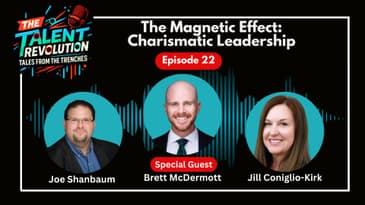
Join the conversation about Charismatic Leadership with special guest Brett McDermott.
#thetalentrevolution #talesfromthetrenches #podcast #listen #human #talentacquisition #workplace #culture #workculture #HR #officelife #careeradvice #leadership #hrpodcast #tapodcast #peopleandculture #humanresources #talentacquisition #listennow
Powered by the WRKdefined Podcast Network.
[00:00:05] Welcome to The Talent Revolution, Tales from the Trenches. I'm Jill Coniglio-Kirk. And I'm Joe Shambaugham. Welcome everyone. And we have a fantastic show today. We have a special guest, Brett McDermott. Welcome to the show, Brett. Brett McDermott Hey, so happy to be here, guys. Thank you for having me. Brett brings a variety of experience. He's a leadership coach, a speaker who helps professionals and organizations move beyond surface level success to build real connections.
[00:00:35] Brett McDermott Heiters, Ph.D.: And he's a leader of the leadership development, communication and mindset. Brett challenges the idea that structure alone drives results and instead focuses on the human side of performance. Again, welcome, Brett. And anything else you'd like to introduce about yourself and your background? Brett McDermott Sure. Well, I mean, boy, what a lovely intro that you just gave me there. And I think you kind of covered a lot of really what I generally teach, but I do. I teach leaders and teams how to communicate.
[00:01:05] Brett Dermott And I think that you can communicate with more influence. And my idea and my belief is that charisma is not something you're born with. It's just a series of skills that you can learn over time. And if you commit yourself to learning these skills, the amount of influence you have on others 10 times.
[00:01:20] Dr. Jennifer Dermott Yeah, Brett, I'm really excited about this topic in particular, because I have seen and watched the evolution of some leaders in my career, where I would have told you that it would never happen, the day would never come for them. Right? So I think with the right coaching with the right focus with the right mindset, watching the journey of people and what they're able to not only, you know, take away from it, as far as how they feel about themselves. I think how you feel about yourself.
[00:01:48] Brett Dermott Definitely shines through in the way you lead other people, but really the influence it has on others has really been something I've witnessed. So exciting to dive in, excited to dive into that topic with you today and hear more about, you know, what advice you have for our listeners, what tips you have, right? I know we're going to talk about some red flags and all kinds of other things that we'll have fun with today. Dr. Jennifer Dermott Amazing. I'm excited, guys. Let's dive in.
[00:02:17] Dr. Jennifer Dermott So let's start with it, then. What is charismatic influence, Brett? Dr. Jennifer Dermott Yeah, so charismatic influence is simply one's ability to project confidence and generate connection. That's basically it at its simplest level. It's the ability to communicate in a way that people respect you, but they also like you. And when someone respects you, Dr. Jennifer Dermott And they like you, they're much more open to your leadership and your influence.
[00:02:48] Brett Dermott So it doesn't matter the topic then, right? Dr. Jennifer Dermott No, not really. You can certainly apply this to anything. I mean, really, any vertical of leadership. If you can get people to respect you, and you can also get them to like you, it's a rare combination. But if you can project both of those qualities, then people are going to be open to your leadership.
[00:03:10] Dr. Jennifer Dermott And that word connection, I think is such an important one to understand, right? As to it sounds simple, right? But making those connections could look different depending on what you're up against, the crowd you're in, the environment, right? All of those other things.
[00:03:28] Dr. Jennifer Dermott So I'm excited to learn more from you about, you know, what are some of those fundamentals that go into that connection piece? And, you know, what type of game plan does a person put together for themselves if they're really after making a connection with other people? Dr. Jennifer Dermott Yeah, that sounds simple. But, you know, making other people feel seen, and feel heard and feel appreciated doesn't necessarily come natural to everybody.
[00:03:54] Dr. Jennifer Dermott In my experience, a lot of leaders do one of these things really well. They do the confidence part really well, or they do the connection part really well. A lot of leaders don't necessarily do both. But it's the rare combination of both that really allows you to influence others around you in a huge way.
[00:04:12] Dr. Jennifer Dermott So how do you get the leaders to buy in? Because I'm sure they're like, what do you mean? I'm okay. I don't, I'm a charismatic leader. I do this all the time. I mean, there's got to be pushback and that buy in from them. Dr. Jennifer Dermott Yeah, no, I think that is a really solid question. And I would say that when I do get leaders, I will say a lot of leaders are actually open to coaching. And they do realize that maybe their communication skills are good, but maybe not great. And that there's always room for improvement.
[00:04:41] Dr. Jennifer Dermott I would say when, when I do come across a leader who says I'm as charismatic as I could possibly be, I'm the best leader out there. Dr. Jennifer Dermott And there's no way I could get better influencing others. You know what, what I will simply say to them is that we can all get better. Dr. Jennifer Dermott In every aspect of lives and even the greatest at anything, there's still momentary and minute differences that can push them over the level to the next plateau.
[00:05:08] Dr. Jennifer Dermott So when I experience someone like that, I try and show them a great leader from the past who maybe wasn't so charismatic, became charismatic, and then became unbelievably charismatic. Dr. Jennifer Dermott Someone like Steve Jobs. Steve Jobs, if you look at his original keynote speeches, was fumbling over his word. It's incredibly awkward. And as time goes on, if you look at those keynotes year by year by year, he gets better and better and better and better.
[00:05:32] And even when he was at his top form, he still worked with speaking coaches. He still worked with performance coaches. He was doing his best to get that 1% better. And that's how you become great. You find that 1% that's going to push you over the edge.
[00:05:46] Dr. Jennifer Dermott So with a lot of folks that we deal with, they love data and they love analytics that show how is there something like that, that we could showcase back to the leaders of here's you're not getting through to the individual like is there something that would be metric driven to leaders to show that they're not being as effective as they are?
[00:06:08] Dr. Jennifer Dermott What are the tangible gains, right? And what do they get back in return for kind of reaching that charismatic leadership milestone, I guess? Dr. Jennifer Dermott Yeah, for sure. I think that the two main tangible gains, whereas we can look at numbers and charismatic leadership directly affects those numbers is top line revenue. Companies are just more productive when they are under the leadership of charismatic leaders.
[00:06:38] Dr. Jennifer Dermott So with a lot of people that can get that type of buy-in. So top line revenue for sure. And then just the ability to maintain top talent. A lot of times people don't necessarily leave the company, they leave the leader. And if they don't respect the leader, if they don't like the leader, they don't feel seen and appreciated by that leader. That's when they start taking the zoom calls during work. Dr. Jennifer Dermott Right.
[00:07:00] Dr. Jennifer Dermott That's when they start sending all those like the connections and they start looking at your pastors. So I would say that top talent retention is almost always directly related to leadership charisma. Dr. Jennifer Dermott Yeah, I agree with that 1000%. And I also wise enough to know that a lot of leaders have blind spots about themselves that if they have the right people surrounding them supporting them, hopefully they can kind of help them, like you said, get better.
[00:07:29] Dr. Jennifer Dermott Even though they don't think they have any problems per se. I'll just say for myself from episode one to episode 21. I've definitely made some improvements. I still have a long way to go with just, you know, on camera presence, right? Those kinds of things. So I could certainly relate to it's a journey. Dr. Jennifer Dermott We all do. We all do. I think communication is just something that is innately human. It's something we do all day long.
[00:07:58] Dr. Jennifer Dermott And the beauty of communication is that we have unlimited opportunities to practice the skills that can really push us over the top. Dr. Jennifer Dermott Agreed. Dr. Jennifer Dermott So what are the core elements? So I mean, let's break it down because there's a lot of technical folks and others that want to break it into pillars or segments of things. Is there those elements of charismatic leadership that you could share?
[00:08:25] Dr. Jennifer Dermott Yeah, for sure. So I usually divide it into two buckets, right? Confidence and connection. So we can start on the confidence side of things because that's usually where people like to start. The confidence bucket is like the sexier bucket. People want to be strong. They want to look confident to others. So we can start on that side of the fence. Dr. Jennifer Dermott And the number one skill, the number one lever that we can pull to project confidence is eye contact.
[00:08:51] It's effective eye contact. And there are ways that studies have showed us to do this properly and ways to do it improperly. Dr. Jennifer Dermott And what the science says is when we're in an interpersonal interaction, what we want to aim for is a ratio.
[00:09:10] We want to aim for a 75-50 split. So we want to aim for 75% of the time when we're listening, make eye contact. Dr. Jennifer Dermott And when we're speaking, a little bit less, 50%, dial it back a bit. And the reason for that is when we're speaking, if we make too much eye contact, it can come off as competitive and domineering, like you're trying to dominate the person.
[00:09:35] And if we look away every so often while we're speaking, we appear more thoughtful and introspective, and then we bring our gaze back to the person in front of us. So the number one thing that I teach when it comes to confidence is eye contact, because if someone's not comfortable sustaining eye contact for long periods of time with his team, he's just not going to be respected in the way that he or she could.
[00:09:58] So to me, the number one fundamental of charisma and generating confidence, projecting confidence, is getting comfortable with effective eye contact. Dr. Jennifer Dermott Now, is that the same in a, you mentioned that was kind of one-on-one. What about in a group? Is it the same kind of ratio? Dr. Jennifer Dermott So in a group, it's a little bit different, right? So in a group, you want to be comfortable with landing on a person for two or three seconds, making eye contact with them, and then moving your gaze to the next person.
[00:10:27] And then sit with them for a couple of seconds. Be present with them while you deliver your message. And then move your gaze to the next person. Dr. Jennifer Dermott Again, every so often, you can look away from people as well. That shows that you're being thoughtful about what you're saying. But that's something you can practice at parties as well. When you're telling a story, get comfortable moving your gaze from person to person, sitting with that person for a beat or two, and then moving on.
[00:10:50] It's a skill that doesn't come comfortably to most people. And I'd say the first time you try and do this, it's going to feel very uncomfortable in your chest. Dr. Jennifer Dermott But like anything else, the more you do it, the more comfortable you become with it. And if you're one of the rare people that can actually speak to an audience like this, and really sit with someone for two seconds, and then move your gaze, you are going to be such a more impactful presenter.
[00:11:11] If you look at most presenters and most people in meetings, they don't really do this. They kind of spray their gaze about left and right. They're like a sprinkler head. They're not really being present with anybody. You can be the rare speaker that does this. It'll really set you apart head and shoulders from the pack. I've seen it. Believe me. It's tough to do, and it's rare, but it's a skill that's worth leaning into.
[00:11:37] It brings people in too, right? When you sit with them for like two minutes, they're like engaging back to you, and they're like you're reeling. And you can also feed off of them if they're not understanding or be able to course correct. But I've done it, and it definitely helps. Yeah, that's a really good point is it reels them in, right? And even when you're not looking at them, they're more engaged with what you're saying because you took that two to three seconds to really stay present with them in eye contact.
[00:12:06] It is unbelievably important in a group setting. So there's a lot of skills we can go over today, but that I would say is probably the top one for confidence. We can keep going down the list, but wherever you guys would like to go. And to me, I think the important thing to highlight here is nobody's taught this, right? For sure. You might have a high school or college course that's public speaking, right?
[00:12:32] How many people other than maybe very certain vocations, don't get me wrong, I'm going to get a bunch of, I wish I got a bunch of emails from people watching the podcast telling me all the vocations. I dare you. Come on, bring them on. Who do a lot of training in this regard. So I think it's a fair point. And it illustrates that we all could use some practice in this area, right? For sure. Not all stopped and even reflected a lot, probably. Yeah.
[00:12:58] You know, elementary school isn't teaching you how to properly listen or how to use vocal variety or downward inflection. Meanwhile, you know, these skills are really what is most likely going to set you apart from the pack. I think a lot of people are really great with their expertise and they know their stuff, but their potential is always going to be capped to an extent to how well they can communicate their stuff. Right. And I don't want to derail because I have so many things going through my head. So I'll let you move on to item two.
[00:13:28] Oh, sure. Listen, we can keep talking confidence. So another way that we can project confidence when we are communicating is what I call the power of the pause. If you are engaging with a really confident communicator, there's someone that is comfortable with a little bit of silence in their vernacular. I think when you talk to someone who's not confident, they're rushing through their sentence almost like they can't wait to get done with it.
[00:13:54] But if you talk to someone who's confident and they're really projecting that confidence, they don't mind a little bit of silence. They'll insert that silence in the middle of their statement. They will let their statements land with a bit of silence at the end. And one bonus of inserting a little bit of silence in your speech is it limits your filler words. The ums, the you knows, the likes. They seem harmless, but they're really not. They sap our credibility and they project weakness.
[00:14:23] So whenever we feel one of those filler words bubbling to the top and we can tell we're about to use one, it's probably because our brain can't catch up to our mouths. In that case, just utilize a little bit of silence. Let your brain catch up. It project is weakness. It projects is confidence. So I call it the power of the pause. There's actually a famous piano player, Arthur Scannable. And he had a great line that I think also applies to communication.
[00:14:51] He said the notes, I play no different than anyone else. The pause in between the notes, that's where the arc resides. And I think we can think about speech in that way as well. That's a cool analogy. I never thought of it that way. But the pause is phenomenal. And people listening, if they know me, I pause a lot during especially phone screens and interviews.
[00:15:15] And it really, there's a lot of folks that just hate that awkward pause and have to fill it in as well. But it's powerful. It's powerful in the conversations and the impact that it can make to a point or just the whole direction of the conversation. Yeah, it looks a little bit of anticipation built up as to how you're going to finish your statement. And it gives people a chance to catch up to what you're saying so that when you do land the point, they're caught up and they're fully on board.
[00:15:44] There's a lot of benefits to the pause. And the best way to use it is just start inserting more pauses in your speech in the middle of your sentence at the end. Just get comfortable with a little bit of silence in your conversations. It's hard in the moment, right? Because you're going through and your head is just spinning with all the information, like you said, right? And you're trying to get it all out. Like I just sped up myself. But to stop in that middle of a piece, it's a lot of practice. It definitely is. It's uncomfortable.
[00:16:12] I think when you first start using pauses in your speech, in that moment of silence, there's a feeling on your chest. There is a feeling that I must be saying something. I got to get this out. Let's get this going. And we just need to fight through that feeling and just start adding the occasional pause here and there. And our messages will land in a much more impactful way. And I say for everyone listening, do it on your phone calls, right?
[00:16:36] Or whether you're HR, any profession, TA, whatever it is, just stop in the conversation and the phone call. You'll see it and you can practice it without actually doing it in front of an audience. It's actually really fun. Yeah, for sure. And listen, some people will naturally speak more slowly. Some will speak in a bit of a quicker pace. And that's okay. And you're going to speak at your own natural pace. You can add pauses to both those communication styles.
[00:17:04] Yeah, and I think this advice applies to every person. No matter what job you're in, no matter what profession you're in, right? This is something we can all practice and evaluate. If I'm really able to do this effectively, how does that impact me as a communicator? How does it impact? I believe it comes off as you're more interested in the other party as well. You're giving them an opportunity. You're not talking at people, right?
[00:17:33] You're having this exchange with people. You're giving them time to process those things. So yeah, yeah, absolutely. The pause works with listening as well. I think when you're listening to someone, let them fully land their message. And then when they're done speaking, wait a beat before you respond because people hate being interrupted. Even if you're congratulating them or telling them on that, they're awesome. They're still going to resent you a little bit for cutting them off. So use the pause while listening as well as speaking. It's incredibly important.
[00:18:05] All right. So not to keep on the confidence side, is there other aspects, Brett, to keep moving along? Yeah, absolutely. So another one of my main pillars of confidence, I like to call it stillness. And stillness refers to no wasted movement, no fidgeting, not overly touching your face while speaking, certainly using your hands, using your body to express your point, but doing
[00:18:32] so in a deliberate way and not feeling the need to always be moving about and almost dancing while you're delivering your message. I think we all know someone that communicates in that style. When you think of the most confident and charismatic communicators and some of the people that come to mind for me are like Obama or The Rock, or if I'm thinking of a character in fiction, Don Draper. They had a stillness about them. James Bond.
[00:19:00] They weren't constantly fidgeting or moving about. Be okay with the level of stillness. And when you're moving your hands, when you're moving your face, make sure it's deliberate and then there's meaning attached to it. So I think just being a bit more still in our non-verbal communication, a little bit more deliberate and slow with our hand movements and our facial expressions can project a lot more confidence. I think an interesting exercise is record yourself in a meeting with all the technology we have
[00:19:29] using Teams and Google Meet and other things. Occasionally you'll record a work meeting. But if you watch that meeting back, I think, I know for myself, I can certainly probably watch it back and say, yeah, that is something I should work on, right? Those types of things. But I think that's a good drill where everyone can zone in on some of those, like you said, facial expressions, other things.
[00:19:55] And just be mindful because I don't think we're all self-aware, right? Yeah, we all probably have one that we've been doing for years and we don't realize it. So I agree, right? Recording yourself, if possible, it can be very helpful. Some people bite their lip. You know, some people repeatedly touch their face. There's a lot of different ones that, you know, can really- No one knows all of mine, don't you, Joe? There's a lot of things that we do that we don't realize are sapping our credibility
[00:20:23] and they are limiting our potential for impact. Little things like fidgets and constantly adjusting our clothes and touching our face, they seem innocent, but they're not. And they are limiting our ability to lead effectively. But with some of those, there's little tips, right? Like holding a piece of paper, right? If you're out in a bigger presentation, you know, if you had to do that, you kind of limit yourself if you're holding a piece of paper then,
[00:20:49] or the microphone or other aspects that would then hopefully limit some of those other facial or limitations that go on, correct? Yeah, absolutely. I think, you know, know thyself. Know what yours is. And then if you can find something like holding paper, like let's say you constantly nervously adjust your glasses or touch your nose or pull on your ear, then yeah, certainly doing something else with your hand, like holding a piece of paper that will prevent you from doing so, is a good start. I wouldn't want people to always lean on that,
[00:21:19] but I think it's a good way to get you started in greening that habit of not constantly touching your face or whatever your personal nervous fidget is. Well, it's a distraction for the audience, right? If you're always putting your hand in your pocket and then flipping your hand to the other pocket or you're adjusting, they're taking away from the message because it's a distraction. And, you know, you lose the words when, you know, someone's always fidgeting in a sense, right? Yeah, for sure. Just bring a little bit more stillness,
[00:21:48] a little bit more deliberate nature to your nonverbal movements, and people will certainly perceive you as more confident. Is there another pillar, Brett? So let's see. We covered eye contact. We covered stillness. And as far as confidence goes,
[00:22:14] we probably should also just talk about bringing your curiosity to the table. I think when you're truly a confident person, you are more curious about other people than you are about speaking about yourself. And it's an interesting thing about being interested in somebody is that it takes a real confident person to be curious about the individuals around them.
[00:22:42] And if you bring a genuine curiosity to your interactions, then people are going to be more curious about you in turn. And they're also going to find you more interesting because you are interested in them. So I would say in all of your interactions, bring a genuine curiosity to the table. Be curious about people. Everyone can teach you something. Remind yourself of that before you walk into a meeting or an interaction. Try and shine the spotlight on others a little bit more than you shine it on yourself.
[00:23:12] And it takes a little bit of pressure off you as well, right? Because you're asking them questions. You're interested in them. You're not trying to show off or impress people. You're genuinely interested in those around you. So I would say bring a genuine curiosity to your interactions, and you will project more confidence. So this might go down later on in the conversation, but it's a fine line, let's say, if you're interviewing, right? You have to be able to answer the questions
[00:23:41] and give the details, but also ask those questions. And you want to be confident, but you're also curious about them. So it might be a separate conversation, but how does that play for if you're interviewing? Yeah, I would say if you are interviewing someone, I mean, for sure, you're going to be asking more questions than they are. And I'd say if you're on the other side of that and you're interviewing for a position and you're trying to get that job, of course, you're going to be asking less questions. But I think it is important to ask some questions.
[00:24:10] And I think when the opportunity presents itself and you find a question hitting you in the brain and you find something relevant to ask, it's important to ask. I know when I'm interviewing someone for a position, I appreciate when the person interviewing for the job actually asks me a question. And it makes me think this person's interested in the role. They're not just here to sign up for a position they know nothing about. So I do think having a few questions pre-prepared before an interview,
[00:24:39] and then even off the cuff, if you think of something relevant in that interview to ask the person who is conducting a question or two, for sure, curiosity is huge. Yeah, I would say like a prime example might be if I'm going through an HR interview and people are talking about, well, what's your experience with benefits and what type of plans have you worked with? I might talk about that, but then say, oh, are you self-insured or fully insured? Right. And then I'm demonstrating my knowledge of how much I understand about benefits
[00:25:08] and my curiosity. Right. So I think it's a good skill to build if you can really just keep it tied to the question and a feed off the question, because it really does create this conversation. And if you're thoughtful about what it is, you can't obviously throw out something that's out of left field that doesn't have to do with the topic they asked you about, but it does engage the person more with you. And I think you leave that conversation with them standing out, right?
[00:25:38] Because you're like asked and answered. And then you kind of volley something back that gives you more insight, right? So I would just say, again, it's a good skill to build on the interviewer front. Yeah, absolutely. I totally agree. And I think while we're still on the confidence front, I'd be remiss if I didn't mention vocal variety. I think that we need to think of our voice as an instrument and adjusting our tonality and adjusting our pace keeps people interested in what we're saying.
[00:26:08] We crave novelty in everything that we do. That's why TikTok is so addictive. We crave the novelty of that next video. Similarly, when you're listening to someone, you don't want to be the guy from Ferris Bueller's Day Off. That's not the guy that's going to keep your attention. Add a little bit of variation to your tonality. Bring it up, bring it down. Add some variation to your tempo. Speak a little bit more quickly and then slow it down. And just by doing this every now and then, you don't want to overdo it.
[00:26:38] But use your voice as the instrument that it is. It'll keep people more interested. And make sure to use downward inflection at the end of your statements. Downward inflection means to drop your tonality when you're at the end of the statement. And what it will do is it'll tell people that you're sure of what you're saying. So you could say the same thing in two different ways. And I'll give you an example. I'm going to do it the wrong way first.
[00:27:06] I'm really confident in my ability to accomplish what I set out to do. Let's try that again. I'm really confident in my ability to accomplish what I set out to do. Bring the tonality down at the end of your statements. It projects confidence. It shows people that you know who you are and you know what you can do. It's a great tip. I mean, hopefully everybody can capture that. So thank you.
[00:27:35] Yeah, I feel a little bit like under the microscope now. I'm like, oh boy. That's a huge one. It really is. And all I would say is with all these tips and all these skills, don't try and do all of them at once, right? Pick one that really speaks to you. Maybe it's the 75, 50 eye contact. Maybe it's downward inflection and work on it for a week. Set a reminder on your phone to go off a few times a day that says downward inflection. And every social interaction, every meeting, every party,
[00:28:04] every dinner you go to, just make a mental note before you walk in to try and be better with your downward inflection at the end of statements. I wouldn't say harp on it or focus on it while you're there. While you're in a social interaction, your main goal should be to be present to the moment. But if you make a mental note before you step into that interaction, you'll find that you actually put that to use. On a subconscious level, you'll remember to use downward inflection more if you make a mental note before you walk into the meeting. One skill at a time and then move on to the next.
[00:28:34] I guess that means, Jill, I need to watch all the podcasts to be able to get better at it, right? I like the idea of one, combat one demon at a time, right? One demon at a time. If you're trying to get better with your stillness and your eye contact and your vocal variety and your curiosity all at once, you're going to be a mess. You're not going to get better at anything. Pick one skill that speaks to you. Set a reminder in your phone to remind yourself to actually work on it and then just work on it. It's a skill. It's fun. Have some fun with it.
[00:29:03] And what you'll realize is that people start to react to you in a completely different way and that's the exciting part. And then you start to get addicted to developing these skills once you see your influence start to grow. Amazing. I love it. I wish I met you a year ago, Brett, personally. That's what's going through my head. But I'm a little too honest at times. You know, honesty is a good policy, especially in the podcast world.
[00:29:32] So, is there other pillars that we should cover then? I mean, it's a lot of confidence there. Yeah. Those are the main things that I harp on. You know, I'd say if there's one thing to cover before we move on, I'd say good posture. Good posture is incredibly important to projecting confidence on a nonverbal level. And a good way to feel what confident, relaxed posture looks like is imagine a string pulling your chest ever so slightly outward and up.
[00:30:02] Not crazy like this. We don't want to look like a Hulk Hogan action figure. That is not what we're going for. Just a string ever so slightly pulling your chest outward and up. Your shoulders are relaxed. Feel that while you're sitting. Feel that while you're walking around. It's going to project a lot more confidence. You're also going to feel a lot more confident walking around and sitting like this. So, I do think a good posture can, and you can be doing all these other things right. But if you're sitting in your chair slumped over with a concave chest, your leadership's not going to land in the same way.
[00:30:32] Good posture is incredibly important as far as the confidence side of the equation. Is there other pillars we should cover or should we move on? I have a question. I have a question about connection. That word connection. If we just dig in a little bit deeper there on connection, can you give us some recommendations on strategies that people can use to create that connection? Outside of the confidence we talked about, what might be
[00:31:00] some other plays? Yeah, for sure. And connection is the other side of the equation. To me, it's just as important because you can have a really confident leader, but if you don't feel like he or she sees you, appreciates you, then you're not going to want to show up and play full out for that leader. You're not going to, you know, run through the proverbial brick wall for that leader. You're not going to be passionate about showing up every day and giving your best. So on the other side
[00:31:30] of the fence is connection. It's just that. It's making people feel seen, making them feel heard and appreciated. You know, we need this as human beings to a similar level that we need shelter or water or air. We need to be seen. We need appreciation. We crave it and we search for it in our everyday lives. And if you're the rare leader that can give that to his or her people, then you're going to be the rare leader that people want to stay for and show up for it day in, day out.
[00:32:00] So the number one thing when it comes to connection, when it comes to forming this bond with people is presence. It's being where your feet are. It's giving people in the moment in front of you your full, undivided attention, which sounds so much easier than it actually is. It's never been tougher to bring your full presence to an interaction. We've all got a to-do list that's 70 things long. We're thinking about yesterday's meeting. We're thinking about putting dinner on the table. What am I making for my kids tonight?
[00:32:30] We are thinking about why our last Instagram post only got 20 views. We were thinking about all this stuff and we're not fully engaged with the people in front of us. Practicing presence in every interaction is the bedrock of charisma, being there in the moment with people. There's a few things that we can do to be more present. Number one is practice it all day long. When you're getting your coffee from the barista, be as present to that interaction as you possibly can.
[00:32:59] Listen to the way their voice sounds while they're speaking. Watch the way their face moves while they're speaking. Watch what they're doing with their hands while they're communicating. I want you to imagine yourself as almost an emotions detective. Really look at people while they're talking to you. Really see them. Really hear them. The different undulations in their voice. Be as present to their communication as possible. The second thing we can do to be more present is when someone's telling us a story,
[00:33:29] try and see that story in your own minds while they're telling. If someone on your team is telling you about their kid's baseball game over the weekend, try and see the field in your mind. See the green on the field. See what's happening in live action in your own mind. What this will do is it'll prevent you from preparing your own statement while they're talking because you are using all your mental bandwidth to focus on their message. And if you give people this type of presence,
[00:33:59] if you give them this type of attention that they so rarely get, they might not be able to really figure out why, but they're going to love being around you. It's going to feel like the sun on their skin and they're going to want to play full out for you day in, day out. Well, yeah. And if you're thinking and visualizing what they're talking about, that gives that pause and that break so you don't interrupt them and they're able to communicate that way and then it's thoughtfulness to be able to come back
[00:34:28] with a question or to inquire and learn more about what's going on. Right. Your response is going to be so much more relevant if you're fully embraced their message while they're speaking. If you're already preparing your message before they're done speaking, it's not really a collaborative conversation. You're talking at each other. You're not talking with each other. But if you're really listening to what they're saying and then only when they're finished pausing and then figuring out what you're going to say next, now that's a real conversation
[00:34:58] where you're working together. Yeah, this is something I sum up in my mind as saying you have to give to get. And what does that giving look like? And how do you invest that in someone else so that you get that back? Right. And at least for me, that's something that I've talked to other leaders about where they frame everything from their eyes only. Right.
[00:35:28] Don't look at the other side of the equation with who's on the other side of that conversation, who's on the other side of that relationship. And that is a person who is a human who is more than necessarily an employee that does a certain job. Right. Like see the whole person in front of you rather than just the role maybe that you see them in as well. And that's just something that I've had conversations around leaders trying to help them make those types of connections and slow down enough to recognize those things.
[00:35:57] So that definitely clicked with me. And I agree, right? See your people as people, the human beings. They're not just they're more than their role at that office. And even just by starting a meeting and asking someone how their weekend went and when they tell you remembering that and then possibly bringing up what they told you at a future meeting, just that little 60 to 90 seconds can make such a difference in how people feel about you as a leader. It's amazing when you can do that and they're like, how did you remember
[00:36:27] that, right? But you've built that connection, right? And a lot of sales folks do it but everybody should be able to do that, right? Because that's the connection you built with your employee or your partner or your colleague. If I tell you my dad's in the hospital and you remember that a week later and you ask me how he's doing, I can tell you care. You see me as a human being that has things going on outside of this office place. I'm going to be so much more likely
[00:36:57] to follow your leadership and play all out for you and be passionate about what we're doing if the leader above me sees me as a person and not just a cog in the wheel. And I think on the flip side, if a leader can be a little vulnerable and showing people that they're human too, that comes back to them tenfold from the perspective of trust, respect, other things, right? When you're building a relationship with someone. Sometimes it takes
[00:37:26] a little vulnerability to really open, kind of open your relationship with someone and kind of take it to the next level. Yeah. And vulnerability is one of the main pillars that I teach on and I do agree. I think that vulnerability is a two-way street. It takes courage to be the first one to take that vulnerable step. But as a leader, if you tell your people that you don't always have the answers and that you have failed in the past, they're going to respect you on a totally different level.
[00:37:56] They're going to feel that human connection with you because they're going to know that your leadership isn't performative, that you're a human being. You're human just like them. You have weaknesses and you feel fear and you've experienced failure. And as a leader, it's important to talk about that once in a while and it humanizes you. Right. So you're building confidence. You're getting connected by listening and taking in
[00:38:23] and thoughtful responses. But how do you deliver that message? Is it like, I know people talk about storytelling and creating this scenario? What does that look like and how you actually deliver and share that message? For sure. So I think that, you know, for one, when it comes to clarity in delivering a message, it's important to not bury the headline. And if you're trying to deliver a clear message to your team, start with the most important point.
[00:38:53] It's a lot easier for people to follow what you're saying if you start with the headline and they know where you're going. So I would say don't bury the headline is the most important thing when you are delivering a clear, concise message to your team so they know actually what to do in an actionable sense after the meeting's over. And storytelling is a huge part of leadership. You know, storytelling's a huge part of humanity, right? I mean, as humans, we are storytellers. We always have been. I mean, you know, years ago, most people didn't write.
[00:39:22] They told stories. That's how we conveyed our messages. So I do think it's important to have some level of skill when it comes to storytelling. And what I would tell most people if they're comfortable with storytelling or not is when you're telling a story, just try and go there in your own mind with vivid detail. And you're just trying to bring that person to that scenario. You're inviting them into that story. And if you go there in your own minds, you're going to enjoy telling that story
[00:39:52] so much more. You're not just recounting facts like a bullet list in your mind. You're seeing that story in vivid detail in your own head. It's allowing you to bring the emotion out in that story. And I think if more people just saw the story in their own minds while they told the story, the people listening would be much more engaged as well. And it's memorable. For sure. For sure. For sure. I think some people when they tell stories they're just like, well, I got to hit on this point at this point, at this point, at this point, and then I'm done. And if you're not enjoying telling the story,
[00:40:22] the person listening is not going to enjoy you there. You got to go there in your own mind so that you enjoy the experience as much as they do. Well, I mean, part of our podcast is also Trails from the Trenches. And this is more of a lesson that I learned in the sense of I had a great teacher that would talk and do a lesson, but it wasn't a regular lesson. It was basically stories. And it was business-related to a topic that he was trying to come across. But I remembered those stories
[00:40:56] I still try to accommodate that in other things that I've done, public speaking or even a group meeting. You kind of give that perspective which gives them an example so everybody can relate to. Yeah, stories move people to take action. Stories move people to make changes in their lives more so than data. I think data and statistics are very important for your point, whatever it is. We have to include stories to back it up as well because stories speak to us
[00:41:24] on an emotional level that data and statistics just can't. I don't mean to move on to a different topic, Brett, but I know there's a lot of HR and TA folks that are going to be listening to this and I want to be able to give them some tips and tricks or ideas to be able to help support their leaders whether it's executives, managers, candidates. I mean, we've talked about confidence and clarity and connection and all these other aspects
[00:41:54] but thinking about it from that perspective from an HR professional whether it's business partners, managers, or talent acquisition and recruiters, charismatic leadership, sharing that information, you know, expressing those things and giving tips and tricks to be able to identify and be able to relate back to their colleagues or candidates. What could you share into that world? I would say that when you're trying
[00:42:23] to ingrain these qualities and these habits in a colleague, kind of like we spoke on before, it's important not to have them try and build these habits all at once and it's important to have a structured plan as to how you're going to become this charismatic self and what I'll usually advise people do at the end of my talks or my workshops is to break it into four weeks and for that first week, have them work on eye contact. For that second week, have them work on
[00:42:53] downward inflection. For that third week, have them work on just being fully present to the moment and then for that fourth week, have them work on being more curious in their conversations and have a plan and say like, this is our plan for you this week. We want you to work on this skill. We're going to work on it together and then we're going to regroup at the end of the week and really treat these skills as skills. That's what they are and keep track, keep each other accountable, keep track of the progress, break it down, break it down into a plan,
[00:43:22] a charismatic roadmap of sorts. Have a plan for your colleagues and your leaders that you want to encompass and have these skills. Yeah, and I would say in all likelihood, the HR professional already has an idea of maybe guiding the person to where they could use help most immediately just from, you know, if they have a relationship or experience. Is that a natural place to start saying if I do a self-assessment and I know
[00:43:51] this is my biggest weakness, do you suggest starting there versus like sequentially or do you suggest taking the steps in the exact order you suggested? No, I think you're right on. I think, you know, know thyself, know your weaknesses and start there and if you shy away from eye contact at the end of your statements, then start there and if you find yourself not being present to your interactions, start there, you know, find your blind spots, find your weaknesses and work on those first.
[00:44:22] I'd love to hear what a workshop looks like and how long they are if you don't mind kind of just giving us an idea of what the work you do and how you structure that. Yeah, for sure. So my work usually is either a keynote which is around an hour or so where I'll go over all of my topics to get confidence and connection and then a workshop is usually a little bit longer, sometimes 90 minutes. I've done three-hour workshops and I'll just break down the confidence and connection framework
[00:44:51] and we'll do real-life examples and I'll break people into groups and have them make effective eye contact and use the downward inflection and get comfortable with pauses and all these charisma levers that we could pull to be more influential and at the end of it, I'll give them what I call a four-week charisma boot camp where I'll say, here are the skills you work on this week, here are the skills you focus on in week two, week three, and week four because there's only so much that you can learn in a workshop. If you're not practicing these skills after the workshop,
[00:45:20] then they're not going to become who you are. They're not going to become habits. So that's usually how I break it down and I'll usually advise at the end of that four weeks, if you feel like you're making progress, do it again. Keep working on these skills over and over again until you don't have to think about them at all and you're using the downward inflection. You're using the pauses. You've got great eye contact without having to even think about it. It takes time though. It takes reps just like anything else. So you kind of keep raising the bar, keep improving,
[00:45:49] keep iterating where you're at. It's like going to the gym. You know, you wouldn't go to the gym and throw 225 on the bench press and go right for it. No way. You know, that bar would come crashing down on your chest. You know, start small. Don't expect too much of yourself early going. Celebrate the small wins. Keep iterating. Keep growing because you can be the charismatic self that you'd like to be. It might take a little longer than you'd like, but I guarantee that that person, that level of influence
[00:46:19] inside of everybody that they just have to work on bringing it out. So this is a little crazy and I just thought of this question, Brett. Oh, nice. An off the cuff question. I like it. Yeah, I love it. I mean, and everybody, these weren't practiced questions at all, but thinking about it, the self-reflection and testing yourself to where to start, right? If somebody else is listening in, it's easy. They can give you their point of view, but is there AI tools in the AI world
[00:46:47] or self-assessments or recordings that could then do that and say, here's where you need to work on, here's the positive, here's the test or the challenge of where you're at? Is there things like that out there? Yeah. I mean, I've uploaded videos of myself rehearsing before big talks and uploaded them to AI and, you know, whatever AI you use, you know, most of them will accept video and they'll give you some analysis. They'll let you know if you're speaking a little bit too quickly or if you've got a facial fidget
[00:47:17] or anything along those lines. Yeah, AI can definitely help you self-analyze for sure. So I'd say lean into it and if you've got a friend that you're comfortable enough working with us on, I think that can be really helpful as well. Maybe just ask a person, like, do you think I make effective eye contact? Do you think I speak a little bit too quickly? Could I benefit from using more vocal pauses? Within my communication skill set, what do you think
[00:47:46] I should work on the most? And that's a scary question to ask, but if you've got a good friend, a lot of times they'll answer it and they'll answer in a way that benefits you. And being a coach like yourself, you would have one-on-one sessions and then watch recordings of others and do a similar analysis and then work through that as well? Yeah, for sure. Advice I'll give people a lot of times is just record yourself speaking for two to four minutes on any topic. Pick a topic, speak off the cuff for two to four minutes and then watch it back.
[00:48:16] And I guarantee one or two things jump off the page. Maybe you're touching your face, maybe you're losing too many filler words. There's something you're going to notice that you can work on immediately. It can be a bit, you know, cringeworthy watching yourself communicate for sure. Like, no one likes the sound of their own voice on their voicemail. It's like that times 10, but it is, it's a worthwhile exercise. I was going to say, if I came up with less than 12 after two to four minutes, I'd be doing pretty well.
[00:48:46] So, one of the things we'd love to do here is share a story in the spirit of storytelling and share a tale. So, we'd love to hear an example you have of maybe a person you helped, you know, through this process and just, you know, what type of gains were they able to reach through your guidance and focusing on charismatic leadership? Yeah, sure. So, you know, first thing that comes to mind is a guy I worked with recently. He's actually the leader
[00:49:15] of a very successful real estate team in New York City and he was looking to just kind of up his communication skills and his level of influence with his team members and when we had our first meeting I realized that the confidence portion he was great at. No filler words, lots of pauses, downward inflection. I mean, you could tell this guy was a confident communicator but I could tell he was struggling with the connection aspect
[00:49:43] and he would consistently interrupt me while I was speaking and I could tell while I was speaking he wasn't fully listening. He was really thinking about what he was going to say next and I will say in a lot of leaders this is the blind spot. They feel like they're delivering their message with gusto and with confidence. They're wondering why their team isn't reacting and isn't following suit in the way they should be and it's because they're not fully listening to their teammates when they're talking. It's because they're stepping on their team members
[00:50:13] while they're speaking so they can get to their own point and it took a number of sessions but we eventually got to a point where he would fully listen to me and pause for a moment before responding and he started bringing this to his team and his team completely appreciated the changes that he made and in turn started following the weekly objectives that he would set for them in a much more efficient way. I think the team has risen in revenue
[00:50:43] by 20% since we started working together and it's because he's not just speaking confidently it's because he's gaining that connection he's being fully present he's listening to his team members he's not stepping on them while they're speaking and it's usually that it's usually a leader is kind of weak in one portion they need some work in the connection it needs some work in the confidence and once you've got both of those your people really start to show up for you. Yeah incredible and I would just say
[00:51:12] we all have blind spots and we can't find them ourselves that's why they're called blind spots that's why it takes other people so there is no shame in getting some expert help just getting that trusted friend I always call it my board of directors of people around me saying I'm trying to work on these things so please help me please support me you know please call out the good behaviors call out the bad behaviors but I love it but I think we all have blind spots and clearly that person
[00:51:41] didn't know exactly what there was but ultimately through I think the gains they start the more you get that success right the more you keep doing what leads you to that success so yeah if you've got that board of directors incredible assets have a few people around you that will genuinely call you out on your deficiencies in a chancell way if you've got two or three of those people in your life
[00:52:11] treat them like gold because they are incredibly valuable right right the pay is not great but the payback is great at least for my board we don't do it for the money that's right that's right baby Joe keeps trying to get kicked off my board of directors but no such luck sorry Joe I think you're in a lot of I am I like it you've got a seat at the board my friend at least I got a seat right so that's it
[00:52:40] well I guess at this point any final closing words of wisdom or inspiration I guess for our listeners all I would say is that charisma is not something you have to be born with it's a skill series of skills and it's something if you devote yourself to it your level of influence and your level of impact will be completely different than it was before so pick one skill work on it this week pick another the week after
[00:53:11] amazing words to live by and great lessons Brett really appreciate it Jill any closing thoughts no I'm glad we had this conversation I've certainly seen this evolution in other people I have high aspirations for myself and I'm on the journey so great conversation appreciate you taking the time with us and certainly wish you success in your endeavors Brett and to all our listeners thanks for tuning in today we're sure you're going to walk away with some
[00:53:41] helpful tips and until next time thanks so much bye bye thanks everyone thanks guys
Sponsors
