
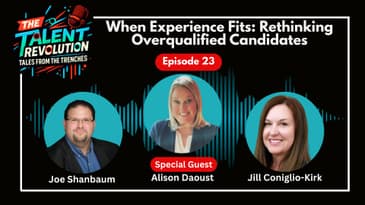
Discussion about overqualified candidates from the HR/TA/Candidate perspectives.
Powered by the WRKdefined Podcast Network.
[00:00:03] Hi everyone, welcome to the Talent Revolution Tales from the Trenches. I'm your co-host Joe Schambomb. And I'm Jill Coniglio-Kirk. You know, Jill, I was hearing and thinking of a word that's been coming up a lot in conversations called overqualified. You know, and I think back in the day it was a really red flag of, oh, we're not going to hire somebody overqualified and, you know, we can't do that because they're going to leave and all these other things that are going on.
[00:00:31] But in the market right now, it's a weird time, right? We have a lot of turnover. There's uncertainty, a hesitation. And I think this is an opportunity for clients, candidates and companies to really take advantage. What are your thoughts? No, I would agree, Joe. I would just say it's an unprecedented time from what I see.
[00:00:53] And as companies are really reevaluating their structures and making other changes in their organization, I could really see a different opportunity for bringing in talent that may have more qualifications than what you would ideally previously have looked for. You know, how do we navigate all this change? How do we position the company and maybe put people in roles who have been there, done that, right?
[00:01:22] And aren't kind of cutting their teeth. So I think it's a great topic. And I am really excited to welcome to the show, Alison Doust. Alison is not only a previous HR practitioner and leader, but Alison has is the owner and founder of Centric Solutions. Alison, welcome. It's a pleasure to have you with us to dive into this topic. Yeah, thank you for having me.
[00:01:48] Yeah, I'd love to hear a little bit about your background as to how did you as an HR practitioner decided Centric Solutions was was, you know, something you wanted to do. Great question. And again, thank you for having me. So I started Centric in 2012, and it was after almost 17 years in the automotive industry in HR.
[00:02:14] I started my career and I'll give you a very, very high level snapshot, but at General Motors as an administrative assistant in HR. And I was on site via Kelly Services. So I was there for almost two years and I was an admin to high level executives in the HR function. So I was going to school at night and I was working at GM and that I think I want to go into that.
[00:02:40] So there we go. That started my path. I then went to to a company called Collins and Aikman, which is now IAC. And I was in HR and I was promoted to a generalist, then a senior generalist and move plant side on that end. And that's where I started really paying attention to talent and how it drives an organization forward. We were adding, we were merging companies, adding third shifts, and it meant a lot of ramp up and a lot of hiring.
[00:03:07] So I was recruiting from a pretty young age while I was still going to college. And I was, you know, I just a light bulb went off. And so finish the degree, you move on up. Then I'm a regional head of HR at a company called OP Mobility, which was at that time it was called HBPO. And so I was the head of HR for North America. And there was a time where we were opening three plants in three different countries. And we did this in 18 months.
[00:03:37] So recruitment is not a single source solution. We were recruiting internally. We were building pipelines through what's equivalent to Michigan works at the different areas. So your unemployment centers. And, but then we were also using agencies to help us ramp up these, these plants and we were successful. So we opened all three plants under budget on time, and it was just so much fun. And so that's when the light bulb really went off. Like I want to open a search firm.
[00:04:04] And it's a lot of fun because unfortunately in that summarized career, I also had to close plants and lay off people and do all those unpleasant things. So at that moment, it was really when Centric was born, when I was opening a plant. And I thought this, you know, we can level this industry up because the agencies that I work with, some were phenomenal. Some were not. And I go raise the bar.
[00:04:31] And so, boom, I 36, let's go open the staffing company. And we need to raise the bar in this industry. And we do bring a unique perspective because I lived it. So of those years, many years, you know, it was almost 17 years in the automotive industry, about nine were plant side. And then the others were overseeing operations. So we can truly partner with our clients and speak the lingo on the timeline and the budgets, the whole thing.
[00:05:01] Right. Well, it sounds like, number one, first, you had to survive the tsunami hiring, right? This mega project. But, you know, that reflection on, you know, how did that feel? And, you know, it sounds like that really ignited a spark in you that, you know, really made this business come to life. So thanks for sharing that. I think there's a lot of people out there, maybe in their early career thinking like, I'll never do something like that.
[00:05:25] But I think you're a living example of saying, you know, if you let your inspiration drive your career, it leads to great places. So thank you for sharing your story. Absolutely. So, yeah. Now we do work across the U.S. and we have three different divisions. So we have a contract temporary division, a direct placement division, and a retained executive search division. We're predominantly technical, professional, mid-management, and executive level.
[00:05:53] So what that means is everything besides the production floor, not that that's not important. That's extremely important. It's just a different model. So that's kind of the structure of Centric. So in all those things in your career, Allison, you've obviously hired top performers, some folks that are rising stars, and then this whole concept of overqualified and really unique characters.
[00:06:18] What are your thoughts on this whole overqualified situation going on now that's in the market and across the U.S. and actually probably globally?
[00:06:28] You know, I can look at it from two different perspectives because when I was the, you know, the head of HR for North America, when we were bringing in candidates, the concern from my side at that time was it's really expensive to bring on a new employee from an organizational standpoint. And you want to make sure that they're not a flight risk.
[00:06:53] So the hesitation is, are they going to come on board because they have a need right now, but then leave in six months when something better comes along? And that's a great question. But from, if you look at it, I think what we need to do is really talk, you got to peel back that onion and understand what the motivations are. Because you could be missing out on some really high caliber talent that has the skills, can jump right in, they're ready to rock and roll.
[00:07:21] Yeah, Allison, I think you bring up some great points and really understanding the candidates motivation is really the most important aspect of this. It sounds like understanding that both from the recruiter side and the company side is really at the heart of maybe where you start when you consider a candidate who may bring more experience to the table than the role the company's hiring them for, you know, warrants. Correct. Yeah.
[00:07:50] Well, that's why it's so important to have the right phone screen and interview with, you know, the initial one setting up with that candidate to truly understand what's going on in their world. And then frame those questions through the whole process so the manager can understand and gain that comfort of why this person would be the right fit and their motivations. And then the culture piece. So again, turnover is a concern and there's lots of different factors for the overqualified to do it and not to do it.
[00:08:19] But, you know, the major ones obviously leaving and other aspects and the cost behind it, but there could be some really good benefit from it. But it starts with motivations, conversations, and it's not just, well, what do you want to do? It's why, when, how, asking for those examples. So the recruiter and the manager have to dig in. It's not just surface level because somebody can just, you know, pull the wool over anybody's eyes in those aspects. Yeah.
[00:08:47] And from my side, Allison, I firmly believe the more forthcoming a candidate is to you as the recruiter and the company, the more we can answer that why. Correct. Where do we want this role? Yeah. Mm-hmm. That transparency and, you know, some examples I've seen in my career as I work with other people who might be in the job market saying, hey, I reached a certain level of my career. And what I'm doing isn't fulfilling for me today.
[00:09:15] I am meeting with a board. I am sitting in meetings. And the whole reason I chose this profession, I'm not spending my time doing that. So it's really not giving me this energy. So while I can do that and I'm qualified to do this job, now that I've, so to speak, arrived at this place in my career, it doesn't kind of fill my cup. It doesn't make me happy. Right?
[00:09:39] So I can resonate with being in jobs or, you know, maybe a step below the job I thought I wanted in my career and doing like a, wait a minute. I see how this person's spending their time and what they're doing. And I'm not sure that's the right place for me. So I would just say, I think a key to it is that transparency. And the more you can kind of invite the conversation with the recruiter, you know, with the company, the more you can satisfy their worries.
[00:10:08] I call them the worry beads, right? Where are those worry beads at? And kind of having a little bit of a roadmap to say, if I could address those through conversations and, you know, navigate and steer that in the right way. Perhaps that helps position me as a candidate in a better way so that they're putting some of those fears to bed. I don't know if you have some experience where you can resonate with that.
[00:10:33] I do. And I would say with my clients, I will address those concerns out of the gate. So what are they concerned about? It's going to be retention. You know, is this candidate going to stay? Are they going to be affordable? Can we afford them? Is there compensation alignment here? You know, will they be engaged at that level or will they be bored? And but what I've seen, you know, it really a lot of the candidates, like you said, they sit in the board meetings and they want to be more hands on.
[00:11:03] They miss the, you know, the work. They in I'm going to say. I have, you know. And this was just passed, like maybe six months ago, but I had a CEO overall and we were looking at some BP levels.
[00:11:22] And we were also looking at some president levels and some of the company, some of the people that I really liked and I thought were the best for the role was a president of an automotive company. And this person, it was just that, Jill. They wanted to be more boots on the ground, overseeing multiple locations. They wanted to be involved with the plant operations.
[00:11:47] They like that side, not the full picture, not the whole gamut, a successful career growing up through operations. And then they landed a president role and they wanted to come back to that COO role. And so it was a, it worked out well in that particular case because there was a financial alignment. The budget was okay. There was not a perceived risk because it was mostly due to the work that was being, that they wanted to do versus.
[00:12:18] And so at the end of the day, they could step in real quickly. They could add immediate value. They could mentor others. They could work cross-functionally. So you can drive the business forward. And that role, that's such a critical role that it can make that company highly successful. Yeah. You know, when you share an example like that, I look at it and say, they report to someone who did their job.
[00:12:45] So now they even understand, what do I need to give that person? What do I clue them into? How do I help give them the right visibility? So I've seen the power of it, right? When you've done that job and now you're reporting to someone like that, how you really can be a superstar. Correct. And, you know, still bring that value.
[00:13:07] You just have to have someone confident and ability to hire, overhire somebody that's not afraid, that's able to utilize that talent in the right way. Because there's some folks that wouldn't be able to do that, right? So that's a coaching opportunity for. Well, that leads to a question I have for Allison because I think Joe definitely hit on one of the reasons overqualified candidates are passed.
[00:13:37] And I know when I've been in pursuit of certain roles, perhaps I was deemed overqualified because the person hiring me perceived me as someone that had more qualifications than they had. So this kind of topic of security, I think, comes to play. Because if the president in that case felt threatened or insecure in their position, you know, that could be a barrier, right?
[00:14:04] Where, and that's certainly something that's hard for a recruiter to control or a candidate to control. It's just one of those real situational things saying, if someone perceives someone they're hiring as a threat to take their job, then perhaps you're not going very far in the process, right? Yeah. I mean, that's the reality. So it's going to be up to, at that point, the hiring manager, if there's a perceived threat, then it's, and the hiring authority is the one threatened.
[00:14:33] It's probably not going to go too far, honestly. But it's unfortunate in some cases because maybe that leader could benefit from the mentorship and could benefit from the knowledge share that that person, you know, in your case that you could bring. And you're not trying to take the job. You're just trying to do the best job.
[00:14:55] You have the skills, the capability, the knowledge to solve the problem that the company is looking to solve or fill with this role. So, right. I mean, part of it is you got to fish that out on a, if, whether it's third party or internal recruitment, fish that out in the intake section, right? That strategy conversation of what if I brought somebody like this? And that depends, and it doesn't matter on any level of a role, if it's a president, COO, or even an engineering role, for example.
[00:15:24] What if I brought someone like this? What would you do that will fit in the pay range and fit in the scope? And then you can kind of gauge from that manager what they're feeling and how they're going to take that perspective, right? So, another aspect that I was thinking of is I've had a candidate who, you know, great career, you know, has, I don't know, five, 10 years honestly left that they want to do.
[00:15:51] They've been to a plant manager and they're like, Joe, and this is a true example. I don't want to be a plant manager anymore, but I want to work. And I've got a lot of work and I got a lot of capability. And, you know, I've got five, 10 years left, Joe. I want to do this. Give me a program management job, for example. Pay me the rate that is going for that and I'm good. And I'm like, well, that's a hard, you know, your resume, your background showcases this.
[00:16:19] And you don't want to mislead anybody on what you've done. And you're going to gain somebody so qualified that could help the organization to take that type of role. That's the other obstacle that's going on right now, too, right? They, they're changing their career. They don't want to climb the ladder. They want to be the steady person that's going in there and driving through that. I don't know, Alison, have you seen that as well? I do.
[00:16:44] But again, so because we're a search firm and we're sending two to three candidates and we're, we're focused on precision. So that candidate, unfortunately, that's hard for a recruitment agency to bring that kind of candidate forth. And that comes with a partnership, right? So that comes with me knowing my clients for a very long time and being able to have that discussion in as a trusted partner and advisor and saying, here's their why.
[00:17:13] And here's their capabilities. And this is, you know, they, they can add, they have a level of experience. They have knowledge, they're stable, they're reliable. That's a conversation I would have, but that's hard for me to just send that. Well, that wouldn't be the only person you send. You could have the conversation or, hey, here's A and B. What about C, right? Think of this person. And it helps open the perspective, I think, of a client.
[00:17:42] And even internally, right? I've done it too of, hey, listen, look at this person. Like they're, they could add value in these different aspects. And, you know, if you really, if the TA is truly ingrained with their business partners and the succession planning, look, you know, this could help grow or mentor someone else here. So you could play into those avenues with the qualified folks in many different avenues, in different ways. Yeah, absolutely. It's a conversation. Always.
[00:18:09] And we have regularly conversations about similar topics, for sure. Yeah, I think a lot of it also has to do with knowing your customer. Like you said, having that trust and transparency or perhaps knowing where they're heading.
[00:18:23] And I can think of a time working in a startup where I joined a startup and I immediately recognized we were, we needed to over hire a bit and have people with more bench strength, more experience in certain roles because of the pace and the lack of structure. Right. I, there were lots of reasons I saw people not thriving that they had hired previously.
[00:18:50] And I recognized that the evolution and the speed at which a startup is going and all the things they need to build dictate an environment where I knew my best strategy was to over hire and hire the person who, you know, can move quick. They can move quickly. They can assimilate quickly.
[00:19:13] So I think sometimes the business circumstances create an environment where there's a benefit, right, to the business, really thinking that way, thinking about their evolution and how quickly they're going to grow. And they're kind of hiring for tomorrow, not for today. So, yeah. That's smart. I think companies that have strong succession and are hiring for tomorrow and can do, yes, I think that's a, it's a definite smart strategy. Yeah.
[00:19:41] And the truth of the matter becomes it all boils down to the things we started at, which are, does it fit the salary requirements? Right. Yes. You know, and all of those things. So, not to say those aren't real barriers or issues, but I think when you have candidates that are saying, you know, I want to do this. I know this title maybe is one lesser than I had before, but I want to kind of build something new and I want to be part of this. It's recognizing maybe there's an upward path down the road for them, et cetera.
[00:20:11] It's just kind of, like you said, getting to that conversation with the prospective employer or positioning yourself if you're not working through a recruiter as to how do you get that conversation with the company? How do you find the platform to present yourself in the right light? What a lot of folks also have to take into perspective is size and scope, right? And size and scope of where they're currently have worked and where they're going to, right?
[00:20:38] So, is it a $2 billion company to a $10 billion company scope? Or is it, you know, size of plant? All of those things play into factor and titles, you know, are different by every company. So, a director somewhere could be a manager somewhere else and vice versa.
[00:20:55] And that's what recruiters, managers, HR, and the candidates also have to put into perspective when they're looking at the new opportunities and be able to help leverage those conversations to be able to show that size and scope and why they can benefit and also, you know, why they're taking that step up too. Yeah.
[00:21:47] As long as the money's there, as long as, you know, but that's, that's more of a, that's the opposite direction. But you see them going from a manager title to maybe a senior title, senior generalist title. We see it flipped every which way. So, I know I said that backwards, but we, you know, the intent it's, it's both, both ways. Yeah. Yeah. And I would just say, not every person's looking at the resume and reading behind the label. So, I think it really all boils down to those conversations and digging in.
[00:22:17] You know, another one, I wonder if you see a fair amount. I've experienced some of these in my career. We have the engineer who decides they want to go down the leadership track, but then they realize they hate being a leader and they really just want to be an engineer and, and do, you know, do that creative work and not deal with the people problems. I think those might be a little easier to, you know, because it's, it's a common, you know, I, they didn't know what they didn't know before they went into leadership.
[00:22:45] And I was like, oh yeah, there's a reason I became an engineer and I'm really good at solving engineering problems. I don't want to deal with people problems, but maybe you can share your perspective there and how, you know, clients perceive candidates like that. Do they see them as attractive candidates? You know? Yeah. We see it all the time. I mean, it's that, it's that HR director who will go to a manager.
[00:23:09] It's that engineering manager who wants to go back to the manufacturing and senior engineering role, you know, or vice versa. They're at a, you know, they're over, we see it all the time. I think that, I think if they're overqualified or perceived as overqualified, they need to be clear on their why.
[00:23:28] And they need to really make sure that the company feels, you know, that the role fits their current goals, that they have the capability, that they're in it for the long, they have to exhibit long-term interest. Because flight risk is the big flight risk. Flight risk and budget are two of the main reasons why companies are, no, they're perceived, you know, they're going to leave.
[00:23:51] As long as that can be explained in really specific terms and speak to stability and long-term interest that they have, that that candidate has, then the company is going to be more open and receptive. Right. Yeah, I think that's really good advice to any person out there in the market saying, understand your why, articulate your story, invite the conversation.
[00:24:20] If you get the opportunity to talk to them, don't walk away wondering if you're going to get the no because you're overqualified. I always say like take on the slay the dragon in the room or call out the elephant in the room. If other people aren't going to call it out, invite the conversation. And I think with some practice and rehearsal and some planning, you know, there's the right way to do that. I think in every interview, you're given the opportunity to ask questions.
[00:24:47] And one strategy I like to use is to think about things that can't the interviewer didn't cover that I want to convey and try to structure a question around inviting that conversation through that question period.
[00:25:00] So that's just a little tip I have, one that I've used myself in circumstances where I was a candidate on the other side of it, trying to make sure I didn't drive away from an interview or in today's world on my computer, shut my computer thinking, oh, I wish I wish they had asked me this or I wish I had that chance to say that. So that's just a tip to say. I think there's a way to structure questions when it's your turn to open those conversations. Absolutely.
[00:25:28] So there's a huge benefit for what we've just talked about by using a third party plug for both of us in those things to gain those perspectives from the candidates. But here's a question, guys. How does the candidates do that when they're applying to jobs? Right. The resumes. There's no words. There's no conversation. Yes, there's cover letters. Yes, there's comments.
[00:25:51] But what can we give to the listeners that are looking for jobs on how to help overcome that by an application? Any thoughts? I mean, they have to make sure that they clearly outline their experience. And they're going to have to make sure.
[00:26:18] That's a tough one because we're getting the resumes in and I have been guilty of saying, nope, overqualified. So I really need to see that they have the exact skills that the job is requiring. So in a scope.
[00:26:35] And they have to communicate their commitment to that role and maybe address out of the gate in the submittal, in the bio when they send me their resume that I realize that I might be perceived as overqualified. But here's the relevant, you know, here's the job that you are looking to have done. Like this, you know, I have the skills, the ability, interest, I'm willing to commit.
[00:27:00] And they need to just really define that and just call it out in the first couple sentences when they submit their resume that here's a relevant experience I have. I am willing to commit to this role. I'm in it for the long haul. And here's why. And that's I think it's kind of it has to be written, at least. I mean, I would agree.
[00:27:23] I mean, I think if, you know, there's this potential, you know, this potential situation where you're going to get past the site and not read. Number one, I would say this best strategy for a candidate is say build a targeted resume. Spend all your time talking about the relevant work that you've done, even though it may not be the most recent work that you've done that speaks to this role. You know, kind of like put it right out there. Perhaps, you know, you take some of the bullet points off that aren't relevant.
[00:27:52] You know, maybe I did an M&A deal and I did all these other things, but I know that's not going to be expected in this job. It's not necessarily a time to brag about what's the biggest thing I've done. What's the most impactful thing I've done in my career. It's about how do I bring the experience and what have I done that's going to come come into your organization and help you solve your problems or set you up for success tomorrow. And I think that's a really hard thing for people to let go of.
[00:28:20] You know, and I know myself, I don't know how many attempts I've taken at my resume. And it's like, you're so protective of, but I did this and I survived this. Right. But I think it's not a time to be proud. It's a time to be realistic about you're not lying. You're highlighting what is most relevant. What is most on point for what I'm targeting. Right. Yeah. Focus on your experience and not your highest title.
[00:28:47] So you bring up titles, which is exactly where I was going. What are your thoughts, guys, on changing the title? Right. You don't want to lie, but you also want to, you know, if you're a vena director, but you're okay with being a senior manager or a manager, you know, whether it's an HR business partner or engineering or, you know, manufacturing. What about, you know, adjusting the titles? Because everyone, you got to remember, they're applying through a system. Right. I mean, if they're using third party, we can talk through that.
[00:29:17] That's easy to be able to talk to the clients. But if they're applying online, it's their resume. It's an AI tool that's also scanning and organizing and someone reading their resume. Are they going to get through and scored the right way? I mean, what's the thoughts on titles, guys? I'm all for 100% honesty all the time.
[00:29:39] And I would not be very happy if I found out that they, like, changed something. I think they can speak to it. But, you know, there's the filters. They're going to have to send that email. They're going to have to send through the, they might have to try to find the hiring authority and then explain some. That's a tough one. Yeah. Yeah. I personally think you can't change your title.
[00:30:06] But I do know in different companies what my title might be might be interpreted differently. So what I've told people to do is say you can put, like, slash or parentheses. Like, I was a vice president. But in some companies, that's an HR business partner, a strategic HR business partner. But you can't lie. You can't just say I was a manager, but I was really a vice president. You know what I'm saying? It's a fine line.
[00:30:31] I think you can kind of expand on what your title was and your scope as you're capturing things. But I think you can't dumb down your titles or create false labels. That's just my own personal take. So I think it goes to size and scope, right? So if you can add lines in your resume about size and scope of the role of where you were, and that will help play into where they are, right? It's the $2 billion versus a $10 billion. The titles. I love the bullet point, guys, question, right?
[00:30:59] Taking out the M&A activities when you're not going to be doing that or playing into if you want to focus more on that technical part of the role versus being a leader and manager and mentoring team members, right? So I think the recommendation for everyone is adjust the bullets to play towards that role. Accommodate the title as who you are, but maybe adjust it. And add a cover letter. I think that's what everyone is saying.
[00:31:25] A cover letter explaining what you're doing, your situation, your why, as Allison keeps, you know, I agree, the why. If you can't get to talk to somebody because it's really hard to get a conversation within a company when there's, you know, unfortunately hundreds of folks applying to these jobs, right? Right. And I will say I learned as much about this on the candidate side, maybe more than I did from the HR side of my desk.
[00:31:52] And I'm kind of smiling because I'm thinking of an interview I had. Joe was actually working for another automotive company and I was looking and in the market, I was working somewhere else. I walked into an interview for a position. I know I could do with my eyes shut, but it was interviewing with people that had half as much experience as me. And really didn't bring good examples to the table that fit the job, right?
[00:32:17] I talked a lot about work that I did and I really didn't enter the conversation with the right mindset around these people immediately were like, yeah, like, thanks, Joe. She's not our person. But when I think about the examples, right, or recency or other things, you need to have the whole story fit. So it's an example. Maybe I'm being too vulnerable now. People are saying she's so dumb.
[00:32:44] But I'm just being real and saying all these pieces of the puzzle needs to snap together for the company. And anytime one doesn't, it's going to be a red flag to them. So think carefully as you go through behavioral interviewing with your stories, examples, and other things. It really needs to fit that position. And you really need to be thoughtful about your preparation. And I think I've learned more through the, oh, that was a bad idea, right?
[00:33:12] And it makes so much sense when you're on the reverse side of it. But it's not your natural intuition. When you're asked a question, it's like, you know, tell us about your proudest moment or your biggest achievement. And you're kind of maybe reaching for something more 10 years back in your career or something like that. So. Yeah. All great points.
[00:33:32] And you just made me completely think of another avenue is, you know, candidates need to get creative, especially if they are overqualified and they need to get their foot in the door to the right person. Because as long as they're clear on their why, they have the qualifications and the skills. It's more of a title thing. You know, use your network. See if there's somebody who works there who can go and speak on your behalf or forward your resume on their behalf.
[00:34:01] They need to figure out ways to go around that database because certain, you know, we don't deal a lot with applications because we're headhunters. We're going to go find a specific person. But, you know, they have to be clear. They have to be creative and and then they need to use some people and then be clear on what value they can add and that they can do that job and that they have that long term commitment and that they're in the price range.
[00:34:31] Because other than that, there's like a say, no, they're a director. We need a manager. Nope. Right. Right. Yeah. So I feel like we've done a really good job of talking about the candidate side and giving people tips. I think I'd like to talk a little bit about to any employers are out there who are hiring candidates.
[00:34:51] You know, what what should their takeaways be from this conversation and what might they be missing out on if they're closed minded to a candidate that could be perceived as overqualified? Joe, I'd love to hear your thoughts there. Yeah. Sorry, I was just going to jump in because it was exciting on that. It's the the the client and company side has to it goes down to.
[00:35:14] The situation for that role, I think, as well, because, you know, could you are they succession planning for someone else that's coming up and and where they're going with that role? You know, it may not be the future plan for it. Right. Right. If it's just a backfill and it could be helping mentoring others. So there's a couple of different aspects that they have to the groundwork has to be played on what that role really is for.
[00:35:37] But if it's somebody, you know, that you can fit in there, that's a little bit more overqualified, that has these different skills and abilities, what they're going to gain is a huge impact. Initially, that's going to just launch pad what's going on. Right. They're going to be able to jump in, add value, give other perspective, mentor others, and they're going to gain, you know, again, it's aligning the compensation, making sure that that fits.
[00:36:04] But if that candidate can just drive in there and add those different technical or skills and abilities that, you know, they weren't necessarily looking at initially, but look at the added value that they've already been there and done some of that. And they're able to plug and play and drive and move the business forward and make that impact. It's a huge advantage for them. And, you know, maybe they, you know, they should be taking advantage of that. Right.
[00:36:33] Here's an opportunity to overhire. And, you know, the manager should be confident enough to go, wow, this person can actually help me and I need this succession plan. Maybe, maybe they're not the succession plan, but they're going to help build up somebody else with me. Right. So the manager should take advantage of that as well to be able to move themselves and their department and function together.
[00:36:57] I mean, I've done this, you know, before when I was hiring and candidates are like, well, what's the, what's the, what's the growth? And I'm like, well, you know, I want you to take my job. And everyone gets stepped back and it's like, come in over hire you. But you just have to be confident to be able to do that.
[00:37:40] Mm-hmm.
[00:37:41] So that's definitely upside.
[00:38:11] It's such a joke. It can, it can level up your entire organization and bring it like almost a good energy. Well, I mean, I use this analogy and there's a video that everyone knows me that they've heard and played, you know, where do you want to go find talent? You know, if you want a basketball team, who's Michael Jordan playing with, right? Yeah. And bring in those folks that then raise that and grow into those things. And there's other analogies you can use, but it's a huge advantage.
[00:38:38] And, you know, it's, it's an opportunity for, for companies to, to grow and explode even faster if they're willing to do that. Yeah.
[00:38:49] So with that, Allison, I guess any, we, we love tales and, and you've shared a couple of stories, but is there any other story or memorable with a candidate or a client where you've been able to maybe successfully hire or, or at least get an interview with someone to gain that perspective on this overqualified world of things? I would say all the time. I mean, it's, we're going to, we're going to have conversations.
[00:39:19] Hey, I have someone there at this level. And, and, you know, I think I gave an example earlier where, where we had, you know, a president that we fed in for, for a COO role. And, you know, you got to have those, those conversations on here's their motivation, but it's also at every level. It's, it's at, like I said, engineering managers to back to a senior manufacturing engineer that's happened. HR, you know, cause we play so much HR professionals.
[00:39:50] We see it, they were, they were a director and they're willing to go to a manager or, you know, sometimes the titles in different organizations are skewed and, and they're, they're a little bit different. So you got to consider that. And it's just a conversation. I call my client and we try to make sure that when we work for our clients, that they are as passionate about talent as I am. You know, I truly believe that people determine the ultimate success of your company.
[00:40:18] So they'll take the call and we're going to have a conversation about it. And I'm going to say, I want you to meet this person. And here's why, here's what you said you need done. And this person can do it. You're going to look and you're going to worry that they're overqualified simply because of their title. And they did have a bigger scope, but here's what they want. You know, they don't want to travel as much. They really, really, really follow, you know, enjoy your company, your mission, your culture. And they've been trying, you know, those things. So I'll have that conversation, Joe.
[00:40:50] That's how I do it. I talk, I, I talk to be that bridge, right? And yeah, you have to kind of advocate for your client and both clients, right? The candidate who's the client, right? And the company, because at the end of the day, you're trying to find this fit and you see it. And they may not be able to see it. And the truth is a piece of paper can't paint this picture about a person and an individual
[00:41:17] and where they're at in their journey and their life and their career and what their motivations are. You know, it's, it's an impossible thing to have a resume that could convey all those things. And I think there's been a whole huge industry built around it. Fortunately for both of you, because you both work in it to say, clearly, it's not as easy as it seems, right? There's a lot more conversations and pieces of the puzzle and parts to this equation that make it all come together.
[00:41:47] Because we all know that very few candidates fail or leave a company because they can't do the work. It's really all about this fit and this motivation piece that is where the magic happens, right? So. You're, you're, sir. You're exactly right. When alignment, when alignment's right, overqualified can become overperforming in some cases. I mean, you can, you might be hitting a gold mine. You never know.
[00:42:17] Absolutely. So I think the takeaway also, and we kind of summarized it again on the candidate side is tell the why, share the why, whether it's an application, a cover letter, a communication, and, you know, the third party recruiters work with them. And, you know, be honest, right? It's the honesty of where you're at, what you're trying to do, and why you're going to be there because you don't want to leave.
[00:42:42] You know, no one wants to leave anybody for those reasons and really try to articulate that. So the fit and the match aligns and everybody becomes happy on those things. Jill, did I miss any of those? No, I think you nailed it. And I think it's a much easier thing to navigate when there's professionals involved, like both of you, who kind of broker both sides of this relationship.
[00:43:06] So I think organizations who don't have that or if they're doing this on their own just need to recognize they need to invest the time and have people with the right capabilities to open the dialogue and have these conversations. So I guess those would be my closing words and pieces of advice to really giving people some encouragement,
[00:43:28] some, I guess, push to consider the resume that might be sitting in their queue in the other pile saying, I don't think so. You know, be curious. Ask those questions. Help your recruiters have an intake where they're trying to understand some of these motivations so we can get to the fit piece.
[00:44:16] Yeah. Understand the why from the third party and the candidate to truly see if it does fit and align to what's going on in that particular situation. At any level and any role in any industry and any discipline, it plays into every different way. So, Alison, it was a super great pleasure to have you here. Really thank you for joining us. Yes. Hopefully I added some nuggets of insight and some trenches, tales from the trenches.
[00:44:46] So thank you so much for having me. Yeah. Thank you. No, great conversation. We appreciate you taking the time. Until next time, we'll dive into a new topic. Thanks, everyone. Bye-bye. Thanks, everyone for joining us. Have a good one.
Sponsors
