
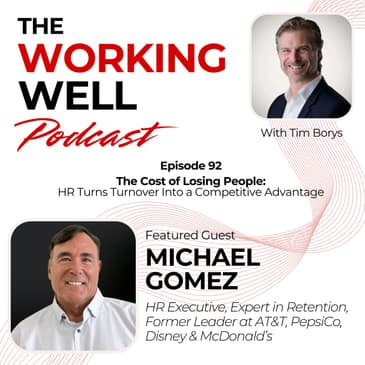
In this episode of the Working Well Podcast, Tim Borys sits down with HR executive and leadership expert Michael to explore what truly drives employee retention, workplace culture, and long-term organizational performance.
Michael shares practical insights from leading large multi-unit organizations and explains why retention is far more than an HR metric it’s a direct reflection of leadership quality, operational systems, development culture, and employee experience.
The conversation covers performance planning, servant leadership, employee development, AI-driven hiring systems, customer experience, workplace culture, and the systems high-performing organizations use to reduce turnover and build stronger teams.
- Employee retention strategies
- Leadership and workplace culture
- QSR and frontline workforce management
- AI in hiring and HR systems
- Performance management systems
- Employee development and coaching
- Servant leadership
- Organizational culture design
- Employee engagement
Powered by the WRKdefined Podcast Network.
[00:00:03] Why do organizations keep talking about retention while doing the exact things that drive people to leave? That's the conversation today. See, turnover is expensive. Training is often weak. And too many leaders are still treating retention like a staffing issue instead of what it really is. A leadership, culture, and performance issue. In this episode, we dig into the factors that inspire people to stay.
[00:00:31] What quietly pushes them out? And what leaders can do to build stronger teams, better performance, and a more stable workforce? My guest today is Michael Gomez. Michael's a senior HR executive with more than 30 years of experience, helping organizations improve retention, engagement, and workforce performance. He's held executive leadership roles with brands like AT&T, PepsiCo, Disney, McDonald's, and Tasty Restaurant Group.
[00:00:58] Giving him a front row seat to what it takes to support people and performance at scale. He brings a practical, real-world perspective on what actually helps employees grow, stay, and do great work. So welcome to the Working Well Podcast. We're the show that explores the critical intersection of leadership, business strategy, and sustainable human performance. And how those areas are defining the future of work. I'm your host, Tim Borles.
[00:01:30] Michael, great to have you on the show. And I'm so excited to dive into all things retention and helping people and businesses thrive through HR. Awesome. Great to have you on the show. Thanks for having me, Tim. Pleasure to be here. And so we talked a lot before this, and I love your background. I love your approach to the people side of business.
[00:01:59] And I think it's pretty refreshing in the industry. So across all the experience you have, what do you feel that leaders still get wrong about retention? And it's a costly topic, right? If you get it right, you're winning big. And if you don't, you're really paying the price, right? But the benefits to the employees with greater stability and a lack of having to retrain other people coming in who are new.
[00:02:24] I mean, it is tremendous to really focus on, you know, the core requirements for success, you know. And there's so many, right? I mean, from compensation and benefits, right? That's a huge one right there. You have to have that right. Probably have to pay at least in the 50 percentile to be competitive. You know, some of the better employers are doing much higher, 75%, you know, even higher.
[00:02:53] But you have to get that right. The benefits piece is so important to people, especially now, post-COVID, you know, mental illness is up five times. It's a huge issue for people. So not only what is the company offering, but how affordable is what they're offering to the people, especially if you're a lower-income hourly worker, say, in a restaurant, for example. So, you know, that's, I think, a big piece of it.
[00:03:23] But, you know, career development and appreciation and a culture of belonging, all these things really culminate. And they multiply with each other, right? So it's like two times two times zero equals zero, right? You have to get them all right. If you're not paying what you need to pay, it's really a lost cause, right? So there are standards that need to be met in order to achieve certain goals.
[00:03:50] But, you know, retention is just a huge and important topic to every employer across America. Yeah. And, you know, for those listening, a lot of my guests are from the U.S. I'm in Canada. So there's quite a few differences in especially the benefits side. But in a lot of entry-level industries, you're not, when I say entry-level, frontline service type industries,
[00:04:16] you don't get those benefits or it hasn't been traditionally offered. You know, I've worked in a restaurant in hospitality for many years and we never had benefits. Yeah. Well, you have to work a certain amount of hours in order to get them, certainly. Many employers do offer them, you know, benefit plans. But in order to enroll, it comes out of your check. And for many employees, there's not enough money left in their check after taxes
[00:04:45] and after they have to pay their bills to pay for benefits. And so, and this was certainly the case for most QSR organizations across the country. There's just an affordability issue that is one that people haven't really figured out a way to solve, at least until not recently. You know, one of the things we were able to discover in my last state,
[00:05:12] supporting a large QSR organization, six brands, 23 states, 440 units, was that, you know, a large portion of the employees couldn't afford the benefits like other employers. Okay. But what do you do about it? And is there a plan, you know, that leverages our tax code appropriately that offers benefits to an employee at a low or de minimis cost? That changes their lives.
[00:05:38] And so when you looked hard at it, we found a plan through a company called HealthWorks HR Insurance Solutions in California, a health work plan, a minimal essential coverage plan. And we took a close look at it. Our ERISA attorney looked at it very closely. You know, it's in 100 companies across the U.S., 60 QSR brands,
[00:06:02] all of which have ERISA attorneys audited by the Department of Justice every year. And it offers all these tremendous great benefits at no net cost because it partners with a 501c3 nonprofit for lower income workers. It's designed for lower income workers. And what do you know? Well, that's what we had.
[00:06:27] And so we leveraged this plan, provided 7,000 employees all of these benefits at no net cost, and changed their lives. Yeah. And changed their lives. But in order to do it, you have to understand what the problems are. You have to do a gap analysis. You have to look. And when we looked at the benefits, we saw, you know, great plans, you know, premium plans,
[00:06:57] Blue Cross Blue Shield, American worker, very good plans. But the reality was the affordability just wasn't there for our lower income workers. And so we provided HealthWorks at no net cost to 7,000 people in September 1 of last year. And it's really been just a game changer. And but moreover, they get a little bit more money in their check. So everybody got a raise.
[00:07:23] So they get all of these benefits, the $25,000 term life insurance policy, discounts on prescription drug benefits, indemnities, meaning cash in the form of a check. If you get admitted to a hospital, $1,000, boom. You're going to be there a month. Every day thereafter for that month, you get money. Okay. You get in an accident, you get a check. You know, so these are real benefits that you can use, that people need.
[00:07:54] You have to get airlifted in Montana. You broke your leg to a hospital. HealthWorks will pay for it. All right. So this is what we did for those people. So one of the most powerful ways of reducing turnover, and the stories have been fantastic, right? People are using and benefiting from it. But more importantly, there's a FICA tax savings associated. So the benefit to the business has been, you know, tremendous from a SUMA and FICA tax savings standpoint.
[00:08:24] So anyway, that's just one of the tactical approaches to it. But many components that impact retention, you know, you have to recognize people appropriately. You have to do promotions appropriately. It has to be merit-based. People have to think it's fair. There have to be equity adjustments, right? All of these things impact retention. Before we get into too many of the solutions, how do you actually define healthy retention?
[00:08:50] Because like not all turnover is bad and not all stability, I guess, is a good sign. Yeah. Well, it's a fair question. You know, you have to look at norms. You have to look at high performance brands. You have to benchmark, you know. And it's industry-driven. Like for the QSR industry, you know, 100% turnover is pretty much an expectation.
[00:09:16] You have some examples, 70%, 75% turnover. Outlying areas, unique continuity. But, you know, 100% is a pretty good standard. But sadly, many brands are at 300%, 400%, 250%, right? And it's just spinning out of control.
[00:09:36] But the objective would be to get to that 100% turnover number because that is, to answer your question, a norm that you can reasonably expect that you would probably, you know, reasonably have in the QSR industry. For those listening that might not know what QSR are, quick service restaurants? Yes. Okay. Yes, quick service restaurants. Yeah. So, but, you know, interestingly enough, you know, Center of Hospitality Management, Cornell University did a really cool study on turnover.
[00:10:04] And they used a Pizza Hut restaurant, a standard size restaurant. And they determined a couple of really interesting things. And one was that the turnover percent is very close to the turnover cost. So, if the turnover percent is, say, 150% turnover, the turnover cost is over 140K.
[00:10:30] And now this is factoring in things, you know, recruiting, selection, onboarding, and productivity losses into the equation, right? Across the number of employees and that type of attrition. That's a lot of money. So, if you're in an environment where you're doing 250 as a turnover percent and that restaurant goes to 150, that's 100K savings in that one restaurant alone.
[00:10:58] So, this is part of why we adopted the health work model because it has that type of impact. And when we benchmarked other franchisees, they saw that 100-point decline. And already, you know, TRG is seeing, you know, 20% decline in the turnover, right? So, it's, you know, it's like it's a million dollars across business units in the first year. Boom. Plus the FICA tax savings. So, really tremendous.
[00:11:25] But back to the point of costs and the importance of retention because it's so vital to the company's profitability. As you're talking about that type of turnover, most, you know, corporate office type businesses would just be like, mind's blown if there was that type of turnover.
[00:11:45] And I think, you know, at least from my perspective and fully aware that I'm probably wrong, but a lot of people expect that, you know, QSR type roles, it's like, wow, that's just the nature of the business. And so, they maybe don't focus on it as much. You mentioned a bunch of other things that can help improve the retention and employee experience.
[00:12:12] So, like, what do the restaurants that get it right actually do? Hmm. Wow. Well, it's a great question. I would say they're incredibly process-driven. Incredibly process-driven and incredibly focused on the experience of the customer and what it takes to get there. Right? To exceed those expectations in a way individuals haven't seen before that makes them return for so many repeat visits. Right?
[00:12:41] This is what, say, a Chick-fil-A and the QSR, excuse me, quick service restaurant industry is doing so well. In-N-Out is doing so well. Eight million a unit. Right? This is the objective. Right? I was benchmarking in-N-Out, you know, a few weeks ago, and I just couldn't believe it. You know, I walk in, the lighting's perfect. Right? All the displays are positioned correctly. The facings are right.
[00:13:08] All the uniforms of all the employees, perfect. You know, white, you know, smocks, different, you know, logos, you know, different pins, different, all perfect. Right? Right? All well trained on their positions, you know. So I start speaking to, you know, someone in the lobby, one of the employees, and I say, how do you like working here? She says, I love working here. She's like, well, how does it work? She's like, wow.
[00:13:35] You know, she's a large store manager, makes $120,000 a year. You know, we come in and, you know, $21 a year to start. And we go through different skill-based pay stations. You start in the lobby, you have video-based training, or you learn, and then there's the application of it in the restaurant with someone supervising you. And this is how it's set up through all the different pay stations. And you can progress from fries to burgers to et cetera.
[00:14:03] You know, our fries come in fresh, the production, the supply chain. The meat is fresh every day. The experience is right every day. And it's just like, wow. So that's excellence, right? Looking at every work stream, every core process, and just nailing it. Right? Understanding that you're looking at it from the customer's perspective, trying to exceed those expectations.
[00:14:33] Yeah, and you mentioned a few things about from the employee perspective, too. And I see those going hand in hand. What other things from the employee perspective? Well, they are the ones that are asked to train the new people coming in. So they like the fact that there's continuity. And they like, and they form relationships with people. Right? So, oh, John has left. Oh. Oh. Right?
[00:15:01] And so, no, it's like, hey, John, see John again. Oh, Mary. Hi, Mary. So, it's, you know, so it's the, it makes people feel more secure and comfortable. Continuity is a good thing. Trust levels are higher. That's all very, very good, you know. But in terms of how you impact the employees, I think it's how you manage them. Okay? It's really important how they're managed. Okay? Knowing empowerment is a cool thing. And managers like to be empowering, you know, with people.
[00:15:31] But empowerment doesn't equal abandonment. Okay? Application versus delegation, that type of approach. You have to look at that core work. You have to make sure the motivation and skill level exists to execute that core work. And it is that understanding that will determine what level of coaching, facilitation, delegation, or direction you're providing to the individual.
[00:16:01] Okay? But if you're saying, okay, go, do it. And they motivate it, but they don't know how, they're going to fail. Yeah. They're going to fail, and no one wants to fail. Right? So, but it's incumbent upon the leaders to look at their work and to make sure that they have not only the motivation to do it, but the skill to do it every step along the way. That is the responsibility of a good manager and a good leader.
[00:16:29] And so, as far as those responsibilities, what different management or leadership styles have you seen that really shape whether people stay, disengage, or start looking elsewhere? Well, in a service business, you know, you really want to look at the traditional organizational pyramid and flip it upside down, where those closest to the customer are now most valuable.
[00:16:55] With the rest as servant leaders to that end, right? Supporting the transactions, you know, for TRG was 30 million, 30 million transactions, right? 500 million in revenue. And that's the difference between people coming back. It's those experiences. As soon as that door opens, they have an opportunity to control that experience. Within those four walls, very powerful.
[00:17:25] But, and so, how do you get there? They have to feel like they want to, right? Employee satisfaction comes before the customer satisfaction. If you have employees who are upset, disgruntled, how do you think they're going to do with the customers, right? Not as well as if they're very happy. Yeah. Okay. So, anyway, just a couple of more points.
[00:17:51] Well, I'm glad you brought that up because I see a lot of businesses focusing on the customer experience and the, you know, the systems and the processes and they dial those in. But they often neglect the people side.
[00:18:10] Your people have to be on board with those processes and the systems and be trained and inspired to show up and provide and live into that system. Absolutely. Yeah. I think there's a couple of points here. One, you know, the managers, the leaders need to lead. And part of leading is being about being there now for the people. Being accessible.
[00:18:40] Having employee huddle sessions. And letting them know that, A, you're listening and that you care. Yeah. Okay. Very, very important. If they feel there isn't, if you're not authentic, if you're not listening, if you don't care, if you're insensitive, the employees will leave faster. They don't leave companies, they leave leaders. Absolutely. Okay.
[00:19:10] Okay. So that is, I think, a very, very important part. But also providing them the skills that they need. And in decentralized multi-unit environments, how do you get to the people? How do you provide just in time what they need? Right. Well, I think learning management systems are the most efficient delivery mechanism. Right.
[00:19:39] Five to 15 minute learning modules provided. High quality content. We're in search of wow. Okay. We're after not just technical skills. How do you, you know, you know, with the degrees, you're cooking the chicken, the process, whatever. But, you know, customer management, de-escalation, crisis management, critical thinking. Right. Situational leadership. Right. Right.
[00:20:08] You know, financial acumen, P&L management. Right. And so when they're learning some of these soft skills, they're like, wow, I'm being developed here. And that's the magic where technical skills and soft skills come together. Right. And they feel developed. And, but you have to provide the mechanism. And it is the most efficient delivery mechanism from a training perspective. Right. And it has to be short. No one wants an hour. Right. Especially if you're in there. No one can spend that kind of time.
[00:20:38] So it's got to be short. It's got to be upbeat. It's got to be helpful. Right. And so you have to spend a lot of time making sure you're delivering the right messaging at the right time. Right. Because they have a bandwidth too. Right. Right. So that's part of it. So there's so many things that, you know, are important that impact retention. And you have to do so many of them, you know, in order to be effective.
[00:21:03] And there's an expectation increasingly with this workforce that, you know, you do more and not less. You know, and I think HealthWorks is a perfect example of something that really helps the people and satisfies them in a way that they haven't been able to receive before. You mentioned the, call it micro learning, those little five to ten minutes little learning modules.
[00:21:28] Where does that fit into the workflow of the average day for a QSR worker? Hmm. Interesting. Well, that's the cool thing about it because you provide a window. They don't have to, when they receive it, they don't have to do it right then. It's not, it's like, they don't have to start it right then. There's flexibility. They might be busy. So they have like a two-week window where they can complete it.
[00:21:54] And you can institute a modicum of testing to ensure comprehension, right? Which is key, right? You can do that, right? But it's got to be sure. It's got to be right, right? It's going to be well-timed, right? And it's a strategy. It is an absolute strategy. And that's part of it. Learning management system training just in time. You know, I see this in a lot of my executive coaching clients.
[00:22:22] They're leaders in the corporate world, all kinds of different industries. Not necessarily QSR, but what we often see is that there's this training, but then the reinforcement and implementation starts to fall flat. And we know like Ebbinghaus forgetting curve, so much gets forgotten right away unless it's specifically implemented.
[00:22:49] And there's recall check-ins on a regular basis. So how have you seen that work? You know, they could do their onboarding and it's watch these interpersonal or de-escalation type things. How do they get integrated into the regular workflow? You build it in and you relegate everyone to it within a system that's transparent that
[00:23:17] records every step along the way. Much like In-N-Out. It's the video training, but then there's the application. That's part of the process. That's right. There's the validation or no, more retraining, right? So, but once it's part of the process and it's built in to the training plan and it's transparent, you can see it. Anyone can come in and go, oh, Elizabeth finished her training today with John. Cool. All right.
[00:23:48] And that's how you relegate processes to the point of achieving excellence, right? And we did that recently with a new performance management and appraisal system called PerformYard. Fantastic. You know, we had 70% of the employees receiving performance appraisals and we implemented the system and it went up to 80% complete. Okay. But it's transparent, right?
[00:24:14] And it's a team thing where the employee provides their input and they're happy to do it. They worked all year, right? And then it's all there ready for the supervisor to come in and look at. But one of the cool things about it is there's a, there's a, a share screen where they can move over the data that they like from the employee into their review that they're doing for the employee. So they're like, yeah, I think I like this over here. They move it in and all of a sudden, boom, boom.
[00:24:44] In an hour, you've done a review instead of eight hours or not at all. Yeah. Right. And you can go into the system and you can see across the organization, across brands, who's completing, who's received, who has and who has. Right. And when everyone knows that's how it is, okay. It has a way of getting people to participate. And then it's a healthy thing. All right. Because now you're bringing a supervisor and employee together. Right.
[00:25:12] I, it's a very, very healthy thing and people rely on it. You know, you know, the last training session I had, you know, I touched on this and a number of other points, you know, and normally there's only like, you know, a hundred people on a call. So there's 388. You know, they have a big interest in how they're reviewed and the performance management, et cetera. Wow. I love that.
[00:25:36] And what I'm hearing is that the larger corporate world can learn a lot from the systems in place in the QSR industry. Because I see so many times in the traditional corporate world where someone goes to a conference or attends a workshop and they attend, company invests a bunch of money in that. And then there's zero follow through.
[00:26:02] They, like the binders, the manuals, the information gets put in a filing cabinet on a bookshelf or just into the ether and it never gets looked at again, some folder on a computer. And there's no follow-up with, from their leader. There's no follow-up and how it's tied to their capacity and capability in the role. So I love to hear that, that people are walking through that process and it's pretty transparent. Yeah.
[00:26:31] Well, part of leading effectively is understanding pattern creation. Pattern creation that sets the tone for the culture and how employees will be supported throughout their employment cycle throughout the year. Right? And if they understand that performance planning comes in the beginning and that a mid-year
[00:26:58] calibration comes halfway through and that a management pulse survey happens and a performance review happens every year. This is the culture being formulated for people to feel comfortable with. This is how we operate. Right? So these are ways of effectively leading, but you have to understand pattern creation. You also have to understand pattern recognition.
[00:27:28] You could easily in the QSR industry say, oh my God, it's time to sell. But if you look at, you know, the patterns of the economic, the macroeconomic trends, the international trends, what's happening with Cuba, with Venezuela, when you understand what's going on with crypto, the impact, you're like, wow, this is going to go. You know, and this is not the time to sell.
[00:27:53] So pattern recognition is a key leadership quality, just like pattern creation. Yeah. Absolutely. And now we talked quite a bit about management behaviors and things that help employees thrive and improve retention, but what ones don't get talked about as much that you've seen make the big, some of the biggest difference in that retention? You have to be there for people.
[00:28:23] You know, people want to know how much you care before they care how much you know, right? So you have to be there for them. And so you have to get, again, pattern creation, formalized processes where you're making sure that there's a mid-year calibration. You're making sure there's a performance planning meeting in the beginning with the employee that supports the strategic plan. You make sure it happens with a transparent system that's automated, that everyone's participating in, right?
[00:28:53] And so, and you also create performance plans that have a number of components that include the accountability measures, evaluation standards, certainly competencies linked to merit dollars, certainly because equally important to getting results is how you get there. But also the third piece, very important, is an individual development plan, not equally weighted necessarily, but you're talking to the employee about their development.
[00:29:21] But as the employer, you're recognizing the need and you're building into the process something that addresses that employee's need that also helps the company, okay? But it has to be integrated into the process and it has to be executed flawlessly to make sure it's happening. And it's not happening across, are they talking about individual development plans for people across America, are they?
[00:29:51] No, no, no, you know, but wow. The impact it has on, wow, you care about me. Oh, you think this particular training class is good for me. Wow. You want to impact retention? Do that. Yeah. Again, happy to hear you say that because that's actually a very common topic I have with my executive coaching clients is I have a lot of clients in the tech industry. And it's not just tech.
[00:30:21] It's across all kinds of it. But what I see is that they're especially technical experts, whether it's medical, legal, you know, technology. Technical leaders that are in a people leadership role are still often very focused on the technical aspects, the job competency, but they're not meeting them, their team as humans. Like what's your growth and development? What are your plans?
[00:30:51] They're not having those conversations on a regular basis. And it still shocks me how rarely that happens. Most of the, quite a few of them are having one-on-one meetings with their team, but they're focused on dealing, putting out fires, talking about the technical aspects of the role, different projects, updates, and things like that, which are important to do, but not necessarily part of a one-on-one.
[00:31:20] And I've had people say, oh, I've worked, reported to this manager for a year and I've never had a development conversation with them. They get their year-end review and they had their quarterly reviews and their biannual, semi-annual reviews, and then they get a ranking or rating, but they've never had this development conversation of, well, where do you want to go with your career? What is it that helps you thrive? And as you said, just meeting them as a person. Yeah.
[00:31:50] You know, there's a process that PepsiCo was, you know, very good at. It was their development feedback process for employees. And it, you know, it happened, you know, twice a year and it had a couple of interesting components, interesting principles that followed, right? And A, it was based off of an employee's performance plan.
[00:32:15] So every employee had a plan, right, that impacted the areas that I talked about earlier, including their development, right? Okay. But when you, when you met and you were, you were getting feedback from your supervisor, there was a give and take. And the employee always went first. Okay. When they were talking about their strengths first, right? They would list out their, go through their strengths. Well, I think I did this well, and I think I did this, and I've been successful this way.
[00:32:45] And I think that, that, that, that, that, that, that, that, you know, the supervisor may be listening and they, they may disagree with one, but when they respond, they don't address that yet. They wait until it's the opportunity areas, right? And they look for every opportunity to augment what the employee is saying. Like, you know, I would agree with you, John, because when you did that, that really helped with this, you see, right?
[00:33:14] And then, so the employee always goes first, followed by the supervisor, first on strengths, then on opportunity areas, right? And that give and take, it was just, it pulls them together and it, and it just ignites the employees. It's, it really drives engagement, especially when you're talking, when you're ending with, now let's talk about how we sharpen the saw here with some improved skills, you know, and it may be a work along.
[00:33:41] I mean, it didn't necessarily have to cost money, right? There could be a big presentation that maybe everyone's going to go through in a couple of months that's really developed for everyone. And that's part of their plan just to participate in that, right? And so there's a lot of ways, and there's a lot of online courses and creative things that you can do to develop people, right? And when you do that, people feel enriched and they feel more motivated to stay with an
[00:34:11] organization, I believe. Absolutely. And that's, I love that you brought that up because it doesn't have to cost money at all. It's sometimes just giving someone an opportunity to learn a new aspect of their role within their role and get feedback in a different way so they can learn, grow, improve, develop in their existing competencies. It doesn't have to be, hey, we're going to fly you across the world to this conference or workshop or take this expensive course.
[00:34:40] Sometimes that's nice, but day-to-day on-the-job learning is massive. And I, yeah. It could be a project role where they're the project leader and they're managing people in the project. Maybe they haven't managed people before and now they have an opportunity to do so. Yeah. Right. Great developmental assignment. And this sort of brings me to a different area I wanted to dive into, but there's obviously a lot of noise around AI right now.
[00:35:10] Where are you seeing this technology that's genuinely helping retention, supporting employees, and where do you see the hype? Hmm. Wow. Well, there are so many great tools and I encourage everyone to leverage AI as fast as you can. I would get on the train as fast as you can because it's leaving. Okay.
[00:35:35] You know, and so, you know, the sad part is, and, you know, sadly you have to talk about this is, you know, someone says, you know, do you think it's going to eliminate jobs? And the answer is yes. You know, sadly. Okay. But it's also going to really help people with their jobs. Some of the tools and the techniques coming out and the benefits from it.
[00:36:00] There's a plethora of opportunities that really leverage, like chat, GPT, it just goes on and on the list of opportunities. It makes you look fantastic. You know, I had my assistant, you know, put one of my communications into chat and came back. I'm like, wow. So, you know, you should, I would encourage people to get on as fast as they can.
[00:36:30] Leverage the techniques. You know, but, and I'll give you another just more powerful example about the benefits of AI. For example, we rolled out Paradox AI across six brands in six months within my last employer. And, you know, it was a really interesting process because it looked at the non-essential activities, the repetitive tasks that were really weighing down the restaurant general managers,
[00:36:59] really, that weren't really adding any value to the business. And when we looked at them, it was like, well, candidate applications, creating interviews, scheduling, background checks, and also sourcing takes a lot of time, right? And they're not like staffing people necessarily, right? And they would schedule some people not necessarily looking at everything they should have been looking at. And ultimately, like nobody shows up, right? So they gave up on the system.
[00:37:27] So we rolled out Paradox AI, automated all those tasks, lifted them up, saved the RGM's time. All of a sudden, they're hiring people in eight days. Interview scheduling takes between three and six minutes. Just incredibly powerful. You know, the restaurant general manager said, you know, I said, look, you wanted help? We provided it. There it is across every restaurant. Boom. Right?
[00:37:56] And we've already changed out almost the entire workforce with better people, given the sourcing. Right? And the system is automated and more scientific. And this group of people coming into the, you know, the workforce now, they have higher expectations. They want it to be efficient. If they have to wait a week or two weeks, forget it. Right? So it has to be automated, transparent, efficient. And this Paradox AI product, I can tell you, has done that.
[00:38:25] It's been a really big hit and a real value add. And it's, let's take a great example of leveraging AI. What were some of the learnings, important lessons you took out of that experience? Well, it was a lot of work in six months from six brands, you know, a lot of communication, a lot of training sessions, a lot of coordination, a lot of effort. A lot of work with IT, very essential.
[00:38:53] Couldn't have done it with IT and the integration of the systems. It was, you know, very challenging. It's an interdependent effort. Definitely teamwork makes the dream work. And we did it with Paradox AI. But we needed the vendor to do their part. IT needed to do it. My HR brand directors in the field needed to do their part. Having to design, you know, the questions for screening and all of the stuff they had to do, workbooks. Extensive effort.
[00:39:22] You know, a lot of coding, configuration, a lot of training. Just a massive effort. But we pulled it off. You know, and I'm not sure, you know, who's done it faster. But, you know, that's probably as fast as you can. You know, six brands in six months. But, yeah, you know, it was, you know, hard work. It was the learning. And what was the feedback you got from the people going through that process?
[00:39:50] The AI scheduling, interviewing, things like that. Well, it's great. Well, one of the behavioral shifts was because they gave up on the old system. All right. So now with the new system, they're just being, it's like, here, here's the candidates to interview. Here they are. One, two, three, four. It's like, oh, now I have to interview. That's right. Muscle build your team. Take the opportunity. Here we go. Right.
[00:40:17] So they kind of relearn that interviewing skill. Right. Right. But it's part of an automated process and therefore it's obligatory. Yeah. You see? And therefore they adapt. And in doing so, they benefit. It's like, wow. Now I've got five options I didn't have before. And it really helps with the dynamic, right? And muscle building the unit, right? Because you're after that experience. You need the best team to do it.
[00:40:48] Yeah. And getting the right people is critical. And it doesn't have to take a lot of time if you do it right. If you do it right. There you go. If you do it right. Yeah. Now you've worked across a lot of different brands and organizations. If we step back a bit to the bigger picture cultural aspect. So what cultural elements do you feel matter most if an organization wants to call it that health, stability, or long-term performance in their people?
[00:41:19] Well, you have to define what your core beliefs are as an organization. Like really well. You know, that you are a customer-centric organization. That you're a people-focused organization. That you are focused on the financial wellness of the organization. You know, one of the things Pepsi did in the 80s was they took the traditional organizational pyramid and they flipped it upside down.
[00:41:48] You know, with the customer at the top. Right? And it was very powerful. And Tasty Restaurant Group did the same. You know? That sets the tone for the culture where the employees are like, that's right. I'm the most important. I'm here serving the customer and I feel like you're coming to me supporting me in that way. Right? Wow. Okay. That's smart.
[00:42:14] You know, being a servant leader means applying the right coaching, facilitation, delegation, or even direction at the right time. All right? But ultimately what you're after is the experience of the customer being fantastic. Right? You know, the return visit being a reality.
[00:42:42] The workflow being driven efficiently. The cost being managed effectively. And the profit coming in the door. Right? And so you have to gauge where do you spend your time. Where do you push? Where do you pull? Where do you encourage? Where do you direct? Right? And understanding individuals' motivations and skills to do the tasks associated with being effective is what leadership is.
[00:43:12] Yeah. I agree. Yeah. It's, there's so much that is missed, I guess. So how do you turn that into practical day-to-day actions that most leaders can follow if we want to? Turn it into traction for people today. Hmm. Wow. Huh. What part? What part do you want me to drill into? There's so many different pieces, you know.
[00:43:42] The areas you feel most are most important. Well, you know, you need to be really passionate about a couple of things. And one is for an organization. Again, defining what the culture is in terms of the core beliefs and mission and all that. You have to do it. Right? And, you know, caring has to be central to any service business. This element of caring. Right?
[00:44:09] If, you know, you want people that generally feel good about serving others. Right? I mean, you absolutely are after those types of people in a service business. That when they do it, that they feel good doing it. That they enjoy lighting up customers like a Christmas tree with joy.
[00:44:39] Yeah. Right? You know, I remember when I was working for AT&T as a young executive. You know, I had to go through operator services training and learn how to be an operator. You know, because I was managing long distance operators. I was 22 out of undergrad, right? Working for AT&T in Manhattan. And, you know, I was into it. You know, I wanted to do a great job. I wanted to provide good service.
[00:45:08] You know, and I was trying to get them excited. And they would, like, you know, call the front desk and give accommodations, you know. And I had joy in saying things like, gracias por llama AT&T. And, you know, and some of the other employers were like, okay, you're going to get paid. Lighten up. You know. But you have to generally enjoy serving others in a service business, I would say. I love that.
[00:45:33] Yeah, when I was running and growing my fitness businesses, I found out early on, I started originally hiring, you know, by education. And I hired a guy who was a PhD in exercise physiology. And I was like, oh, he was a great guy. One of the worst trainers I'd ever hired because he was just could not relate to people on an individual basis. And I had a good conversation with him.
[00:46:03] I'm like, dude, you need to be in the lab somewhere doing experiments on, like, tendons and things. And, you know, that's your ideal. And it was my hiring mistake. Right. We've all had one. Just one. Just the only one. But I realized early on that I looked at, hey, the best people I'd hired, what do they have in common? And I realized for the industry I was hiring in, it was people that had taught summer camps to kids.
[00:46:31] And so I'm like, if you can thrive in a summer camp environment, teaching to all these kids, that energy and enthusiasm and that just desire and passion to serve people. For me, that was a turnkey thing. That was one of the first things I looked for. And it served me so well throughout the entire time I had the business. Yeah. They also learned patience. Yes. De-escalation.
[00:47:03] But for me, that was a big aha moment. Oh, okay. Yeah. So what is it I actually want? I can teach the physiology, the anatomy stuff. No problem. Yeah. Who's coming in the door? Right. Who you're hiring? Oh, my gosh. I mean, you want to treat it as a family. You don't open your front door to anyone. Yeah. Right. You want to, right, because you're concerned about the health and wellness of the family. Right.
[00:47:32] You want to think about it that way. And you want to hire fantastic people. And the more fantastic the people are that you hire, the better you feel about serving them. You know, anyway, aside from that very important aspect, more macro level stuff, you know, focusing and aligning the workforce, driving the culture. You have to have the linkage between the strategic plan and the individual efforts of the employees supporting it.
[00:48:07] Okay. Beyond that, certainly there's people forecasting. It would be an example. Also a mid-year calibration. Also succession planning. Very important. And certainly you've got to ask for feedback from the managers and all the employees. How are we doing? An organizational health assessment annually, every year, absolutely.
[00:48:33] And if you do it and you get the feedback, you better do something about it. Glad you said that. Right. Right. And then you have to ensure that you give them an opportunity to provide their feedback about how they felt they did as part of an automated process. And I can tell you, PerformYarn did that for us. You know, the automated performance appraisal system. Fantastic. And so, and people deserve a review.
[00:49:02] I mean, you work all year. I've worked all year and not gotten a review. I'm like, yeah, didn't get a review. You know? It's like you might have liked the review, the merit increase you got and the rating you got, but there was no review. Yeah. And so you feel slighted in some way, I think. I don't know. Well, and one thing too that I think often gets lost on leaders is that those reviews and the ratings should not be a surprise.
[00:49:31] If someone's getting blindsided by the review, that's a failure in leadership because that should have been in the moment coaching throughout the year and development opportunities and conversations that happened. And I see so many people I've talked to being like, I came out of nowhere. Like, I didn't realize I wasn't doing things right. Yeah. And you don't want that. No. Yeah. Well, the problem is, well, here's another point, right?
[00:50:01] So we talked more macro earlier about a developmental feedback process and the employee always going first, followed by the supervisor, right? First with strengths, then opportunity areas. So that's the process, right? But the principles that's being followed is you have to maintain or enhance self-esteem. Right? That has got to be a principle you're following. And it's a correct principle. It's like a lighthouse. We can't break it. We can only break ourselves against it. Right?
[00:50:31] It's always the correct thing to do to have people, the employees go first. Right? And it's always the correct thing to maintain their self-esteem or enhance it. Right? And a lot of these meetings, when you're bringing the supervisor in this process together, I mean, it's powerful. And the supervisors really like it. They come back to me and they're like, yeah, I wasn't too sure, but that was fantastic. That was, you know, it's like great. I'm glad you like it. You know?
[00:51:00] But anytime you're bringing people together, I think you're winning, you know? Most of the listeners on this podcast are people who are leaders, but particularly senior and executive leaders. If you had to sum up, you know, wave this magic wand, sum up all your knowledge and what are the key takeaways that you would leave people with today? About what?
[00:51:27] About how to be a better leader and particularly around the retention side that we talked about earlier. We have to concern yourself with their current skill set and really understanding it. Okay? And in doing so, then understanding what opportunities exist to improve it and have discussions around that with people. You know, when you do that, they're like, wow, this person's really taking an interest in me.
[00:51:56] So that's really fundamentally important for with any direct report relationship. You want to try to do that. But, you know, having a performance plan at the beginning of the year where you're setting the stage for the expectations. Clear and concise expectations about what's needed to be achieved. And you lay it out. Right? And you lay out the competencies. And you lay out also a development plan for them.
[00:52:24] You know, maybe it's a class, a work along, whatever. And then you're having this alignment discussion at the beginning of the year and they're like, okay, all right, all right, all right. Mm-hmm. People want to know where the bar is. People want to jump over the bar and be rewarded.
[00:52:46] No one wants to think they're jumping over the bar and then find out at the end of the year that they didn't jump over the bar. Okay? That's why performance planning is so important, particularly as it relates to not just the accountability or the measure or KPI,
[00:53:07] but the evaluation standards for each that lay out what's outstanding, what's excellent, what's good, and what's unsatisfactory. And when you do it with that level of definition, it takes some time. But once it's integrated into an automated system, it's there the next year too. Okay? With some modification that may be needed. But people know where the bar is. All right?
[00:53:37] And if you do it right, understanding the elasticity that exists there, right? Because if you make it too high, oh, I can't do it. Right? You know, if it's too low, you're paying out when you shouldn't be paying out. So it's a science. So it has to be done correctly. But if you do it right and automate it and make it transparent, it's there for the long term. And it's the best way of focusing, aligning everyone's effort.
[00:54:04] It's like making sure you're squeezing every bit of effort out correctly, driving every level of efficiency and providing every level of clarity for the employee. A quick story. I remember I was in undergrad and I had a public speaking course. And the professor said, you know, for my class, we're going to have a contract here. And here's the contract. If you get an average of this grade, you know, you can get this.
[00:54:34] If you do this and if you do a 100-page paper, you can get an A. If you don't, you can only get, you know, a B or something. And he laid it out. And most of the students looked at the 100-page paper and they said, yeah, I'm not going to do that. Yeah, I'm not. So I'm like, you know, let me go talk to this guy. So I walk up. I go, so tell me about this 100-page paper.
[00:55:00] He goes, oh, well, you know, Mike, you know, I just want some volume to it. It doesn't have to be 100 pages, you know, but it's got to have some way to it. It's got to have some need to it. It's got to be a substantive document. You understand? I'm like, yeah, okay. I go, I'm going to do it. And so I did. And I thought I was, you know, going to get an A. But just to be sure, I took his contract with me and I put it inside the jacket that I'm wearing just like the one you have on.
[00:55:27] And I walked up to his office and said, hey, you know, I'm just going home on break and I just want to let you know I'm expecting an A. And he says, well, I was thinking A-. And so I reach into my jacket and I pull out the contract and I snap it with my fingers. And I said, well, I was thinking A. He goes, okay, Mike, have a good break. Enjoyed having you in the class. I go, see you later.
[00:55:58] So these become, you know, contracts in a sense. Right? This is what the expectation is. And if you do this, you can be guaranteed this type of rating. Yeah. Yeah. Which equals merit dollars, a percent increase, right, et cetera. And also impacts bonus money, right? Yeah. If it's set up well, you want people, if it's benefiting the business and it's benefiting them, you want people to reach that level.
[00:56:28] Oh, absolutely. And it pays for itself. And everyone wins when you do it that way. The organization wins. And then it grows and the infrastructure expands and you can promote people. Isn't that nice as opposed to a retracting structure, right? When it's expanding, that's when people are feeling fantastic and most secure, right? It's with growth. All right. So everybody should be lining up to make sure the organization is successful so it can continue supporting you and your family. Right?
[00:56:57] So anyway, so that's a big piece. The development feedback piece is huge. You have to ask for feedback. You have to do something about it. You have to review people appropriately. These are the fundamentals of making sure you're managing an organization appropriately. If you're not doing these things, something's wrong. Okay? These are multiplying things. All right? Two times two times zero equals zero. We don't want any zeros. Right?
[00:57:27] You have to do performance planning. And these are interdependent processes, right? When you're doing developmental feedback, well, you're doing it based on what? The performance plan at the beginning of the year. Right? When you're assessing someone's performance, then you're talking about that in succession planning. Right? And you're talking about it again in the performance review. So you can't – it's an obligatory process.
[00:57:56] One that it's a pattern creation. It's a cultural formation of things that people can expect. And it should be broadly articulated to the organization. So they're like, oh, this is what I can expect. You know? It makes me feel stable. Right? And anyway, so that's all part of it. I could go on. Amazing. Well, this has been awesome. And there's so much more we could talk about.
[00:58:22] But for the sake of time, we want to keep it in a bit of a certain window. So I really genuinely appreciate you sharing your wisdom and experience and insights. Thank you so much. Where can people find you? Well, mike at mgidelivers.com is my email. Okay. And that's a good way of connecting with me. Also on LinkedIn.
[00:58:50] You know, I think I provided you a link. I'm on LinkedIn. You can connect with me on there. I'll make sure that you put in the show notes. And I'm happy to answer questions for people about any of the things I talked about. Okay. So you want to shoot me an email, feel free. I will respond. Okay. I'll try to view that as timely as I can. But to you, Tim, thanks for having me. It's been a delight. You're a pro. I really appreciate you giving me an opportunity to share some things with your folks today. My pleasure. It's been an honor. And like I said, I'll make sure those go in the show notes.
[00:59:20] And yeah, looking forward to reconnecting again soon. Okay, great. Thank you, sir. That wraps up another episode of the Working Well podcast. If you enjoyed the show, please rate, review, and subscribe wherever you get your podcasts. Now, which guests or topics would you like to see featured on the show? Message me through LinkedIn or on the contact page of timborris.com with your ideas. Thanks for tuning in.
[00:59:48] I'm Tim Boris with Fresh Wellness Group, and I look forward to seeing you on the next episode.
Sponsors
