
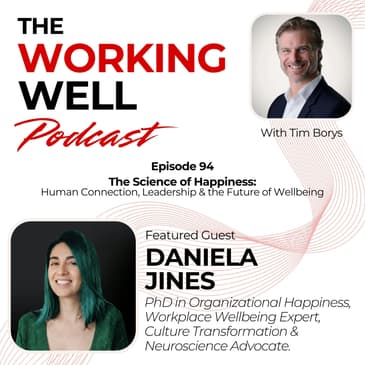
In this episode of the Working Well Podcast, Tim Borys speaks with Daniela Jines about the science behind workplace happiness and why human connection is essential for the future of work.
They discuss:
- What happiness at work actually means
- How wellbeing impacts performance
- Why leaders shape culture
- The role of rest and recovery
- AI’s impact on employee experience
- Building workplaces where people thrive
This episode explores a new definition of success one where performance and humanity work together.
#WorkingWellPodcast #WorkplaceWellbeing #Leadership #FutureOfWork #EmployeeExperience #HappinessAtWork
Powered by the WRKdefined Podcast Network.
[00:00:04] We spend most of our waking lives at work, yet for too many people, work sucks. Research shows that less than 20% of people are thriving at work. To the large majority of employed humans, work is at best a necessary chore to endure. For a significant number of others, work is a deeply negative and even traumatic experience. So what if we've been designing work backwards?
[00:00:32] What if happiness at work isn't soft, optional or idealistic, but foundational to leadership, performance and long-term results? Today, my special guest is Daniela Jines and we're exploring what human thriving actually looks like inside modern work and life. We'll talk about the science of happiness, the case for a more focused work day,
[00:00:57] the impact of AI on how we experience work, and a question I think every leader needs to wrestle with. What if the future of work isn't about doing more, but about protecting what matters most? So let's dive in. Daniela Jines, she's an internationally recognized expert with a PhD in organizational happiness and workplace wellbeing. She also happens to have a law degree.
[00:01:22] Originally from a small town in Bolivia, she's a Fulbright scholar who integrates neuroscience, art and humanitarian work to transform corporate cultures. Welcome to the Working Well podcast, the show that explores the critical intersection of leadership, business strategy and sustainable human performance. Plus how these three areas are defining the future of work. I'm your host, Tim Boris.
[00:01:53] Daniela Jines, amazing. So good to see you on the show and reconnect again after not too long ago when we chatted. Now, we are going to dive into all kinds of exciting, fun topics today about happiness, sustainable performance, wellbeing. Before we get there, I just love, I always ask guests to do a bit of a review of sort of what led you to this field of work and how you got here. The short version. Absolutely. Thank you so much.
[00:02:23] Big fan. I love your work. I love what you're doing for the work that people need to know and do better. I grew up in Bolivia, a beautiful place. Around poverty, a lot. A lot of people needing things for my whole life, traveling around the world, seeing that people have so many needs as a lawyer, trying to find what's the key to make us whole.
[00:02:48] Even though there are no economic materials to make everyone happy, I understood that everyone wants one thing in common. Everyone, every culture, no matter where you are, they say, I want to be happy. And then my research led me to answer that question. What do we do? How are we happy? And it seems that it's not as hard as we thought. Oh, I look forward to diving into that.
[00:03:16] And one of the things that connected us was this happiness at work sort of lens, I guess you would say on it. Now we spend around 90,000 hours of our lives at work. When you look at how work is currently structured, what concerns you most about the time we're spending at work? I love how you have that data because that data itself makes you chill. You don't realize how long we stay at work.
[00:03:45] More than with our families, our significant others doing sports, more than anything, we stay at work. What concerned me is that if you put your attention into something, your brain will absorb it, will codify it, and that will be your reality. So if you're spending time at a job that makes you miserable, you are training your nervous system to be miserable, but not only at work, with your family, when you sleep.
[00:04:13] And you are kind of signing a contract that says, oh, when you're 70, that will kick in, you'll get a disease, Alzheimer's, cancer, any of those horrible things because your nervous system is on high alarm. So yeah, that scared me a lot. So I've all heard that happiness at work would be, or we at least think it would be nicer. Well, in practical terms, what does it mean to be happy at work?
[00:04:41] Or let's say, let's start with in general. What does it mean to be happy in general? And then how do we translate that into the workplace? Beautiful question. I love answering that because there are over a billion answers about what is happiness.
[00:04:57] Everyone has a definition, but I use the neurological one, the scientific one, which means that serotonin is high, the amygdala and the brain is calmer to a point that you can be the best part of yourself. That means that your high flight or fight is off, you're calmer and you can make decisions with everything that you have.
[00:05:24] Basically, that means when you're at best. That is happiness, happiness for science, dopamine, serotonin, oxytocin in a good enough level. And at work, that means that you're not blocked. Happiness at work means that your capacity is in such high standard that you can be the best at what you are.
[00:05:47] And, you know, when I explain that to CEOs, they love it because before they would think, oh, happiness at work means everyone dancing, not doing the jobs. But it's actually the opposite. They're so motivated. Their nervous system is so calm. The vagus nerve is where it needs to be that you just want to produce and be doing stuff and be creative. So, yeah, that is what actually happiness at work is. More production. Sounds a bit like a flow state.
[00:06:18] Absolutely. You define it in two words. I kept on talking and you define it faster. And you mentioned talking to CEOs. I've talked to so many different clients over the years as well. And there's often a feeling that people, their own situation is very unique. So they're like, oh, well, my situation is different. I've got this going on and I've got this going on.
[00:06:42] When you talk about happiness globally, what are the universal truths around happiness? Regardless of culture, age, gender, race, whatever it is, what are those universal truths that create happiness? What a great question.
[00:07:05] And I love that you were acknowledging that every human being is different and every human being has a different situation at work, at their families, health wise. But there are three that I would identify because our brain follows patterns. The first one is if you know how to breathe, you know how to be happy at work with your families, but especially at work.
[00:07:29] The second one is if you control your thoughts, you can control whatever the external is doing to you. A horrible boss, a hard work environment, long hours. And the third one is what you feed to your body is what will make you stronger or weaker.
[00:07:52] And to me, and this is not just me, it's many science around the world that share this little formula. Let's recap those again, just in case people didn't, I heard, mindset, fuel. Breath work, yeah. Breath work. The way, the breath work is one of the biggest and strongest tools to regulate the vagus nerve.
[00:08:19] The vagus nerve makes us feel stressed, anxious, even have suicidal thoughts. So once you control the vagus nerve, you can almost guarantee that you can see around and be okay. It seems hard, but breath work seems to be the tool that it's easier to manage and it doesn't cost you money. The second one is like you said, the mindset, whatever you're thinking.
[00:08:45] If you're thinking I have the worst boss in the world, your brain is going to codify instead of fight or flight. And therefore you're going to be reluctant to receive any communication with that person. And when you nurture yourself with good food, good relationships, good exercise, you can make the change. Basically, no matter where you work or where you are, you can feel happy at work. And that's such a relief from a science perspective.
[00:09:15] I love it. And again, there's so, such simple tools that we have at our disposal. Yeah, they are. And they're cheap. Oh yeah. My background in the health and fitness side is the same thing. I used to say to clients, what we're talking about is not rocket science here. Everyone has access to it. Your thoughts, your actions, how you breathe are just the fundamentals.
[00:09:44] You just said it in the conversations we've had previously. You handled that so good that I immediately knew that you know exactly what you're doing because you need to use that on yourself first. So I was asking you, how much do you exercise? Do you have time for yourself? And you were telling me, yes, exactly. I prioritize my well-being, time with my family, because those things actually make your brain stronger. Things that we usually run away.
[00:10:11] Another thing that I want to point out, team, that for me it's fascinating, like you said, it's not rocket science. It actually comes from our ancestors. If you go through different cultures, they prioritize breath work, ritualistic routines to connect with nature very carefully what they add. Lots of routines based on well-being. So we're not discovering anything new. Yeah.
[00:10:40] Virtually every culture in the world has their own rituals around breathing and mindset. And, you know, some are clothed in the religions aspect. Other ones are just personal performance and health. You look at, even take that to the elite athlete side. Part of my background is working with elite and international athletes. You told me.
[00:11:04] And every athlete that's performing at the top of their game has these rituals in place. And yet somehow business leaders don't think it, I guess, belongs in the workplace or that it doesn't relate to them. So when you see happiness at work or when you talk about happiness at work, how do you see it shaping the culture and performance and long-term business outcomes?
[00:11:29] I think it depends, of course, on how conscious and self-aware the CEOs are. We've seen studies in different parts of the world. Sweden, I think that it's by far the one that it's experimenting more with happiness at work. And when a CEO, when owners of companies are conscious, they're shaping their cultures in a way that people have a sense of belonging that goes beyond their desks, beyond their work.
[00:11:58] It creates a family feeling that makes people feel loyal, therefore more engaged. So I think that in this new era, if we want to continue to have high demands of mental health providers, stress, antidepressants, we can keep on going on the way that we used to. When you are just a number, you just need to perform, produce.
[00:12:23] And this idea that the more you work, the more you produce will slowly but surely will kill us. If not, the other way is to be aware that there is another way that it's actually cheaper, that makes everyone happier, and that actually can boost produce and efficiency, production and efficiency. I'm just getting so excited. I'm glad you brought that up.
[00:12:47] And we will dive into that in a minute, but I have to just shout out to all those CEOs out there that have the bums in seats mentality, or that maybe believe this is important, but then abdicate responsibility for it to HR. I think that is one of the biggest mistakes I see in corporate culture is that one department is responsible for health or wellness or well-being.
[00:13:15] It's every single leader, particularly the senior leaders in the organization, how they show up every single day, what they recognize, reinforce reward with their team and their team's teams, and how that's showing up across the organization that creates well-being. Correct. We're speaking the same languages. It needs to start with yourself.
[00:13:40] If, as a CEO, you are the first one to believe that everything is ruined and that production is the only thing that matters, that is so contagious for the organization. There's actually beautiful experiments of the first 10 minutes of interaction with your team. They can mark the day.
[00:14:01] If they see you smiling, if you're like even dancing a little bit, start with a joke or ask a personal question, the brain codifies safety for your team. Therefore, you can have better meetings, better work days. So, like you said, the CEO has such a good role to play, the same as people that are leading any kind of group. Yeah. Yeah.
[00:14:25] Now, in our previous conversation, we, and one of the reasons when we connected was this six-hour workday approach. I'd love to dive into that a little bit more because in North America, at least, we hear a lot about the four-day work week. But a lot of people translate that into four 10-hour work days and they just take an extra day. So, it's still the same number of hours of a bum in seat mentality.
[00:14:54] So, talk to me about this six-hour work day. Wow. Thank you. That's very controversial, actually. Lots of people get scared. I mentioned that to some CEOs that we work with and then immediately go like, you know, very defensive. So, this is a controversial thing that might change an organization. It's been proof that basically this formula is becoming more and more real.
[00:15:19] The less we work, the more we can produce if we know how to manage how we rest. It's almost mathematical. And basically, it proposes that if you know how to motivate people to do their jobs, they can do it faster and better knowing that there's a reward coming.
[00:15:44] And the reward of time has become so important because we no longer have time to be with our families, to exercise, to pay the bills, to just stare at the sky doing nothing. Italians describe it as dolce farniente. And that, for science, has become so important. The art of doing nothing. So, if you apply that in an organization, it might sound controversial. But data, like real data, you and I, we are scientists.
[00:16:13] And we need to see results on paper and on studies. Data shows that if you know how to handle that gap of time where you let people rest, their brains and the nervous system will be so reset that you just want to produce more. So, talk to me a bit more about the science behind it. Science behind it. So, the research, once again, we have to give kudos to Sweden.
[00:16:41] They've been doing that either six hours a day or four hours a week. They pay you the same. And what they do is they promote outside activities. So, you're going to have these hours for yourself, but you're going to use these hours on family time. And you need to kind of report that to your supervisor. So, here, there's a photo of me and my family. There are some hours that I did at the gym.
[00:17:10] There's this breath work course that I'm joining, this Wim Hof program that I'm doing. And then they take data to see if, for instance, people are reporting less of sick days. That is one of the biggest data. So, in a company, for instance, in Sweden, and all of that is on the website. That's the good thing. It's not hidden information. You can go and check the reports and the data. So, they see, okay, how many sick days people are reporting.
[00:17:39] Over a three-month experiment, people reported 30% less of sick days, which is amazing. They also took data on the amount of conflicts they were having at work, you know, process, procedures. They reduced over 20%, 20, 21%.
[00:18:06] The time of stress, they were taking stress tests on people. They were reducing the stress. And it's on and on. The data shows that if you know how to manage that free time, people would like to produce more. And that's another thing that happens with your reptilian brain. You know, the part that makes you more connected to nature.
[00:18:28] You create a sense of bonding and loyalty with the people that is giving you more. That bond of loyalty can even decrease corruption if you apply it to public policies. So, this is a huge thing. And there's Toyota. We know Toyota. It's been applied in Sweden. And Toyota in Sweden is actually using this model.
[00:18:56] And they're taking nonstop data to start using it in other branches. So, we already have a mix, huge organizations that are thinking to give the big step. Let's see how data behaves for that organization. But so far, they're taking it serious. That's great. And you mentioned a lot about, you know, Sweden and other countries.
[00:19:21] I think North America, particularly in the U.S., I think Canada is probably pretty close behind the U.S. in terms of levels of stress and ill health and burnout, fatigue in the workplace. What do leaders typically misunderstand most about how stress, performance, productivity, happiness connect or disconnect?
[00:19:51] I think there are lots of misunderstandings. I think that we were raised in after World War II as well that production needs to be serious. And I think that's the biggest misunderstanding. Production needs to be creative no matter what you do, even if it is in a repetitive work.
[00:20:16] I'm talking about big companies on where the only thing you do is you put an arm to a doll. And that's what you do for eight hours. Even that work can be creative and done faster if you're motivated enough. So this idea that productivity needs to be serious is killing your production little by little. No one wants to be part of that.
[00:20:40] You'll end up having people that quit or get sick or are just not happy what they're doing. And they will betray you the moment you less expect. And that's scary. Yeah. And we could do an entire separate podcast about stress and the physiological impact of it on the body. But how do you see that showing up for most people in the typical workplace?
[00:21:10] The stress. When I start working with a new organization, I see high levels of stress. People that end up confessing that they cry on the bathrooms. One data that I shared with a colleague that works with antidepressants is that seven out of 10 CEOs are or were on some kind of antidepressant to work.
[00:21:37] That is horrifying, knowing that we're talking about people that are extremely smart, that they got there because certainly they have some capacities. There's nothing against antidepressants or medication. They save lives. But if you only use them to try to erase whatever is going on in your world, they would eventually not work and make things worse. So that's what I see.
[00:22:04] A lot of fights, a lot of conflict inside the teams, a lot of sick days, a lot, a lot of sick days. And, of course, a reduction of productivity. That's kind of like a diagnosis that you will see immediately when you go to an organization and you see that they're not happy. And you see the opposite when you go to a happy one.
[00:22:31] Well, yeah, and I almost see the you talk about the sick days. I think at the lower levels of an organization, yeah, you see lots of sick days. But at the higher levels of the organization, you don't see as many sick days because they tend to just work through it. And their productivity is through the floor. They're not very productive at all, but they're trying to show grit and just show up. But they're not effective.
[00:23:00] And when you're trying to report to a boss that is stressed out, burnt out, sick, literally and figuratively, and not leading their team well, there's a cascaded effect throughout the team and the organization in those situations. What are you seeing the data show around these types of metrics in an organization?
[00:23:29] It is scary for CEOs. You were absolutely right when you said CEOs sometimes they don't take sick days. They just take drugs, different kind of drugs. There's a lot of alcohol consumption. Adderall, there are a lot of things that you need to take because you need to show your team that you're stronger, that you can do it. And that's the way to do it. You power through, you show up no matter what.
[00:23:55] But we see a lot of Alzheimer's developing in the long term. And that is something very peculiar in CEOs. 70s, 60s, you start forgetting things because, of course, your brain is always on high demand. You don't give your brain time to process the information, to give quality information. It's all about fight or flight.
[00:24:22] And that, of course, has ulcers, lots of stomach problems for CEOs, lots of problems. And I talk to you openly about things like sexual dysfunction a lot for girls and boys, women and men. Little connection with their families. Lots of divorce. When you talk about data, one of the numbers that pop really a lot is divorce.
[00:24:52] Inability to have relationships because your relationship is with production and it becomes an addiction. And when you are in a loop of an addiction, that's all what you want. That's what produces dopamine and you don't want anything else. So you don't have the capacity to relate to other people. So lots of senior and executive leaders are very data driven.
[00:25:16] What's your business case for this when you have to break down the numbers for them about well-being and performance and happiness in the workplace? Yeah. If you have a strong culture based with values, meaning that every organization member has clarity of the mission, the vision, and they believe on it, 30% of productivity increases just by that. I'm saying simple things.
[00:25:44] You are a new employee. If you absorb the mission, the vision, what the spirit of the organization is, you have better chances to become productive. But it usually happens. You are a new person. You don't know what the spirit is. You don't know what the principles are. You just need to catch up. That itself will reduce productivity.
[00:26:09] Another thing that is super important and that I've seen for data, open spaces full with air create 50% more of brain capacity. Just like that. Just like that. Just having more air. The airflow is so important. Music. 5% of productivity increase. Increase. And I'm giving you three that are no cost, that are super simple, and then sometimes you think, no, I don't want to do that.
[00:26:37] I don't know if you remember on Silicon Valley, they were creating new buildings where people would stay with fake lights only so you can produce more and you would forget what's day and night. Research has shown us that that works for a very short time. It works, but for a very short time. Then your brain starts the chaos and productivity decreases. So there's simple things.
[00:27:05] I'm naming extremely simple things that could make productivity better for your company. Yeah, you alluded to it a bit before as the industrial revolution or that industrial area assumptions and how they're leading to how so many businesses and companies are structured and organized today.
[00:27:30] Talk to me a bit more about what you've seen from your research and how that's showing up still today. It's scary. It's scary. One of them that I would like to point out is the role of the women in areas where we think that we've advanced and women can take leadership.
[00:27:52] Data has shown us that it's still hard for a woman to have a CEO position because psychologically it's hard for a man to follow and to lead. So that data was very interesting because every day we see more women taking power, becoming CEOs, but they need to go the extra mile to get credibility from their team, especially from the male perspective.
[00:28:21] So that I think that data was example of that. And I have to call it a current event. We saw that with the U S women's hockey team. And like, I just have to say, they're way more successful than the men's hockey team. And, you know, it just, I don't even, we won't even go into that, but that's just one current example that is so in my mind, just ridiculous and offside.
[00:28:48] And the fact that it's 2026 and we're still having this conversation and we have to keep having it every single day is shocking to me. Correct. Yeah, absolutely. And the second one is it's also going to impress you. Back in those days, we needed to keep it very formal because anything could happen. You're not allowed to create lobbying boundaries between workers.
[00:29:16] And that has been replicated over and over. When I arrived to the States, even, you know, it's the sexual harassment rules are very, very formal and they are important. Please. I want to address, they are important, but that formality has also made us lose the possibility of hugging your coworker or spending time laughing or going deep into what's happening in your family. How do I help you? Let's celebrate birthdays together.
[00:29:45] So that formality over the decades has made us really cold on a place that you don't care anymore what's going on with them. And I've seen cases that, you know, there are people battling cancer. There are people whose family has died, but they don't say that at work because they are scared to become or break the formality. And that is actually creating a toxic workplace that makes no good for anyone.
[00:30:14] So I think those are very scary as well. And the third one is to show vulnerability. We were told and trained that we need to be formal. And if you are ashamed, you cannot cry. You cannot apologize. That's one of the biggest things that we were told. If you're a CEO, that means that you have all of the answers. The moment you apologize, that's weakness and you're not allowed to show it.
[00:30:39] But research shows that when you have a CEO that it's vulnerable, that you know it's also facing challenges. Your reptilian brain becomes connected because you see it as a human and loyalty increases. So once again, what we're talking about, team, it's not new things, not rocker science. It's basic humanity.
[00:31:03] You know, coaching work I do with clients, I still have leaders that say, oh, when I ask about what they do to build rapport with their team, you're like, well, no, one-on-ones are just about business and what happens outside of work is not my, I'm not interested and I don't care and I don't believe it's my place to do that. And I'm like, well, they're human. Like, we bring our whole selves to work.
[00:31:29] And if someone's going through cancer, they're going through a divorce, they've, you know, their kid's sick. Who are we to say that it doesn't affect them? And even if they don't say anything or it doesn't show up at work, it's still there inside. And they're not performing at their best because they haven't had the space to, no one's acknowledged that.
[00:31:56] I love that you ask about data because it's fascinating. And they're doing little researches that they do in different groups. Germany is doing beautiful research on leadership and tips that you can do to be a good leader, especially because of the culture. And what they show is that if a CEO knows the name of their workers, as many as he or she can memorize,
[00:32:24] that increments trust on 13% already. So basically, that's all you need to do to increase the trust in your organization. Know their names. And that sounds so easy, but it's not common. Sometimes we have leaders that they have no idea the names of the people that clean, the names of the people that are the drivers. And it's as easy as that. Get to know their names first. You'll see more results.
[00:32:55] Yeah. Yeah. It's simple. And what you said doesn't cost money to do this. And I see this as, you know, whether it's the happiness, well-being. I think it all comes down to leadership. And we're leaving so much performance and well-being and happiness on the table as a society.
[00:33:21] Because we're looking at things through an outdated lens. This is when professional careers and profiles like yours become so efficient. If you go and you analyze leaderships that we admire, presidents, big CEOs, they have not only a therapist, but they have a coach like you.
[00:33:49] Because you can be absolutely good in what you do, but no one learns to be a great CEO or a leader over the time. There are tips. There are things that you need to know. It doesn't matter how smart you are and what you do. Being a leader requires work, self-awareness, little trainings that you need to do. You need to follow by example.
[00:34:11] For science, there's no other thing better than be the person that you want your workers to be. And you need to rely, if you have the possibility, on people like you that will guide you through exercises, tools, and things that you can do not only to be better at what you do, be better with your team, and be better as a human being as well. Well said.
[00:34:36] To take that to a bit more of a practical standpoint for anyone who might be listening, which leadership behaviors do you feel most strongly influence whether a culture supports thriving or burnout? I love this phrase. Leaders always eat last. I love that phrase because it gives you a responsibility over your time.
[00:35:06] Team as a community. I know that we're not all community-oriented, but for the people that are obsessed with production and making money, this is also a great tip. Leaders always eat last. Meaning that if you can be empathic, if you can understand and feel what your team is feeling, you've got a gold formula.
[00:35:34] And I think that once you understand that, once you know how they feel, how they work, how they suffer, when you are open for them to reflect their opinions about you, either on paper or one-on-one, you have a gold team that won't abandon you. And there's beautiful stories that you can see on the internet. And there's not a secret.
[00:35:59] Angela Merkel, prime minister of Germany, she had a group of loyal people that never left her because she had time to go shopping with them. One-on-one, every week, she would have conversations of five minutes with the cleaning crew, with the secretary, with the driver. And then when you try to get information out of the driver, like juicy details, give me the tea, the people would just say amazing things about her. No secrets.
[00:36:27] No one would betray her because she had that discipline. Connect with her. And we're talking about this might create a revolution in the economic environment in Germany. You have people like Obama. Not everyone likes him as a politician, but we can address him as a good leader. The people that follow him, follow him hard. And it's because he follows those little acts of discipline. Always thank you.
[00:36:56] Always looking at people's eyes, even if you're so angry. Recognizing people's values, saying thank you. Those things are like, once again, it comes from our ancestors where we value and acknowledge everyone's service. But when you put it on a CEO, you have a golden nugget. And I always tell the people that I work with, please don't believe anything. Anything that I'm saying, don't believe me. Try. If you try first and it works, try it with a co-worker.
[00:37:26] If it works, try it with your team. And then we'll talk about results. You'll be surprised. I love how you brought up the fact that even if someone is just obsessed with production and making money, that it still matters to them. And that's something I've said for years. I've literally had CEOs say to me, to put it bluntly, I don't give a shit about people. I just want our money and I just want the company to be successful. And I said, great.
[00:37:56] Then you have a fiduciary duty to your shareholders to take care of your people. Because every research study out there shows that when you take care of your people, it returns benefits to the business. So you don't have to care about people. If you care about the business, that means you need to care about people. And that, I think, has lost so many people. What you're just saying is so true.
[00:38:24] I had a professor that made us read the stories of successful people over the world. And a difference from the ones that were successful and the other ones who were at the top. But they had biggest problems. And the biggest problems were betrayal. So it is fascinating how if you are on the top, you're producing everything.
[00:38:50] If you haven't cultivated loyalty with your team by showing, by caring, by being there, you can be betrayed so fast. And that can destroy your whole career. And all this empire that you've been building, it can be destroyed. And it has happened over and over with different CEOs. I think one book, it's fascinating, or it's a research. It's the nightmare of every CEO betrayal. It's kind of a huge research.
[00:39:20] But you can look it online. That's the beauty out there. We're not lying. You can verify that information in real life. Yeah. And there are a lot of the command and control leaders that create great results, even over a medium term. But it's done at a massive expense to loyalty, turnover, stress, burnout.
[00:39:47] And you're creating a loyalty by fear. And that, you know, dictators, oligarchs, that's the model that gets created. And it works until it doesn't. Yeah. Which is not loyalty at the end. It's like you said, it's fear. Yeah.
[00:40:09] I think we have such a beautiful opportunity right now with all the media and all the tools that we have available to actually look inside ourselves. Tim, there's a reality. And now that we're talking about data, it's scary how many CEOs end up dying alone or divorced or with the family away. Because all we do is we put effort on producing money, making results.
[00:40:36] At the end of the day, you get home and you're alone. And that's when you start thinking, what have I done with my life? And it's too late. When you see CEOs that are older, the ones that actually were able to find a balance, they're happy. And most of them, they were doing things for the community. That's funny enough. Like this, this very interesting, but it's recurring data.
[00:41:06] The people that know how to manage their responsibility with their community and making money are the ones that age better and they have happier lives. Yeah, we're at a very critical inflection point in, I guess, our history as a society with AI coming out right now and just taking over everything.
[00:41:30] As you look at how AI has already been impacting the employee experience, we'll call it. What do you see as, how do you see AI reshaping the employee experience? We have an international collective of happiness and we've discussed this openly. It is scary. We need to celebrate AI.
[00:41:55] We need to celebrate the discoveries that humankind has done. And I think it's fantastic. It's making our lives easier. But it's also creating a huge gap between humans and connection. And it happens, I was talking with one of the CEOs who was very frustrated because their clients were making many complaints about their assistance over the phone.
[00:42:25] And it's because most of it, it's their robots taking the calls and taking the complaints. So he went back to having and investing money onto online people, like real people that over the phone will help you with the service. And he was actually very surprised and happy that those complaints, the clients stopped complaining. His goal was to use AI to save money. But there are some places on how you can really use AI.
[00:42:55] And there are others. This communication, the connection. Humans will never stop craving connection. Never. That's why our brain is shaped as in we need a significant other. We need friends. We need connection. If we ignore that, we are creating new humans that will be less prepared with an immune system that becomes weaker.
[00:43:23] Once again, we go to data. We've been finding more learning problems in teenagers that were used to computers only because their prefrontal brain wasn't trained to receive information, to codify information. Bigger trouble speaking and communicating because we're always in front of a computer. We don't need to talk. We don't need to write.
[00:43:49] So it can be dangerous if we are not careful, understanding that humans need connection. And that's always going to be the case. If not, we're going to lose contact with our nervous system. And once again, the immune system becomes weaker when we don't have contact. And that's science. Once again, not me being all corny and, oh, let's hug. It is science. I was just watching a keynote.
[00:44:20] I think it was the Congress or the U.S. Senate, where the researcher was talking about Gen Z and how they're the first generation in recorded history to be actually lower than their parents' generation at every single cognitive task. IQ, IQ, EQ, everything like that. Because, and they brought it down to technology. Humans have learned and evolved to learn from other humans.
[00:44:50] And so now this is the first generation that is pretty much just learn to learn from a screen or from computers. It's scary, isn't it? Yeah. And they were talking, this is like, this is global data from all kinds of different school systems and companies and organizations that have been studying this for the past 30 to 50 to 70 years. It was beautiful in South America.
[00:45:19] We did a little research because we tend to think, oh, the South American people, they don't have much food, therefore malnourished. Therefore, their QAs, their IQs are not shaped enough to be, you know, smart enough.
[00:45:34] And they compare with different countries on where, for instance, Japan, where the kids are usually have a computer since their child's, their brains, the amygdala and the neocortex in South American children were better. Meaning that their ability to solving problems are better.
[00:45:55] However, reply and connect to danger is better because there are, like you said, learning from each other. There are strengths and weaknesses in every area, but you just need to acknowledge the consequences of what technology can do to us. Being also, of course, grateful because it can also save lives.
[00:46:16] But another thing, Tim, that you were saying is it's a reality that when you do exercise, when you are in contact with other people and pushing yourselves to the limits, you become stronger mentally and physically. Like you said, athletes are extremely smart. When you do IQ tests, they perform very well. And you might think, but they're not going to school. They're not in academics. Yes, but they're forcing coordination, solving problems every time.
[00:46:46] Therefore, they're at their best capacity. Therefore, they're happy. Well, you know, I haven't really discussed this in different shows before, but we're at this inflection point, particularly since COVID. People are getting less movement, less exercise. They're less socially connected. Technology is becoming more and more a part of everything we do.
[00:47:13] And food is not getting healthier. I'll say that. And so you apply all these layers and each one of them on their own isn't overly significant, but you start to add it up. And over time, we're seeing the impact on stress, burnout, lower well-being, disengagement, illness.
[00:47:39] All these things are starting to spiral across society where these things are happening. And in societies where it's not happening, you don't see those trends. You don't see. The microbiome has been lately the microbiome. You know, that little bacteria that we have in the stomach for people that don't know. Science has confirmed that the microbiome has a close relationship with the brain. It's like our third brain.
[00:48:08] And it is, it's scary to see that CEOs, people that are working really hard and they don't have time to nourish themselves properly and are starting to have stomach cancer, ulcers, deprivation of sleep, like chronic sleep that we think that will be corrected with pills. But the microbiome, what we eat is starting to ruin us little by little. So it's a whole, a wholeness.
[00:48:36] That's why I insist when I talk with CEOs that have enough possibility to hire and to work with a consultant like you, it is important because no one has the time to understand, oh, work and the microbiome. Oh, work and the brain. Oh, work and breath work. But it's not hard to apply that knowledge. What you need to do is learn a little bit what you can do.
[00:49:00] And thank goodness is, it's starting to become more popular because also people are starting to see how companies are, are losing people because of burnout. Yeah, it's, it's not, I think sadly, it's probably going to get worse before it gets better. Because I used to say in my health and fitness business, people don't change until the pain gets great enough.
[00:49:29] And I don't think companies have felt the pain enough yet. Employees are feeling a lot of the pain, but I don't think the senior leaders have felt that pain yet. And we think that it's going to be replaced by AI. But there are things that humans would need to do still with their hands, with our arms, with our legs. And we need to worry about that, people.
[00:49:51] I think that internet, it's a tool that can help workers, common quote unquote workers, that learn a little bit of what they can do to help and protect themselves. Even though their CEOs are not doing it, even though the high hierarchies are not doing it, you still as a worker, you can take actions. And it's easier and cheaper than you might think.
[00:50:17] Absolutely. And that's, you know, a lot of times when I'm working with leaders and companies, there's this pushback of, well, you know, health and well-being is an individual responsibility. And I'm like, absolutely, hands down, the individual has responsibility for their actions. As a leader, you have a responsibility to build the strongest, highest performing team that you can.
[00:50:44] As a company, you have the responsibility to build the strongest, highest performing organization that you can. When each of those levels are working in unison, it's remarkable the results you can get. What we're seeing now is that there's a small fraction of individuals that are taking matters into their own hands and doing what they can to stave off the storm of a toxic boss in a toxic workplace.
[00:51:11] And the rest are just burning out of them. A lot of some leaders you see in any organization, amazing leaders that create strong teams. And they're this bright light in the fog of the organization, we'll call it. And then there are some companies that go above and beyond and build that. And they're the outperformers in the industries.
[00:51:37] And so, yeah, I still haven't solved the way to create that spread across more of the population, more of the individuals, more of the leaders, more of the companies. And hopefully that's where your happiness collective can help with that. I love the collective. And I also love the idea that we are starting to reach out to governments as well.
[00:52:01] When you understand as a government, and that's what we did in La Paz, one of the governments that I was part of, we try to use this knowledge as a macro level. When you teach these specific tools in schools, in universities, in families, then the knowledge is spread. And like I said, there are easy things. You and I talked about this. How are you sleeping? Are you sleeping watching TV? Please don't do that.
[00:52:30] That's immediately going to set your biggest nerve for a bad time. And you need to be productive the next day. The first thing that you do when you open your eyes, do you listen to news? Yes, it's important. But it's or the cell phone. You are killing your melatonin and you are setting your brain for stress since you open your eyes. So there are tiny little things that you can do to save yourself. But also we call out to governments, to organizations. We have a responsibility with this world.
[00:53:00] And the more we understand that these responsibilities, first, lead by example, being the best human you can. And the second one is if you have a group of people that you are leading, you have an intrinsic responsibility to care for their well-being or at least to stop being a shitty person that gives them pain. And then it evolves from that. There are many organizations that are trying there to make lives better for workers.
[00:53:28] And I think that the bigger this movement grows, the better we can predict the times for our kids, our children, our nephews to be like, because it's becoming hard for them. Well, here again, you're preaching to the choir here. Yeah, yeah, exactly. You and I, we're in the same team. Now, you in your book, you post a powerful question.
[00:53:55] What if the future of work isn't about doing more, but about practicing what matters most? How, when you look at that, what do you feel matters most right now for society? Let's start there. I traveled the world before I opened this, before I wrote this book. Like I said, asking people, what makes you, what do you need? What makes you good? What do you want? And the answers team, it's I want to be happy.
[00:54:24] I want connection. I want time with the people I love. I want to feel purpose on life. I want to feel that my life matters. And for that, you don't necessarily mean or need a college degree. You don't need to have a job in New York in a beautiful window making millions of dollars. This purpose, this feeling that your life matters, it's really important. And your boss should be able to provide.
[00:54:53] But if he or she can't, there are tools for you to understand that. If you are cleaning dishes 24-7 on a restaurant, your life still has so much purpose. If you are saving lives as a doctor, if you're cleaning houses at nighttime, it still has purpose. And once you are aware of that and how you can codify your brain to feel gratefulness and gratitude, then you can have a better day and better lives.
[00:55:23] And it is possible. It makes me think of these, there's leaders listening right now, I guarantee it, that are feeling that stretch between the demands of performance at work and caring for their people. What shift have you seen that you think can create the greatest impact for leaders in that situation? Forgiving themselves and being self-conscious.
[00:55:52] We are scared to go inside ourselves and judge ourselves. It's a very, very scary situation being vulnerable. I think when a leader is able to say, okay, I am here. I want to listen to all of my mistakes. I want to receive feedback of the things that are not, I'm not doing good. That's when your skin changes. It's a horrible sensation. I got to be honest.
[00:56:20] And there's a very simple exercise you can do. You just ask for reviews, anonymous reviews from your team. You'll hear very shocking things that you might not be ready. But when you take it with humbleness, you'll see a transformation. And those leaders are the ones that surprise me so much. And I want to speak openly about my boss. I have the best boss. I work at Surf Break Co-Living.
[00:56:47] This guy is one of the most successful persons I've met. His name is RJ Martin. When I call him into something, he goes like this while he is, you know, absorbing it, not liking it. And then he breathes deeply and chews on it, as we say, for a day or two. And then he comes more refreshed, more powerful. When he needs to apologize, he looks in your eyes and apologize.
[00:57:18] And then he asks you, show me how to do better. So that gives me the responsibility of, oh, okay, how do I make this better for us? I've never met someone so open. And the guy is successful. I tell him that everything he touches becomes gold. His businesses, the people, his family, because he has that humbleness.
[00:57:41] So I would say connection, self-aware, be humble with what you do and who you are. That transforms not only you, but your team. Thank you so much for sharing that. And amazing advice for leaders out there that are listening. Humility and introspection can go a long way. For all of us as humans. Daniela, thank you again.
[00:58:09] It has been an honor having you on the show. And I look forward to reconnecting again. Where can people find you if they're searching for you outside Hawaii? Of course. Oh, my gosh. This place is fantastic. And it reminds us that we need to be connected to nature. So Hawaii is always a home. You can check Surf Break Co-Leaving on internet. You can check. If you type Happy Organizations Collective, you will see our organization. We're open.
[00:58:37] And the idea is to share the experience for free because I know that people sometimes are reluctant to invest in these tools for their workers. Okay, that's not an excuse. We'll give it to you for free. Tim, I think that people, you and I, I already officially invited you to be part of our collective. We need to make sure that these little tips are spread. We have such beauty inside of us as humans.
[00:59:06] Our life is such a privilege. And sometimes when you're invested on making money, on your purpose is to shine and be successful, we really forget the real things in life, which is, you know, the feeling of a hug of the person that loves you the most. And I think that once we understand that, our lives can be better. I'm so, so honored to have you in my life, to count on you as a colleague, as a teacher,
[00:59:35] and hopefully as a collective member soon. Thank you for this time. My pleasure. And I look forward to reconnecting again soon. That wraps up another episode of the Working Well podcast. If you enjoyed the show, please rate, review, and subscribe wherever you get your podcasts. Now, which guests or topics would you like to see featured on the show? Message me through LinkedIn or on the contact page of timborris.com with your ideas. Thanks for tuning in.
[01:00:04] I'm Tim Boris for Fresh Wellness Group, and I look forward to seeing you on the next episode.
Sponsors
