
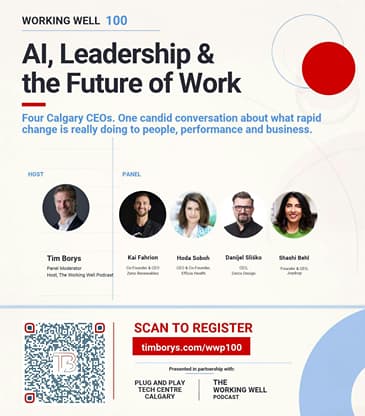
For our 100th episode, we did something we've never done before a recording in front of a real audience at Plug and Play Alberta, with a full panel instead of a single guest. Host Tim Borys sits down with four entrepreneurs across healthcare, renewable energy, retail, and marketing to debate what AI is actually doing to business, leadership, and the economy and where it might be taking us next.
Meet the panel:
- Hoda Soba, CEO & Co-Founder, Africa Health
- Kai Fahrion, Co-Founder & CEO, Xeno Renewables
- Shashi Bell, Founder & CEO, Joydrop
- Daniel Slisko, CEO, Circo Design
In this episode:
- How four very different businesses are actually using AI right now
- Who really benefits from 10x productivity gains employees or employers?
- The IKEA case study: redeploying 8,500 roles instead of cutting them
- Why small "boutique" businesses may have a structural AI advantage over big enterprise
- A live audience Q&A on critical thinking, guardrails, and the K-shaped economy
- An unfiltered debate on capital, labor, and taxation in the AI era
- A closing lightning round: what each founder hopes we get right five years from now
Working Well Podcast is hosted by Tim Borys of Fresh Wellness Group. Got a guest or topic you'd like to see featured? Message Tim on LinkedIn or through the contact page at timborys.com.
#WorkingWellPodcast #AIatWork #FutureOfWork #Entrepreneurship #SmallBusiness #Leadership #Episode100 #LivePodcast #Calgary #KShapedEconomy
Powered by the WRKdefined Podcast Network.
[00:00:00] Welcome everyone and welcome to Plug and Play Alberta. This is a very special episode of the Working Well Podcast. So far we've done 99 episodes and this is number 100. And we're doing it a little bit differently today. This is the first time we've done it with a live audience and a live panel. All of my other ones have been over Zoom and I have to say I like this a lot better. It's cool to have people in the room. So just over four years ago I started this podcast.
[00:00:30] And it's been a great journey. I originally did it, I was saying I had an intern at my business and a marketing intern and she took this on as a side project. And we committed to doing I think it was 20 episodes and we're at 100 right now. So I realized I loved interviewing people, learning about their business, learning about what's working. The original premise of the podcast was to just, I guess, more about my interest.
[00:01:00] I sort of live at the intersection of human performance, leadership and business strategy. And it always fascinates me how those three areas collide in various businesses. And some of the challenges that we're facing are really at the intersection or the heart of that issue. Obviously it's hard to ignore AI these days. Or people, if someone says what's AI, then we know they've been living under a rock.
[00:01:27] But AI is transforming everything we do, particularly from a business standpoint and also from the leadership standpoint. So I thought it was great, a great topic for our 100th episode.
[00:01:39] Before we dive in and I introduce our great panel members, I just want to do a little shout out to Plug and Play Alberta for hosting this amazing venue. If you aren't familiar with them, they're amazing for the business community and they do startups in all kinds of different industries. But check out their website, plug and play Alberta. And they have locations all over the world. So definitely worth looking at.
[00:02:06] And also we've got Calgary Live Video and Alex over there is making sure all the tech works and the streaming's working. So the fact that you're seeing me right now is thanks to him and Calgary Live Video. And so you'll see their logos up here as well. So thank you. This is again a much bigger production than me sitting in my home office with my podcast mic.
[00:02:32] So I'm excited to be here. Now, on to our panel guests. We have a great diversity across the panel here in terms of the types of businesses, length of time in the industry and the well, all kinds of different great positive impacts they're making on their city and the community around. So Hoda Soba is building a more human tech centered model for midlife and menopause, which is really cool.
[00:03:02] Her work sits at the intersection of health care, technology, trust, innovation and systems change. So I'm looking forward to hearing what you have to say. Kai Farah is the co-founder and CEO of Xeno Renewables. Now, look at me. I already messed up. Hoda is the CEO and co-founder of Efica Health. Forgot the whole business. Kai Farah is the co-founder and CEO of Xeno Renewables.
[00:03:27] You may have seen their trucks driving around the city, putting solar panels on businesses and residential homes. And Kai was an electrician, was one of the two co-founders of Xeno, was actually installing and putting them on the panels. And now they're expanding across Canada. And are you in the States yet? No, not yet. Not yet. Just Canada. Just Canada. All right.
[00:03:49] And so he brings an interesting approach to it because he's got skilled workers putting, installing solar panels on buildings and houses across the province and across the country and having to deal with the technological side of change. So that's an interesting part of the panel. Shashi Bell, founder and CEO of Joy Drop.
[00:04:15] And Shashi is a veteran entrepreneur and retailer who grew Twisted Goods to nine locations and then sold it and is now onto Joy Drop, which she brings a strong perspective of customer experience, brand entrepreneurship and the value of human connection. So I love the retailing aspect of this because we're, it's something different than the tech and the healthcare. And that brings us to Daniel Sliscoe, CEO of Circle Design.
[00:04:43] And nearly 30 years of entrepreneurship. Looked pretty good for 40. Business at 10. Do you think they put us together on the end? Yeah. And Daniel's on his sixth business, I think. He's exited two businesses. He's incorporated a bunch of the businesses. He's started into a brand and marketing firm.
[00:05:08] And I'm looking forward to hearing his perspective on the changes in marketing AI and how that's impacted his business growth over the last 30 years. All right. A round of applause for our panel. We'll dive in. All right. Now, with AI, there's so much we could talk about and there's endless options to discuss in that.
[00:05:37] However, with, I want to know on the small to medium business side, what are each of you doing with AI in your business right now? How are you using it individually? Let's just go across here. Hoda, you can start. How are you using it? Well, I use it personally as a, you know, running the business and helping me to, you know, define strategy, kind of understand market trends, you name it.
[00:06:04] But then our business is also built on utilizing AI to improve healthcare. So we are using it all around. Okay. Full, full circle. So what I, actually, before we go into there, let's go to Kyle. Perfect. Yeah. Thanks. Yes. We use it kind of the same realm. Like I use it in my personal side of things when it comes to leadership and different aspects. But then I think the big piece within the business is utilizing it for client efficiency. So journeys throughout our process.
[00:06:33] The big thing for me is looking at how can I make the process smoother, faster, more efficient for the company and for the client at the end of the day. So we use a lot of AI for that when it comes to that and automations and integrating it. I think the big thing we're still figuring out is how to make everybody use it and make everybody understand the uses of it. A lot of times it's still used as like a glorified Google, I would say. And so getting people to start to utilize it as business systems and improvements has been a big part of this year.
[00:07:03] And implementing there, but we'll get into more I'm sure. Yeah, I would say as my colleagues, I definitely use it on the personal for efficiencies and organization. But within the companies, it's on the marketing. We utilize it on for content strat, content creation. It's really evolving that team as well as chat bots, whether we like them or not. We're trying to use them more and more, but that's been a slower. And we'll also get into that because there's a customer.
[00:07:31] There's a balance between the customer service and the piece that people don't, not necessarily always getting the question right for the customer, but the chat bot side. And then for myself personally, it organizes my life. I'm not going to lie. It just crawls in and organizes my life in terms of because I no longer have an EA. And also the getting the briefs that I want to be reading on the week, it crawls through that.
[00:07:59] So it's definitely an efficiency and organizational tool for myself. Yeah, we are we are in the AI rabbit hole. So it's kind of evolved from digital adoption. So kind of managing your stack, like your everyday software that you use every day. And now it's automating it. So connecting all our softwares together and then and then we're playing with agents and automation.
[00:08:27] So we're taking our stack or digital think, you know, our digital adoption and then connecting AI do it and then asking it to do things for us. So it's pretty powerful. And and we're I feel like we're just getting started. It's like, yeah, that's kind of how we're using it. So it's pretty powerful. Right. Great. And that's very similar to the experience that I have talked to a lot of clients on the executive coaching side.
[00:08:56] I work with a number of different clients and it's pretty big spectrum from traditional businesses and insurance and banking to I've got some clients that are building the frontier models at big tech companies. And the the differences in the ways that AI is being used across all these companies is astronomical.
[00:09:20] What I have seen with a lot of people, especially getting started, is that they're really just doing the same work they've always done, just doing a faster with AI. So I'm curious to know what you're seeing in terms of how it's really reshaping your business, not just allowing you to get more done in a shorter amount of time. Start out that and Daniel. Yeah, I'm like, you know, if I look at our staff partners as if I compare them to soldiers, you know, they used to have machine guns.
[00:09:47] Now they have this like super weapon. So we're making our every member of our team more productive and it kind of takes the stress away from them. Right. So like we're we're we've got an attitude of let's make everyone as powerful as possible. We're actually monitoring how how much AI everybody's using. So we can. Yeah.
[00:10:10] Based on their usage or their tokens or the how much are they spending, how how how much are they going to the edge to the limits where that we set for them. And we want them. We're encouraging it. Sometimes it gets us in trouble. So sometimes it's almost like it's so powerful it's in the wrong hands.
[00:10:30] It's not like if I would say like I give a designer the power to develop and it actually goes in and makes a mistake, you know, because the operator is asking it. And then our developers get a little frustrated because they got to go back in and clean it up. But but but we're we're creating guidelines and, you know, we're we're getting everyone to collaborate and teach each other how to use it.
[00:10:56] So like, hey, next time you do that, make sure you include this in the prompt. Like so it won't it won't it won't go wild on you. Right. Things like that. Yeah. Yeah. You know, I I would say almost the opposite of we're not we didn't go galloping into it. It's like this cautious little baby steps into it. And I think as a leader, I every time thinking of implementing something with around AI, the first question I ask myself and before I take it to the team is,
[00:11:25] is this going to decrease is it going to decrease friction or is it going to decrease care? Because we are retail and we're customer first. So I have to answer that question. And if it's going to decrease friction, then start going going towards that. We take that avenue. Now, what that has meant is where we've really seen it reshape our business has definitely been in the marketing realm.
[00:11:49] I mean, we just did a podcast with someone who normally a podcast would cost us. I don't know how like ten, four or five thousand dollars if we did it properly. And then we've manually be taking these sound bites, using them for Instagram, using them for all the different social profile, the profiles. This new AI program, it's just an example, was $300 to do the podcast. And it actually then flips out and it took out all the sound bites.
[00:12:18] And then not only that, it then crawls the algorithm for Instagram, Pinterest and all that, uses the best sound bite out of that algorithm and puts it in. And well, now all of a sudden that just reshaped that entirely reshaped within one week, the way we content do our content management. And in the fashion business, that's huge. So that was the one way. And then the other piece was we sort of talked about it with regards to your son.
[00:12:44] But it was this fact that using it for fashion design and creating, we can create programs. And so it opened up a whole different sales channel for us in terms of doing private and corporate programs that we could provide. So it was two very fundamental game changers. One really decreased expenses and one actually added a whole new sales channel, which we hadn't anticipated. Awesome. Awesome. Yeah, I think for us, the big challenge is always we have a brick and mortar business, construction.
[00:13:14] We're literally physically putting solar panels on someone's roof, very hard to implement AI into that. But for us, it's like implementing into the process that we use for that. So a big piece that we've kind of used this year is paperwork and back end work is like reducing the aspect of how many hours are actually spent on the complicated aspect of submitting all the paperwork through the different channels. The AI aspect now is super cool where you can take a picture of something.
[00:13:41] Like, for example, we take an electricity bill and we used to have to manually input all the data into our software, run the software. We now have built so you can take a picture of it. It pulls all the data for us, uploads it into our design software, and then literally our designer goes in and puts the panels on the house. And now that cuts it down to kind of five minutes to design that home. So it's the speed of the process. I think the less touch points where less errors can happen. We, though, still have checkpoints for everything.
[00:14:07] I think a big part with AI that I still have a lot of skepticism is 100% on how it's used and like trusting it with all the data. I think if you just blindly use it and trust it to build the business things for you can have problems. So we saw those checkpoints in place, but we've really seen it process driven is a huge aspect of where the usage has come into play. And just allowing people to kind of understand that and use it to accelerate what more they can do, but also, again, building their skill sets with it. So, yeah.
[00:14:38] Amazing. What's the thing about you? Well, I was a very early adopter of AI. So much so that I named my chat GPT Paxi a couple years ago. So even at work, like people refer to Paxi. Like what did Paxi say? So I've, you know, kind of through my own experience in building a business, have gone through the iterations of it makes work faster.
[00:15:05] It, you know, alleviates repetitive tasks. And, you know, just how I've used it in my own, my own kind of the way I manage and, you know, try to build capacity within the business, particularly as a startup. It's been a godsend because you have a whole team of advisors built into one engine, especially as it gets to know you.
[00:15:35] But where I've seen, you know, as my own usage and then just seeing it, how it's evolving and the capabilities that are like where it was three years ago versus where it is now is insane. Where it was six months ago. Exactly. Where it's now about how are you like, it just opens up all these possibilities of how do you create value that you never would have even thought of. Right.
[00:16:02] Like I find that my conversations with my, with my chat GPT are just evolved beyond, you know, like help me with this task or, you know, it's really like where trends are. And I'm just getting a different perspective. And if you don't like it, you can just keep going back and forth. So I find like for me, it's really been about expanding possibility.
[00:16:30] And I think, you know, that's, that's what we're paying for. Like it's gotten more expensive as well. So if you're just using it to build efficiency, it's, you're not really getting the value out of what. Yeah. One thing that's come up a lot in the coaching, you know, most of my 95% of my client or my coaching clients are leaders themselves.
[00:16:52] And when we talk about leading teams and you're all business owners, you have your teams that you're training and developing and growing. A conversation that's happening is that with AI, everyone, every human will end up being a leader. We'll have to have leadership skills because when you're, if you're essentially leading a team of agents, you have to performance manage.
[00:17:21] You have to set clear expectations. You have to communicate in an effective way and trust, but verify, check, check the work. And there, there are many leadership skills that individual contributors are now going to have to have. But then as leaders, we might be leading a hybrid team of humans and agents.
[00:17:43] And when, when we look at the, especially in the small to medium business realm, what type of training and development do you have in place to help your team, not just be better leaders of humans, but to better lead with AI as well? Let's start at this end again.
[00:18:06] I don't think that we've invested specifically in utilization of AI. I mean, or AI, we've made it available. We've, you know, kind of created an expectation of, you know, when to utilize it. I don't know.
[00:18:28] I don't, I don't, I don't necessarily think that other than, you know, developing skills around how do you structure prompts. Yeah. I think our utilization of AI is more a reflection of who we are. Right. And the way we, for a leader, it just kind of reflects back. Like, I don't know. That's just my. Yeah.
[00:18:55] I think this, this is an area where we're still, we're still developing. We, the, the, like trying to implement it is, I think I mentioned earlier in introductions, like for us, it's at the leadership level, it's being utilized. And I think it's, it's still figuring out how to trickle it down into the business itself. Like we have a lot of individuals in the business that utilize it, but it's not a mandate or like here's specific training. Though, one of the things that I've found and that I was shown and now use quite a bit is just like Claude University.
[00:19:23] Like they literally could, you can just utilize that link and send it to the people that work with you. And I know there's always the battle between ChatGPT and Claude and which one's better at what moment. But depending on what you're utilizing, like very similar aspects when it comes to how you use it. Again, prompts, like we did build some documents where how to prompt properly and kind of figure out how you're asking that question.
[00:19:44] Like you said, the leadership perspective is, is kind of part of that, but we have a long ways to go before we kind of have a booklet or something saying, hey, this is how you utilize this. So everybody should do it within the company. I think we still, we still have some work to do there. I think that's a great question because I think that as we're, it's evolving sometimes faster than we can even take it in. So our job as a leader is to, to understand when to put the brakes on and when to really embrace it and go forward.
[00:20:13] So I said, I had to develop my own framework and it did start with the question decreasing and I can't, I have to keep, I keep on repeating it because it's important to me. It's decreased friction or decreased care. Those are only two things. Well, if it's decreasing friction. So it's one thing for me to implement it. And as leaders, we're always going to take it and embrace it the fastest. Now we have to get it to this team.
[00:20:35] So then the skills I find that are, we're actually our starts with even before the training, it starts with the way we're hiring now that we know that everything we're building is on this AI. And one of the skills that we never used to pay as much attention to in hiring. And now that it's actually a big block of our hiring block is the critical thinking skill, because back to AI is only as good as the inputs we put in and it'll give gives those outputs.
[00:20:59] So that means that we're asking even from our sales team is it's not just enough that they've memorized the stuff. It's can you ask the right questions at the right time so that you can get back, you can get, if your answers aren't just being repeated back to you, you can go, do I like this output? And I'm going, am I going to question it? So it, yeah, like, AI actually, the way somebody uses it can tell you if they're a critical thinker or not.
[00:21:26] A hundred percent, but like, I don't know that we can, and that's where we're struggling. So we can't change the team we have. We, I mean, I've got great, I'd like to think I had really great critical thinkers. I guess the other piece where it's shaped, it's shaped the way we hire now. It really has changed that dialogue on hiring and the skill set that's required for, to be in our, on our team. And, um, that was probably one of them.
[00:21:51] And then I think back to leaders, what we need to do is sometimes I'm guilty of it. It's like a bright, shiny object. I mean, an entrepreneur, the definition is bright, bright, shiny squirrel, bright, shiny squirrel. Let's take it on. It's like, take a breath. Is this actually needed? And that was a skill that's taken me years and years and years, but maybe just because it works great for you, it's won't work in my setting.
[00:22:16] So it's, it's that moment when everything's going at the speed of light, just to take a breath and go, do we need it? So. Yeah. Yeah. We have a motto, a hundred strong. So we're always training, making us, you know, the top 100 as strong as possible. So we're, we're all about certifications. It doesn't really matter what it is. Is it leadership? How far are you going to take it? Is it AI?
[00:22:44] So like, like with Claude, um, they give you everything. You can get AI, you can get Claude cert or a thropic certification through skill jar. Um, so I just challenged my team. Like, let's be strong. Let's get, let's get this hundred strong. Um, so no matter what we're doing, um, I think training is very important. Continuously learning. You know, when I started my career at 21 and me today and me at 21, we are two different people.
[00:23:12] And if I didn't continuously learn and continuously push myself and then kind of like in the middle of my career, I realized, well, if I'm doing that and I'm leading the charge, well, I'm going to be a little bit more. I got to make sure everyone's following me. So, so that's kind of how we, um, we encourage it. Right. Um, so we're always like, we're willing to pay for it. We're willing to do whatever it takes. Um, no cost, uh, will ever be turned away if you want to improve yourself. Uh, because we know it's just going to make everyone better.
[00:23:40] Because if there's one person that breaks that steps up and, and is willing to learn and certify themselves, well, their colleagues are going to go right behind them. Right. So that's. May I add something in on that? Just to go on on what you were saying. And I think what I'm hearing implicitly is, is that you have to build in time. Like you can, it's one thing. Yeah. So again, back to your question was as leaders, what we need to do is that we need to make sure that we, we have this capacity.
[00:24:08] We have to build in time for those resources to be learned by our team. And that's really important. Totally. I, I, we have a, we have blog developers and they're, some of them are embracing AI quite a bit. I make it public. Talk to tow heed, talk to like, you know, so the ones that are struggling, they're running their colleagues, having these little one-on-ones trying to get some, you know, so, um, you know, so that's always important.
[00:24:35] So just, you got, you got to give it time, you can't implement something like that quickly overnight, but you do have to influence it and, and, uh, encourage it for sure. And that brings up another point, uh, as AI takes over seemingly everything, what, what's essential in your business to maintain the human element, the human connection? What, what can you never see AI taking over? Shashi. Yeah. Because I sell, you know, connect. Yeah.
[00:25:05] You see Nate connection. I think we saw it, you know, and not that we want to talk about COVID, but what it did give us, it shined a really bright spotlight on humans need connection. And the, the, um, so we utilize that to our benefit. When I go back to the friction care, I'll use chat bots for, for us. Sometimes a chat bot may not actually hear what the customer is saying.
[00:25:32] And we're probably, I'm probably not as developed as Daniel is on, on what we've given our chat bots to say. So it was this, instead of them being on 24 seven, we have this, we have now that you'll have a human. And if you want a human experience between nine and four, there's going to be a human that will answer your question, you know? So it's this hybrid of, um, making sure that does this customer, some customers just want efficiency and some customers actually want the connection. And our job is to understand what's what and then, and give it, give it to them.
[00:26:02] So, but we also sell tangible and I, I kind of always go back. And now the drum I'm beating is that in this land of digital information and a lot of information and, and is that people still want little tangible pieces. I sell jewelry. So those, now those tangible pieces become stories that preserve the emotion, preserve the connection and AI will never be able to take that away.
[00:26:29] So it's how do I flip that and use that for, to in a retail environment and have people want to come to the third space, which is a physical environment, right? Whether that third space be a coffee shop, a store, um, a library, those third spaces exist, still exist for a reason. And we then, so. Yeah, I think very hard question. I think it's an interesting question too, just because everything going on this week, we were talking about this before, right?
[00:26:58] With all the kind of now the call for these tech business owners, like of, uh, Anthropic and ChatGPT to meet and talk about these problems, right? That like, there's this whistleblower and there's all these things going on when it comes to like humanity and AI kind of everyone kind of racing to that, who's going to be there first. Um, so it does come into play, but I do agree. I think that a big piece of it for us, again, we're brick and mortar. The last thing that probably will come into play is that a robot is on your roof installing solar.
[00:27:28] I think it'd be cool to see, like I'm here for it, but I think that that would help me a lot with insurance and all that stuff. But I think it's a, it's a, it's a big piece of like, it will it come most likely. But I think what humans have always done a good job at is when we simplify one piece of our life or an aspect of our life, we find another way to keep busy or to do something else. We evolve with the times. I think we've done it so many times over the course of humanity.
[00:27:55] And so I think we'll find a way to find something else to do. Um, I think it just takes away positions that maybe they maybe aren't the ones that we wanted to do or it allows individuals to, to look at like creative side of things. And I think evolve their skill sets is what they do and become, I always look at AI as like, instead of it being taking someone's job, I look at it as like, you can now 100x that person or 10x that person, depending on what their skill set is. I think that's going to be a big piece of it. Yeah.
[00:28:22] Again, there will be pieces that they will take certain aspects, but I think that's a fairly long ways away to actually see it in action. And I think it's about how we evolve with the technology itself. Now Hoda, I'll come back to you in a sec, but Daniel, I want to hear. Yeah. Yeah. So our attitude is we're already thinking about our next office renovation and we're going to replace our reception desk with a, with a whole coffee counter. Of course you are. We're going to be like Starbucks. Just come visit us, come hang out.
[00:28:52] Um, AI is not going to replace creativity. It's not going to replace strategy. It's not going to, it's not going to go and implement something like a human's going to do that. So there's going to be a lot of, I think we're going to be a lot more social. We're going to talk about things more. We're going to slow things down a little bit where we have more time to actually design the perfect thing and then go to AI and say, go do this, go make this. And, oh, we don't like that version. You know, and we'll, so there'll be a lot of like social enterprise in my opinion.
[00:29:22] And I think we'll have more time. So like, I believe there might be a three day, three day work week. We might not have to do it in five. We might just do it in three and then we all just get together. Maybe it'll be spread out. You know, that's kind of how I see it coming and maybe how things will evolve. We'll come back to that comment in a minute. Because Daniel's utopian society. I have a lot of questions there. But Hora, what's essential for humans in your business versus AI?
[00:29:52] Well, it's healthcare. Exactly. So how many of you would be okay, you know, trusting an AI tool to diagnose you and feeling confident that that's, you know, it's got all the answers and you're going to walk away and. Well, there was Dr. Google and then there's Dr. Chat GPT or Dr. Claude. Right.
[00:30:18] But at the end of the day, I think there is decision making and critical decision making that particularly in an area like health where there's so much nuance.
[00:30:31] And there's things that, you know, I mean, we've built a system that utilizes data and synthesizes it against guidelines to produce clinical intelligence for our practitioners and physicians so that they can do a lot more in less time.
[00:30:49] But at the end of the day, they can look at things that go beyond just data points that can influence and affect how you treat somebody. And we as a society are not there yet either. Right.
[00:31:07] So I think for us in healthcare, even though as much as I love and I embrace AI, it's a very, it's a very fine line because there are things that we as humans still possess that AI hasn't been able to duplicate. Absolutely. And so Daniel brought up a great point about AI making us more efficient, being able to 10x, 100x our productivity and our performance.
[00:31:38] So if we look at it from the business standpoint, who reaps the benefits of that productivity? Do employees still work that same amount of time and produce 10x or 100x the results? Or do they cut it half and they're twice as productive working half the time? Something along those lines. Where does the balance come into play? That's a great question. Throw it out there.
[00:32:07] I think it's already happening. I think it's an emotional connection to AI. So if you're somebody who has a master's in computer science and you spent, I don't know, 10 years to get that degree, and then you go out into the workforce and you work another 20 years and you're like this master, and then all of a sudden there's this thing called AI that could do it better than you, you're going to be pretty salty. You're not going to be open about it.
[00:32:34] And that's my experience, like talking to these really profound experienced people that aren't. But then you got the flip end. You got the young people straight out of college, straight out of university, also with masters, and they're embracing it, and they're willing to do it. And they see this like powerful tool and their emotions are different. They see it as an opportunity, right?
[00:33:02] So I think there's going to be, again, these are based on my conversations with people in my industry, but I think there's going to be a little bit of a revolution where young people are going to start coming in and undercutting the establishment. Right? So this is how it's been done for, you know, 20 years, 30 years.
[00:33:25] And then this 25, 26 year old kid right at a university could do it for a 10th of the cost. Yeah. But then the establishment is not going to trust that person. So eventually that's going to be, that's the revolution that I see. And eventually it's going to be like, it's going to be a kind of a little bit of a battle. Mm-hmm. I think we've reached a point where it isn't a niche anymore and it's not a competitive edge.
[00:33:54] So whoever reaps the benefit of the productivity gains, it kind of cancels itself out. I think at the end of the day, who's going to reap the benefit are, is our people in terms of, because it goes beyond productivity and it gets into value. Right? Like the industrial revolution didn't turn us into lazy, you know, irrelevant beings. Right?
[00:34:19] It pushed us to be creative and develop something we wouldn't have even ever thought about. So, you know, and that was with like, you know, tactical, you know, building things. And then you sort of elevate that to critical thinking and being able to synthesize like immense amounts of data and draw insights like that.
[00:34:44] Like, I just sit back and I go, I'm not afraid of bots taking over. I think I'd rather have bots than Donald Trump. So, but at the end of the day, I just, I can't, I don't know. Like, I just can't imagine if what the printing press and the industrial revolution did for humanity, what, you know, AI is going to do for us. Like, who knows? Hmm. Yeah.
[00:35:12] I think it, again, it's like we're leaders, leaders now there. It's part of the responsibility is to, is to what are we going to do with the capacity that we're creating in our businesses. But, you know, there's all sorts of, I won't get into the cost, but talking about the difference between, again, it's my age. I've been in this, in this world for 30 years now. But as I see the 20, same 20, 20, 30 year olds, they're embracing it in a very different way.
[00:35:39] It's not that the work has been less, but there's also an expectation within that group that I didn't have, that I'd actually have a personal life while I was building my career. And I think that's the beautiful thing again, and that goes back to connection. As I, when I talked to my son, who's 22, like he has a, he has a, and it, and I love it and embrace it. He has an expectation of a really great personal life as well as working dang, dang hard in his business life. So I think if we manage the capacity and go, okay, yeah, we've got it.
[00:36:09] We no longer expect you to work 80 hours in order to get to be in the C-suite. You can work a decent hour. You, you can get those, you can still have fun. You can play and have, and sleep. I don't know about you, but I didn't sleep much in my twenties and thirties. And, and he does. So, and I like that for him. Yeah. Well, and that's one of the key aspects of this podcast is that the heat
[00:36:35] the human aspect of the, I guess the implications of AI and, and not just AI, but the great bigger picture of business and leadership. There's so much burnout these days. People are just getting either getting driven into the ground or driving themselves into the ground. Entrepreneurs are some of the worst for that, not taking care of themselves.
[00:36:59] And that's where my original business started was working with entrepreneurs and executives one-on-one because they weren't taking care of themselves. And so as I got into the corporate world, it was about how do we elevate the human experience while still creating sustainable high performance. And I see we're at this really big inflection point right now, because I know some of my coaching clients, especially in the tech field, they're really noticing it.
[00:37:28] They're like, I'm producing three, four or five, 10 times the results I was a year or two ago, but I'm working 80, 90 hours a week. And the expectations of the companies and leaders keep going up. And so it's like, oh, you can produce 10 times more. Great. Awesome. And when you finally burn out, well, we'll just replace you with someone else.
[00:37:53] And, you know, one of my clients is actually he's building the model to replace his whole department, like the AI model. And so we talk about morale and as you're as you're facing job roles like that and how as a leader are you communicating? Hey, maybe you are working on something to put yourself out of this particular job, but are we going to lay you off?
[00:38:22] There's a great thing was from three years ago now. Ikea put in a chat bot and they replaced it was 8500 customer service people, but they didn't actually lay them off. They repurpose them into interior design and they added a billion dollars recurring revenue to their value. And that's true. That was added value. Yeah, absolutely.
[00:38:44] So as you look at your business right now, what do you see is that next leverage point for you? Let's start with Hoda. I think in our business, healthcare is still in the dark ages.
[00:39:08] So in terms of the work that can be done to bring it into like the Stone Age, there's a lot of opportunity yet. So I think, you know, and even like for you being in a bricks and mortar, you know, there's still so much work to be done. Yeah, absolutely. I don't think we're at that point.
[00:39:34] I mean, we also do development and I have some of my developers here where, you know, we're looking at building, you know, moving more towards, you know, building agents that can do some of the tech development. But then as developers, you need to become more of a business analyst. You need to understand business requirements.
[00:40:01] You need to be, you know, learning, you know, how to read the needs of a business and recognizing how you can direct the tools. So again, it's about elevating the value that people create. So, yeah, I think on my side, it would be sorry. It's a cultural shift within the business. I think a big part that we saw probably we started 11 years ago. We probably saw at the beginning.
[00:40:28] It was one of those things where it's like it's cool to have a ping pong table in your office and it was cool to have a fridge and maybe some beer and stuff like that. And that was a cultural difference that you had as a business. And that was the very, very early on kind of tech side of things. And now I think it's a cultural shift of like if there's a performance metric that you measure someone on. So let's say you would say in a day you have to complete these tasks.
[00:40:51] If that individual figures out how to do those quicker or how to do those more efficiently with AI and let's say they set up all of their bots and they say, OK, over lunch break, I'm going to run this task, I'm going to go do Pilates and then I'll be back and they can have that and integrate that into life. It becomes a cultural difference that you can have as a business that maybe your competitors don't have at that point yet, because maybe they say, well, instead of you going to do Pilates, I want you to go work on this because I need to get more out of you.
[00:41:18] I think it becomes as a leader is how do you actually start to shift that culture in your business and allow people to if people are utilizing these technologies and are thinking ahead and are thinking smarter and are thinking, I know how to make this task easier for me, but still get the same amount done as the person beside me that just doesn't understand that. I think that's kind of the stepping stone of well, then they have the perks and the benefits of being able to have maybe a bit more of that balance.
[00:41:45] Right. Like we on the same way you like in your 20s, you don't sleep right like you're building the business. And I wish I had these tools because it would have been that much easier to be able to kind of still have that work life balance and not let that go. So I think I'm going to interrupt it because I would would it though or would you have just doubled down and like separate separate the CEO from me.
[00:42:06] It depends like a yes and no. I think that because yes and no, because a lot of times like what we forget as entrepreneurs is that when you run yourself into the ground and do 20 hour days, you think you're efficient 20 hours a day, but you're not like don't tell me anybody is. You're actually probably only efficient for eight hours of that. Right.
[00:42:27] So what I look at is, is what I would have done is I would have taken that time and I if I could have a role, a AI running something for me during a break and I can go do a workout. I'll come back 10 times more efficient after that break and then I can actually do a 20 hour day and be efficient through that whole period. So that's kind of how I look at it. I think there's certain triggers for different people where those will make you have that reset that maybe you don't burn out and have to go on a on a two month vacation because you can't take it anymore. Right.
[00:42:55] It's it's that you can actually build those pieces into your life and utilize the technology to make that easier for you. But again, different for everybody. Yeah. Well, I kind of think you answered is kind of case in point. I actually was in like I didn't learn that till maybe yesterday. And so I you which was it was a great I really appreciated your answer the way you said it because it is setting up a different culture and you talked about values same values culture.
[00:43:20] I think we all have it. You have to integrate that into your business and then whatever your value your culture is, you're utilizing those systems to augment what you've already set in place as as that. I yeah. What was the original question? I was like, I just love those answers.
[00:43:39] Just how you're how you're communicating that desire to spend the time and double down on effort if you're if you're yeah. And then I think and not you and not like lay someone off because you are using this back to well ours. I can't imagine actually laying someone off because I've been more efficient. I can't just so that our culture is curious part of our values is curiosity.
[00:44:09] So if we brought something in once we brought in it and then utilized it for a new sales channel, I was able just to move some of the people into we've got a new sales channel. I we've got new risk that revenue that just we need people to ensure that that that revenue keeps on happening. So they just get moved and we give them skills that they don't have it and and we keep going.
[00:44:30] So back to our job as leaders, if we're going to IE efficiencies mean more money, more money means an opportunity to then either not just doesn't mean put it in our pocket. It means create more value for a team that's helped us get here in the first place. So yeah. Yeah, it's it's sometimes so it's it's hard to tell what's going to actually happen.
[00:44:56] Right. We're all like we're just going to have to sit back and see how it's how it's going to affect society. But I really think it is something like there's people that still think this is a trend, you know, and then I'm like, I've you know, I've had interviews with developers and they're like, it's a trend. I'm like, how like trillions of dollars are being invested. Even the government is utilizing AI to say, you know, to be more productive and do things.
[00:45:24] So like so it's for me, it's hard to like it's something that everyone's going to need to figure out how to live with. And I think there's going to be a huge society, not just culturally, but I think that one generation will have to help another generation accept it. And I think that's what's that's what's coming. Like, I think the the youth. So it's like knowledge. So so knowledge of all and wisdom of none.
[00:45:53] But those people with all this knowledge is going to they're going to they're going to shift around and teach some of the people with some wisdom how things are going to like what the future may may actually hold for us. Right. Yeah. So it's going to be very collaborative through generational between the generations, I think. Well, and in one of the talk with leaders, one of the key skills we talk about developing these days and probably the most important one is adaptability.
[00:46:19] Can you, you know, to use the overworld pivot overused word, but do can you adapt to the change? And, you know, what Shashi said about moving one person to this different role. How do you train people to develop new skills and to see a trend and shift with it and capitalize on opportunities?
[00:46:46] And that, I guess, brings me to the next point is the small business, small and medium business about adaptability and being able to act faster than larger competitors. You know, the enterprise moves like it's like turning the Titanic. And so does AI or how does AI provide small and medium businesses a competitive advantage? Or is it the other bigger companies have so much money that they can just invest in it?
[00:47:16] What do you see as the opportunities? Well, I think AI has democratized innovation and the ability for anybody to come up with an idea and develop it and evolve it. So I think it, I mean, the old adage, it's the survival of the fittest, right? So it's a time in history that you have to adapt.
[00:47:43] And if you're not adapting, then, you know, you kind of, it'll, it's not going to make you irrelevant. It just pushes you into areas that maybe you wouldn't have chosen for yourself. But the great thing about AI is it's, it's there for everybody. Like the power that somebody, anybody in the world has at their fingertips to, you know, if they have an idea to develop it. So I think that whole notion of the bigger company and that still hasn't gone away.
[00:48:12] Like when you've got a mammoth of a company that has systems and legacy systems or whatever, you know, they're at the disadvantage. It's the smaller companies that can, you know, adapt quicker. Yeah. Yeah. I think I would agree. It's just about, we can be more nimble, but big businesses still have the deep pockets to be able to afford the whatever consultants and all the different aspects that they can bring in to build this out. But like any entrepreneur, I think that's kind of the focus of the business you want to build, right?
[00:48:39] You're kind of there to see, you see a problem and you try to solve that problem or take that problem on that other businesses maybe can't solve fast enough. And it does level the playing field a lot. I think that's, that is a big piece of it is that now you're not starting at this like ground zero. I think you do have a bit of a jump ahead because at the end of the day, yeah, you can start at the same point. And money, money doesn't play as big of a role, but I think it'll always be these big companies with big backing will, will still have an advantage.
[00:49:08] It's just maybe closing that gap. Yeah. I was just, I think for small companies, especially like under 10 and under, you use the word democratize. I think that's a great word to use because what it allows them is not to have to spend, especially the leaders. Like to be real, the founder is usually the founder, the CEO, the CFO, then the janitor. And now all of a sudden, you know, they can get, they've got something, they can be the redundant tasks around book work, around data entry.
[00:49:37] That can be done. So they, they have this opportunity to create if they've got this great idea to actually spend their time in creativity, as opposed to mundane tasks that still take time and you're paying someone.
[00:49:49] And so I think that that's just, it's for small business. It's amazing opportunities, which were not there 20 years ago because you had to do all of the stuff and now all the stuff can be done by a computer and you can actually do the stuff you love, which will probably grow your business even better.
[00:50:09] I think the future is boutiques. The thousand people companies are in trouble. You know, they have this overhead that the boutiques don't. And with this innovation coming in and you know, what do they do with their people? What are they, they're established a certain way.
[00:50:24] There's an expectation on them as a, as a midsize or a large company where a boutique has nothing but room to flex and grow. And now they have this tool that now that we have an advantage with AI to, to like 10 X everywhere, a hundred X everybody within the boutique, within their organization. Right.
[00:50:46] In 2010, I developed, I started developing an ERP and the, and the guy that his name is Chris Simmons. Chris and I worked on this project and we worked on it for five years to improve it.
[00:51:01] So imagine a small team of developers developing this software took us five years. I happened to talk to Chris a month ago and I go, Chris, how long would it take to, to, to rebuild that ERP? He goes a week and 10,000 tokens. Imagine. So imagine the power. Well, we took five years to develop. You can do it a week and 10,000 tokens. Right. So I think the future is boutiques.
[00:51:29] I just don't know how it's all going to play out, but I think it'll, you know, as the big companies start downsizing because of this tool, the small and medium businesses will flex and we'll kind of like the world will be more boutique. I think. Yeah. When are they talking? It's not going to be long until there's the one or two person unicorn company. And so, you know, what you can do with an idea and AI.
[00:51:58] Yeah. Can, can really be scaled. Right. Yeah. Let's just try and get this all this time to be creative. Like that's like, I used to have to carve out and I still do carve out thinking time. Do you all do this where you've had in your, in your calendar blocks of time where you just get to think about your business. And now you can do that. You can have 20 hours of that.
[00:52:17] Yeah. And that's a great point and goes back again to what do we do with that extra productivity and that you've nailed it in terms of probably one of the least utilized tools at our disposal right now is stepping back and reflecting on the business. Yeah. Yeah. And then, as Stephen Covey said, working in the business, working on the business, not in the business. I think it was Stephen Covey. Was that? Yeah. Or no, that was.
[00:52:48] Rockefeller. No, E-Myth, Michael Gerber. But yeah, so many leaders are just so back to back to back. You know, you're 30 minute meetings, 16, 30 minute meetings a day. Then you got to do your work after the meetings and people are working 10, 12, 14, 15 hours and it's just go, go, go. And there's not enough time to step back.
[00:53:13] So, you know, when you talk about leverage in the small to medium business, how do you use that productivity to actually step back and do the thinking, the creativity, the planning, the strategizing that doesn't happen or is not happening in a lot of these larger businesses? Yeah. I feel like the customer service, as much as I want to believe it'll come back, that part, I'm a little complex too.
[00:53:42] Like, you know, being in retail, you might have a better grip on it. But, you know, in the 90s, if I wanted to buy a car stereo, I'd go into a future shop or a Best Buy or a car stereo place. Yeah. I talked to like a sales person for like hours and he would educate me on that car stereo. And then I'd go home, think about it and come back and make its decision. Today, you get the idea in your head, you got a phone, you start researching it. But the last thing you do is talk to a human being.
[00:54:11] Yeah. If you want, you know, maybe if you're buying a car, you're forced to go to the dealership. You already know what make, model, the price range, but you still need to talk to somebody, right? Unless you're buying a Tesla, you do it online and you show up and pick it up. Or it drives to your house. Right. Yeah. That'll be the new thing, right? But yeah, so that I'm always like thinking about like, will customer service actually, like traditional customer service actually come back?
[00:54:38] Will people be wanting to talk to people about a choice or will they just still self-help themselves, you know? And I don't think that's like, I think the word customer service is probably, you use the word traditional. I would say that's all traditional. I would say now it's experience, like customer experience, which is different, right? And I think that's the differentiator in retail, in bricks and mortar, is it's not, it can't be just the conversation. There's a value add and what else can that be?
[00:55:07] But there's still an emotional connection. It's just not in two hours of talking. Now it's something else. But you can also get that even without people, right? Like, yeah, I think in terms of value and something knowing you, right? And then when you need somebody, it's for, again, something that's more complex, has, you know, a different sort of element of creating value.
[00:55:32] But, you know, I far appreciate interacting with, you know, a tool that knows me and can sort of, you know, kind of profile my persona and cater to me versus an Air Canada agent or, you know, like where they're unhappy sometimes or, you know, people that are, it's not about value. It's just they.
[00:55:58] Well, I think, and I think that's where it is, like really what's going to separate the good companies. And I was just saying that for my, for my opinion is that that customer experience, that connection, the human connection, we're going to want it. Maybe not in the traditional way, but then how do we, and for sure, bad human experience is going to be bad human experience. But I would say that if you have a, go into a store and you've just had this amazing time, maybe you haven't even bought anything, but you've walked out with a smile,
[00:56:27] you're going to remember that. And then the next time you're going to go and you're going to go, I want that connection. I want that feeling. And no matter how well my chat GPT boyfriend, and that's how I refer to this, I'm not married yet, but we're dating. How well, you know, he knows me. It's still not an experience where I'm like, oh, I've got the warm fuzzies and, and I want to go back.
[00:56:51] And, and then that, uh, I think I, I feel like my, just, and this is just my opinion that now those third spaces are about preserving, preserving our connection with people, preserving our disagreements, preserving our, um, feelings about, uh, a wedding, a birth, um, um, this. It's even, there's a reason why you'd wanted to do after your hundredth episode, you want to mark the occasion with something tangible. Yeah.
[00:57:20] And that was important to you. Yeah. So how, you're not going to be able to do that. Like we still look for that. My point is that I definitely agree. There's a human experience that nothing can be, can replace. But when you're talking about replacement of jobs, it's, um, AI doesn't just do that. It has to be trained to do that and you need people to do that.
[00:57:43] So it's taking those experiences and how do you, you know, embed them in every touch point of, you know, the, the, the life cycle or the value chain of a customer experience. Right. So I think there's, there isn't an absence or, uh, you know, uh, opportunity hasn't died. It's still, you know, you just have to redo it and, and however it manifests and yeah, absolutely.
[00:58:09] And does that speak to the future of where humans provide the value is if we think of AI and compute as being the, the background that runs the systems and, and structure, whereas humans create the connection points and there are certain businesses that can pretty much be fully automated. Yeah. And there are other ones that, uh, we haven't even developed yet that humans are when, whenever, when all this other stuff is automated,
[00:58:38] you know, I always think of all the jobs that have been created. Think of, uh, 20 years ago or 25 years ago, like, uh, to be a SEO or a social media manager. It was like, what was that? When we were going to AMB sound or future shop to get our car stereo, it's like social media wasn't there. These things didn't exist at that point.
[00:59:00] Uh, my space miss maybe out a little bit, but, uh, but then now as we're going into AI, we're, that cycle's turning a lot faster. So in three years, five years, what are the roles and jobs that humans could do that could add tremendous value to other humans? And what's AI going to take away? Well, what are they like, what percentage of our brains do we actually use? Like the power of our brains, 10%, I don't know.
[00:59:27] But like, to me, innovation, just like, what the heck can the other 90% do? Do you know what I mean? And so when you're relieved of, you know, of things or disabused of, you know, tactical things and you can engage other parts of our, you know, our brains, like, who knows? That's how I choose to look at it. Because if anything, human history has taught us is innovation is hard. It takes time. People have to adapt.
[00:59:55] But I don't think we've been, I mean, yes, in some cases we've been worse off in terms of military, uh, innovation. But, you know, I think humanity has, has proven that we can do amazing things. Yeah. And I guess part of it is what is the, there are going to be some people that would happily plug into the matrix. It was going right now. And with AI, there are people that just dive in head first and that's what they spend 18, 20 hours a day doing.
[01:00:25] But there are also many other people that are pushing back on it, but also seeking those other outside human experiences, the chance to connect more. And how do you see that playing out? I know this is going bigger picture now from our conversation, but I'm curious to know your perspective. Yeah. I think, I think it touches a bit on the last question as well.
[01:00:50] A big thing from like the car stereo side that we've noticed over the last 10 years is that 10 years ago we were educators. Like we would have to have conversations with people for two, three hours about what solar even was and that it was a viable option for a house. And now people are coming to us. They know exactly what products they want. They know exactly what kind of solutions they want. And you're creating an experience for them to buy from you instead of your competitor.
[01:01:15] So I think you're now, I think you mentioned this, it's an experience for that person that you have to create because they've been, they're more educated on the solutions that are already available and the solutions that can be sold to them. And I think they're not coming to us to be like, hey, sell me on this product. It's, I want a really great experience. I want an interaction with that human aspect. We find a lot of that aspect is in person.
[01:01:38] They like to have that human connection to be like, okay, I'm signing this contract with an experience that I liked and that a company that I can trust rather than, hey, sell me on the product. So I think it's evolved a lot from that side of things. A lot of the consumer buying side has changed dramatically on what they know and how they utilize that knowledge towards their buying decisions. And I think that's a huge pivot that we've seen over the last 10 years. But yeah. Yeah. I think you've nailed that answer. Like, I agree.
[01:02:08] You just said it way better than I did. On the retail side, the consumer is often a lot more knowledgeable than the representative. Yeah. Yeah. How do you create that connection? Yeah. 100%. Help facilitate the buying. You kind of talked about it too in terms of at the end of the day, like, so they know they can, in the medicine field, they can go and get the data, but they want the doctor or the nurse practitioner to tell them. So it's kind of that same piece.
[01:02:36] They still that final, it's almost like a human validation to that whole experience, which is why it's not a service any longer. It's an experience. And I think that's it. Well, and I guess part of it is, and there's going to be, I know, varying degrees of this on the panel, but with AI taking over a lot of lower level jobs, administrative jobs, and entry level,
[01:03:02] how do new people coming into the workforce learn the basics, learn the ropes to get to the more advanced or expert levels if they're not getting the experience of that, like, putting in their time, I guess you would say? Yeah, I think it's like, it's no different than financial literacy. You come out of school, nobody teaches you how to, like, manage your money, right? Which is another thing about the education.
[01:03:32] Totally. Talk about. So it's like, so like with my children, I'm doing that. Like my parents, that to me, you know, they taught me financial literacy. I'm also teaching my children AI literacy, right? You know, my youngest is, I graduated high school. I had him intern for the summer. I said, you need to build a website from scratch. And then I kind of gave him these goals. And he, you know, he's at a point now, his AI is, he named it Franklin.
[01:04:03] And he's like, you know, I've caught him a few times, like four o'clock in the morning, coding and like building this and improving it. Right. So by the time, you know, 10 years from now, when he, you know, he's in the workforce and he's, you know, in his late 20s, Franklin is going to be so advanced. Right.
[01:04:22] So, so, you know, getting everyone in there young, it's never too late, but I feel like this has been, you know, the vision of AI has been around since the 60s, since the 70s. The personal handheld devices. Yeah. You know, like if you look at Star Trek, you know, Matreki, if you, but if you look at that whole series, Star Trek, they had a computer, you knew everything. You could ask the computer anything.
[01:04:49] You had hand, everyone had a handheld device that did something, even medically cured you, you know, just to do something. So I think the vision of this has been around for a long time. It's just embracing it and, and, and, and being the one, you know, stepping up and trying to learn just no different than financial literacy. Right. We had a Palm Pilot here. I guarantee Steve Jobs is a trucking vehicle. Beam somebody.
[01:05:19] Yeah, exactly. Yeah, exactly. I thought that was the coolest thing. I've, I've been a tech geek my entire life and I, I love it and yeah, so I, I've, I always call myself a passionate optimist, but I think AI is a tool. As with any tool, how you choose to use it, how you choose to integrate it is, says a lot about you, but it also speaks to the outcomes that you get. Yeah.
[01:05:44] So I think to your point of, you know, how do people get the experiences that we had, you know, kind of learning the ropes and the workforce has changed anyway. Right. So it's a different, it's a different world. So they're going to know things that, you know, we don't know how to adapt to. So I think it remains to be seen.
[01:06:06] That idea of having to do the jobs yourself to really, I think that that's a thing, that's a thing of the past, you know. That's awesome. We've been talking a lot here. I want to go to the audience for a bit and bring a few audience questions in. And what, who's got a question for the panel? I guess, what didn't we talk about that you want to hear about? You got to really use your Jim voice though, because you don't have a mic on yet.
[01:06:35] Thank you so much for sharing your thoughts about AI. And you also forgot about the positive side of AI. I just wonder, what are some concerns of using AI? Okay. So for those watching online, what are the concerns about AI, the negative side of AI? Let's start at that. I'll leave it for the movies.
[01:06:59] Like, you know, a good AI movie or a good movie always has drama and always has. So, but in my experience, life is not like a movie. It's not dramatic. So I'm always going to stay positive and be optimistic. So I'm sure there's some things that we have to be cautious about, but as a society, I think we're going to keep it on the positive side.
[01:07:22] I don't think there's a mad scientist that's going to take over the world or let AI, I think, you know, we'll intervene and we'll make sure things are, it's used positively. Right. I think it goes a little bit into the question. I'm too, I'm not a doomsday. Like, I never look at it on the negative. I tend to go not kumbaya, but definitely on the optimistic side. But I do think that there's guardrails that we have to think about.
[01:07:51] And one of the things I always question is, is are we actually growing future leaders, critical thinkers? Like, are we? And so you mentioned it, too, then the onus becomes upon in families like literacy or in schools. Maybe we might have to change some of the curriculum in schools to start to correspond with what's happening as kids get out of school.
[01:08:15] But that's my something I think about for sure is are we developing future critical thinkers in the way that we need to? And do we need to start thinking about curriculum at four year old, five year old, six year old to keep on with the growth of this? Yeah. Yeah, I think I'd add to that on like security, I think would be the only thing, right? Checks and balances. I think a lot of people are very quick to put everything into AI.
[01:08:41] And like I always use the analogy, I'm not going to give someone my credit card number and just be like, here you go. So I probably wouldn't put certain things into AI that like that I don't trust that, again, you put it into the Internet or you put it into the system. It's going to be there. So I would just say like the negative side could be if you implement it to your company and just kind of say everyone use it how you want and go put all of our data into it. That could be, I guess, a negative aspect or an impact on a business.
[01:09:10] But you also can only do so much and you can only train people so much and try to put as many checks and balances in place. And I think we did this in the like in the past as well with phishing emails. There's still people that open them. You can train as much as you want. There's still going to be the person that clicks and thinks that they have to send me $10,000 or I have to stuff like that. So I think. Your cousin's a seller. Yeah, exactly. Like it still happens today, right?
[01:09:31] So I think it's just like that might be a part of it is just the security aspect and really putting guardrails in place and trying to be smart with your decisions that you're making on how you utilize it. And yeah, just checking things. Yeah. And AI still hallucinates. Yeah. At the end of the day, it still hallucinates.
[01:09:49] And, you know, depending on what you're utilizing it for, you know, again, in health care, people will put things into AI and come up, you know, with an impression of what they might have. And then you see them and it's like you just spent, you know, two days worrying about something that you didn't have to because what you're feeding, you know, doesn't have everything, doesn't know everything about you. And I think we have to be cautious as a society.
[01:10:17] Like, I mean, I've had people, lots of people say to me, well, you're in health tech. AI is just going to, you know, put you out of business. And it's like, well, no, because what you put in it is what you get out of it, right? So there's still that human element of the guardrails.
[01:10:33] One thing I find really irritating about AI in business is, you know, you ask for a proposal or something from someone and then you get like, you know, 15 pages back of AI stuff and you have to kind of, you know, read it and know what's garbage and what's not. So I think it's getting better, but I think it can be a time waster also. And then it has a huge environmental impact as well, like the amount of energy needed to power AI.
[01:11:02] And then just knowing what the environmental consequences, we don't really know. I mean, we're going to find out. It's going to be one in just outside of Edmonton, right? Yeah. Data center. So. Yeah. Two things occur to me. One, I saw a stat that is probably six months old now. It was, I think close to 75% of people took like the first output of whatever they got from the LLM and took it verbatim and copy and paste it.
[01:11:32] And so being able to, my fear is that we outsource our critical thinking and that we stop learning to think and rationalize and do the thinking that's necessary for us to be human. I think that's a challenge because a lot of people are just trying to make, take the easy way.
[01:11:51] And as a society, I think we'll start to see a split in terms of those that are using AI as a powerful tool to learn and grow and develop and 10X or 100X their abilities and those that just rinse and repeat. Yeah. That's right. I think it's a parallel of the person that, you know, if you're a critical thinker, you'll always pick. Yeah. Do you want to add about the phishing emails?
[01:12:18] So the new phishing email, I guess, or the new way the bad characters are doing it, they're creating prompts. So if your AI is crawling their website, it can prompt it to give them your information. So you got to be really careful of what, how much information you give your AI, especially on personal information or banking information. And, you know, those places you can't be reckless.
[01:12:44] So you have to still do those things manually, can't automate the banking, but you have to be careful because, you know, you don't know where your AI agents are going out or what they're crawling. But the bad characters are creating the new form of phishing is a prompt that will tell your AI to do something, right? So, you know, you got to put those guardrails up. More audience questions. Yeah. Yeah. Well, giving off the state, you know, like, you guys are all...
[01:13:13] Can you use your gym voice to speak up? You guys are all business owners, managers, and teams. Seriously, where did you guys learn leadership books, mentors, what that journal of what? Question, where did we learn leadership? Well, I'm old, so from a book, not AI. You know what? It's, I think, you just talking to people, like, yeah, business groups, talking to people.
[01:13:41] Yeah, I started my first business at 21. So it was taking the action and that, and then, and failing. So like at 21, you can imagine, like, I hired people older than me. Some were quite older than me. And trying to lead a 45-year-old when I was 20-something was a challenge. So that's kind of like, so I did it the low, I took the low road, like the Buddhists say. I just did it. Did it. Yeah. And pivoted and learned, and then books too, for sure.
[01:14:11] But yeah, the failure piece. Yes, yeah. It's only a failure if you do it twice. The first time's a learning opportunity. Yeah. Yeah, I would double down. I was 22 when we started the company. And same thing. I think it's just, I learned a lot of leadership from my parents. I learned a lot of leadership from sports. I think sports is a big aspect that you were talking about as well. And then honestly, just the community in Calgary. Like the business community in Calgary is one of the best I've seen. Like just been able to be a part of. There's a lot of people that are willing to help and teach you.
[01:14:40] And so that's how then I was able to kind of meet business advisors and have people support us. And once you kind of have that vision for something, a lot of people are willing to help you through that. But yeah, it's pretty much trial and error and failure is a huge part of it. Well, I'm an immigrant. As an immigrant, that beats life into you.
[01:15:01] But I think it comes down to grit, tenacity, and curiosity. Yeah. Like if you can lean into those things, especially curiosity and a willingness like where it comes to like grit and tenacity. Like I was always willing to do anything. Like any job I had, I just used everything as a learning opportunity.
[01:15:29] So I think, you know, that comes down to your skill. Well, yeah, I'd say there's no substitute for actually doing it. Like as Shash said, what was it? First time is not a failure. Second time is it is. But yeah, you can learn all the things in books and take all the degrees you want.
[01:15:56] But until you actually get in and start doing it, that's where your best learning is. School of hard knocks. And your AI, like I don't know if you've utilized your AI a lot. Like my AI knows me so well now and I can get feedback from it. Like I'll never forget the time that it was just like, oh my God. I had gotten this email and it was this passive aggressive email. I couldn't figure out why it made me mad, but it made me mad. So I put it into AI and I'm like, why did this make me mad?
[01:16:23] And it knew because it knew me and it just like exposes things. So I've been utilizing it for, you know, how have you seen my, you know, skills in this area? And it actually, you know, depending on how much you use it, it is valuable. I do actually have human interaction. All right. Let's take one more question from the audience and then we'll do a little wrap up. Yeah, here we go.
[01:16:47] So what I've heard before, there's an erosion of middle class happening. The richer are getting more rich. The poverty level is rising. More people are falling into poverty. I heard you guys all talk about small and medium business and that it's going to become a boutique type world and small and medium business is the way to try. What?
[01:17:16] I'm a bit of a skeptic maybe because what stops the big companies from just going faster and quicker? They have more money than more people. They can do more. What's the balance? What's going to change to make that happen instead of the large growing faster? I'm just curious about that. So just reiterating the question for those online, I guess what's stopping the K-shaped economy from happening?
[01:17:45] Yeah. Yeah. And big business from taking over everything? Yeah. You know, being in marketing, people do business with who they know, who they like and who they trust. So you can have all the money in the world. You're not going to buy my trust, right? You might get to know me faster or you might get more exposure.
[01:18:07] So I just think if you play your cards right and you focus on your audience and your target audience or the people you want to work for, you just have to go through that scenario. They need to know you. They need to like what you're about. And they need to trust you as much as a friend, as much as you trust a friend. So corporate can't do that. You can't get to that level.
[01:18:29] You might trust them to do certain things, but on a boutique level, like I think really depends on the trust gradient, but where you fall. And like if you're buying a carton of milk, you don't really need to trust the guy. You just like, is the milk not expired? But if you're hiring a lawyer or an accountant, yeah, the trust gradient is a lot higher because they're dealing with your personal finances. The same thing with boutique versus corporate. I think, yeah, can they wipe us out? Maybe. Maybe.
[01:18:57] But I think if you hustle and you play down that, you know, knock that whole, you know, customer, I think you'll win them over and you'll be okay, right? Yeah. Yeah, I think that's a, like that question, I think it sits. And I think it's actually also the question almost, it's an overlap of what you were talking about as well. I mean, we're starting to see a little bit backlash. It's not enough, but there's the big, big business is getting bigger.
[01:19:26] There's monopolies and we know what those, who all those monopolies are. But I do think that as humans, in fact, and it is a piece of connection that as humans, we are starting to go, is it really fair that someone has, like someone, we know, we all know that it was the first T behind a name now. Like that's a huge gap between people that can't eat and what is the social responsibility.
[01:19:50] And I think that's kind of what you're asking, is that where you're sitting is, and I'm not quite there that, that we're there yet. But I do feel in humanity, we're actually starting to say no, that we need to break these apart. And we're actually, we're actually lobbying the governments in North America anyways. We're lobbying those governments to go, this, we can't, one company cannot have all of this. It's just, it's just not right for it.
[01:20:20] I don't know what the answer is. I don't think we're there. But I do think that that's another, the K economy also happens because of the critical thinking piece, that if we don't get our education in line with where we are, it is easy for us because we've been easier for us to talk about it because we're in it right now. I'm not sure how I would feel if I was 20 or 30 and starting and I didn't have the critical thinking skills from school.
[01:20:46] I think that there's a gap just like anything when there's a big phenomenal change that happens so quickly. There's a generation that missed this education. And then there's still going to be another generation that has to lobby for change and education to catch up. And we always know that there's legs behind and we might be just sitting in the messy middle right now until things start to break apart. That's kind of how I, and that the optimist is in me is saying that those will break apart and we'll get back to, get back to here.
[01:21:16] And I'm hoping that's the obvious. Yeah, I think very hard question. I've listened to a lot of podcasts and different opinions on this. I think it's, there's not an answer that's a blanket. This will solve the problem. I think right now, I mentioned this one of my answers before is there's obviously all this stuff going on with like, Hey, we're racing too fast towards AI. Like we need to do something. And there's some meetings happening in the U S about this now on what does that mean? Like, well, how do they actually put in regulations? How do we start to regulate these things?
[01:21:46] Kind of like the internet, right? When the internet first came out, it wasn't regulated. There was always things that weren't in play. And I think it was, there was people that could, that could build these businesses and do these things and build monopolies. Again, I think we repeat these things a lot of times in, uh, in society and humanity. There's, there's aspects of the oil and gas industry that were like that too, right? In the early days, it was one behemoth that then got split into different companies. I think it's happened more than once, but we definitely have, I think an issue that needs to be addressed.
[01:22:13] But the, the, the, always the big problem is you want, you don't want to de-incentivize entrepreneurship because if you go, and this is the biggest thing I hear on these podcasts is that if you go and you say, okay, we need to tax more. We need to do these things. You're de-incentivizing, uh, entrepreneurs that are employing individuals, right? They're creating jobs. They're creating GDP growth. And so I think there's a piece of that that you have to look at. Then there's loopholes that also can be used by a lot of these billionaires on how much taxes they pay or what they actually utilize and, and different things.
[01:22:42] So I think I don't have an answer to say this is what it should be, but it's definitely something to watch. And like you said, I think it's the uprising of the, the individuals that say we've had enough, like this isn't what we want, or this isn't how it should be, will be that kind of aspect, that loudest voice in the room kind of thing. I think people do need to speak about these things and have these hard conversations rather than kind of just showing up and saying, this is the reality.
[01:23:08] So, yeah, I think it's just an ongoing conversation that's going to evolve very quickly with everything going on, just like AI. It's super fast and week by week rather than an issue that maybe we deal with next year. So, yeah. I was sharing with the group here earlier. I was in San Francisco in June at a networking event and I hadn't been to San Francisco in about 15 years.
[01:23:35] And I just remember it being nice. And so this experience, this time, this event took us to like Google headquarters and YouTube and Cloudflare and like amazing. Like these, you know, one of them had, I think it was like LinkedIn where like a whole candy bar and, you know, it was amazing. And then you go outside and it's just like homeless people everywhere.
[01:24:04] It was so like, I don't know. It just made me sick, actually. I don't know how somebody could go in every day, you know, to these buildings and just, yeah, it's quite bad. I don't know if anybody's been there for a while. But the way I look at it is I don't think it's AI or technology or, you know, outsourcing that has created this. It is the taxation system. Trickle down economics doesn't work.
[01:24:34] Trickle down economics doesn't work. You know, the fact that if you look at how much taxes people used to pay in the U.S., like in the 1980s, it was a lot more than what they're paying today. And I think it's an imbalance of power not really tied to the economics.
[01:24:50] But what I do believe is that AI and the tools just with a computer, there is a democratizing element to it where it opens up possibility for people that wouldn't otherwise have had that because capital is king. Right. Right. And labor is shit. Right. I did swear. Yeah, you did. First one. Wow.
[01:25:15] And even like from my experience being in the startup world, it's just it's really like there's an ick factor to it where capital is just revered and labor is, you know, it's not valued. And there's something fundamentally wrong in our society. So I'll just stop there. Thank you for the questions. We're going to do a quick lightning round to finish.
[01:25:43] And then we've got some networking time. So all those online, you're going to miss out on the networking and hanging out and the in-person thing. So next time we do a panel, come out in person. All right. Quick lightning round. 10, 15 seconds to answer five years from now. What do you hope we got right about this AI transition? Oh, yeah. I don't know. The three day work week. I don't know. We have more time to be more social and friendly, I guess.
[01:26:14] Okay. The decrease of the gap between the haves and the have nots. Okay. I think that humanity, that we see that humanity is better than it is evil when it comes to using things like this. Yeah. I hope it solves some of the problems that we can't seem to solve, like hunger. Sure. There are lots of those problems these days. And I think, again, passionate optimist.
[01:26:42] I think we have more and more tools at our disposal to start creating that change. And from what we're seeing is the pendulum has swung quite far. And I'm confident it's going to start swinging back in some way or another soon. All right. Thank you, everyone, for joining us online and in person. 100th episode of the Working Well podcast. Looking forward to the next 100. This is going to be awesome.
[01:27:11] And connect with us. Everyone's LinkedIn and websites and everything I've got on the website. This will be posted. Well, it's streaming live now, but we're going to post it on the podcast site. And you'll be able to see it on all the different places. We'll post some reels coming up soon so you can catch the key highlights. And thank you again to this amazing panel. Love the insights and wisdom.
[01:27:39] And thank you for being here in person and sharing today. Thank you. Thank you. And final shout out to our partners, Plug and Play, for hosting us at this amazing venue and for being the wheels and grease behind the scenes to make everything work. Thank you so much. Calgary Live Video for making the tech happen. And Alex, you're amazing. Thank you so much.
[01:28:07] And anyone who wants to put on a live production like this, he's your man. All right. We will see you soon. And everyone online, you're missing out on pizza and snacks and drinks. Excellent. Thank you. Take care. Thanks.
Sponsors
