
What do electrical engineering and HR technology have in common? More than you might realize!
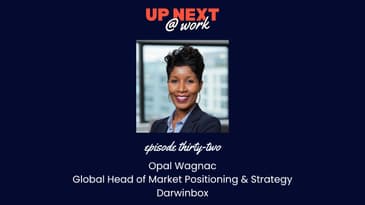
As we kick off the next season of Up Next @ Work, Jeanne Achille chats with Opal Wagnac, the global head of market positioning and strategy at Darwinbox.
No doubt Opal is already familiar to many listeners, as her previous roles include SVP at iSolved and VP at UKG. Opal brings fresh solutions to old problems and has her eye on the new challenges brewing over a very near horizon. You’ll enjoy Opal’s thought leadership as much as we enjoyed speaking with her, and yes, AI is mentioned.
Connect with Opal on LinkedIn.
Powered by the WRKdefined Podcast Network.
[00:00:09] Hello and welcome to the next season of Up Next at Work. We are the podcast on the Work Defined Network that speaks with very interesting guests, but also takes a look at the convergence of professional and personal journeys. I am so delighted to have a guest with me today who we had on stage at HR Tech a few years ago and she just blew the audience away. So getting
[00:00:37] time with her again is going to be amazing today. Opal, thank you so much for joining us. I'd like to start out by asking you to please introduce yourself to our listeners and tell them a little bit about who you are, where you are, and what your title is where you are. Awesome. Thank you so much for seeing you again, Jeannie, and having me on. This is my first time, of course, doing the podcast,
[00:01:03] but I've always loved working with you, you know, and especially having me at HR Tech a couple years ago. You guys are doing such an amazing job just being able to not only highlight people, but also share our stories. I feel like our stories are very encouraging, so thank you for giving me the platform to do just that. A little bit about myself. My name is Opal Wagnac. People have trouble pronouncing my last name because they see Wagnac, and they just say Wagnac or Wagner and may think
[00:01:30] I'm a typo, but think of Cognac and you're halfway there. So that's pretty much the full pronunciation of my name. My whole goal in the HCM is really to deliver on the promise of human capital management. That's what really got me interested in human capital management, but also what got me interested is the level of problem solving. Many years ago, I graduated with a degree in electrical engineering.
[00:01:57] I just loved math and science, you know, and in particular when it came to science, like electricity and magnetism, like the things you can't see but the forces you dare not defy, right? And so I always see that and recognize that even in people too. There's sometimes there's the people that is an energy that they just possess or they just walk into a room. It may be the it's like the intangibles that have a lot
[00:02:20] of power. So that part of science always truly fascinated me and I always wanted to go actually in semiconductors. That was my main goal to graduate. I had went to a Columbia University in the city of New York. I'm a woman of the tropics originally from Jamaica, grew up in Miami and then I was in New York City. And so 17 snowstorms later.
[00:02:45] How traumatic for you. I'm a native New Yorker, so we're kind of just immune to all of it. Wow, you're definitely a resilient bunch, right? But I don't know, I didn't really care too much about, I liked what the semiconductor industry was doing, because I found it fascinating to have this to build the chips in the brain of this entire mechanism. But I'm also one of those people like my environment matters even
[00:03:12] more. And so I didn't find the environment that appealing to me. So I decided to like lean in on my computer science skills, because you have to do computer science courses to get your degree. And I was like, oh, you know, I'll just do some programming and I'll do consulting. It looks like they they pay for your travel. You can see the world on their dime. Good, because I'm broke. Right. And I moved to Washington, D.C. and I worked for CGI for several years. And the thing I loved is that
[00:03:42] with consulting, it made you parachute into these different business models. Right. One project I was working with 3M, I know more about Post-its than I care to. Right. And it's a fascinating story behind it, too. I was going to say, I can't even imagine. Yeah. So it was just a wonderful time, whether it's with 3M or even dealing with the United States Patent and Trademark Office. Some very interesting things you tend to learn as you're there to develop
[00:04:12] solutions for them. But it's very, very interesting how how they come about. You know, so those types of business models fall solving those problems. But there was one problem in D.C. They still had winter and I could not deal with the cold anymore. So I came back, came down to South Florida and that's where I was just 15 minutes away door to door from Ultimate Software. And originally they had hired me
[00:04:37] to build out their recruiting application. And that's when recruiting was just getting its start into HCM. And so I was like, oh, this seems doable. Sure. You know, and I joined the team there and it really built out because I had my technical background pretty much on the platform for many years to build out its configurability, build out security workflow, all of those things that were needed. You know, the things that that have to work, you know, and if they don't, you know,
[00:05:04] that's when you get popular. But I kind of like electricity, kind of like I don't like electricity. It's the intangibles, right? You just do, you enter a username and password and you hit a button, but you don't see all the things that are going on. So true to form, still in the technical capacity, but around in Ultimate Software's time period, there was a time when they want to get, you know, taken more seriously as a tech firm, right? And really wanted the Gartners and the Forsters of
[00:05:33] the World to do exactly that. So my lovely mentor, Cecile Alper-Larue, as you know. Ah, love her. Yes, absolutely adore Cecile. I owe her so much. This woman owes me nothing. Like she, listen, I'm not having another kid, but the name Cecile is up there. Okay? There you go. There will be grandchildren someday. So there you go.
[00:05:59] There will. I hope so one day, one day. But to say all that to, you know, with Cecile, it's great to have leaders like that in your lifetime or in your career who saw something in you. And she pulls you out, pulls you, pulls you to the side and said, you know what, you are very strategic and I think you should really double click into this strategy role. And I'm just like, oh, but you know, I was so on the execution path. Like to me, that was a part of my identity.
[00:06:29] And for her to see that, it's not until I actually are with other strategic people that I can see what they're seeing. You know, it's funny how your incubator works. You know, it's like, you don't see it until you're in that realm, you know, that you're like, oh, wow. Context. Yeah. Context is so important. Like having somebody bring you in and make you part of it, make you own it with them. Yeah, no. And I think that that's one thing that's missing. We're all in
[00:06:57] our own little bubbles, unfortunately, too, right? Where there's something about, there's a reason why a newborn goes into an incubator. It creates an environment where we, where they can thrive. And Cecile really did that for me. And with Ultimate Software, me leading the charge, you know, getting that leader, you know, stamp of approval from the gardeners, foresters, and of course, the rest is history with UKG. But being there, and of course, having another
[00:07:22] wonderful leader, who played a major part in my development, too, was Jodi Kaminsky. You know, she was a CMO also at Ultimate Software. And it's like, I will be, it'll be remiss if I tell you my story, and I miss out these key people, you know, so. It's not lost on me that these are two women. And no matter what, I also felt like they understood the assignment. Yeah.
[00:07:50] You know, as if I was assigned to them. And it wasn't, and of course, a lot of DEI was going on, but they were made it very clear. It's like, this is not a charity, Opal Knight. No, we see, we see that you see you. Right? So it was good to be seen. And at the same time, giving me more responsibility, you know, you know, managing with like the Amea marketing team, and just really having a lot more of that type of exposure, you know, my brothers and sisters in
[00:08:18] sales, and also in marketing and products. So I felt like I got a lot of well-roundedness in that meteoric rise of Ultimate Software. And I believe that now Ultimate Software really prepared me for a time such as this. So here I am, you know, at Darwin Box, and I get to compete against the product I helped build, which is fun. Right? Interesting. Interesting. Yeah. How does that feel for you? I mean,
[00:08:47] Darwin Box is like a rocket ship from what we're hearing out there in the market. Yeah, well, you know what? It's one of those things too, where I'm sure, and I'm not the only one, there's plenty of people that are in product, even to this day, where they're the pace of ideation, the product can't keep up with. You know, and so I got to a point where I was taking ideas in my head, and it's like, I got to put it somewhere, right? And create a vault, you know, because I also didn't,
[00:09:16] it was, it became more of that, the larger you get more bureaucratic it can be. Of course. And, you know, a bit more lumbering. Yeah. Yeah. Yeah. It's inevitable. Exactly. Right. And not as nimble as it once was. So I didn't have a lot of faith that a lot of the ideas that I had, it will actually bring into fruition. But I was doing some fractional work, you know, from a strategy standpoint, especially commercialization for some CEOs in the space,
[00:09:45] HCM or HCM adjacent. And then I met with the Darwin Box founders, because some of our sellers from Ultimate or UKG came over to Darwin Box, and they were starting the movement in the United States. And so they were very clear on the things that they would need. And one of those things was me, right? So I'm here at another point where I get to shout out yet another woman,
[00:10:14] who was, has been also very instrumental in me actually being here at, at Darwin Box, because it was, it's Sudi Korba. So she's our head of sales in the U.S. and she made it very clear from an org chart. And it's like, I wasn't even here yet, but she already had in her mind what was necessary to really be successful. And so here I am making that all happen. I'm the global
[00:10:38] head of market positioning and strategy here in Darwin Box. So a lot of the things that we have to do to really make it, things are moving very, very quickly, right? And being that I've been with so many HCM vendors, just whether it's Red Bull Ultimate and then converting into UKG with iSolve and now here at Darwin Box, that go-to-market maturity doesn't lie, right? And it's important
[00:11:05] that I'm also a purist, also go-to-market certified too, by the way, where there's a lot of things that people just want to do because they see their competitors doing, right? Or it's kind of like your kid, you know, your daughter wants to wear mommy's blazer, but you're like, okay, you'll be swimming in it. It's important that we wear the clothes that fit us for the time that we are in. And so that's how we know that we can chart our success and it will be in that upward and forward
[00:11:33] motion, you know? So we're doing that now here at Darwin Box. And, you know, Darwin Box has been around for over 10 years, almost 10 years, you know? And the platform itself about like six, seven years. And the first installment of Darwin Box was a bot, right? Really? Interesting. And it doesn't get more
[00:11:58] AI native than that. And so what we've done in that time period is really built out all of the HTM functions on an AI platform, you know, on an agentic layer. So whether it is recruiting, whether it's onboarding, whether it's performance, many of them are able to do all of the similar functions. So if you've never seen a demo, I encourage you to please watch where you're seeing
[00:12:26] a lot of things being configured all via prompt, you know, where people are uploading their policies of, you know, through implementation and it's like, it'll generate all the configuration, make that translation. So even the implementations are taking a fraction of the time, you know, coming off of like long legacy players, you know, in the space. So I say that to say that
[00:12:49] Darwin Box is a very exciting time where I can finally see that we are really poised to deliver on the true promise of HTM. You ever would always say that, you know, let your HTM take care of all of your back office so you can focus them, focus on being more strategic. Right, right. Right. And like, how many times have we heard that? But has it really delivered Jeannie? Has it?
[00:13:16] No, no, no. And, and, but I'm curious. Okay. So, so I hear what Darwin Box's business imperative is, and clearly the technology is, is superior and, and you're ahead of the game there. But did the market need another HCM, another HRMS, so to speak? You know, you, you made passing reference to the legacy systems. Surely they are paddling like ducks below the water, trying to, to get to where you are.
[00:13:47] They have to, they have to, many of them are publicly held. They have to. Yeah, they have to. And of course, you know, you know what happens when you're no longer relevant, right? Like, like, we don't need another Blackberry story to know what happens. Right. Right. Right. When it's over, it's over. When it's over, it's over. And then here comes this one phone with one button and knocked out your phone with all of these buttons, you know? And so like, you know,
[00:14:13] you thought more was more and here's like, oh, actually less is more. So like, there's a lot to say, even like how they took their, their eye off the prize, or they got really complacent and very comfortable too, you know? So, but you have to always be innovating and you may also get to a certain point where you kind of run out of rope. Right. And so when looking at that level, like you're
[00:14:37] like right now, there's like two distinct options that are right now on the table for any chief people officer that needs to make a decision on an HCM. You either go with your legacy players, right? And, and, and going with the legacy players, it is, it's one thing to like, okay, they understand HR to the brim. They cut their teeth. These are, these are, this is people soft, you know, legacy. Well, and you dance, you dance with the devil, you know, you know,
[00:15:07] there's some of that that's happening. Yeah. Honestly, you don't get fired for work day, you know what I mean? Exactly. Right. So even from a self-preservation standpoint, right. You'll have a lot of that that's going on with, that's really sustaining all of the legacy players. And of course they're adding on AI features and, and that too. And then you have those that are just AI native. Here's a workflow. You can do whatever you want. You can put your taxes,
[00:15:34] you can, you can brush your teeth with it. You know what I mean? You can do it like, like you would think that these AI bots can do anything. Right. But the truth is they're all, they're both sides of the, of, of the street, but they're running off of the same agenda where at the CEO or at your board level, AI needs to be in every part of our business. Yeah. Right. So you've got these rando sending like bots just like, Hey, here's a bot, which was completely devoid
[00:16:01] of context, has no idea about HR or even how the relational pieces of, of the company has to work, even from a compliance standpoint. That would be a huge concern. Exactly. That would be a huge concern. So you're just operating willy nilly. And then you're wondering why that fails. And then you have the legacy vendors just like, okay, great. We have the HR context, but all you gave me was a chat bot. Like you can't do this. You can't do that. Like, so a lot of those come with a,
[00:16:30] with some limitations because the architecture is not there. So this is why it was actually very prime for Darwin box to step in. Right. This is a prime area where we have the domain expertise as well as the gen AI, agentic AI. We have all those same AI capabilities as those AI native HCM. So this is why an AI native HCM to me was actually, this was prime. I've been asked by so many, um,
[00:17:00] so many analysts like why North America, right? Why North America? Why now as we're moving into different geos. And I was like, you know what? Fair question. Right. And so with India where Darwin box is founded, it did amazingly well then into Southeast Asia and also into the middle East, really maturing those markets at a record pace. Okay. Cause the company's only been around for 10 years
[00:17:27] at record pace. Then typically I know that what the analysts were kind of getting to, they're like, okay, you probably should go to Australia first kind of English speaking. Yeah. They favor the English speaking countries. And then maybe you should go over into your next go to the UK. Yeah. Go to the UK. Right. And then you come for the Vick of Home. Right. Right. Right. And now if I
[00:17:53] were to take the, the over the river and through the woods path to grandma's house, how long would that have taken me? Yeah. Right. And if I took that path, will this window of opportunity still be around? Probably not. Right. So we have to take, we have to strike the iron while it's hot. So this perfect storm, this is perfect where the best of both worlds is really what's built
[00:18:18] Darwin box, the domain expertise, as well as the AI native capabilities. So even having a lot of the structural things that are going on, we're seeing it all actually even our customer base where there's a convergence of HR and IT. I wanted to talk to you about that. Cause you and I touched on that briefly and, and that's a huge topic. And I, I have been beating that drum now for several years.
[00:18:44] Um, and, and quite frankly, falling on deaf ears in many places, cause those are very siloed, operationally very siloed and also, uh, not a lot of common ground in terms of speaking the same language, so to speak. What are you seeing in the market? You know, so I just got back from Vegas one in the morning and I went to an IT conference. Right. And of course I said, I'm going to, you know,
[00:19:13] play up this whole HR and IT thing. Right. And, and see what happens here. Right. And so it was a true to form I, IT conference, which I actually really enjoyed because a lot of the tech that they were talking and showcasing all excited about that's all Darwin box. Right. Very cool. So I felt very, very vindicated through that. Yes. In, in your, in your element.
[00:19:37] In my, I was definitely in my element there. And so in speaking to some of the IT leaders, oftentimes we know that HR is our primary buyer, but I flipped the script, right? I only spoke about a lot of the agency that the platform has and IT was like, oh yeah, tell me more. And I said, not only that imagine your HR domain being able to tackle all of these things too. It's like, oh wow, if we, if they had something though. Yeah. You know, so it's like, so, so interesting how they
[00:20:07] were willing to listen, you know, as long as it led with them as a subject and not the predicate. Exactly. You're, you're leading with IT. So you're speaking, again, you're speaking their language. Yeah. And, and, and, and fostering advocacy with them, which is so important. You know, I know we don't have a lot of time left. So I, I would be remiss if I don't swim back to your times at Columbia,
[00:20:34] uh, studying electrical engineering. That couldn't have been commonplace. Not that you're, not that you are old. I don't want to set that, but you know what I'm saying? Like, listen, even today, that's not necessarily, um, the story that leads you into HR technology. So, so how did you even get into that major? You know, it was just one of those things where, um, my dad was a master electrician
[00:21:04] and I mean, sometimes we drive around in Miami and I show my kids like some of the buildings that are the schematics for it. Yeah. You know? And I just remember coming to the house and having these large drawings. You, you, I thought he was an architect, but no, that was wiring plans, you know, wiring plans and the voltage for the kitchens and stuff like that too. But I didn't really know, I didn't know what I was really reading. And so it wasn't until I knew my dad didn't really
[00:21:32] know that I was interested in that as well, because it was very atypical for a woman, you know, they call it a girl child to, to be interested, you know, in that. And so it wasn't until my senior year. Um, I was, I had my physics homework open on, on, in, in the kitchen and I got up to go get something and I came back and my dad was in my book. He said, whose book is this? And I thought at first, I'm like, am I in trouble for like leaving my stuff scattered all over the
[00:22:01] kitchen? And so, and I was like, it's mine. And he was like, you like this stuff? And I said, yeah. I said, actually, I love it. And he was like, but you're a girl. Oh, right. And so I said, yeah, my whole life. Yes. You know? And, and then right then and there, something just flipped it for him because it was almost as if he was thinking that my brother would be interested
[00:22:27] in my brother really wasn't. Yeah. And so he just started writing feverishly, all of these, like, he'll draw it. Like whenever you have a test, just draw a circle, just draw a circle. And you, and you know, every formula that you're ever going to need, just draw the freaking circle. Right. And so, and so he's like, and you, then you draw a line through the circle. You put a V here, you put an R here, you put an I here. That tells you everything. You have voltage, you have ampoule, you have, and he's telling me all these things and I'm just starting writing it down, you know?
[00:22:56] And because my, my dad was also dying at the time from cancer. Oh, awful. You know? So that I didn't. So this was his legacy to you. Wow. Wow. So it definitely stuck, but that's one of the things I kind of wrestled with at the same time too, where yes, coming into the degree, there was definitely no line at the ladies room. Trust. Yes. Okay. No line. Oh my gosh.
[00:23:23] You would have to turn on the light. Yeah. Right. You were the first and only of the day. Yes. First and only of the day. And, but I was wondering if I was abandoning that legacy by not going into what the degree was structured for. And I really had to, I didn't really wrestle, wrestle with that, but it was one of those things that kind of stayed in the back of my mind.
[00:23:46] Mm. But what gave me some respite is that it wasn't necessarily about being an engineer. It was about solving problems. That's what it was all about. It was about solving problems. And I got to a point also with just developing product that honestly, I'll say here product is boring. You know, I, I got bored. I literally got bored. It's a means to an end. I've heard you talk about solving problems previously. And,
[00:24:16] and this is, I, I'm again, a huge proponent of critical thinking skills and anything that can help facilitate that. But, but your ability to identify the problem is, is also critical to the solution. A hundred percent. Say it again for the people in the back. Oh my gosh. Like, it is definitely critical to be even to like, I can see, I can see something. Let's say if you're, you're even reading an article, I read the article, we will walk a bet, walk away
[00:24:46] with two different stories too, because your experiences that make up Jeannie Akil are different from the experiences that make up Opal Wagnac. Yep. Okay. And you know what? We should walk away with something different. So far be it from me, I really get upset when people are like, or trying to, um, thinking that, that as if, as if I'm an imposter, you know, or, or, or, oh, you know, what, what articles do you read? And I was like,
[00:25:14] Oh yeah. Yeah. Almost trying to type, type box you into like this canned version. And I said, listen, I don't think you're ready for this, you know, and let's be clear. I'm not going to walk away with the same perspective as everyone else. And neither should you. Yeah. No, we were made different on
[00:25:37] purpose. Well, it also goes to knowing your value. I mean, you, you should own that. I mean, your thoughts, your set of experiences, your uniqueness, that's part of the value you bring to whatever setting you're in, in life. And that's what maybe shift as well from the engineering where it was literally you, you're it's what done now do the tools change over time? Yes. But not fast enough for me.
[00:26:03] Mm-hmm. Right. No, it does. It does change, but I found more fascinating, like to, to solve the problem. How do you get people to separate from their wallets? Mm-hmm. Right. That's right. That motivation, that getting people. Yeah. That buying decision. That right there, because one day I heard an engineer saying, why do we spend so much money on these
[00:26:28] marketers? You know what I mean? You need to have more spending money on engineers and whatnot. And I remind them of a story that got me to think differently as an engineer. And that was when it was a company called Ricochet Wireless. And I thought what they had was fascinating tech, fascinating tech, because it was around like what, 2001, 2002, very early 2000s, people were still using dial up, you know, something like a fax machine and then,
[00:26:57] yeah, well, you know, all that stuff. Sure. And they came out with wireless internet routers. And I was like, that is fascinating. Imagine one in every home. Exhibit A, Jeannie. Right. Some day, right? Some day, right? Some day. Yeah. And, and that's what also let me know for, so for an engineer to create that and market to another engineer, you didn't have to say much to me.
[00:27:24] Right. I can read the spec and I know what, so, but I imposed my vision and my value. Yeah. Right. They did not articulate the vision and the value. So we told as an engineer, I'm what 1% of the population. You're not going to do well. Right. If you're, if you're relying on me and people like me, you're just not going to do well. And so I say all that to say that that to me
[00:27:51] exposed a different problem. So the company went belly up and so did my money with it. But that's exactly what happens is, you know, sometimes if you're an engineering driven and not respecting marketing, or there are plenty of circumstances where the product is mediocre and it's being over marketed and has, you know, a reputation that far exceeds its capabilities. So, yeah.
[00:28:20] No, a hundred, a hundred percent, you know? So like I, I say, I feel like I needed to be a different type of engineer and it was not necessarily about going up the ranks or the leadership ranks or things like that. I just felt that there was different love. There's value at different levels. Right. And I feel like it's like, talk about layers of an onion. There's definitely layers to me. And then, and that engineering layer, it fulfilled itself for the time that I was in. Mm-hmm.
[00:28:46] Right. And now I feel that there's other problems to solve, but the one problem that to me is the most fascinating is the human problem. Right. We are constantly changing our minds. Um, I have clothes that are no longer fashionable and I bought them last year. You know what I mean? It's just like, yeah, it's like the only thing that doesn't go out of style is money. You know what I mean? But here, even COVID, right? COVID changed a lot. Some people left
[00:29:14] there to go make what? Stationery? Exactly. Or go live in Vermont and, you know, raise cattle, cows or lambs or sheep, whatever. I'm a city kid. So I don't know anything about that. You know what? But hey, you like it. I love it. And so I say that as I say, now imagine if you're trying to build a product and something shifts like that, where people are looking at values differently. Right. Right. Right.
[00:29:40] And then to me, you also need to roll with the times too, and have a way of, you know, there's people who need to focus on product a hundred percent, but there's also those who should not have their allegiance to the product, but have their allegiance to the market. Because at the end of the day, you stick the landing. Well, it's gotta be that perfect 10. Gotta be the customer at the core. That's gotta be. You know, Opal, you and I could talk endlessly about this. Unfortunately, we are close to time.
[00:30:10] And I want to make sure our listeners know how to reach you. And, you know, if they're interested, how do they learn more about Darwin Box also? Oh, no. So definitely you should check us out. We're also kicking off a series, a continuing series actually of our AI intelligence tours. This is where we are going out and meeting the people. You know, it's a different play. There are many people are using a lot more of the social elements. Don't get me wrong.
[00:30:40] We're going to be doing a lot of the social elements. We're going to be doing a lot of the social elements. But at the same time too, this is also where we will not be go very far if we're not relating to one another at the same time. So we are going to make sure that we're going out into city to city. So we have these intelligence tours that are out there. I'll definitely send you the website so you can see the events that we have coming up. So if we're coming to a city near you, please stop by. Please come and check us out. And also you can find me on LinkedIn. LinkedIn.
[00:31:11] So I'm going to wrap us up, but I have to give you a plug for the tour. I went to your website. I took a look at it. There's a message that resonated with me profoundly. And that is from each event, an attendee would make a connection, you know, a personal connection, personal professional connection. It is all about the people. That is what keeps the world moving around and around. And I just loved that.
[00:31:40] I love the physical tour, even if there's 10 people in the room. It doesn't matter. You know, it's all about the people. And to add to that, too, a lot of people ask me, where did Darwin box come from? The namesake. Right. It's just like, how do you come? How do you guys come up with that name? And of course, that prefix, of course, being Darwin. Right. Sure. And we have an idea of what that theory also represents.
[00:32:05] But the main thing that Charles Darwin was really pushing is that it wasn't about the the fastest, strongest who survived the species. It was the ability to adapt. Yes. Exactly. It was the ability to adapt. Right. Yeah. And know that you cannot do that alone. Yeah. Yeah. You cannot do that alone. So that ability to adapt became based the not only just the namesake, but also the undercurrent
[00:32:33] for everything that we do, not only for the employees ability to adapt and reskill, upskill and and change their lives. But at the same time, a lot of these business models. Right. They did not. They weren't able to change and move with the times when they needed to. You know, we saw some of our favorite restaurants, some of my favorite restaurants, we had to dine in. Right. I know. And they basically went away. You had those who were able to like, hey, we got curbside. Right. Right.
[00:33:00] I was getting curbside cocktails, truth be told. Those are. Yeah. I mean, seriously, though, you're like thankful for businesses that have that that depth of awareness, that depth of awareness. But you know who had to pivot the ship? It was HR. Yes. Right. A hundred percent. You have to know staff for that. You now need to target, change your doors into distribution centers. That's right. That's right. Who had to get behind that? You know? That's right.
[00:33:27] That ability to adapt not only at the business model quickly, but also for the employees. You also have to be able to keep up with the times. Yeah. Yeah. Right. Right. So not only survive, but thrive that that's that's what I'm hearing. And so, oh, thank you. Thank you so much for being our guest today. Oh, my pleasure. I'm sure our listeners are going to take away quite a bit from this particular episode of Up Next at Work.
[00:33:55] And please be listening for our next episode, which will be dropping very soon. Thank you again, Opal. It's delightful to chat with you today. Thank you. Take care, everyone. Bye.
Sponsors
