
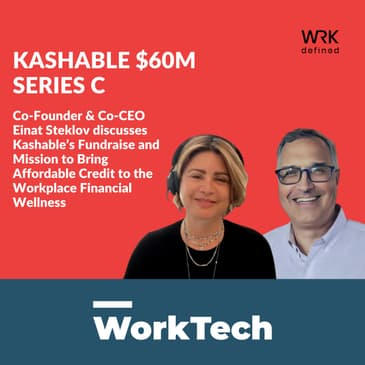
In this episode of the WorkTech Podcast, host George LaRocque sits down with Einat Steklov, co-founder and co-CEO of Kashable, to discuss their monumental $60 million Series C funding round led by the Goldman Sachs Impact Fund. At a time when middle-market funding has been scarce, this deal stands out not only for its size but for the powerful validation it provides for the financial wellness category.
The "Action" Gap in Financial Wellness For years, employer-sponsored financial wellness was limited to advice and education. However, as Einat explains, "advice alone is just not enough" when 78% of Americans are living paycheck to paycheck. Kashable bridges this gap by combining expert financial coaching and credit monitoring with Socially Responsible Credit®, low-cost loans that serve as a lifeline for employees facing unexpected expenses like car repairs or medical bills.
How It Works: The Employer Advantage Kashable’s unique model leverages the employer relationship to offer credit to those often shut out of traditional banking. By utilizing employment data for underwriting and payroll-linked repayment, Kashable can say "yes" more often while maintaining a resilient business model. This system creates a "win-win-win":
-
For Employees: Access to credit that helps build or repair their credit scores—often by 45–50 points.
-
For Employers: A reduction in 401(k) loan withdrawals (up to 30% in some cases) and improved employee retention and focus.
-
For HR Teams: A seamless, tech-driven implementation that integrates with major HCM and payroll platforms like Workday and Business Solver.
A Mission Validated by Goldman Sachs The partnership with Goldman Sachs’ Impact Fund brings with it a commitment to measurable social impact. Einat details how the $60M capital injection will be used to scale Kashable's reach from the 5 million lives currently covered to the 100 million+ American workers who still need these essential financial tools.
Whether you are a CHRO looking to bolster your voluntary benefits package or a fintech enthusiast interested in impact investing, this conversation provides a blueprint for how technology can foster a more inclusive and resilient financial system.
Key Takeaways
-
Validation of the Category: A Series C led by Goldman Sachs signifies that financial wellness is no longer a "nice-to-have" but a durable, institution-grade business model.
-
Moving Beyond Advice: Effective financial wellness requires an "action plan" that includes tangible tools, such as affordable credit, alongside education.
-
The Power of Payroll: Using payroll integration for repayment provides the certainty needed to offer better terms than the open market, directly helping employees build credit files.
-
Protecting Retirement Savings: Providing an alternative to 401(k) loans helps employees keep their retirement plans intact, addressing a major long-term problem for both workers and employers.
-
Scalability via Tech: Seamless HCM integrations are critical for adoption, enabling HR teams to "flip a switch" and deliver high-impact benefits without a significant administrative burden.
On this episode Einat and George discuss Series C Funding, Goldman Sachs Impact Fund, Financial Wellness, Socially Responsible Credit, Fintech, Employer Benefits, Payroll Integration, Credit Score Improvement, 401(k) Loans, Employee Retention, HR Technology.
Learn more about your ad choices. Visit megaphone.fm/adchoices
Powered by the WRKdefined Podcast Network.
[00:00:02] HR tech, work tech and investment are transforming the future of work. Are you in the know? Welcome to the WorkTech Podcast. Join host George LaRocque for expert insights on the trends, M&A activity and strategies shaping the workplace. Brought to you by OneWorkTech.com and the Work Defined Podcast Network. Hey everyone, welcome back to WorkTech. It's me, George LaRock.
[00:00:28] And we've got a really interesting conversation queued up for you today on two fronts. One, there's an exciting funding announcement that we're going to dig into, but it's with a company that has a really interesting mission. And I'm excited about digging in on that. I'm joined by co-founder and co-CEO of Cashable, Einat Steklov. Einat, welcome. Great to have you here. Thanks. Great to be here. Well, I'm aware of Cashable, but I'm excited to learn more.
[00:00:57] If you could just spend a minute or so introducing yourself and the audience to Cashable, that would be. Sure. So Einat Steklov, I'm co-founder and co-CEO of Cashable. Started this business together with my co-founder, Rishi Kumar. We both immigrants to this country. Came over with a very promising future and a pretty good present back then. And despite the fact that I'm an attorney, worked at a law firm, I was not able to secure a single credit card.
[00:01:26] Because I was lacking any credit history. Years later, that experience stuck with me. And when I met Rishi, both of us knew that we had to make a difference. We had to change how the financial services industry, how this market is looking at people and find other ways to give people access to financial services. That's a great, great story. I love a good backstory, a good founder story.
[00:01:56] And that, you know, when you've, you know, experienced the need, right? So the problem that you're solving, one of the problems that you're solving, you know, that gives you perspective. I really appreciate that. So what caught my eye recently was your Series C. And we were talking before we recorded. One of the things that stood out to me last quarter was there were no Series C.
[00:02:21] The middle of that part of the market was missing. There were a lot of early stage, a lot of super late stage like debt funding. So the big question was, you know, as we roll into Q2 and through the rest of the year, will we see any of this? And lo and behold, here you are. I think a sign of good things for the market. Tell us about the deal, though. It was a pretty sizable Series C. I was impressed by the investors, the size.
[00:02:48] So tell us about the deal and who's behind it. Sure. Many aspects about this Series C capital rates for us are extremely significant. The first one was that the lead investor here is Goldman Sachs. And it gave a very strong validation to Cashable as a business. And what's more unique in that is the fact that within the Goldman family of entities,
[00:03:14] it is the impact fund of Goldman that is looking to add financial wellness and impact on everyday Americans to its operations. And the combination between the Goldman as an extremely strong financial services leader, giving us validation for the business that we've built, the impact fund comes in and put a stamp of approval on our mission,
[00:03:43] on how we execute on that mission and on the outcomes that we are able to deliver. And the fact that this is a Series C and not a C, which I'm glad I didn't know that there were no Series C, right? It could have add to the stress. But I didn't know that. Series C means that Cashable is a mature business. We've built a company over the last 13 years. We built it with very patient capital, family offices that helped us get going.
[00:04:11] We got hundreds of employers at this point, big names, brand names in the market to adopt Cashable for their employees. And now Goldman comes in and say, yes, this is a business that's not only doing well for itself and building a resilience business for itself, but it's also doing something good for everybody else, for every everyday American, the way we look at that, and that's Cashable.
[00:04:40] And that's Series C, $60 million coming, Goldman was leading, our existing investors participated with significant amounts. All of that together comes to support Cashable in our mission and give more assurance to our partners, the benefit broker, the platform, the technology platforms,
[00:05:01] and mainly, mainly employers that trust Cashable with their employees and help us deliver financial wellness for the people. Yeah, it really is a validating, you know, point of time like this. It's Goldman Sachs. You know, we've all heard of Goldman Sachs. But, and because you're in the world of, you know, benefits and wellness, financial wellness,
[00:05:28] even more important that you're validated by a fund and a banker like Goldman Sachs. So congratulations on that. I'm curious if the, like with impact funds, when I've seen it in the past, it's not just a brand. It's while it is a stamp of approval, they're looking to see those results ongoing. So you're making a, you know, I always tell folks you're choosing a partner when you commit to an investor.
[00:05:53] And there's a commitment to continue to deliver on certain KPIs, in this case around impact. Is that fair? It's absolutely fair. Okay. To say we are committed not only to Goldman. We're committed to the employers that actually chose us. We are committed to the benefit brokers that trusted us with their clients, the employers. But more than anything else, we are committed to people that we open up the door.
[00:06:23] And for many of them, we are the first step into financial services. Maybe if I can take a step back and just describe what we actually perceive to be an issue and how we actually resolving it, it might help people, your listeners here. Yeah, that's perfect. I'd love to sort of get into the macroeconomics of it and sort of what's happening and where you fit in that picture. That's perfect. Sure.
[00:06:53] So we all hear the statistics of working class Americans can't finance. 78% of them are living paycheck to paycheck, that people don't even have $1,000 in the bank account if something happens, that they don't have money to repair their car, to fix the roof. We all heard the statistics. The question is, how do we solve it?
[00:07:18] And for many years, financial wellness for employers, for the benefit brokers or the benefit directors, financial wellness was let's give an advice. Let's educate people. Let's help them learn how to budget, how to think about their financing. And in the more recent years, employers actually understand that advice alone is just not enough.
[00:07:44] You give advice alone, the engagement is low and the outcome is even more minimal. What Cashable came into the market and say, advice is great, but we need some action plan to get a wisdom advice. And what Cashable is doing, we are combining the action, a low-cost loan, access to credit for employees together with the advice. We either provide advice from our side, financial coaching, webinars, credit monitorings.
[00:08:13] We have all of that available on our platform. Or we integrate with the employer. If the employer does have all of that or some of it, we will integrate with the employer, financial wellness services. But the action piece is unique to Cashable. And the reason that we can actually do the action piece, the reason that we can give loans to say yes to more people than anyone else in the open market is because of the partnership with the employer.
[00:08:40] Because the employer provides us employment information that allows us to underwrite people for credit beyond just credit scores. We look at employment information. We have a good understanding of group behavior, very similar to how insurance is underwriting group health or group life. We're doing a similar thing for lending. We are able to do that on the information that employers give us. And then employees individually come to Cashable platform.
[00:09:10] The employer is not responsible for the loan. The employer is not on the loan documents. The employer doesn't take any risk or pay for the loans. But the employer helping by facilitating the repayment of the loans through payroll, whether it's direct deposit or payroll, it comes directly from the payroll.
[00:09:29] What a combination of employment data and repayment through payroll is doing for Cashable is that we have superior information that is not available in the open market in order to underwrite and say yes many more times. We also have more certainty on repayment on time, every time. Because if you think about payroll, very predictive, right?
[00:09:53] The result of that is more people have access, people that never had access to traditional lender getting a yes and getting a loan from Cashable. Those loans are significantly better than what people individually can achieve in the market. And then they pay them on time, every time. And we report to the major credit bureaus.
[00:10:15] And for many people, this is the first time that they are being reported to major credit bureaus on what most of the time is a perfect repayment patterns that helps them get better credit scores going forward, building up their credit files.
[00:10:31] So 90% of the people that did not exist with the major credit bureaus, when we checked them for the first time, for the first cashable loan, have 90% of the people do have a credit file in the major credit bureaus by the time we see them the second or third time. 60% of the people. Hi, I'm Jeremy Ames, your host of Signals, a Starbold Studios production.
[00:10:54] I'm taking bold ideas and real challenges submitted by leaders like you and turning them into powerful conversation with actionable results. Some weeks, I'll react in just four minutes. Others, I'll bring on experts for deeper dives. So send up a signal and I'll throw you a line. Overall, get to see an improvement in the credit scores of 45, 50 points. And this is significant, especially for people on the lower side of the credit scores.
[00:11:20] If you had a 620 and now you're 670, this means that credit cards will start to look at you. This means that when you go to buy your iPhone, you buy it on a payment plan and not with cash. This means when you rent an apartment, your landlord will ask for one month or two month security deposit and not six months. That's a difference between being part of financial services and being completely shut out of the system.
[00:11:47] Yeah, that's, you know, to have that kind of impact is really powerful. And I was curious about the shape of the loans themselves. You're saying they're very competitive for these folks. What does your customer look like? What types of companies, what size of companies can take advantage of a program like this? And do you see any similarities in adoption? What does it look like? So it's hundreds of employers from all sorts of industries. I can name a few.
[00:12:16] If you think about logistics, we have UPS, we have Amazon, we have XPO. If you think about manufacturing, Kraft Heinz. If you think about hospitals, Temple, Drexel, Hartford Health, Sharp Health, Jackson Health. If you think about retail, whether it's Hyatt or Lufthansa, it's across the board. BAE Systems, Cognizant, Wipro on the technology side.
[00:12:45] So it's really across the board. We have a lot of government, public entities, the state of Illinois, the state of Tennessee, San Mateo County, Pima County. We have cities like Salt Lake City. It's across the board. Yeah. Actually unique is that the HR teams, the benefit teams in those employers, saw the needs and saw a way to solve the issues. It's interesting. For example, we have Huntington Ingalls.
[00:13:15] He's an employer that came to us. And after a few years, they ran a research to look at before cashable and after cashable. I think they looked at three years before, three years after, and they compared loans taken from retirement plans. Huntington Ingalls saw a reduction of more than 30% in loans taken from their 401ks after they put cashable in compared to the period before.
[00:13:42] 30% reduction is thousands of loans that were taken from their 401ks. Now, is this the employer problem? I would say every employee problem is an employer problem, right? Because people cannot retire at the age that they wanted to retire or that the employer expect them to retire because they actually draw the money out of the retirement plan ahead of time.
[00:14:08] Does it create more manual work, more headaches for the HR teams when people borrow from their retirement plans? Absolutely, yes. Can we solve it 100%? No. But are we reducing significantly? Yes. And we're doing it because we're creating an alternative. And if you put in front of people that action piece, not only the advice, hey, it's not great to take your money from retirement plan when you're in your 40s.
[00:14:34] But if you put a solution, if you put a tile in your retirement platform before people had a chance to click on this, I want to take a loan, learn about cashable, you have actually have a chance to change that behavior more than just a webinar or one more advice. Because you combine the advice with an action. And that's what we actually communicate. That's what we are providing on our platform. Yeah.
[00:15:02] So for those HR teams and those CHROs, these companies, what does it look like from an implementation perspective? What does that ecosystem look like? You've mentioned retirement plans. You've mentioned payroll. Where does Cashable integrate on the back end and where does it become visible on the front end? Sure. So Cashable is a fintech. And here the tech comes to play. Okay.
[00:15:27] We already integrated with dozens of payroll systems and platforms, technology platforms that typically host voluntary benefits or benefits for employers. So the first thing I would say, if we already integrated with the platform, in many cases for the employer, it's really a decision. They say yes and we flip the switch. So for many of them, it's not going to be a real integration.
[00:15:55] In those cases where employers are running their own payroll, there's a good chance that we already integrated with the payroll system and now we're just tweaking it. Whether it's an API through Workday, whether it's a CoreStream integration or ABC integration or Business Solver, we're already in so many different platforms that we integrated. We have the knowledge. And if we don't have the knowledge, we have the tech team, the engineers to do that. If it's completely, completely painless for the employer, no, it's not.
[00:16:24] But the employer, we're making it as easy as possible. And the vast majority of employers, when I interview employers, when I go post-integration and say, how was it? Most HR teams will say, hey, this was nothing. This was really light on our end. You guys took most of the work on yourself. And this is because we are a tech team and we realize that integration is a big hurdle for employers to put a new benefit in. And we're built for that.
[00:16:54] We're ready to take the majority of the work into our side. And so from the employee's perspective, I think that payroll connection and both in the way that you described the payment of the loan, but also being integrated into that system and being most of those payroll systems are also connected or provided by the HCM platform, which is doing benefits enrollment, et cetera.
[00:17:22] So that's a real differentiator on both sides where you're getting not just the customer integrated, but your ability to get utilization of the benefit and be visible and then provide that impact to the employees. It's all, it's a sort of circular motion there. Are there other places that I'm not thinking of that where cashable is appearing? You know, it could be as simple as just, you know, you're running campaigns into the employee base. I have no idea.
[00:17:51] We do run campaigns. Loans as opposed to open enrollment where you decide on your health care at the end of the year and January 1st, you have it. Loan is not something that January 1st, you say, hey, I'm going to need a loan in June. So it's a life event, right? Something happened, you need a loan. So we are running campaigns. Many times we're running it with the employer that actually go back to their employees and refresh their recollection of what is available for them.
[00:18:21] That the financial coaches are available for them. That credit monitoring is available for them. That a loan, access to credit is available for them if they need it. There is, you know, for people not from the lending, it sounds weird, but there is a season for lending, right? It's very seasonal business. So beginning of the summer, it's a high season for loans. And also the holidays is a high season for loans. Okay.
[00:18:46] So there are seasons where people actually spending the money and instead of going and take high cost, high interest rates, loans or loans that are beyond their affordability, it's better to go back to cashable and check what's available for them. But the employer serves here as one more thing. This is a trust layer.
[00:19:10] If you think about the vetting that employers are doing for healthcare, for life insurance, the same thing goes with cashable. Employers actually looking at us and vetting us from the business perspective. Something that you as an individual, most of the time, you don't have the capacity to do that. And definitely if you urgently need money, you don't have the time to do that. So when employees see that their employer actually open it up for them, there is some trust level that goes here.
[00:19:39] And indeed, it's easier for employees to take a loan from cashable. There's less exposure, less documents that they need to upload because there is information that comes to us from the employers. And employers should leverage their power, their ability to do these kind of vettings, to look at cashable. The relationship between us and employers are B2B relationship, right? They are our clients. We are providing services for their employees.
[00:20:09] We are committed to certain things vis-a-vis the employer. So when employees see that their employer open up cashable for them, it comes with some sense of this is a good place for me to go and explore and sign up with cashable for credit monitoring and sign up for the financial coaches.
[00:20:29] So we do see a higher engagement than you would typically see if this was just a loan in the open market or if this was just a coach in the open market. It's the combination of all of that that comes into one place in a platform that is very intuitive, very easy to navigate and quick on results, right? We provide the loan metrics, the key terms on the screen.
[00:20:59] It's very transparent. It's fully compliant with laws, with all the federals and state laws that are applicable here. It's a very, very fintech experience for the individual employee. Yeah. Yeah. That makes a lot of sense to me. So now understanding, you know, the value that you're providing the employer and the employee, the impact that you're having with the employee. So now you've got this, you know, substantial Series C. What's next?
[00:21:29] What are you going to do with that? How, what kind of further impact might you be providing for your customers and their employees? I'm going to do more. So there are about 160 million Americans employees in the market and about 120, 130 of them, million of them actually take benefits from their employers.
[00:21:55] We right now cover about 4 million, 4 to 5 million. This is the coverage. This is, this is the number of people that have access to Cashable through their employers. So I have another hundred million to go. And, you know, I have really good brand names that adopted Cashable. Each and every one of them is willing to be an ambassador for us. Each and every HR team is looking at Cashable and, and appreciate what we deliver.
[00:22:25] We provide the employer a lot of impact reports on their employees. We provide them a feedback in an aggregated level. So without disclosing any individual employee, we show them a picture of their employee that they haven't seen before, that they don't have access to. And we also show them how people actually engage with us and what else can be done on the financial wellness side.
[00:22:50] So we definitely plan on taking this money and put it into our B2B sales team, into our go-to market. We have a strong client success team that, that is engaged with the employers and we, we are building more on that team. So we definitely plan on doing more.
[00:23:10] Yeah, that's, that's a, that's a great answer, especially because what I heard was a lot of focus, focusing on solving this problem for more companies, more people, you know, that we could use more focus in the market. I'm sure you might decide to do some bigger and better things as, as the data suggests, but I really, I really appreciate that answer. How can folks learn more about Cashable? How can they follow this?
[00:23:38] And do you have any, sounds like you've got some research and some data that folks might want to, want to access. I'm assuming that's at your website. Website is one place, but definitely reach out either to, to our sales team. If you're interested to engage in this conversation, it's sales at cashable.com. You can reach out to me, a not E I N A T at cashable.com. You can reach out to info at cashable.com. We will answer.
[00:24:07] We're answering. We're pretty good on, on that. You can call us. You can, you can follow us on LinkedIn and Facebook. We are there. Great. Great. Well, and not congrats on the round. Congrats on all of the success. And thanks for telling your story here on WorkTech. I'd love to check in somewhere on your way to the next hundred million lives. Let's set a date. All right. Well, thank you.
[00:24:34] Really appreciate you having me and giving us the opportunity to, to tell our story. I think it's an important story and I would love to have as many people as possible know about it. Great. Great. Thanks to everybody, wherever you're watching or listening out on the work defined network. And until next time.
Sponsors
