
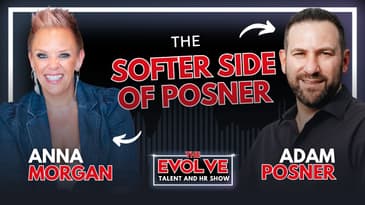
In this episode of the EVOLVE Talent & HR Show, host Anna Morgan sits down with Adam Posner, founder of NHP Talent Group and host of the globally ranked podcast The POZcast. Adam shares the real story behind his career pivots, entrepreneurial journey, and how podcasting became a powerful flywheel for both brand and business. From building a recruiting firm to recording nearly 500 podcast episodes, Adam reflects on resilience, authenticity, and what it truly means to show up for your community. He also opens up about navigating a cancer diagnosis while continuing to build, create, and lead. This conversation is a candid look at the human side of leadership, career reinvention, and the role community plays when life throws unexpected challenges your way. In this episode, you’ll learn: Why authentic storytelling creates stronger professional communities The real reason most people start podcasts (and why it usually fails) How Adam built a recruiting business after losing his corporate role The difference between good recruiters and great recruiters in today’s job market How AI is changing recruiting—and why it won’t replace great recruiters What candidates can do today to stand out in a hyper-competitive job market How podcasting became a flywheel for Adam’s brand, recruiting firm, and partnerships The leadership lessons Adam learned while navigating cancer treatment Key Moments 00:00 – Introduction and Adam Posner’s career journey 04:10 – Losing his corporate job and pivoting into recruiting 08:30 – Starting NHP Talent Group and building an entrepreneurial path 12:00 – The realities of today’s hiring market 16:00 – AI in recruiting and what candidates get wrong 20:45 – Adam shares his cancer diagnosis and treatment journey 28:30 – The power of community during difficult seasons 33:00 – How podcasting became a flywheel for business and brand 37:30 – Podcasting mistakes most new hosts make 44:30 – Conference season, future plans, and closing reflections Adam Posner is the Founder and President of NHP Talent Group, a New York–based recruiting firm specializing in marketing, media, tech, and product roles. He is also the host of The POZcast, a globally ranked career podcast approaching 500 episodes where he explores the life and career journeys of leaders across industries. Through his work in recruiting, podcasting, and content creation, Adam has become a trusted voice in the HR, talent, and future of work ecosystem. | Follow Us | Follow Adam Posner Website | https://tr.ee/B5ujzSTP8s LinkedIn | https://www.linkedin.com/in/adamjposner Instagram | https://tr.ee/i8j9WcUQdJ Follow Anna Morgan Website | https://yourcareerbff.com/ LinkedIn | https://www.linkedin.com/company/evolve-conference-careerbff/posts/?feedView=all Instagram | http://nstagram.com/annamorgancareerbff/following/ Facebook | https://web.facebook.com/anna.morgan.351104 Join the EVOLVE Shine 2027 waitlist: https://yourcareerbff.com/evolve-2027 Interested in collaborating or sponsoring EVOLVE experiences? Book an EVOLVE partnership call: https://calendly.com/annamorgan/evolve-partnership If this episode resonated, subscribe, share it with a fellow HR or Talent leader, and leave a review to help more people-first leaders discover the show.
Powered by the WRKdefined Podcast Network.
[00:00:00] Welcome to the EVOLVE Talent and HR Show. I'm Anna Morgan, your career BFF known as the Rescuer of Dogs and Careers, but now the creator of the EVOLVE Talent and HR Experience. My career has been one big series of unexpected plot twists that now have landed me in the world of events for the recruitment and HR industry.
[00:00:23] EVOLVE was born from a desire to build heart-centered spaces for leaders to show up boldly and learn together. This show is for the modern day employee, a people-first leader, individual contributors, managers, executives, practitioners, entrepreneurs, and fractional leaders who care deeply about humans and are not afraid to do work differently.
[00:00:48] If you influence how people are hired, developed, led, and supported, you belong here. On this show, you're going to hear conversations with talent acquisition leaders, HR, business partners, event organizers, sponsors, speakers, and attendees who are passionate about building human-centered, connected, and creative workplaces.
[00:01:10] So if you're ready for something a little bit different, community, fresh energy, and practical inspiration that you can use right away, you're in the right place. This is the EVOLVE Talent and HR Show. Let's dive in. All right. Hey, everybody. I'm Anna Morgan, your career BFF and now host of the EVOLVE Talent and HR Show.
[00:01:34] I'm super happy to have my buddy Adam Posner here today. Adam, for those that maybe don't listen to you on the podcast, shame on them, or know you from LinkedIn. How are you introducing yourself these days? Shame, shame. Anna, first and foremost, thank you so much for having me on the show. Excited to be here, friend. Excited to chop it up. Thank you for rocking the shirt. But yeah, I'm Adam Posner. I'm the founder of NHP Talent Group, a recruiting and staffing firm here based in New York.
[00:02:00] We focus on all things tech, marketing, media, product. That's my day job and my other day job, my passion, my love. I'm the host of the POSCAST, a top global career podcast. I've been doing that. Just celebrated seven years and about to record episode 500. And what I love to do is unpack my guest's life journey told through the lens of their career. Amazing. Amazing. With a big focus on that inner tenacity, really owning your story, whether it's the underdog comeback or really chasing your dreams.
[00:02:29] And not being afraid to be in that figureoutable energy. And I love that. And it's been such an honor, Adam, over the years. You and I both joined LinkedIn in 2006. 20-year anniversary. Jeez. We just talk about anniversaries, right? Look how far we've come in 20 years. I know. And I was reflecting back. I mean, I really think we started interacting in the comments probably in 2020 when so many of us were starting businesses and trying to figure things out.
[00:02:59] Now, you've been doing the podcast since 2019 and then kind of blazing your own trail as an entrepreneur since 17. Is that right? Yeah. I can't believe I launched my business in 20. It's going to be nine years this August. Isn't it wild? And then you're like, I'm just getting going. Just figuring it out. That's how I feel. Through that journey, I've definitely seen different shades of the pause, if you will.
[00:03:23] And what I've grown to really appreciate through our time meeting up at in-person events and through our community is really the vast ranges of your personality and truly like the softer side of pause. I think that was some of the things I wanted to dive into today. In addition to kind of your squiggly career and transition from the traditional world of work to what you're doing now and a lot of the pivots and left turns that you have taken throughout your career.
[00:03:53] So when you're looking back on that decision to start your own business, you know, how did you feel as a corporate employee? You know, you, like many people, had a couple of different industry opportunities and then you had that opportunity with VaynerMedia.
[00:04:09] And I've heard some of that story for the listeners that may be feeling like my squiggly career or I can't pivot or is should I follow this nudge that's coming up for me around what's next in my career? Yeah, so much unpacked there and I appreciate it. I mean, I think first thing I want to touch on is you talk about the softer side. And I think that was part of an evolution. It's always there, the soft underbelly.
[00:04:34] And I really found through my content journey, that really is what resonates and generates the most real, authentic conversations in the comments and not being performative. Listen, there's posts I put out. I mean, everyone has their content pillars, right? Like I'm promoting the podcast. I'm promoting jobs. I'm promoting recruiting. But it's those posts where I really talk about like behind the scenes, what it's like, whether it be real life, parenting, marriage, going through cancer battle, ups and downs of job tribulation. Those are the things that really resonate the most. And it's also the most fun for me to write because it's from the heart.
[00:05:04] And I love to write. I really do love to write. And certainly I lean on AI for certain things, certain pieces of content. It's not the end all be all uses frameworks. But when I just write from the heart, from the gut, like those are the ones that really land the most. And I think that's what connects me most with my audience of the show and audience of LinkedIn and other social medias because I'm real. Like what you see is what you get. Now, obviously, like all of us, there's pieces that you keep reserved for your friends, for your family and the personal side. There's a lot. But you know me like I wear my heart on my sleeve.
[00:05:34] I tell it how it is. I have a terrible poker face, except for the poker tournament in Vegas when I beat Jesse Tinsley. So it's the third time I'm talking about it just because he was a former professional poker player. I need to have something to like grasp onto. That is impressive. You know, it was kind of by accident, too. I didn't plan to beat him. If podcasting and entrepreneurship doesn't work out, we know where to find you. I'll be at the Bellagio Poker Room all Vegas week.
[00:05:57] But I also found this side of me came out over the years of the evolution of the podcast because I became better at my craft. I became more engaged with the conversations. I became more discerning in the guests that I booked on my show because those are the conversations I wanted to have. Those are the conversations that resonate because at the end of the day, if you're a podcast host, most important thing is not you, it's your audience. And if you're mindful about your audience's listening journey, because if you're not interested in the guests, if you're just thinking about the next question, the audience is going to hear it.
[00:06:25] So being intrigued, being naturally inquisitive, which is something I am, has really led me down the path of being softer. Now to your second and third questions. There's a 10 part question there. We like to call it in podcasting. I need to get better at that. No, one at a time. Those left turns. Left turns, right turns. The first 15 years of my career, I worked in marketing and media in New York City. I worked in account management, digital strategy. I was an account guy at ad agencies. I worked in-house at SiriusXM and marketing and American Express and marketing.
[00:06:53] And then as you mentioned to my last role in that side of corporate America, I was working for the great Gary Vee at VaynerMedia. I thought it was my forever job. I literally idolized him and everything he was doing at the time. And I was like, oh my God, this is literally like the Holy Grail. Fortunately, and I'll leave it at this, the grass was not greener on the other side. I was a different person than I was now and it did not work out. And unfortunately, I ended up losing my job. And it was at that moment, Anna, where I was like, I was 35. My daughter was literally just under a year old. And we just bought a house out of Long Island.
[00:07:23] I'm one of the most expensive places in the world to live. And I was like, holy shit, like, what am I going to do? Do I, two things. One, A, I need to make more money. But more importantly, is this really what I want to be doing? I've been doing this for 15 years. Do I thoroughly enjoy this? Do I like this? And it was the hardest decision I ever made to pivot. But when I thought about that pivot and it didn't just happen overnight, it was a long and hard process, lots of conversations with myself, with my wife, with mentors and close friends and people that I trusted.
[00:07:50] And all signs pointed towards recruiting because I had those core skill sets that I learned through having informational interviews with lots of recruiters that I had. I knew that if I was going to recruit, I was going to recruit for what I did previously. So I didn't have to learn the industry. And it gave me a huge advantage because I had that IP. I knew what I was looking for in marketing, media and tech jobs because I worked with all these folks before. But I needed to learn how to be a recruiter. And most people think they could be a recruiter just like they think they could be a real estate agent because, oh, I bought or sold a house once or I did home renovations.
[00:08:20] No, you can't. There's an art and science to it. And we're not even talking about all the technology now that people think makes it easier. Yeah. You have tools that can help with sourcing and outreach, but you still need the human who knows how to be a recruiter to talk to a candidate, understand their motivation. So, yeah, I made the move into recruiting and I spent two years at a search firm, a great search firm called Onward Search. Great mentor, Tom Hall, taught me the art and science of recruiting. And then I jumped on an opportunity to start a new division with this other recruiting firm that didn't work out. And it was at that point when it just wasn't the right chemistry, to be honest.
[00:08:49] And I remember it was it was an August day and the office is in Union Square here in New York. And I walked out into the into the park and I said to my wife, I'm like, this is just not going well. I've been here a few months. I did just something not right in my gut. And she goes, why can't you just do this on your own? She literally just said, she just said, like, why the hell are you giving half your money to the house? Like, what are they giving you that you can't do on your own? I'm like, she's like, we have a room. You have a desk. You have a computer. You have a phone. You can buy a LinkedIn recruiter or whatever the hell you want. Right. And that was it.
[00:09:17] And almost nine years ago, I haven't looked back. And it's it's crazy because I would not be able to do that at 22 years old coming out of college. No way in hell. But I had the business acumen. I understood it. And damn, those last few years have been a roller coaster, my friend. Well, and, you know, you had a little bit of that more corporate recruiting experience, like you said, that you were able to learn the basics and then accelerate based on your industry knowledge. And cheers to Ilona for reflecting that back to you.
[00:09:46] And maybe at that time, the one that you had to kind of borrow the belief from that you are ready, you know, to step into this new season of your career. What I especially appreciated is your radical honesty about what you were doing at the time. We talk about it in job search, the pros and cons, but it really comes down to looking yourself in the mirror and being like, do I really like this? Does this ignite me when I'm in the work? Does it feel like work?
[00:10:14] Or am I just so immersed in the hunt and the joy of matching people with organizations that it's a hell yes. Even if there is that uncertainty looming in the future. Yeah, there's there's a lot to unpack in that one. Recruiting itself, I thoroughly enjoy as a profession. Days that are absolutely terrible. They're like yesterday. I had an absolutely terrible day. You know, those days in recruiting when when nothing is going well. That's when my hair gets like right. Massive because I've been like. Yeah.
[00:10:44] And like there was just two brutal like miscommunications with the client that was all on their end. And I lost two candidates who were far along in the process. And I won't go into details on that. But like as a recruiter, especially contingency, the risk is all on your side. You're not getting paid until you fill the role and you're putting all this time and effort. And so there's two sides of it. Right. There's two points. One, you're deeply upset because your investment, your time investment, you've just lost it. That investment went to zero. And you're also you're upset for the candidate. You're upset for the process. You're upset because you put all this time and energy and effort into it.
[00:11:14] But that's the job. And I'm not comparing. But I'm just saying like doctors lose patients. Recruiters. This is a terrible analogy. I'm going to get fried for this one. I've been rushing to pit lately. It's not the same. It's not the same. But we'll call it stocks. Like you're a stock trader, right? You're going to lose deals. You're any type of salesperson. You're going to lose deals. The doctor analogy is terrible. But that's part of the job. We're in the no business. We're in the loss business. Of course, you want to have more wins and losses. But, you know, it's kind of like baseball. If I'm batting 330, I'm a Hall of Fame freaking recruiter right here.
[00:11:43] That means I'm only successful 30 percent of the time. But OK, so where my brain went is the area that you focus on in the marketing and advertising space. The hope is if something like that doesn't go your way, who are your next five best clients or potential leads, where you could take the momentum that you built with that candidate and hopefully create some other conversations for them. Well, that's that's a move, right? Hopefully you have those opportunities. Sometimes you do. Sometimes you don't.
[00:12:12] And you learn quickly if a good client. Listen, in any sales based role, there's good clients and bad clients. And I'm not saying good or bad people. I'm saying good or bad clients. And we all know those red flags that make good and bad clients. Well, speaking about like managing clients, like if you're looking pullback, what are the leadership behavior or way organizations are showing up that you're tired of seeing right now? There's a lot of that. Obviously, performance based behavior. I think that listen, if we're going to kind of pull back the curtain a little bit on what's
[00:12:42] happening in the job market right now due to economic conditions right now, it's an employer driven market, which means that clients, companies have the pick of the litter of whoever they want because there's so many good people out of work. So the reality is you might think you're a good candidate, but I promise you you're not the best because the best is out there because the best is out of work right now. And companies could be much more selective. And there's no more right now giving chances. That's not happening. I'm just giving brutal truths right now. There's no there's no giving chances.
[00:13:12] There's no looking at somebody with ancillary skills who could do it right. Like, of course, most candidates, of course, I could do that role. I just looked at the job description. I could do this job in my sleep. But guess what? On paper, because there's so many applications coming in that whoever the recruiter is on the other end, they're being myopic and laser focused for better or worse on looking for that exact profile that they want. And that is just a hard truth right now. Just a straight up hard truth that no one wants to hear. But that's the truth.
[00:13:37] How are your candidates showing up to conversations with you right now? Are you seeing any trends or commonality around questions or trust in recruiters? Recruiters, et cetera? A couple of things. One, multiple times it's happened. Usually I'm saying on average, probably once a week at this point, when I reach out to a candidate, they're asking to somehow for me to verify who I am and that I'm a recruiter. And I deeply respect and appreciate that. And that's a signal.
[00:14:05] What's happening out there with a lot of fraudulent recruiters out there, a lot of BS. And I'm fine with it. I go here, here's my LinkedIn profile. I'm talking to you as a human. Look at my profile. Look at my content. And that's another great thing about content, too. It helps with my recruiter brand, obviously. But like, that's Adam. I'm talking to him on the phone. That's him talking to me. But there's two different types of candidates. And this is even before the current situation. There's candidates that come to the table prepared and there's candidates that do not. Now you have to break that down between active candidates and passive candidates.
[00:14:33] If I'm reaching out to a candidate who's a passive candidate already working, I lower my bar a little bit on how well prepared, because I'm the one who's selling, right? I'm in the driver's seat. I'm the one selling and they're receiving the information and processing it. However, if you apply for a role, if I reach out to you and you're interested and you're an active candidate and you don't come to the table, like the worst, there's two things for me. One, we're talking about a passive candidate. If you did not take the time to thoroughly read the job description in advance, which takes, I don't know, three minutes. I think we could all say, I'm going to keep this clean.
[00:15:03] We all have a couple of times a day in the privacy of our own home. And we're probably sitting down looking at our phone. You can't tell me that during that time, you can't look at the company website and read a job description and come a little bit prepared to the fricking table. But worst is, oh, and I'm so sorry. I didn't, I didn't have time. I've been so busy. I didn't have time to look at the job description. You had time to fricking watch that crappy Bridgerton. And like, what are you talking about? Like you were sitting there binging season two of the pit and you can't even like, by the way, we just.
[00:15:33] We just started season two of Paradise. I don't know if you watch Paradise. Who's the main? Oh, no, I've not seen that. Excellent television. So that's a big trend we're seeing now. We're seeing trust and we're seeing candidates either coming very prepared and that separates them. That's one way to separate yourself from a candidate. Like how easy is it to be prepared? And then like you could even with job descriptions and profiles through ChatGPT as a candidate and have questions prepared. Like it's not that hard.
[00:16:04] Right. In your space, are you seeing the impact of using AI on like in the content on the resume? Or are those candidates staying more agnostic and true to their writing ability in your space? I'm curious. It's brutal. I think as a candidate, especially if you're out of work for a while, you're going to lean on these AI tools because why not? You're thinking companies are using these tools. I can cast a wider net.
[00:16:30] I need to I need to get my foot in the door and you're doing yourself a disservice because I see a lot of candidates putting experience in their resume that they don't have. Because what will happen is and most good recruiters will do this. I will look at your LinkedIn profile. I'll look at your resume and I can tell the company you're working at, the job you're doing, the history of the work you've done. I can tell you have not done this. Either you've never done this at all or you've not done it to the extent of the experience that you're stating in your resume. That's a red flag to me. I get it. You're a candidate. You want to get in the door. You need something to happen. You need a job. You need money, obviously.
[00:16:59] But you're doing yourself a disservice and a good recruiter is going to smoke you out in two seconds and you can look like a fool. Yeah, it's tough. It's true. How are you asking candidates about their AI knowledge or what are your clients requesting from a knowledge base for AI within organizations? Well, obviously, certainly it depends on the role. Like if it's obviously an AI specific role, I'm looking at AI engineers, which I work on, AI product managers, which I work on a lot.
[00:17:28] That's one of my core specialties. Obviously, I'm going deep into the tech side. Right. I'm understanding. I'm pulling back the curtain on the platforms they're using, which languages they're familiar with. But then generally speaking, if a client's interested in just AI familiarity, I'm going to ask candidates how they're using it professionally and personally. Tell me what you're using. Tell me what you're messing with. And like I want to hold back. Like if you're at least messing around on ChatGPT or Claude, or if you're like, hey, you know what?
[00:17:52] Last weekend I decided to mess around with Claude and I built a workflow for my job application process. I built a tracking system. That's what I want to hear. And it goes back. It levels up to the most important thing after 500 conversations with senior leaders. What do they want to know in the interview process is how you figured it out. Theo, how did you figure it out? Your problem solving ability. And that's what I want to get to in my line of questioning. I need to know that you're a logical problem solver.
[00:18:21] And give me examples. All right. So in one word, finish the sentence. AI has made the workplace blank. AI. We were just playing Cards Against Humanity for the last two days with my son. So because I want to get a thoughtful. Yeah, the kid version. Family finance. It's a little bit dirty too. AI has made the workplace lazier. And I think that's because I'm speaking to the majority of the masses, not the ones that are fully embracing it. And not the ones because that's what's going to separate.
[00:18:52] The cream is going to rise to the top here. If you embrace it and use it the right way and don't take it as gospel. Don't use it as a crutch. Use it as a tool. You're going to win. And if you want to take it a step down and dial it into recruiting, AI is not going to replace recruiters. It's going to replace the bad ones. And it's going to make the good ones even better. It's not going to replace recruiters. At a granular level, there's some companies that may use it. Like, for example, I was talking to one company. And it's a small, not a star. I mean, it's a small, smallish company.
[00:19:20] But for some reason, the CEO is doing recruiting. And I'm like, first and foremost, that's a waste of their time. I mean, if your CEO is doing that, your business is not going anywhere. And I'm like, and then they're like, well, he's got that sourcing tool. I'm not going to name it. And he's getting candidates and he's just having conversations. I'm like, that's a waste of time. That's a complete waste of time. A hundred percent. So think about what's one part of your work or life that you would like to see AI take over and like take off your plate completely.
[00:19:47] Driving my kids to sports practice and dance lessons and everything. And maybe we'll get there with Waymo. Waymo is going to take care of it. I'm telling my kids will be too old for that. And I don't know if I'm trusting Waymo to take my seven-year-old to basketball practice or trust my daughter in an autonomous vehicle. But when it comes to AI, for me, I use it a ton in recruiting. And I mess around every single day. I'm trying something different. I'm trying a new tool. I'm figuring out what works. So it's made me such a better recruiter. And I'll share a little bit. I really had to lean on this when I was going through cancer treatment last year
[00:20:15] because I was only able to work about 50 to 60 percent energy capacity per day. When you're going through chemo, what knocks you out? Fatigue is real. I never knew what fatigue meant. I thought it was kind of like one of those BS things like imposter syndrome. Oh, I have imposter syndrome. Are only women in perimenopause get it? No. And what I did was I was forced to keep my efficiency level high because as a business owner and an entrepreneur, if I don't work, I don't make money. If I don't kill, I don't eat. So I had to still recruit and perform.
[00:20:45] So I leaned heavily on these tools. And through that process of necessity, I was able to dig in deep in any hesitations I had. I went deeper on screening. I went deeper on sourcing. And that gave me more time when I had my energy levels. That was a time I used to talk to candidates and clients. When I had low energy levels, I was in the sourcing and using the tools when I could just sit in my bed with the laptop on my lap. And that's how I learned how to use these tools. That's how I also broke the barrier of old dog, new tricks. And now I will try every single tool out there.
[00:21:13] It changed my whole mindset, Anna. Like now I'm just so tech forward. Look at us, right? And it puts me in a position where I could talk eloquently and fluently about the tools that are out there. I could talk to them about the candidates. With the podcast, my sponsors are in the HRTA tech space. I could talk to them as a practitioner. I'm not just a talking head. I'm not just a quote unquote thought leader. I'm a recruiter who use and uses these tools every single day, who talks to candidates every day.
[00:21:41] And I could talk specifically about those use cases on the candidate side and the recruiter side. Amazing. Amazing. You had mentioned, I mean, to answer the question around where I would love to have technology takeover is the laundry picking up after my teenager. But I will tell you, once they start driving, what a gift of getting your time back. It's scary too, right? To release that control and trust that they're going to be OK. You have to let them fly. Gosh, yes, exactly.
[00:22:09] Well, you mentioned your diagnosis and it was stage three Hodgkin's lymphoma. For people that aren't familiar with that, can you tell us a little bit more? You described this period of time last year as emotional purgatory as you're heading into conference season. Yeah. So I'd love to hear more about that journey. Well, first of all, that post that you're referencing, that was straight up from the heart.
[00:22:33] And I wrote that post three days ago before it posted because it was my creative process. I literally had the thought. I didn't want it to escape. And I just wrote the post. I wrote it right into LinkedIn. I didn't put it into any kind of chat. I mean, I run Grammarly through everything just for grammar and formatting and stuff too. But I just wrote it and I just wrote from the heart and I found the picture I wanted to go with it. And I just wrote it. And that post did really well. And when I say really well, it's really well from the engagement in the conversation.
[00:23:01] I don't care about clicks or likes, whatever, but like the meaningful conversations that I had from it. So just to hit the rewind button and kind of feel everyone on the story. Two and a half years ago, I went for a routine heart checkup. I turned 45. I'm like, you know what? I got to get the ticker check. You got to get your oil changed. You got to check into the hood, right? You got to go in for the colonoscopy. Do the physical, especially for the men out there. They tend to be a little more adverse from the doctors than women.
[00:23:28] Yet the colonoscopy, get the heart check, get the prostate scan, check your oil. You're not just doing it for yourself. You're doing it for your family and your loved ones. Do it for them. It's not that big of a deal. You're in and out. These things aren't major procedures. Even the colonoscopy is not that bad. One of the best naps you'll ever have in your life. Trust me on this one. You wake up refreshed. You feel a little violated, but you wake up refreshed. But to go back to my journey, went in a routine heart scan. The doc said, good news, strange news. Good news is your heart is absolutely fine. Your good heart health.
[00:23:58] The cholesterol is a little high. We'll take care of that. Don't worry about it. But they noticed a mass right under my sternum, right under the breastbone here, center mass. And the doctor says, I don't know what that is, but we need to figure that out. After three failed biopsies that came back inconclusive, I went in for a surgery at NYU. And they went in and because of the location of it, they had to use a cyber knife and deflate my right lung and put me on my side. And I have four like kind of like bullet wounds right here. And they had to go in and they were able actually to take out 30% of it.
[00:24:28] They couldn't get the rest because it's all tangled. It's a gelatinous mess. And it's tangled upon in all the arteries and veins that go through here and close to the lungs and the heart. So you can't get the whole thing out, but they're able to get enough of it out. And yeah, it came back as stage 3A Hodgkin's lymphoma, which is quote unquote, the good one. And when I say good one, it's good because A, it has a 95% survival rate after five years, which is one of the highest. And second, they have the treatment and the chemo dialed in so well that it's hyper effective.
[00:24:58] But nobody wants to hear those words. You have cancer. Nobody does. And it's so funny. It's funny to me now. But like you see it on TV, like I have some bad news. It wasn't even like that. Like the doctor was like, the doctor, the doctor delivered it. He's like, he's like, yeah, came back positive for Hodgkin's. Maybe that's the New York bedside manner. And this doctor, I mean, Zervos is great. This guy, you look at him and you're like, I want that guy as my doctor. Head to toe Prada, like soft spoken, but firm like this guy. And you're going to listen to him.
[00:25:27] This guy was a G. He's a G. Dr. Zervos, NYU, your G. Shout out. Best thoracic, robotic thoracic surgeon in New York City. If anybody needs him, I got a reference. Hopefully you'll never need him. And if you want me to put him in the show notes, a link and a shout out, we can certainly do that. Dr. Z, he's great. So that diagnosis today is the 25th of February. That diagnosis was on the 17th of February, 2025.
[00:25:52] And at that point, went to the oncology team at NYU for a consult. And then we went to Memorial Sloan Kettering. Ultimately decided to go with MSK for multiple reasons. I mean, it literally is best in class. Nothing's wrong with NYU, believe me. But when you have an opportunity with our, luckily my wife's health insurance to be covered by the best hospital in the country for what I have with the best team focused on Hodgkin, which is a blood cancer. You go there. And Dr. Zane, I'll see you in a couple of weeks. I love you. You're great. She's another G.
[00:26:22] She's awesome. Yeah, it was tough alluding to that post. I asked the doctor. I had no idea. We hung out quite a bit at Transforming. And I kept it, obviously, only a couple of people knew because I wasn't ready to share. But I made a point. I can't believe you still went. I understand why you did. I mean, I had a commitment and I had a sponsor lined up and I needed to make that skrill, right? And I also said to the doctor, I go, is there a difference if I start next week versus March 28th? And she's like, no. I was like, I have to go do this thing.
[00:26:51] And she's like, go do this thing. And it was also like a last hurrah for me because I didn't know. It was the unknown. I didn't know what was going to be after that. I didn't know if I was ever going to come back. I knew I was going to live. Listen, there were those late night moments. There are those deep, dark thoughts. I said 95% is not 100%. Let's be real. 95% is not 100%. 5% is still a very shitty risk that you're going to die from something. Yeah. I don't want to hear that ever. So I went in and I did what I had to do with Transform.
[00:27:20] And I loved every minute of it and tried to live it up. And then I came back. And then a week later, I started chemo, which was definitely the scariest thing I've ever done in my life. Because it's fear of the unknown. Like you see it on TV. You don't know how your body is going to react. And after the first three treatments, I still had long hair at the time. I still had all my hair. Right. Oh, that's right. I forgot you had the man bun going. Yeah, that's done, by the way. I'm sticking with short hair. I love short hair, by the way. It's so much easier and it looks better. Everyone's like, yeah, I'm glad you're done with the man bun. That was a good experiment. I was like, I had to do it once in my life.
[00:27:52] But it was like, you don't know what you're going to go into with the chemo. So the first three treatments, I still had my hair. And I said to one of my buddies, I'm like, is there a chance that they may not lose my hair? He's like, there's zero chance. And literally, it was crazy. And I really talked about this. It was mid-April after about three treatments. And my wife went down to Florida with the kids. I couldn't travel. She went down to see my parents and go away for April break. And I was in the shower and literally, like what you hear, like it just started, clumps started coming out.
[00:28:20] And I, like in a movie, I was just crying on the floor of the shower. Like it was fucking terrible. And I lost my shit. Especially for men to lose their hair. That is a whole nother. And it was crazy. And I called up our friend who lives around the corner. She's a hairdresser. And I was like, Lisa, she didn't know about either. She didn't know what was going on. And I'm like, I told her. She was over like a few hours later and she cut my hair. She didn't shave it, but she cut it really. And then like the hair loss was crazy. And then the worst part, I mean, aside from the chemo, which sucks.
[00:28:49] There's nothing good about chemo. You feel like shit changes you. It really does. And losing your eyebrows and your eyelashes is humiliating. Like, of course, bald men look great because they have eyebrows. Bald men without eyebrows is weird. Or a beard or a mustache. Yeah. And it was really hard for me how I look. But I also understood this is what I was going through. And I made the decision also to continue doing the show and putting my face out there and sharing that experience. And I didn't talk about it publicly until I was done with treatment. But people had to be watching the videos.
[00:29:19] What the hell is wrong with them? Is he sick? A couple of people reached out to me and I talked to them. But that was a hard decision, too, because this is who I am. This is my journey. And this is the show. And I didn't want to stop that. Yeah. I mean, I'm obviously very proud.
[00:29:33] Can I say very proud of you for sticking with us for 2017 because the different circles that we run in from a consistency standpoint and reinvention standpoint, like that sustainable commitment to sharing and amplifying other people's voices and the purpose that the podcast serves for you and your business and what it does for you personally, too.
[00:29:56] I've realized through my community building adventures that why I love gathering people is because it's in service of I organically end up being leveled up through my community. You know, I know how I heard about your diagnosis through our mutual friend Brian Fink. And how would you say your community showed up for you through that time, despite maybe not knowing exactly what was going on? Yeah. So we are we are blessed, rich in friends.
[00:30:26] We have some of the best in, I say, the world of work. Our personal friends, our family, like absolutely like the best people in the world, like real friends, like people are going to be there no matter what you do that for them. And blessed on the same side where we have this group, our HRTA homies that are real people, real friends that care about each other. Some of us are competitors. Some of us are competitive products, industries, competitive recruiters, competitive content creators.
[00:30:55] But we all believe in the fact that we're all good people. And that's what comes first. And humanity and the community showed up like big time. And there was certain people, yourself, Fink, Joel, Evan. I mean, everyone knows who they are. They know who they are. And I was very mindful about sharing my story with certain people offline. And I did not decide to share my story intentionally until I was in remission in October. Yeah. Right before breakfast, right? Yeah, it was right before.
[00:31:25] And because I didn't want random people that have good intentions, but I didn't I didn't I don't have the time to service all these feel good reach out requests. Right. Yeah, I get it. I mean, there's probably so many things that you've learned about yourself and your priorities. You know, how did that change your perspective on your work and your health and your life moving forward? That's a tough one, too, because obviously health comes first. So always, if you don't be healthy, you don't have anything. It's really true.
[00:31:55] At the same time, as I mentioned before, I still needed to run a business. I still needed to make money. And that's the end of it. I'm not a W and two employee that could have taken six month medical leave and still gotten paid. I needed to work and I need and I lost a lot of momentum. I had really good business and podcasts and content momentum going right into transform. And I was like, oh, shit, like now what? And one of the saving graces Unleash was coming up right afterwards. I couldn't do it. And I'm an incredible, incredible partner, a core sponsor of my show, Fountain.
[00:32:23] And they had me booked in. And I was like, guys, I was like and I told them straight up what I was going through. I was like, but guess what? I have an incredible host that I want to introduce you to, Rona Pierce. And Rona stepped in. And Rona is my homie. I love her to death. She is my homie, too. We lift each other up like she doesn't even realize how much she encourages me. And we drive each other and they said yes. And she crushed it. She crushed it. And that moment happened for a reason because I think it also accelerated her and her confidence
[00:32:52] and how I believed in her. She went in. She did a great job. And that's made her better and jumpstarted her business, too. And things happen for a reason. It worked. It helped everybody. Yeah. And I was so impressed that you and Rona had that collaboration. And I was like, how kick ass of Adam to ask her to do that, especially when the podcasting space seems to be a little more male dominated or has been.
[00:33:19] And passing the mic and giving her that opportunity. And she's so smart and so well organized and is teaching me a ton. And now the official media partner of Evolve. And we're partnering, you know, for future content the whole rest of the year, which is amazing. You have a great partner there. She is a well-oiled machine. She knows what she's doing. She's great at content. That's what separates her. I think there's two things that separate content. Well, obviously the content and the host. But it's process.
[00:33:49] It's process and output. And she has it dialed in. And that's one of the secrets to my success. All the years of working in marketing and media and my project management skills. People are like, how the hell do you put out so much content? I'm like, I am a well-oiled. You have no idea what happens behind the scenes here. It's me and me and me. A small team, but I'm doing it all. I want to reflect back, like, just how special and talented you and Rona are to have that natural ability.
[00:34:16] Because when I look back on the evolution of things that I've built and the times that I've reinvented now, luckily you get to learn from folks like you that I'm building in more of those foundational packs to allow me to show up more as that CEO, more in the creative space and ultimately build more community and safe spaces for learning and ways that we can elevate each other and the world of work.
[00:34:46] So you kind of sit at that place of talent, brand, content, and to me is like the OG on the podcasting side in our space. You know, for those that are starting out, you gave me the tip. Thank you. How has podcasting accelerated opportunities for you as you have kind of reinvented or changed things within how you do your podcast? I think I'd be dead in the water right now if I didn't have the podcast. I think with recruiting being awful right now, it's really bad.
[00:35:15] Let's call it what it is. It's tough. We're scraping by right now. I have this brand to lean on that attracts candidates, that attracts clients, that gives me credibility, that gives the receipts. It gives me an opportunity to secure sponsorships. So another revenue stream that I have. But more importantly, it's given me something that I love to do. I love to be behind this mic truly. And I say this all the time. I would give up recruiting tomorrow if there's a podcasting opportunity to give me as much income. But I need the two of them together right now.
[00:35:43] I've thought about hanging up recruiting and going full in on podcasting, but you need a long runway for that. You need a long financial runway for that. And I don't have that right now. I know what it would cost and take for me to do that. And I just don't have that right now. I know how much money it would take for me to invest and to get me to the next level, to take the show to the next level, to drive the sponsorship and add revenue to make that kind of money. I don't have that right now. But what I do have is a show that still drives the recruitment side of it. So I'm stuck in this place of both. One drives the other.
[00:36:12] And I'm also embracing it. And how do I continue to add fuel to the fire so one drives the other? Podcast drives recruiting. Recruiting drives podcasting. It works. I didn't plan it. It has that kind of wagon. It's a flywheel. It's a flywheel. And I never thought it would. I didn't plan it. I just decided in February of 2019, said I wanted to try a podcast and I hit record on a Zoom call with Quentin. And everybody likes to be a guest on a podcast. Yes. Initially. Back then. And then I realized about 20 episodes in that I started to book decision makers at
[00:36:41] companies I wanted to work with. And I wouldn't even didn't even know I was a recruiter till after the show aired. And I was like, hey, Anna, thanks for being on my show. By the way, I don't know if you know this. I'm a recruiter. I recruit in marketing. I see you have four open roles in your company. Can I help you with those? Those couple of years right after, 70% of my business was coming from the podcast. And then I started to figure it out. And I was like, all right. I can do this. I definitely appreciated that and looked at it.
[00:37:07] I'm like, that's a sales funnel, a perfect way to build trust and receipts. You mentioned the receipt piece. And when I look at the future of what we're facing, the receipts equal trust. And I feel like trust is going to be top of mind for everyone we interact with, candidates, clients, our community, et cetera. And a platform like that where people are like, he's the same in person as he is on the podcast or online.
[00:37:36] There's something I want to kind of dig on that one that's really been getting my goat lately. There's companies and people out there that are either selling or think that you have to start a podcast or use a podcast solely for business development. It's not going to work if that's your intention. I get emails from companies, hey, we're just starting a podcast because they're trying to sell me podcast production. They're trying to sell and get me to their sales funnel. I don't need to be on your show that hasn't been out yet. I see what you're doing here. And also, if you don't have it in you where you no one understands how much work this takes, Anna. No one understands.
[00:38:06] My next question is around that. And like and so you have all these people out there that think, hey, you know what? Business sucks right now. Start a podcast. I'm going to start a podcast. So either I could say I'm a podcaster. And in my book, if you haven't kept this up for at least six months, a year, don't call yourself that. And I mean that lighthearted. And like, well, the statistics say like most of us do six episodes and then quit. Right. If your intention is straight up for like business development, it's not going to really work out.
[00:38:34] I'm telling you, it's not going to work out because then your show is going to suck and no one's going to listen to it. And yeah, you might make that connection with your ICP that you wouldn't have if you did cold calling. I'm talking solely on purpose. It won't be genuine. They'll see through it and be like, oh, you just started a show and you want me on? What's your show? Because so many people are doing it that it's BS at this point. Right. And I think it's hard to stand out.
[00:38:59] And again, going back to the receipts and trust in community that you've been building since 2017 is super impressive. With your guest and being a guest, what are some of your pet peeves with podcasting? So my biggest pet peeve when I am a guest on someone's show is when they're not prepared. And there's been a couple of shows when I've come on and they're like, you used to work for Gary Vee? And I'm like, you didn't even remotely look, read anything in my story.
[00:39:26] Or one of the other things I don't like is when they give me too much of a softball question where they're like, OK, Adam, welcome to show. Tell me about yourself. If it's a show that I'm on that like is not a big show, I will go off. I will just talk. I do not give me that opening. It becomes the pod show, literally. That cannot be your first question. That cannot be your first question. You have to try different questions. I've been trying this question out lately for the last year where I want to know deeper about the origins or something like Anna. Before I even get started, I need to know more about Anna. May I ask you, what did your parents do for a living?
[00:39:56] Like that's how I'm going to start. If you're doing the intro the right way, you don't need the audience to know about your guests, what they do. You don't need to do that. Focus on the questions on the show. Like so my pet peeve when I have a guest on the show and I've gotten a lot better this over the years. When I get inbound and I get a lot of inbound requests. First, I filter out almost 80. I filter. I could literally look at the headline and I'll delete it. And because a lot of it's spam. And then I have my few PR people I work with. They know what I'm looking for.
[00:40:21] I will ask to see samples of the most recent last five shows that they've been on because I need to get a flavor of their energy and their feel. And here's the biggest thing. If I'm not interested, I don't care who you are, if you're the most important person in the world. If I'm not interested in your topic, I'm not going to be interested as a host. So that's one of my filters. But if you come on my show and you're not prepared with good audio, if you're calling in from your phone, we're not going to do the show.
[00:40:45] Early on, I had this NFL player who called in from his car and he was driving and he had the phone mounted like down below, like down by the console, by the stick shift. And you're looking at his chin. He's looking down and it's like looking up at it. I go, A, I'm not doing this because you're driving. B, I'm not doing this because you're driving. And C, this is just terrible. And he understood that. And he's like, well, I don't know if I'm going to be able to reschedule. I'm like, I don't care. I'm not doing this and I'm not putting it out.
[00:41:13] And he respected that and we rescheduled and he did it properly. Good for you. I think a lot of people would have been really hard to do that. You respect your art and your craft. I respect my art and my craft. And more importantly, I respect my listeners. I'm not going to put a shitty show out there just to be mindful of your time because you can't respect the schedule. Then reschedule. If you have something coming up, listen, stuff happens all the time. I mean, podcasts. Before I went through treatment, I would rarely reschedule a show. But then I realized, you know what? We're all human. We all have stuff going on. And this isn't the biggest thing in the world. It's a podcast.
[00:41:43] We can reschedule. It's not a big deal. So, I mean, you interviewed some massive heavy hitters from David Metzler, Grant Cardone, my favorite, Claude Silver. One, how did you feel when you booked that first big name? And who was that? Yeah. So, first and foremost, Claude's going to be out in Vegas at Transform. I'm going to bring my book. Bring your book. She's the best. I love her so much in so many ways. Crazy. My first big guest was probably my biggest guest is Kevin Smith. All right.
[00:42:13] Chasing Amy Clerks, Jay and Silent Bob. As we know who Kevin Smith is. And I was lucky enough serendipitously to be introduced. And he did the show. And I'm a huge fan of him. And I was just so happy. And I realized two things. One, I thought it was going to blow up my show. And the show did well. It's not even in my top ten, which is crazy. It doesn't matter. It doesn't matter to the guest. Because unless the guest shares it, it doesn't matter. It's only the people listening to it. But what's so amazing about that episode is, first of all, he showed up as who I thought he would be.
[00:42:43] Like authentic him. And he talked to me before we went on the air. And he was a couple minutes late. So he stayed a little bit extra. And first thing he did was he talked about me. He's like, kudos for you for having the balls to name your show after yourself. He's like, I love that audacity. And he referenced his show, which is named after him from his nickname to his podcast. I forgot the name of it. I mean, your brand is your name. It's a brand. And it got me like laughing. And then I intentionally went deep on one topic with him.
[00:43:10] And that was his experience working with George Carlin on Dogma. Because George Carlin's my comedic hero. He's my foundation for comedy. George Carlin's everything to me. He's the foundation of my humor. Like it's all built on these tapes that my dad introduced me to George Carlin. And then I went to sleepaway camp and I had my cassette player. And I just listened to old school, dirty George Carlin. And we spent time. And after the show, he said to me, he goes, thank you for bringing up something on a show that I never get to talk about, that I've always wanted to talk about.
[00:43:39] And he's like, I deeply respect the hell out of that. And he's like, you're on to something here. And I think it was episode, I think it was under 100 when I had him on. And that kind of lit my fire on podcasting. It also gave me the prompt to go deeper and not just ask the same questions. Because when you have a lot of guests on that are big guests on a lot of shows, they want to get their point across and they're talking heads and they want to promote something and sell something. And you got to get them to talk about something different. So go three steps deeper, get them to talk about interesting stuff, because that's what's going to make you and the show interesting.
[00:44:08] And I think that's also like you're giving someone like me, a newer podcaster, like the permission slip to not have to follow all the other scripts in the way other people are doing it. And trust that curiosity component that we both have that makes conversations fun and unique and that are a little bit different. And one of my actual planned questions was, what is something that you're really proud of that you don't get to talk about very often? That's a good question.
[00:44:37] I think the thing I'm most proud about when it comes to the podcast is the consistency of it. I have not missed airing a new episode every single Friday. It's amazing. I've had done a couple of reruns, but I haven't missed it just because I was on vacation and stuff. And I was only recently when I was when I was when I was away in December, I decided to run a couple of old ones because I wanted to be focused on my family and be present on vacation and not babysitting a podcast. Now, I batch load. I'm usually eight to 10 episodes ahead. I pre-programmed them, meaning my next three weeks are already loaded in the system.
[00:45:07] They're already set to go out. But when you launch a show. I can only hope to be like the pause one day. It's not that hard. I'll teach you. It's really not that hard. It's just process, Anna. It's not that hard. Thank you. But once you get into the consistency, keeping up with it, still having the drive, because there are those moments when you're like the ups and downs. You're like, I'm not feeling it today. I'm not feeling it this week. Do I really want to keep doing this? Well, how did you push through those ups and downs when you're like, I want to light it all on fire and never hit record again? I took a break. I did it last summer when I was going through treatment.
[00:45:36] I gave myself almost six weeks and I had enough shows to get through it. And I did it the year before, the summer before. I took five weeks off from recording and I knew I was going to do that. So I front loaded and I recorded 12 episodes in three weeks. And I was like, I'm just going to plow through it. I'm going to crush these shows. And then I'm going to be able to like sit back, relax on the podcast, focus on business. And once you figure that hook out, it's a game changer. But you also have to balance it because what you don't want, what you don't want is an episode to get too stale.
[00:46:03] You don't want to record this show on the March of February and it doesn't come out till May. So you have to be careful. I had one of those moments with my podcast, my breakfast content. I'm like, I can't put it out at Christmas. No. And that's it. And that's a tough one because the live events, that's a different story. And we could sidebar on that because we're getting close here. But so my rule of thumb is seven, eight's my magic number. Ten weeks. Seven to eight to my magic number. Four, because that means if I record for you eight weeks from now, it's going to come out. And that's still an acceptable amount of time where you're not like,
[00:46:32] oh, I don't even remember coming on your show. I don't even want to talk about it or promote it. And now you want me to share it? Who are you? And the tidiest I've gotten recently is three weeks where it's like, shit, I haven't recorded in a while. And these shows are scheduled to come out because I got to put a new one out every week. But then you also give yourself a breath. Like over Christmas, I decided not to an episode because people are traveling. If it lands on a holiday, you know what I mean? Like just. Yeah. But I'll play a best of and the best of are great because it gives your fans an opportunity to listen to an episode they never listened to before, potentially.
[00:47:03] So what I'm starting to do now more, and I need to get back on the train here is for a while, I was putting out a best of every Wednesday. My show comes out on Friday and Wednesday I put out a best of. I need to get back into that. It's really literally just hitting rerun. It doesn't take long. Like it's not a hard thing to do. It'll take me five minutes to replay an episode. Yeah. Nice. Well, we are coming up at time. Even though I could bend your ear probably for another hour on questions and industry
[00:47:30] chat, I want to be conscientious of making sure we stay on time. So we're in the midst. We have officially started conference season. Selfishly, where are you headed? Can we be looking for you? And, you know, what are you excited about? I know you have a big event coming up very soon that has to do with the numbers four and seven. Yeah. Birthday this weekend. But happy birthday. Thank you. I'm excited. March 10th, I'm recording my 500th episode.
[00:47:59] I'm recording that in studio in New York City in Times Square. I'm not going to give too much away, but it's really the first podcast I'm doing talking about my treatment and what I went through with my audience. And I have an incredible guest who we're going to have a two way conversation. He is an expert. He's a prize journalist. He's incredible. Excited for that one. And then a few days later, we hit the road for 10 days in Vegas. I'm calling it the Vegas Chronicles and the Vegas Chronicles. I'll be I'll be at Unleashed.
[00:48:27] I'll be moderating an incredible panel on that Wednesday, recording content for our friends over at Penn and then spending the weekend or anniversary weekend with my wife in Vegas. And then we're on to the Super Bowl that I call Transform. And I'm excited. I'm doing content with our friends at Overalls, Fountain and Penn. So we're going to be doing a lot. And here's a little alpha. Yes, I'm going to be putting out content from the conference, but it's going to look a little bit different. It's going to have a new flavor to it, a new approach.
[00:48:55] I think like Anthony Bourdain meets TA Tech meets a little bit more documentary storytelling a little bit more. Well, we're going to see how this works out. Just you need to keep evolving. You need to keep changing. Yes, you do. You need to keep invigorating yourself as a creator. You need to stay sharp. You need to stay in the game. And try, try different things. Well, I'm excited to join the Transform and Unleash Vegas Chronicles with you through this
[00:49:20] journey of getting to know you from just being a little circle on a face on LinkedIn to being able to have a conversation like we have today. I told you when you were going through your diagnosis that I kind of adopted you as a virtual coworker of mine because we ended up running and commenting in all the same places. And, you know, entrepreneurship can be a little lonely.
[00:49:44] And knowing that I had these virtual ups in my back pocket made some of those harder days a little bit easier. And, you know, I don't know if I've ever really kind of conveyed that to you. I've been watching and just really inspired by the action that you've taken. Your resilience and certainly has given me some sparks to keep going on some of those days where I was like, I can't do this much longer.
[00:50:13] And also like saying, have the courage to just start and take that messy, imperfect action to do the podcast or host the event. So thank you for being a part of that journey with me, I would say. Right. So that means the world to me. And you hit the nail on the head. A solo preneur, small business, we got to stick together. And I think that's the beauty of this community. We lift each other up. We were all going through the same shit. And even if we're not going through at that time, there's a good chance we've been through it before.
[00:50:42] And if you got each other through it, that's what it's all about. And I deeply appreciate you. And thanks for having me on the show. And everyone check out the podcast dot com and connect with me on LinkedIn. Look at that. Yes. Well, this is the softer side of pause by your career. Be up Anna Morgan. And until next time, thanks for being here, Adam. Thank you. All right. Thank you for joining me today on the Evolved Talent and HR show. I'm Anna Morgan, always your career BFF.
[00:51:08] And my intention here is simple to create brave, fun and high trust spaces for people first leaders so that they can connect, learn and also remember that they are not alone in this work. So if today's episode gave you a moment of relief, made you laugh or give you that spark to just keep going, then we are doing our job. Until next time, please keep showing up boldly.
[00:51:35] Keep caring about humans and always keep evolving. Bye. Thank you.
Sponsors
