
Leave of absence looks like paperwork until you're the one holding it. A request lands, and you're reading federal, state, local, and company policy against each other while an employee waits on an answer during the worst week of their year.
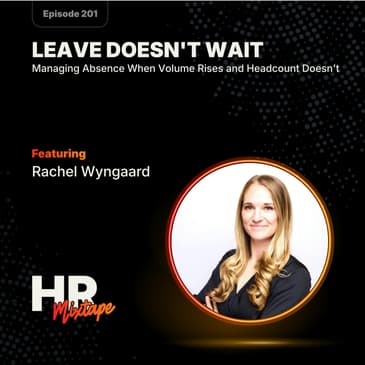
Rachel Wyngaard, Senior Product Manager at Mitratech, worked in HR, talent acquisition, and recruiting before moving into product. She now leads the build and launch of Mitratech Leave, an AI-powered leave of absence intelligence platform.
In this episode, she breaks down:
- Why leave requests keep climbing while HR headcount stays flat, and what that gap does to case quality
- How the tactical thing HR asks a vendor for differs from the root need sitting underneath it
- What changes when you design HR software for the worst day of the quarter instead of the ideal one
Timestamps
[00:00:16] Rachel's path from recruiting and talent acquisition into product leadership at Mitratech
[00:01:01] The three problems running at once inside every leave case, and why only one of them is paperwork
[00:01:41] The employee at the center of a leave case is living through surgery or a family emergency, not filing a request
[00:02:14] Leave volume climbed for more than half of employers last year and staffing never followed
[00:02:35] New and updated laws add qualifying reasons, stacking questions, and complexity to every single case
[00:03:40] The gap between what HR asks a product team to build and what HR needs it to solve
[00:04:11] What goes wrong when teams hand leave to an outside administrator, and why the liability stays home
[00:05:29] Rachel's product rule: design for the most stressful version of the interaction
[00:06:42] The one change small teams can make this quarter without buying anything
[00:07:00] Headcount thresholds, new states, and a remote workforce that moves all change your leave obligations
Guest Bio
Rachel Wyngaard is a Senior Product Manager at Mitratech with a focus on building HR technology to solve real workforce problems. With deep roots in HR and talent acquisition, she brings both practitioner perspective and product expertise to the Leave of Absence space, and is currently leading the build and launch of Mitratech Leave, an AI-powered leave of absence intelligence platform.
Brought to You by Paylocity
Paylocity is the fastest growing unified platform for HR, Finance, and IT. Paylocity brings your people, processes, and data together in one place so HR leaders can spend less time managing systems and more time doing the work that actually moves their organizations forward. Learn more at paylocity.com
Keywords: leave of absence, leave management, HR compliance, FMLA, state leave laws, absence management, leave administration, employee experience, HR technology, product management, talent acquisition, case management, compliance risk, small HR teams, remote workforce, multi-state employers, HR operations, AI in HR
Powered by the WRKdefined Podcast Network.
[00:00:01] You're listening to the HR Mixtape, a podcast for leaders who want to understand people, strengthen culture and navigate change with clarity. Today's conversation starts now. Joining me today is Rachel Wingard, Senior Product Manager at Mitratech. She spent years working in HR, talent acquisition and recruiting before moving into product and she now leads the early stage development of an AI powered intelligence platform.
[00:00:36] Rachel, thank you so much for jumping on the podcast with me. Happy to be here. Thanks Sherry. So you have worked on both sides of the equation as we talk about what's coming up. The HR seat and now the product side building for HR teams. So when it comes to things like leave of absence, what do people outside of HR completely underestimate in the process?
[00:01:00] That's a great question. Before experiencing it firsthand, most might assume it's pretty straightforward. I certainly did thinking you have a leave request, a policy, maybe a form. But in reality, there's three big things that are happening at once. One, policies are just not straightforward. There's a whole stack, federal, state, local, your company policies.
[00:01:23] It takes a lot of research to piece together what leave should look like, what it entails, and mistakes can create a compliance risk. Then two, it's not a check the box and done situation. Once you've got the research down, now you have to manage this living case with lots of paperwork, communications, requirements.
[00:01:40] It's messy. And then at the center of it all, you have the human, that employee. And the reason they need leave, which is often a major life event, surgery, family emergency, it's such a critical time to show up for your employee or risk damaging their trust and engagement. Yeah, that last point about leave being such a big part of the employee experience is definitely something that I think gets missed.
[00:02:06] You know, when you talk to HR teams now about managing leave, what are the pain points that you keep hearing over and over again? A few things keep coming up. One is leave volume without headcount. More than half of employers saw leave requests increase last year. That's a consistent trend since 2020, but they've not seen a corresponding growth in their staff or tools. And many teams are handling leave of absence manually.
[00:02:34] Then I hear a lot about compliance overload. So the major reason we're seeing an increase in leave request is new and updated laws. There's more qualifying reasons for leave. So volume is up, but also the complexity of each case rises because now you're looking at this overlapping landscape of federal, state and local laws that all keep changing.
[00:02:57] So figuring out how they work together. So figuring out how they work together. Do they stack? Are they concurrent? Employers want to make sure that they're covering their bases and it's really hard. And then lastly, I'd note that it's really challenging to coordinate all the things that come along with managing a case, the paperwork, the communications. It's a lot of admin on both the HR and employee side.
[00:03:18] So as you've talked with teams, you know, your unique role of sitting in product now, I think is really fascinating because I think that you have this ability to potentially see that gap between what the HR team is asking for and potentially what they actually truly need. Where do you pull those two things apart when it comes to, you know, figuring this out for us?
[00:03:39] Great question. So the ask that I usually hear from HR is often pretty tactical. Make this specific thing easier or calculate this for me. But the root need is always the same.
[00:03:55] It's get this compliance risk out of my hands and into a process that doesn't depend on one person remembering everything and doesn't hold room for variability, which is where compliance risk can creep in. The other piece that I hear a lot is I'm so frustrated. I just want someone else to do it for me.
[00:04:18] So they end up outsourcing, which can have mixed results. I've heard experiences of leave getting declined when it shouldn't. Then they're liable or getting involved to fix it. And others wish that it was something they were capable of managing because they want to give that human connection and be there for their employees.
[00:04:37] So as you think about this gap and some of the complexities that they have in your experience, in your career experience, you went from recruiting to product operations to building AI products. What do you think your time inside that HR function really taught you that still shapes how you think about building product now for HR practitioners?
[00:05:01] Most of my focus was on the talent acquisition side. And there you're working with people and their careers, their livelihoods. Oftentimes it's wrapped in your identity. So again, very human centric. And I think that's why I love building HR products. I'm always focused on the human experience involved. So the key thing that I bring to my product perspective is that humans are unpredictable.
[00:05:28] Things rarely happen in an ideal state. So when I build, I ask constantly, what is the most stressful version of this interaction? What happens when three urgent things hit all at once? Too often design can focus on an ideal state, but real HR just doesn't work that way. So I try to build for the hard day and not the easy one. That makes so much sense, especially because in HR we have a lot of hard days.
[00:05:58] And managing leave is difficult. We touch base just a little bit on that employee experience perspective. And it's so important to show up correctly for our employees, but it's also a toll emotionally on the HR practitioner, especially if it's, you know, a sensitive medical issue or some of those kinds of things. So having the right tools in place to help make the process run smooth is definitely an added value for the HR teams.
[00:06:23] You know, when you've talked to smaller teams, what's one change that they can make this quarter to really ease up their leave burden? And maybe even without buying something new, because I mean, while we love to talk about product and buy a new product, you know, what's a change that they can make that that really is going to have a big impact this quarter? Yeah, absolutely. So if you're not building case records now or if you don't have a consistent way for tracking, that's the best place to start.
[00:06:51] Document your process so it can evolve. You can find the areas that you want to scale as you grow. But also keep an eye out on how your organization's growth is going to impact your process. Are you reaching employee count thresholds where new laws start to kick in? Is your remote workforce moving around? Are you expanding into new states? That can change what you need to be thinking about when it comes to leave. Yeah, that makes a lot of sense.
[00:07:18] You know, as as our listeners kind of digest all of this and they want to learn more about the company you work for and the work that you do, how do they do that? Mitratech.com is a great starting point. Super easy to get in touch with someone who's excited to help you navigate HR compliance challenges. And if you're specifically interested in what we're building in the leave space, my favorite part of my job is talking to customers. So I would love to connect on LinkedIn, hear about your leave process, your leave experience.
[00:07:47] Feel free to reach out. I love it, Rachel. Well, definitely look forward to connecting online. And thank you so much for sitting down and chatting with me. Thanks, Sherry. Thanks for tuning in to the HR Mixtape. Like, share, review, and subscribe to support the show and help more people discover these conversations. Until next time, keep the conversation going.
Sponsors
