
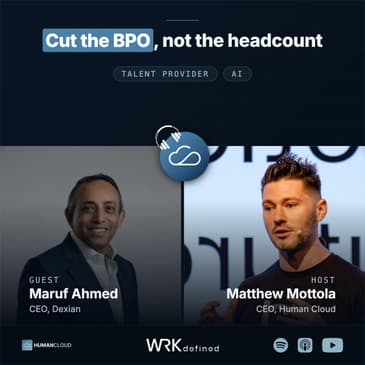
Most AI headcount conversations start in the wrong place. A leader sees a 20% workforce reduction and a 10% stock bump and calls it strategy. Maruf Ahmed has watched three technology waves roll through the talent market from inside a company that staffs half the Fortune 500, and he thinks that math is backwards.
The layer AI actually automates is not your team. It is the BPO contract sitting next to it, because low-level repetitive process work is exactly what outsourcing was sold on in the first place. Cut that, and what remains is judgment, relationships, and institutional knowledge. That work gets more valuable, not less.
Dexian has been in business since 1994. Maruf started it with his brother as a side hustle that produced $400 in revenue over its first two years. It is now 70 locations worldwide, 10,000 employees, and 2,000 clients.
We're building Human Cloud from the other side of that same shift, so companies can find and deploy the right flexible talent solutions in minutes instead of months.
In this episode, Maruf Ahmed shares:
- Why the BPO business is in trouble and staffing is not, since AI consumes the repetitive foundational work outsourcing was built on and leaves human judgment as the scarce input
- The ROI reframe most C-suites get wrong: stop counting "I saved someone an hour" and start counting top line. Let recruiters screen 10 candidates a day instead of cutting half the team
- What is happening to entry-level roles, where demand for junior developers and testers is falling, and why that is the exact tier where people used to learn systems, fail, and build judgment
- Why Salesforce refused to let Dexian's digital agent sit a certification exam, and what "it's for humans only" reveals about how unprepared our systems are for a digital workforce
- Where rates are actually moving: no wage depression on standard roles, real inflation on AI specialists and forward deployed engineers, and nearshore demand replacing bulk offshoring
Maruf Ahmed is CEO of Dexian, a talent and technology solutions provider he built with his brother from a side business into a global firm, and was named to SIA's 2026 Staffing 100 North America list.
Listen now on Apple Podcasts, Spotify, or wherever you get your podcasts.
About Human Cloud: We help companies find and deploy the right flexible talent solutions in minutes instead of months. We automate discovery, compliance, and orchestration across 1,000+ workforce platforms, so business teams move fast, procurement teams stay in control, and rogue contractor spend turns into a strategic advantage.
Powered by the WRKdefined Podcast Network.
[00:00:05] All right, Maruf, thank you so much for hopping on. So you listeners, I'll give you context, or if I told you this. So we get like a pitch a day on usually someone in the talent industry saying, hey, you should have so-and-so hop on. And to be honest, I usually never, maybe read the first sentence.
[00:00:23] um, you, we actually said, you know what, let's go have our team do a deep dive in terms of research on you individually and your company. And we're pumped. We're pumped to meet you, man. So we, you know, it's an honor to have you on. We can't wait to learn more. And I'll give you listeners some context. So a lot of time, you listeners, you're hearing from the talent platforms or the executives that are more on the entrepreneurial side.
[00:00:50] So you're hearing from what we would call, you know, this, this truly flexible workforce. It's cutting edge. It's only 10% of budgets. It's fringe. It's niche, whatever. And then on the inside, you're hearing from the internal leaders who are crazy enough to go forward with this world. Now, Maruf Ahmed Ahmed, you've been ahead of the talent world for what, 30 plus years. And this is why, what I can't wait to learn from you is you didn't have to go into this talent world.
[00:01:17] You actually started with an MS in electrical engineering from George Mason. So you, this is not a, you went into recruiting because it's all you had. This is a, you could have done whatever you wanted. Um, and you decided to get in this talent world. So first it's an honor to have you, but you want to do a little intro on yourself, the company, and then we'll get into why you were crazy enough to get into this world.
[00:01:39] Sure. Uh, thank you for having me on Matthew. I know it's an honor from my side as well. And I'm excited to have a good discussion with you, understanding what's going on in the flexible talent and technology solutions world. Um, so Dexian is a talent and technology solutions provider. We have been in business since 1994. So we just celebrated our 32 years on June 23rd. Yes. Uh, and you're right. I mean, I am, uh, engineer by design. My bachelor's and master's is in engineering.
[00:02:09] And we kind of bumped into the world of staffing and, and, and workforce solutions. Uh, when I was working at my first job, um, at that time, windows was the rage, just like AI is the rage right now. The machines were out there that could support this great, uh, laptop and technology platform.
[00:02:28] And there was a huge demand for people with technical background. And, uh, so it by almost by accident, the group that I was in, my manager asked for some referrals. We did a couple of referrals and then they asked for more referrals for technology people that we had in our friends and family network.
[00:02:44] And we thought, okay, that could, this could, uh, this could be a good, uh, opportunity to do a side business. So we provided a few people and that's how Dice started. Uh, we rebranded as Dexion a couple of years ago. Um, and we really did that for six years. Uh, you know, I was full-time working and also me and my brother who basically founded the company and doing this on the side, as a side hustle. The first two years revenue was $400. That's it. Two years, 400 bucks.
[00:03:11] Right. So, um, six years down the road and 2000, you know, with all the turmoil and everything, we said, okay, you know what? We want to jump into this. We had a, we had, we had about 30, 40 people billing for us and let's do this as a full-time. We have a good background. Engineering background is not bad to have. And same is the background that my brother had that should it not work out. We'll, we'll be able to earn a living. So let's do this full-time.
[00:03:35] Right. And so this journey started there. And, uh, here we are 25 years later since that 2000 decision, uh, fairly large company. Um, we are, uh, we have 70 worldwide locations. Um, our revenues are north of billion dollars. Uh, we have 10,000 employees, um, 2000 clients, um, half the fortune 500 and really gives us a bird's eye view of where the workforce is going with the talent is going, how the technology is.
[00:04:05] affecting them. And having a long-term relationship with some of these big clients gives us an ability to even consult with them and even get ourselves, you know, Dexion has changed over this 30 years, multiple times, you know, whether, whether it was the great recession, whether when the, when the procurement came in more in, in the business, when they are, when the vendor list came in, when I was doing it, there was no vendor list. If you got a, if you had a friend, you could put them in the, uh, put them to work. And now there are lists and things like that.
[00:04:35] But we adapted with it. So I am, uh, I'm really excited to have this discussion around the effect of AI. Now that that's having in the workforce design and the talent space. Um, and this is consequential. It is like the internet, which, uh, which we faced in early nineties, a lot of hype, a lot of data center, this and data center, that, but it is happening and it will happen.
[00:04:58] So, so how we, rather than resisting it, adopt it and move forward with it and have a digital workforce along with human workforce, which is the future is, is where we want to shift towards, but also because it's such a nascent technology talk about how we can get there. Yeah. I love the, uh, two years for a hundred bucks. I'm sure how, how happy were your parents when you told them that? Very, very happy. I mean, you know, this is the beginning of the American dream, right? That's right.
[00:05:28] Do a business. Yeah. I, uh, I can't even imagine. I mean, my parents wouldn't care. And I think, I mean, this is my fourth business. So the first three were total duds. Um, first two were total duds. Third was okay. Um, and this one's been whatever, 10 X better than the other ones.
[00:05:44] But, um, would love, would love to see. Yeah. What you're, that would be hilarious. Now I wonder, you know, a question I had for you that I'm sure a lot of entrepreneurs would, would ask. Um, and that is why in the world did you get into the talent space?
[00:06:03] So you could have, you could have been building semiconductors, right? You could have been, you've been building the coolest stuff in the world. And you said, I'm going to go into the talent world. Why? Why?
[00:06:18] So, so like I said, uh, Matthew, it was a bit accidental, right? And it was really, I mean, the first, my first talent space, uh, placement probably would have been my brother, who's the founder of Dices, because I was working at the client and I was working on the quality assurance project at that time.
[00:06:36] And I wanted to move to more engineering project and they're like, they wanted somebody that is just like me. And I said, well, my brother is graduating. He's just like me. Why don't you give him a shot and I'll help him train. So that was a sort of our first talent placement. Didn't make any money, but he was a placement.
[00:06:52] It was accidental because I think the environment was such where there was a lot of demand for software engineers, IT professionals, because like I said, the 80286 chip was out. Semiconductor was out. Windows 3 was out, which was the first mass platform where, where, you know, you could, uh, you could have Lotus 1 to 3 rather than that. You had Windows products out there. So it was accidental, but, you know, we thought that, okay, look, it's, it's a, it's a cool business where we are referring our friends.
[00:07:22] We're making some money from a job and we are making some money from a job and we are making some money from it as well. And it only accelerated because the internet boom started around 98, 99 and it continued from it. And that's when we decided, okay, you know what, let's do this full time. There is enough business out there. And there was, there was a huge demand for people. What our engineering background allowed us to do was to be more analytical about it, try to find solutions.
[00:07:49] And even from that point of view with our clients and, and say, okay, why do you need this workforce? What kind of talent do you need? Let me get to the right person. Um, and so here we are. I mean, so it was an accidental entrepreneurship, uh, but it was, uh, you know, but it worked out pretty well.
[00:08:04] I, I wonder when you look at, so this is usually fun. Usually we have to wait like 30 minutes to get into this discussion. But when we talk about, we talk about AI, right? Obviously it's taken over everything. Um, a year ago I would have said, eh, you know, and mind you in 2016, it was deep learning, neural networks, machine learning. Right. And I, I, I literally had these massive rigs next to me trying to make AI real. And it just, it wasn't right. It was like, it's not working.
[00:08:35] So when it, when, when, when chat, CPT first came out, I was like, okay, that's whatever, you know, it's something now. I, I, I mean, we are, we are only the company we are because of AI today. And we're seeing the things we're seeing. It's just out of control, different, innovative, disruptive, whatever words we want to use. But what would you say, Maruf Ahmed? How do you, how do you describe it to your friends, your customers, yourself? What do you think the state of AI is right now?
[00:09:05] It is an assistant that can help you do high level work that can help you be better on things that you are passionate about and, and take care of some of the mundane day-to-day foundational stuff. I think that every one of us probably will have an, our AI agent avatar there somewhere that's going to be both professionally and personally help do things.
[00:09:29] You know, I've, you know, so in chat, GPT, when I go there, I was working on some landscape design and it knew the previous questions that I had asked. And it was actually telling me based on where I live in the climate, helping me do that. Right. In the previous time, I probably would have had to figure that out, spend some time, Google this and Google that and put things together. AI did that for me. And so I could, you know, move on with the project much faster.
[00:09:52] So I think it is going to be a case where it's, it's just every one of us will have a assistant AI digital agent that's going to help us be better. Yep. I couldn't agree more on that. Now getting into the inner. So you're in your customers, they're all made and above, right?
[00:10:11] Okay. So when getting into the, the enterprise environments, this is where I think that there's never been a more stark difference where as a startup, you can get away with so much and you can use AI in a way that is incredible, like cloud code or codex, whatever it is. Incredible. As an enterprise, you probably can't and you shouldn't because the stuff that I get away with, they never could.
[00:10:40] It could, it could sink their business. But when you look at with your customers, how, how are they embracing it? What are they talking about? What are they investing in? What's working? What's not working? What are you seeing? So we are seeing a lot of push from the C-suite to adopt AI. Telling the, even, even in a large enterprise clients, because everybody is like, we gotta, we gotta have an AI component. I think the market also rewards you when you do that.
[00:11:07] So we are seeing a lot of push from there that get AI into the business, make it work, right? Where we are running into issues, as you, as you pointed out, because of the risk and stuff like that. Legal, from the legal, we are seeing issues like, okay, how does IP work? How does learning work when your boss, your digital agent is learning from my data, but now you could use it somewhere else. And, you know, how does that work?
[00:11:35] We are seeing pressure from middle managers that are looking at, okay, what does it mean for my workforce? And no, I don't want to reduce my workforce by 30% just because digital agent can do it. And they are, they are not embracing at this point, but they will eventually, that even the digital agent is part of your workforce. So, so we are, we are having that, that issue.
[00:11:58] We are having issue from the IT that's saying, okay, what does it mean in our environment when you have this, this agent that can read this and did that? What's, what it, it's not a human. So what is, what is its liability there? You know, I mean, we have, we went through, we went for our digital agent that we had created because we did see the AI wave coming. So a couple of years ago, we bought a couple of small AI company just to get their talent to have a AI solution. So we have a couple of digital agents.
[00:12:27] We wanted the digital agent to take a certification exam. And so like Salesforce certified digital agent. And we got pushback from Salesforce saying that you can't do that because it's for humans only. What's a, what's a Salesforce certified digital agent, right? And so we, so we are seeing those kinds of lockers there, but it is probably valid, as you said, because, because there are risks out there for bigger companies and they have to be careful.
[00:12:57] But the ROI is also so huge for certain places that the C-suite cannot really walk away from that either. I mean, we are seeing work that used to take two, three days being done in two, three minutes, literally that, literally two, three minutes. Right. So, so, so what we are seeing is the initial set and you have the same sort of, you have some early adopters that want to push the envelope a little bit and, and, and let us do more.
[00:13:25] You are seeing some that are cautiously asking for advice, asking to say, okay, where else have you done it? So that they have, from that failure, they will learn. And then there are some that are, that are just waiting it out right now, even though they are saying they want to do AI. And the other bigger challenge that I have seen, Matthew, is to be able to define the ROI of the AI in the true top line and bottom line fashion. True top line and bottom line. Not, not, not, not, I saved Matthew one hour.
[00:13:53] Just because I said Matthew one hour, that doesn't mean that he was more productive for my company by one hour and, and drop, drop some EBITDA or, or sold more. Right. How do you do that has been a big challenge that we are seeing from the clients that are saying that I see that you can do this and it's so cool. You saved me all this time, but how is it actually making a difference in my business? I hope I answered your question there. No, it, it, it's interesting.
[00:14:19] Like it, part of me is, part of me thinks that there's never been a better time. Um, a year ago, if you were someone that had fully embraced AI and let's say you were a software dev, it has probably never been a better time to be an employee. Meaning you could probably work only an hour a week and get everything done and your boss would never know. Right. Like, and I, and I think that's true.
[00:14:43] And you, and, and then now, but I think that's recalibrated where now just because you shipped 10,000 lines of code does not mean that you've done a good thing. If anything, it could be worse. So, uh, it, it, it bucks all of the traditional ways to measure ROI productivity, you name it. And it's an every factor. Like if you're a CMO right now, I wouldn't, I would argue you probably should get rid of 60 to 80% of your company.
[00:15:11] And then the ones who are left should be using agents and other forms of, of talent to get things across the line. Right. Like there's never been a more different way to work that has, that is delivering good results. Um, what I would add to your point about the, you know, two days to two minutes. Right. That's assuming that it's not on a loop. And so that's assuming that you're going in and manually prompting.
[00:15:36] Like once you understand software and automation at its core, you realize, holy crap, if you create the loop, then it's not two minutes. It's actually, I don't even know what you would call it. It's, it's a loop, right? It's a loop that without you telling it. So, so there's added, I mean, it's just the, the ways we measure value, everything's getting disrupted. Yes.
[00:15:57] Right now on the actual individual side, what have you seen in terms of is entry level development? Is that reducing going away? Is certain types, like if you're a front end design, like if you're a front end software developer, I would assume you're kind of screwed. I can't imagine you're going to outcompete cloud code.
[00:16:23] But what are you seeing in terms of the individual roles and, and, and types? We are definitely seeing slowdown in those roles from the demand that comes to our place in, in terms of individual developers or individual testers, coders and stuff like that. Exactly. We are seeing, we are seeing, we are seeing slowdown in that.
[00:16:44] And it's a, it's a, it's a problem for the organization though, because those were some of the foundational work people did to learn the systems. Those are the foundational people work, some of the people did to fail and get judgment and knowledge. When you actually don't have that anymore and you kind of jump to the second tier of, you know, a developed product that you are, that, that you are refining.
[00:17:13] That skill set being lost could be a problem. That's how I look at it. But we are definitely seeing less of those roles, right? Now I would again date myself. When I was coding as an engineer, I had to worry, worry about memory management. I had to worry about pointers. I had to worry about those kinds of things. And then visual C plus plus visual basic ghost tool came and you could just draw the boxes and the code would be generated behind it. That would clean up all those memory.
[00:17:38] I mean, we used to have memory leak that would crash the machine that had nothing to do with the product. Right. But then we moved up and we started using those tools and build on that. Right. Now you might say that this generation doesn't know what a memory management means. And does it matter? I don't know. I mean, you know, after my generation, they did not do a memory management. They didn't have to worry about cleaning up stack space and things like that.
[00:18:03] But anecdotally, I feel that it takes away from some basic foundational learning, which is important for some people's development. I mean, you know, there is a reason why people say you need 10 years experience here or five years experience there. It's the experience that comes with learning, failing, doing those things that make you better. And I feel that that is starting to get missed because we don't need those entry-level testers. So you do the testing, you learn.
[00:18:33] I mean, I started my career as a testing product quality assurance. So that's what I'm seeing, Matt. I do not know what the downstream repercussion of that is, of not having those foundational skills. But definitely, there is an effect there. And let me ask you a funny question.
[00:18:52] So, like, let's assume that I know that I'm going to get a 10%, you know, increase in my stock price if I reduce my workforce by 20%. And I know that you're going to be screaming at me, don't do it, don't do it, don't do it. But I don't really care, right? Like, I'm kind of like, I think I'll take the stock price over you screaming at me. What are the implications of that?
[00:19:20] Like, obviously, there's a cyber risk. Is development not going to get done? One is, like, what can I be expecting in 6 to 12 months if I'm just laying off without actually having the right structure and plan? I mean, it's like any strategic planning. If you are short-term oriented, you usually end up paying it long-term. That's how I look at it.
[00:19:43] I mean, so if you're just doing for the stock price and not doing because your work design requires it to be that way, then you are actually not going to be in a good place a year down the road. And your stock price might take a hit there. Now, if you have looked at your processes and decided to actually look at it and figure out where humans fit in, where digital agents fit in, where automation fits in,
[00:20:08] and you do it, that design, and that data results you into cutting it 20% or reducing the cost 20%, then you're probably okay. Then your stock price is going to be fine and you're going to be fine. But I also look at this from an AI rage point of view that people always talk about the efficiency on the AI many times on reducing costs, getting rid of those 20 people, that you are 20%.
[00:20:34] I think the benefit is actually the other way, where you can actually increase your top line by 20%. That those people that are there, rather than cutting them, give them something higher level to do, that they can produce that top line results. I mean, I have recruiters. Today, they can screen five candidates a day, let's say, right? Rather than saying, okay, I come in and now I can do it with half the recruiters because the AI will screen the candidates for me.
[00:21:00] I'm looking at, let's the recruiters do 10 candidates a day now and not lose anybody and drive my top line business. Because most of our clients, unless they're a monopoly, they have competition. And getting efficient in driving the business, I think, is the better value of AI than looking at it as somebody that you reduce your headcount. That's my personal opinion on, and that would, again, if I double my business, guess what?
[00:21:30] My stock price will double, probably. Yeah. And let me ask you very tactically. So rates, then regions, what are you seeing? Are rates going down, going up? And then what regions are you seeing actually be more... Are you seeing for my technical talent that we are placing? Yeah. Yeah. Yeah. I have not seen the rates go down, actually. I mean, I think there is still competition.
[00:21:55] I am seeing AI specialists, AI engineers having far higher rates and far higher demand. Again, we have been in the business long enough to know that when SAP and ERP system can... We used to have SAP developers asking for 400 bucks an hour, 500 bucks an hour. It was not unusual at that time. Now it has come down to closer to that 100 bucks, which is steady state. So we are seeing rate inflation on AI savvy, AI specialists, forward deployed engineers, whatever
[00:22:24] you call those, those roles are having. But the standard roles that we place, whether it's a developer or not, we are not seeing the rates come down. What I am seeing is less of a demand for more of the junior level positions because people are starting to figure out whether they need those people or not or how many of them they need. But they are not... You know, I'm not seeing a wage depression.
[00:22:50] And let me ask you, Marv, related to that, when you've seen these other waves, right? So let's even go back to like Windows to mobile, like Windows, Internet to mobile. Was there... Was it the same thing? Was junior developers then what was getting hit the hardest? Or how is it... How is this transition different? No, because they did not have in those...
[00:23:16] There were new technologies out there where people who are specialists was in higher demand and they were commanding a better rate and they had the ability to pick and choose. But the foundational level work still had to be done and somebody had to do it. In this particular case, the difference is that the AI is starting to do some of this foundational work, right? So that's the reason. We are not seeing... We are seeing that difference there. Which... Okay. So then... So secondary question. Well, let me... Let's go into regions.
[00:23:47] So are you seeing that now there's more US hiring of US talent? Are you seeing that there's a shift more from, say, LATAM or Africa or Asia? What are you seeing from a regional perspective? From... So from our perspective, because we are global and we are more than just one dimensional providing resources in the US, we are consulting with our clients when they're looking for the work to be done saying, okay, how should the work be designed?
[00:24:17] And what we saw last year, last two years, there was a lot of demand for nearshore work, a lot of demand for let's go to Mexico, let's go to Brazil, which is similar time zone, but cheaper in cost, but easier to travel to. So we are seeing a lot of that. We saw last year, last couple years as people, as the companies were under the cost pressure, but they still wanted to work in the same time zone. We haven't...
[00:24:45] We didn't see the similar growth that we saw, call it about 10 years ago, where there was a lot of offshoring, which is like going to India kind of thing, where the time zone is different and all that, but you just bulk send the work. We didn't see... We haven't seen that. But so we are helping our clients to say, okay, look, Dexion can do multiple stuff for you. You tell us what you need, and then we can help you design how the work gets done.
[00:25:10] And we are seeing more of a hybrid that people still prefer US talent, but they like to augment it with a nearshore talent, mostly in the last couple of years, it looks like. Let me ask you a question. So I, you know, what's funny is I'm kind of leading the, what did they say? Like I'm kind of leading the witness in this question. Okay. So be very skeptical when I ask it, but then I'm also, I'm also asking someone who you're probably very biased in what I'm, what I'm going to ask you.
[00:25:39] So one of the things that I, when I look at, and this is, when I look at it, it's actually like capability, skillset agnostic. So I think this is true in every skillset, whether it's finance, accounting, marketing, you know, development, you name it. But so one of the things that I think AI is doing is it's no doubt reducing the number of people you need for the same level of productivity. No doubt. It's also increasing the scope of what each individual can do.
[00:26:06] And so when I look, I think a team of a hundred probably could be trimmed down to 10 full-time people, but they are doing probably five more things and they're earning more of the judgment. Right. So I think that's true. Then I look at, okay, what's the implication of that? Well, I think one of the implications of that is, well, if you don't staff up a team of a hundred, you are more, uh, you, you need more of an ownership and a loyalty and a closeness
[00:26:34] and something that I think the BPO and outsourcing world, to me, I just look at, I'm like, Ooh, that doesn't really make any sense anymore. Right. So like if now I only have 10 people on my team, or let's say I have, you know, 10 full time and 50 contractors rather than a hundred total. It doesn't really make sense to me to go, okay, I'm going to go pay this BPO who they don't really deeply understand me. We're not building up institutional knowledge.
[00:27:00] It just, to me, second level implication is you want people that are actually in the tent versus out of the tent. Even if in the tent is, you know, contractors or external, but still on your team. I, I know I just led the witness, but for you to me, that, and to me, that also means staffing should be more in the driver's seat because you're placing the individuals and you're taking accountability for that individual placement versus more of a BPO service. But what do you think in this logic pack?
[00:27:29] Do you think this is, is more, we need more staffing, less BPO? Oh, like who do you, who do you think is winning and losing? And I, I know I kind of just led the witness and saying my bias. Yes, look, but I am biased the same way because I'm in the staffing and I will tell you. Yeah, exactly. What I am saying, by the way, is that the BPO business is in trouble.
[00:27:52] BPO business is, is getting automated far more with the AI agents and BPO business, the value prop that was out there, which is again, some of those foundational low level repetitive tasks. Exactly. AI is taking that, right? And, and to your point, therefore the workforce that you have is becomes even more important. The human judgment, the human relationship, the people that are understanding that your vision, the projects that our clients need becomes more important.
[00:28:22] So staffing does become even more important for, for our, our clients and having partners like Dexion becomes more important for them because you are providing with them, them with the human talent that they're expecting them to do more. The mundane work, the work that it could be automated, which by the way you were right. I mean, whether it was machine learning or scripting and all that did not really happen in the 2015, 2016, but AI seems to be a lot, lot more proficient right now.
[00:28:51] So I think it's going to happen this time. I think the BPO business definitely is going to get affected by that and you're going to have a lot less of it, which I, which is why I think a lot of, when we are looking at the India business, there's a lot of angst there because a lot of the businesses were running out of those Indian outsourcers that were running BPO. Staffing becomes even more important because even in the best of times, you don't want your employee base to be a hundred percent just employee.
[00:29:21] You want to, you want to have your workforce flexibility because you don't have a hundred percent of the work all the time. So, so to have a hundred employees when you really need a hundred sometimes, but you know, most of the times you can do with 90 and then projects come in, you need 10 more. That's where you need somebody like us that comes and gives you those 10 more, understands you, has relationship with you, understands the talent pool. So I think the staffing will be fine. Staffing business will be fine.
[00:29:47] It is actually needed, uh, it needed a lot more as you are trying to build that right workforce structure. Yeah, no, I, I totally agree. Listen, I think, uh, and intentionally I want listeners to, to reach out to you. So, um, sort of the last, the last question I got in my end work is like you, let's say you are, you're your customer, right? You're a CTO, CIO, or you're one to three levels below.
[00:30:17] And listen, you've built, you've built your career on a bunch of principles that are probably gone now, right? So you're 15 plus years in. And as we all know, it really sucks when 80% of what you're used to no longer makes sense. And it's up to you to, to change. Right. And I think every leader, we all are having to change. Um, me as an entrepreneur, I'm like, oh my God, I feel like life has changed in a year in a way that I could have never accounted for.
[00:30:45] But what, what advice do you have to your customers, to our listeners to really navigate this? Should they go in blind and disrupt everything? Should they go with a partner like you? Should they join, you know, should they go do the Stanford AI course to master AI? What, um, what's the, the one to three things you want them to do right now? The difference is you should get a partner like us. No, of course.
[00:31:14] But, but honestly, look, I mean, like I said, that AI is real. It is like the internet and you had probably 50% of the 60% of the companies that were in that era gone, but you still have your Google and your Ebays and your Amazons of the world. So I would say that our customers should definitely figure out how AI would affect them and, and, and embark on the journey.
[00:31:38] Now they can do it with partners like us or they can get a small team that gets more AI proficient, but not knowing AI, uh, is like not using computers in the nineties. You know, when it came out there, whether you are in IT field, whether you are a developer or whether you are a accountant that's doing spreadsheets, if you still wanted to be in your black notebook, it did not work. Right. So you have to, you have to embrace it. So I would, I would say embrace it. Don't be afraid of it.
[00:32:08] We have gone through many of these technological changes, uh, uh, and over the 19th and 20th century, whether it's industrial revolution, whether it's a computer revolution, now it's AI revolution and people who have been not scared, but prudently, um, you know, put that those practices in their business were more successful 10, 15 years down the road. So, so we want to be consultative with our partners or customers. That's what we are trying to do.
[00:32:36] And, and I could see, like I told you that the conversation on the AI is happening at a far higher level than the conversation around the staffing. Staffing used to happen at a director manager level, AI conversation at a C-suite level. Um, but nothing to be scared of, but something to be done with proper risk mitigation, governance and, and, and, and, uh, framework. Those are important, right? Okay. What, what are the legal implications? What are the AI implications? What are the ethical implications?
[00:33:06] Those things are, those things are important. Certainly you can take a Stanford course. I, I took one of those courses myself. Uh, I think it talks about the basics, but just like everything you only learn when you are, when you are in it and when you kind of fail in it and, uh, and, and learn from that failure. Yeah. Yeah. When you say just go gung ho on the AI a hundred percent, I probably would not do that because I love failure to learn from, but you don't want a failure that is fatal and ruins your business. Right.
[00:33:34] Uh, so, but I would, I would take this very seriously and I would not sit in the sidelines either. I don't think, I think in the two years ago, maybe there were some companies on the sidelines. If you are in the sidelines, regardless of the industry, you are probably falling behind. Yeah. I love the, uh, 50% of companies didn't survive right. The past. And I think in this case, man, it might be 60 to 80%. Yeah. Or they might become the best company they ever, they ever could. Right.
[00:34:02] So we're, well, listen, thank you for hopping on in the show notes. Um, you'll, you'll get, you know, Marou's LinkedIn and website and you name it. First to many, my friend, thank you for hopping on. Thank you. Thank you for having me. You take care.
Sponsors
