
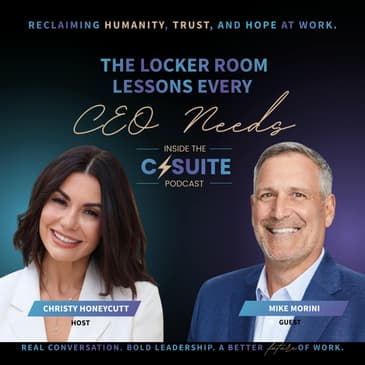
Some of the most important lessons we carry into the C-suite aren’t learned in a boardroom, they’re learned in the moments when the plan falls apart. Mike Morini knows something about that. Before becoming CEO of PlanSource and building a 30-year career in software, Mike pursued a very different dream: professional football. He made it to the Buffalo Bills. Then he got cut. He spent a year on the New Jersey Generals practice squad before eventually finding himself on an entirely different field—at IBM.
What could have simply been a story about failure became the foundation for how Mike thinks about leadership, teams, culture and accountability today. And that’s what made this conversation so meaningful to me, because leadership rarely follows the path we imagined. Sometimes the role you wanted isn’t the role the team needs you to play. Sometimes the setback becomes a lesson. And sometimes the greatest leadership growth happens when we’re willing to put our ego aside, listen, adjust and ask:
What does this team need from me now?
In this episode of Inside the C-Suite, Mike and I talk about what it actually takes to build an elite team—not just a group of talented individuals.
For Mike, it starts with three C’s:
Culture. Customers. Community.
But there was another concept that really stayed with me:
Your “say-do ratio.”
Do you do what you said you were going to do? It sounds simple. At the executive level, it’s everything. Trust is built when leaders consistently close the gap between their commitments and their actions. When they listen to customers—and respond. When they give people clarity—and the authority to act on it. When they hold themselves to the same standards they expect from everyone else. And when something isn’t working, they have enough humility to change the play.
Mike talks about becoming the CEO of your role—taking ownership of your contribution regardless of where your name sits on the org chart. I love that, because leadership has never been reserved for the person with the biggest title. It’s about understanding your role, owning your impact and making the people around you better.
Maybe that’s the ultimate locker room lesson:
Talent might get you on the field.
Performance might keep you there.
But character determines the kind of leader people want beside them when the game is on the line.
Mike, thank you for such a thoughtful conversation—and for reminding us that sometimes the moments that don't go according to plan become the experiences that shape us most.
If you lead a company, a team—or simply want to lead yourself better—this conversation is worth your time.
What you'll learn:
How failure can reshape leadership
Why culture should come before performance
The three C's: culture, customers, and community
How to identify true team players
Why accountability begins with leaders
The importance of a strong "say-do ratio"
How clarity helps leaders perform under pressure
Why authority must come with responsibility
What it means to be the CEO of your role
How AI and remote work are changing leadership
Why emotional intelligence still matters
How community can become part of leadership
| Connect With Us |
Follow Mike Morini:
LinkedIn – https://www.linkedin.com/in/mikemorini/
Company – https://www.linkedin.com/company/plansource/
Website – Benefits Administration Software for HR Teams
(Mike Morini is the CEO of PlanSource and a 30-year software veteran with extensive experience growing and scaling enterprise software companies. His leadership philosophy centers on building high-performing teams, putting customers first, and creating cultures where people have the clarity and accountability to perform. At PlanSource, he focuses on transforming the business through customer insight, strong teams, and disciplined execution.)
Follow Inside the C-Suite:
Subscribe on Spotify: Inside the C-Suite
Subscribe on Apple Podcasts: Inside the C-Suite
Follow Christy Honeycutt:
Website: https://www.christyhoneycutt.com
LinkedIn: https://www.linkedin.com/in/christyhoneycutt/
Instagram: Christy Honeycutt (@christyhoneycutt) • Instagram profile
Facebook: https://www.facebook.com/christyhoneycutt
TikTok: Christy Honeycutt on TikTok
Book: The Inner Work of Leading in a Broken System
Want to be on the show or know someone who would be a great guest?
Podcast Nomination Form: Inside the C-Suite | Christy Honeycutt
Powered by the WRKdefined Podcast Network.
[00:00:00] So Mike, I know you follow the philosophy of the three C's. I'd love for you to share with us what those three C's are and what they mean to you. Yeah, I think first is culture, right? You have to build the right environment if you're going to succeed in whatever you're doing. Technology, coaching a little league team, whatever it is, it doesn't matter. It's foundational, it's culture, theme approach, all that kind of stuff.
[00:00:20] The second for us is customers. And that's one of the first things we did at Planned Source. We changed the mindset here to a customer-first environment. Hey, look, if we're going to be the partner of choice, we've got to make sure our customers and our partners are happy. So put the customer first at all costs. That's how we've done it. And then the last piece that has been really important to me through charity and through other things is building a community. As a company, you're in an environment and you want to be a positive contributor to the community.
[00:00:44] So that's kind of been the foundational elements when we come in and transform just to give people a grounding of, hey, what are we all about? The three C's, right? Culture, customers, and community. And we're ready to rock and roll. Hi, I'm Christy Honeycutt, your host of Inside the C-Suite, where execs get real about leadership, impact, and what truly drives high stake decisions.
[00:01:14] Today, we're talking about the locker room lessons every CEO needs. I'm honored to have Mike Marini, CEO of Planned Source and a leader who spent more than 30 years building high-performing organizations. But before the boardroom, there was the locker room. Mike was a standout college quarterback who earned a shot at the NFL with the Buffalo Bills.
[00:01:34] An experience that taught him early that talent may get you on the field, but it's accountability, execution, and how you perform under pressure that determines what happens next. Those lessons have followed Mike throughout his career and shaped how he thinks about what he calls the three C's. Culture, customers, and community.
[00:01:54] Because high performance isn't just about hitting the numbers. It's about creating a culture with clear standards, staying relentlessly connected to the customers you serve, and building a community people want to be a part of. This is one of my favorites. Let's jump in, shall we? Mike, I am so excited to have you on Inside the C-Suite. Thank you for saying yes. And I know that my introduction did not do you justice. I would love it if you'd introduce yourself to the audience and tell us a little bit about what you do. Great. No, happy to be here.
[00:02:22] Yeah, really simply as I'm a tech CEO, I'm currently the CEO of Planned Source. And really what I do is I build elite teams to help transform companies. What I do. Part of an extension to a sports background when I was younger, but the model works and it's fun and I'm in a great situation right now with a great team.
[00:02:39] And very humble too, because I know you're like a 30-year software veteran. So look, I know there's a couple of things. I'd really like to start because I read your, for those of you that watch and follow the show, I do a brief intake, which just helps me understand what's important to you. And something that really stood out to me is that you had to start with the Buffalo Bills. You worked your entire life to get there. We all know that that is not easy. And then suddenly you're cut. What did that moment teach you about yourself? He said, I had a little bit of anger that I didn't know was in there, but it happens.
[00:03:09] It's a humbling experience, right? Because you're on a pinnacle, you're rising, you're told you're good. You get a chance to sign a free agent contract and you come to the reality that you're just not good enough, right? So after I got cut by the Bills, I went home and trained because I was going to go into the other league, the USFL with the New Jersey Generals. So I went home and I was the head JD coach at my high school and I was a line coach for the varsity. It was really fun. I trained with the kids. They were excited because here's the guy moving on.
[00:03:34] And then I went to the Generals and spent a year there on the practice squad and I never played a regular season down in either league. And so you learn very quickly, what am I going to do next? Right? My dad swung a hammer. I was one of five kids. We were probably lower middle class family. Great family. Loved my life. I had children when I was young. I had my first child at 22. So I had to go figure this thing out. So I had to figure out how do I take what I learned as a teammate and an athlete with focus and drive and how do I transform that into something where I could build a good life for my family?
[00:04:04] And luckily for me, I went to Colgate University. We had a great alumni network. There was a gentleman named Gordon Watson who helped recruit me. It was a fan, local guy. He got me an opportunity to interview at IBM and that changed the world for me. So I was lucky to have people that paid it forward for me. And you started at IBM as an account executive. Am I accurate in that? You are. Sales guy. Loved it. Amazing, amazing training.
[00:04:27] Back then, they don't do it today, but it was a full year of sales and marketing training in the field for a month, in the Atlanta education facility, in the field for a month, in the Dallas education facility. And it's investment. We talked about this before. They must have spent a half a million dollars on us as young AEs being trained. But what a foundation for me. I mean, it gives me the integrity, the public praise, private reprimand. Be buttoned up. Do your homework. All the things that you would expect from the white shirt, dark suit IBM guys in those days with the striped ties.
[00:04:56] And it was a great way to learn. Loved it. A former IBM colleague of yours as well. I'm not sure if you know, but I can say that they had so much education back in the day. Like we were not wanting for education. I think there was like a minimum hours of requirement that you had to take per annum. So good job, IBM. You got Mike Marino where he is today. Yeah, you got it. So looking back at that young man in the locker room, at both of the organizations that you talked about, the Buffalo Bills.
[00:05:25] And what was the other one? It was the local league in Jersey? Yeah, New Jersey Generals and the USFL. What would you tell that young man today? Good question. Keep working at it. Be harder. Learn from your losses and don't stop. Just move ahead. Don't stop. Yeah, I think, again, I go back to my dad. He referenced a lot. He always said, when you get in the situation, keep your eyes and your ears open and your mouth shut till you learn enough and then be decisive.
[00:05:50] But also be humble enough to know if you get more information later, you have to change your decision. And I think that's kind of just been the foundation of my leadership skills. It's always been a team first. Build a world-class elite team. Work together as a team. Play the role the team needs you to play, not necessarily the role you may want to play, right? But if you're a team, it shouldn't matter. You want to be on the winning squad. And that's how I tried to build the teams for a year.
[00:06:15] And I think if I told the guy one thing in that locker room back then, it's stay focused, stay driving, and stay humble along the way. Based on how you came up, because you have very strong leadership traits, based on how you come up. So I face this a lot in coaching. A lot of leaders find that when they have failure, that it's a setback instead of a setup for something greater or kind of putting them in their purpose. Do you see that as well? How do you see those two? Yeah, I think if you don't fail, you didn't put yourself out there. Nobody's going to bat a thousand. You got to push it.
[00:06:44] If you want to get aggressive and push the envelope, you're going to fail. And as long as you take a moment to reflect and learn from those losses, that's the only way to do it, man. And I think, you know the cliche, you learn more from your losses than you do from your wins. But for us, it's being able to be self-aware enough to go back and say, what didn't I do right? Or what didn't I read right to make this thing happen? And be okay with that. You're not going to win them all, right? But if you don't compete, then you don't know. So you got to compete.
[00:07:13] And if you're going to lose along the way, just learn from it. That's how I would approach it, man. I love that. So Mike, I know you follow the philosophy of the three Cs. I'd love for you to share with us what those three Cs are and what they mean to you. Yeah, I think first is culture, right? You have to build the right environment if you're going to succeed in whatever you're doing. Technology, coaching a little league team, whatever it is, it doesn't matter. It's foundational, it's culture, theme approach, all that kind of stuff. The second for us is customers. And that's one of the first things we did at Planned Source.
[00:07:43] We changed the mindset here to a customer-first environment. Hey, look, if we're going to be the partner of choice, we got to make sure our customers and our partners are happy. So put the customer first at all costs. That's how we've done it. And then the last piece that has been really important to me through charity and through other things is building a community. As a company, you're in an environment, and you want to be a positive contributor to the community. So that's kind of been the foundational elements when we come in and transform, just to give people a grounding of, hey, what are we all about? The three Cs, right? Culture, customers, and community.
[00:08:12] And we're ready to rock and roll. So if you take those three Cs, and you talked about building world-class competitive teams, how do they fall into those three Cs? How do you make sure that you're selecting, you're drafting those best players for the team? Boy, isn't that a great question? So by the time an interview, except for my direct reports, by the time an interview comes to me, the leaders have decided whether they have the talent, right? And in today's world, talent is table stakes, right? Talent will get you there. Talent will get you seen.
[00:08:39] But how long you stay seen is depending on who you are and your drive and your commitment to excellence. So for me, I'm looking at culture by the time I interview most people. Will they fit in the team environment? Will they play the role we need? Not necessarily the role they want, the things we've talked about. And I do it with a question, which for me, I've been asking for 30-something years. And it simply goes down to, do you love winning more than you hate losing? Or do you hate losing more than you love winning? And it's subtle. The therapists and the analysts will tell you
[00:09:09] there's no right or wrong answer. But for me, there is a right or wrong answer for my environment and the culture I'm trying to build. And I did it as an athlete. And you do it as a business person. If you prepare to win, if you think about it, if you do your homework in the business world, know your customers' drives and desires, practice your presentation, coordinate your team approach. If you prepare to win and you don't, you should really be mad, right? You should hate losing, right? And so I may hate losing. I celebrate the wins, don't get me wrong.
[00:09:36] But what I'm looking for by the time I meet with people and my leadership team is, do they have that drive? Are they willing to put the work in? There's no shortcuts. Are they willing to take whatever role is necessary to be on that bus with the winning team? Winning as a team is more important than winning as an individual out on an island somewhere in my eyes. And I do use the sports analogies, which some people roll their eyes because I'm a sports guy. I love it, right? It's competitive. It's great. But think about football as a great example. You have 11 men on the field.
[00:10:05] 10 out of 11 execute flawlessly and one doesn't. So you've got a 91% hit rate, 91% performance. But that one 9% person doesn't execute all 11 fail. There's no better example than that in the world on where you have to be cohesive as a team. And that's the kind of culture I bring to the company. I don't care what role you play. I hope you don't. And we did it at Plansource, right? Because we changed a lot of the leadership out. And in the beginning, we had people doing things that we needed them to do. And my take for them is, guys, don't panic.
[00:10:35] When we get the final leadership team together, we'll sit at the table and we'll figure out who should be doing what. But just do what we need you to do today to help the team move forward. And it's had a tremendous impact on this business. The focus on the customer and the focus on teamwork, we tore down silos. And so that's been the approach. Which it's just really, do they have the right cultural statement? I know they're going to have the IQ if they got to the table. Do they have the EQ to be able to do how we want to go about doing it? Which is build that community, be a team and then go get it. And it's worked for me.
[00:11:04] It sounds a little bit like motherhood and apple pie. But really, when you treat people with respect and you empower them and you build a team to go, it's had, people have delivered for me for years. I'm really proud of the approach we've taken. There's very few CEOs that actually get what you're talking about. And I say that with a lot of knowledge. I've been there, I've seen it. But when you do get that right, when you do get there, we're all rowing in the same direction. If one fails, we all fail. It's more of a, it feels like management back from like prior to 2008,
[00:11:33] which I haven't seen in a long time. We, our culture has moved to more of a me versus we and I versus team. And it is interesting to see where it's moved. So what are some green flags that an individual is showing? I'm in it for the team. I'm in the right culture fit for plan source because I know there's organizations that'd like to copy what you're doing. For us, it's interesting. As a Vista portfolio company, I love this. They're great owners. They educate. They do a lot of things that many PE firms don't do.
[00:12:01] They have a stringent playbook. I may not be the ideal guy to stay play by play, but we're having great results. So they like me right now, which is really good. But as a Vista company, the best example here is you have to operate inside the framework of a financial standard, right? For us, it's a three-legged stool. Customer comes first. If you do the customer right, then the employee gets a better platform and a bigger opportunity for them to grow. And then as a PE on company, we have to provide some type of return, right? So what I saw with the team we assembled here
[00:12:30] is we had to transform this business. Go to market changes, roadmap changes, get us more modern, get back in touch. But we had to do it in the framework of providing a financial return to our owner. And when you do that and you're in that tight structure, even though you want to invest more, you have to see who's willing to horse trade inside the framework of the annual operating plan. And what I saw from this team when I knew I had winners was I had a head of revenue stand up and say, listen, I don't need those two extra sales guys. We got to get the product roadmap right. Take that money from here and move it over there.
[00:12:59] And then I saw another executive say, hey, this is mine. I'm not trading. Well, that person is no longer here. And the folks that we're willing to work within the framework that we were required to work in are the ones. And it just happens. You can see it. I'm a hands-off leader, right? I know what I know. I'll jump in. My job, I believe, is to hire great people and let them run. And when they hit a roadblock, get the roadblock out of the way. But also make sure we're staying consistent to our vision and our mission and our culture. But when you get the right people, you don't have to remind them that a lot.
[00:13:29] And so, look, this is a really strong team we've built here. They're domain people, which we need. But they're also people who have a track record in this market of delivering and everybody likes it. So I think we're a hot play right now in this space and the benefits administration space has gotten really hot. So we're excited about what's coming. So it's about empowering. It's about watching them being a team player. It's about forced trading and having each other's backs. And like I said, I know it. I guess it comes from the locker room environment, right? Where you had your brother's back. You'd go to war with,
[00:13:59] you didn't care who they were, what race, what creed, what color, the guys next to you on that line. You went to battle with them every week and you had their backs just like they did. And I've been able to transform that mindset and I don't know why. Maybe it's just the relatability. Been able to empower the people and they seem to like it, right? We like to have fun. I gotta laugh. So look, we have a great environment. It's a fun team. And the people who struggle with me, I guess, are the ones that don't realize because you're approachable, because you like to laugh, don't confuse that with
[00:14:29] I've got a fire burning my belly and I'm going to run through walls. And if you make a commitment to do something, you're going to do it or you're going to be held accountable, right? And then kind of that's the world we live in. Work hard, play hard, I guess. I love everything you just said. So I want to dig into something you said because this is something that I hope so many CTOs out there that are creating new products here, that it has to be right for the customer. When it's right for the customer, it provides opportunity for my employees to grow. That, what you said, my friend, was huge
[00:14:58] because there are so many new products out there and there's this ego that's kind of around these products and we lose connectivity with the very reason we built those products, which is our customers. So when it's done right, your team grows, your organization grows. It's just a beauty. So I just have to applaud you because that was probably the biggest nugget that I heard you drop so far. It's not rocket science. I know. We got here and the previous leadership, it was just a little misguided. They didn't know the industry, they didn't know how tight-knit it was.
[00:15:26] And so when Greg Mercer, who's my chief growth officer, got here, he's my unicorn who knew the domain and I brought him in. He and I went out and kissed the ring. We did the roadshow. We met with our resellers, we met with our partners, we met with our customers and said, look, mea culpa, we've missed it. What do we need to do? And the commitment that we made as a team coming in here, and I think this is really important when you're trying to transform a business that had a great foundation. In the early years, they loved this company, great technology stack, real good product people,
[00:15:56] domain people here that we needed to complement with. We made an agreement as a team that we were going to tackle the hard things. Let's leverage AI, let's do the right stuff, but let's leverage it to what are the most difficult things that you guys have been dealing with? And the good news for me is I brought in new executives from all the competitors. Our head of product came from Alliant, our technology came from Benefit Focus. So we had people who knew the market and knew what worked in other places, and we were able to bring them in here and make a focus. And we very quickly found out that there were three primary things that our people
[00:16:26] were struggling with, both our partners. And so those are the things we put at the top of the roadmap. And those are the things that we delivered. And that's why this transformation has happened so quickly. We've only been here two years and we're rocketing. I think the year before I got here, they sold 10 new deals direct. Greg's first full year, he sold 44. So the impact that just listening and redirecting the energy and taking this great foundation that Dane Williams, the founder, started for us and just building on top of it in the right way, the way the market needs it. Like I said,
[00:16:55] it's not rocket science, right? You just listen and go. And so we're excited. Momentum is good. The team is fun. We know we can build a high growth company here. And it was worth coming out of retirement for. It was fun. Oh, Mike, you're such a treat. And for those of you watching, I hope you're watching because this is not the actor to my friends and neighbors, but he looks just like him. What was his name? Jon Hamm. I'm a lot taller than John Hamm. But thank you for flattering. I mean, it's just, I feel like I'm talking
[00:17:25] to a movie star, but apparently the wife is the OG. So we'll have to get her on next. He is the OG. You'll have to sweet talk her to come on the show. So you said something else I'd like to dig into. And this, I think we've lost the art of accountability. Everybody wants to be a leader, but I feel like, and I've seen, and I know personally that a lot of organizations are not holding their leaders accountable to be able to surprise and delight and grow the organization. Curious what your thought is on accountability, if it's important,
[00:17:54] and how you leverage that within your business. Yeah, I don't think anything's more important than leadership teams being accountable to their employees and companies being accountable to their customers. I mean, I don't know how you survive if your say-do ratio isn't high. And one of the things we walked into here, and I talk a lot about say-do ratio. One of the things we walked into here is the say-do ratio is low. And so, we brought in a new leadership team in the back half of 24. In 25, I told you we did those summits where we brought in the top resellers, top customers,
[00:18:23] and we said to them, here's the framework of how this team is going to go about servicing you this year. And everybody loved it. It's listening to it. But they were holding back saying, okay, well, let's see what you do, right? And our say-do ratio had to be high. Well, we did those same summits in January of this year and gone through the roof. People can't believe how quickly we transformed. They were so pleased that we said we were going to do these five things and we did all five. And we did six and seven. So, we over-delivered. And we're seeing it, right? Our NPS scores from our customers, direct customers,
[00:18:53] went from 9 to 43 in a year. Our NPS scores from our reseller customers went from 29 to 73. And 73 is market-leading standards when you're dealing with NPS with customers. So, what do I think about accountability? I think it's absolutely essential. Your say-do relationship has to be close to 100% and you have to measure yourselves to make sure you're holding yourselves accountable. Thus, the NPN scores, CSATs, employee satisfaction surveys, we do all that stuff to make sure that we continue to listen. And when we make a direction,
[00:19:23] you know, the deal I have with the team is, look, let's make a decision. I don't want to debate it forever. But we got to be humble enough to know if we're wrong, we got to adjust. So, if new data comes in, let's just adjust it. Don't die on the mountain of something you have to die on. Let's make a decision, let's move, and let's be humble enough, let's continue to listen, humble enough, and let's make adjustments as we need to as we go forward. And this team here, the leadership team here, has done a tremendous job of that. I love that. Well, and we're living in such uncertain times and we have a multi-generational workforce which we're all navigating, right, and customers
[00:19:52] and internal. How is that going for you? Do you have a lot of multi-generation within the workforce? It's a challenge. I got to tell you, as an old school guy and I'm going to date myself here, if I ever told my dad I needed a mental health day, I think he would have thrown a lumber at me when we were carrying lumber. I get it. Look, today's world, I worry, I've got five grandkids, right? You're a grandpa? Oh yeah, I had kids young. Yeah, I am. They're amazing. They warm my heart. It's what life is all about. And I worry about the world
[00:20:21] that we've created. Instant gratification of Amazon Prime delivering in two hours. I love it. Don't get me wrong. It's convenient when you travel like we do. The social media pressures that are out there, it's a challenge. I use this expression and I'm sure I'll be criticized for it but it is the reality of how I think. When you create a generation where everybody gets a participation trophy and you don't understand that there are winners and losers in life, it just happens. And there's no shortcuts to win and you have to compete and some days it's not going to be fun and you're not going to be happy
[00:20:51] and you're not going to get what you want but tough. You got to learn from it and move forward and don't get in that position again. And we have some challenges that we see in the workforce of people who are a little too entitled. I've seen it in folks that come in and you hire them and they, what's my next job? And I, well, do you have to execute on this job? What's the next? I don't care. I struggle with it a little bit to be honest with you but we listen. We want to create the right work environment for people to give them an opportunity but there's no shortcuts. At least in an organization that I run, there's no shortcuts to putting the time in
[00:21:20] and pulling up your bootstraps every morning and going to get it. You just have to go do it. So I would tell you that I'm not upset that I'm in the last job that I'll ever have in my career because I think there's going to be some social challenges as we go forward. Right? Look, COVID caused some of this, right? With everybody going fully remote and nobody wants to go to the office and I get why we're here. I'm not sure how we navigate to it. I'm hoping the pendulums always seem to swing back. I'm hoping that we get back to a little bit more of normalcy and people understand that. Yeah, sometimes you have to go into the office and oh, by the way,
[00:21:50] it's really good for you because you have those conversations in the hallway that you may not have had and you can learn from it and grow from it and go from there. So we'll see how it balances out. I know Wall Street is demanding people in the office again and people are liking it, but we haven't done that yet, but we'll see how it all melds together. So long answer to a short question. It's going to be interesting to see how an accountable, sports-driven, competitive CEO manages the future of work. And you mentioned it, the younger Gen Zs and the Millennials too. My son graduated with an MBA
[00:22:20] during COVID and I wasn't able to be there. It was on Zoom. And so if you think about the experiences that they've had with education and with just communication and their first jobs, their first onboarding was remote. So the communication style is a little bit lacking and they're also the loneliest generation on the world. And so interacting with us Gen Xers and everybody else that has a very clear opinion of what it should be and what it is, it's, I agree with you, we're entering a very interesting
[00:22:50] future of work. Yeah, look, the tools have never been better, right? So it's really cool, right? But maybe some of the tools are too good where you don't have to think and you don't have to read anymore, right? Just dip Tate into ChatGPT and you got your proposal, right? Yeah. And now people can see when it's only ChatGPT-driven because of fonts and other things and it's a balance. Look, I work with the Colorado University football program. Their coach there is a good friend and we talked about how transforming programs to winners is so similar
[00:23:18] to transforming businesses and that you have to build elite teams and so I spoke to the team this year. He invited me and it was quite an honor. I spoke to the team about clarity of your purpose and commitment to the broader and I use that do you hate winning, do you love winning more than you hate losing analogy with those guys and it really resonated, right? So I was credible. I tried to play football, I didn't make it and I had to pivot. I had kids young, my dad swung a hammer, I had to figure out how I was going to do this. So it resonated but still there was something that's not quite there, right? Something that's missing
[00:23:48] a little bit, right? And I can't figure out what it is yet but it'll come. Does that make sense? It does and I've got a theory on it. I'd love to chop it up with you later. I really think that my son is a millennial. He's a director at a university in Texas and he says his opinion is that AI is killing the critical function and like the way that we think the critical thinking skills. He said it's insane. Everything from applications to university to their programs, everything that they're doing is over leveraging the technology. So if there was a way
[00:24:18] to use that power for good I think we might find the future of work in that demographic. But yeah, we're going to watch this unfold because it's uncertain just like AI. Everybody's trying to figure out how and where do they put it and how do they keep their people engaged? Well you and I talked earlier about the balance of IQ and EQ a little bit, right? And when you're remote and you're using technology to do everything and not engaging, how do you create the EQ? How do you really learn to read the room? Like I pride myself, I read people. I've been successful in my career
[00:24:47] because I read the room, right? You have those instincts where you have to understand the nature of who you're sitting with when you're across the table. And when it's all remote and it's all through AI and all, how do you build those interpersonal skills where you can pick up on the nuances? I think it's a challenge for them. I think it makes it harder for the younger generation to do that when you're remote and all technology driven. So we'll see through the years, right? We will definitely see, but I think you hit the nail on the head there. It comes down to communication. I remember when you used
[00:25:17] to get a text to see if you could take a phone call. Now you get a text to see if you can take a text. It's just like the rules for communication have completely changed. With the kids can't get a hold of me, they'll message me on social media. So it's just like I'm checking five different platforms to respond to people. So Mike, you also talk about developing leaders that perform under pressure and this ties back very much to your background and your sports methodology. What guidance would you have for other CEOs out there that are trying to develop high-performing leaders
[00:25:46] under pressure? What's the difference? Yeah, I really think it comes down to transparency and being very clear. I talk a lot about clarity of your purpose, right? What are you going about doing? And I think where people struggle under high pressure is when their role and what you need them to do is not clearly defined. ambiguity makes you crumble under pressure. So I think my guys will tell you they know exactly where they stand with me at every time. It may not be good, it may not be bad,
[00:26:15] but it may be good, it may be bad, but they know. And I think just the clarity of it and not being afraid to have the harder conversations. Some people avoid the hard stuff. They're willing to have the rosy and the good stuff, but they're afraid to say, hey, I turned to Greg, hey, Greg, the way you handled yourself in that meeting after me, I didn't like it and here's why. So help me understand why you said it the way you said it. And I'm not condemning Greg. I'm trying to understand why he did what he did and whether he understands by doing it that way it set the meeting back. So I think
[00:26:45] if you have clarity on expectations, what their role is, what your role is, what everybody's doing to make it successful, I think that helps people find it under pressure and also to make sure they're putting the work in, making sure people are prepared. And so we have a staff meeting every week, it's probably three hours where everybody goes through the state of the business, all eight of my leaders. And then on the off weeks, we do that every other week, on the off weeks, I have one-on-ones with them for an hour. And it's just, hey, what are we doing? What are you thinking? How's it going? Anything I should keep my eye on? What can I help you with? What's causing you
[00:27:15] the most pain? And when you keep that dialogue going and you're measuring how you're performing and moving forward, then the pressurized situation doesn't seem as pressurized. At least that's how I read it. So again, it comes down to clarity, it comes down to transparency, and it comes down to preparation. And if you make sure that you're preparing as a team and you're doing it together, I think you have a better chance of performing under pressure. I think you're talking about authority with responsibility because so many people have authority without responsibility, right? Responsibility without authority, rather.
[00:27:45] And so you're giving them responsibility and authority and then lovingly kind of having the sidebar transparent conversation. I've always said this, but if I care enough about you to have a hard conversation, like no one wants to do that, no one wants to call you out on something, but if you've got someone that cares enough about you and what you're doing to have that conversation, that is somebody you should keep by your side at all times. I'm not attacking you. I'm talking about something you did that didn't make sense. You talk about that authority. If you ever listen to any of the other podcasts
[00:28:14] that I have a mantra, which is be the CEO of your role. And I talk about that in the company, whether you're the receptionist answering the phone or customer support, own it. Own what you're doing. If you're knowledgeable in Austin, it's your role, take the chance. And if you make a mistake, the worst thing you can do is hide it. Just say, look, I screwed this one up. Here's how. What are we going to do so it doesn't happen again? I'd rather have that than people who are waiting to make a decision. Go do it. If you're an engineer and knows their role a lot better than I do, I can't do it. Go do it, man. Do your thing and show me you got it.
[00:28:44] Deliver results and we'll keep taking good care of you. That's the nature of it. So I do talk a lot about being the CEO of your role and I think that's the same thing. Have the responsibility but also have the authority to do that responsibly and go from there and I think it works good. I like it. I love this. I love everything you said. So this has really been a lot of fun to have an interview with the lead actor of Friends and Neighbors and just a genuine guy and your heart is where your mouth is because you also are part of and what? Ells for Autism. You're a part of that
[00:29:14] as well, right? So you don't only lead as a strong leader but you lead with your heart and as a good example. So thank you for your service and if you want to give L's for Autism a shout out, please do. Yeah, that's the community piece right? Ernie and Liesel Ells had a son Ben who was severely autistic in the back days and when they lived in the UK they didn't have a place to help him and they came to the States Jupiter, Florida and started a foundation and I was at SAP at the time and we were a big sponsor for Ernie's. He's a wonderful human
[00:29:42] as his wife Liesel is as well and they started this Ells Center for Excellence in Jupiter that we've been sponsors of for years at SAP and then I brought them to Workforce Software and now brought them Ernie being a big golf guy and then we have a grand finality down at the Breakers in Palm Beach at the end of the year. I think we've raised over $45 million and I co-chair the Northeast one with a buddy of mine named Steve Peck who's an ex-SAP guy and Amy Schultz who's still at SAP. The three of us
[00:30:11] are kind of the triumphant there that have been doing it for years. It's just so rewarding. They're good people. The center of excellence they've been built. They take care of the people. A lot of challenges for the autistic community as you age out at 18. Now they've made it for adults as well and there's training opportunities there where they teach them to there's a lot of guys working in bag rooms at golf shops. There's a lot of guys and gals working in grocery stores and things where they've been able to provide them a platform that helps them be self-sufficient which is so rewarding and so fun to watch. So thanks for the plug
[00:30:40] for Ells for Autism. It's an amazing charity. Look it up and anybody with children on the spectrum that needs help give them a call. It's just an amazing heartwarming organization and they're building a big facility in Jupiter to help. I love that. I'm a big fan. Thank you so much again Mike for holding space for myself and the audience and just bringing your energy and your leadership. As we close is there any final nugget last piece of advice you have for the audience and how can they get a hold of you and your team if they want to engage PlanSource?
[00:31:11] Great. We're at plansource.com if you want to reach out to me it's just mike.marini at plansource.com so no problem whatsoever. No, for me you just got to be real. I've worked and seen people and been at roundtables where egos get in the way and look don't get me wrong we all have egos, right? And we all want to be succeed and go get it but I think today for me it sounds corny but my observation watching behavior in the airports and watching things happen look kindness is free man it's not that hard just take a breath and understand
[00:31:40] you don't know what the person next to you may be going through so give it the benefit of the doubt and stay true to who you are help where you can take care of people I had so many folks take the time to mentor me I try to give it back push people push them to achieve because they'll feel really good about themselves when they get there and that's all we're doing I mean plansource is I love the team I love what we're doing and how we can help HR executives today who are under a lot of pressure with smaller teams and have a higher demanding employee base I love the things that we're doing to make the HR people's
[00:32:10] lives better but also the people who are consuming the benefits making them more informed and easier to do and to make sure what we do in benefits administration this is where work meets real life this is the piece of it where you go to an emergency room with your child who's injured you want to make sure you're locked and loaded and nobody's going to hold you up and so we take that really seriously and I think it's about listening and going forward and just being kind and making it happen keep pushing there's no shortcuts I know a lot of things in that thing right there right but it's enjoy what you do
[00:32:39] and work with people around you elevate the people around you that's what the game's all about you've made a new best friend you just didn't know tell your wife get ready for dinner you got it look forward to it thanks again Mike thank you for having me it's such an honor and a pleasure and guys go like and follow this guy at his company and please like subscribe and follow Inside the C-Suite and let me know who you want to see next cheers all right thanks Christy
Sponsors
