
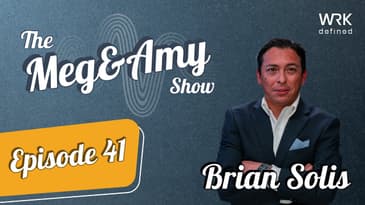
🚀 AI DARWINISM: Futurist Brian Solis reveals why most companies are using AI to optimize yesterday — and the "spark of the possible" that separates real transformation from glorified digitizing. Learn why ServiceNow's AI maturity index actually DROPPED in 2025, how IKEA's chatbot generated €1 billion in new revenue, and why intellectual humility beats technical expertise for AI-era leaders. ⏰ TIMESTAMPS: 00:00 "What if?" — Cold open 00:16 Welcome and bio 01:14 Meet Brian Solis — what he's up to at ServiceNow 03:06 What is AI Darwinism? 09:12 The 5 stages of AI maturity 13:31 Why the AI maturity score dropped from 44 to 35 18:43 How leaders react to AI — and where they get stuck 23:51 Visionary vision: the leadership shift AI requires 28:30 The IKEA story — how €1B came from asking the opposite question 38:48 MindShift — exploring what you don't know you don't know 50:19 Leadership Corner: managing younger, less experienced execs 59:35 What if? Closing thoughts 🔑 KEY INSIGHTS: - ServiceNow's AI maturity index dropped from 44/100 to 35/100 between 2024 and 2025 — and that's actually progress, not regression - "Visionary vision" requires CEO/board agreement to change measures, incentives, and reward structures, not just AI adoption goals - Most digital transformations failed because they were just digitizing — the same pattern is happening with AI now - IKEA reskilled customer service reps as AI interior designers and generated €1B in net new revenue in year one - The AI-era leaders who win aren't the most technical — they share deep curiosity and intellectual humility - "Spark of the possible" beats "art of the possible" — what AI makes newly imaginable matters more than what was already imaginable 📚 RESOURCES: MindShift (Brian's book): https://www.briansolis.com/mindshift/ Brian Solis website: https://www.briansolis.com ServiceNow AI Maturity Index report: https://www.servicenow.com/research/ 🔗 CONNECT: Brian Solis: https://www.linkedin.com/in/briansolis/ Submit Leadership Questions: megandamyshow@gmail.com Instagram: https://www.instagram.com/megandamyshow/ LinkedIn: https://www.linkedin.com/company/the-meg-amy-show #AIDarwinism #AITransformation #Leadership #BrianSolis #FutureOfWork #DigitalTransformation #MindShift #MegAndAmyShow
Powered by the WRKdefined Podcast Network.
[00:00:00] And who doesn't want to do amazing things? Who doesn't want to be Walt Disney and stretch our imagination? Who doesn't want to be a Steve Jobs to innovate in technologies that change the world? It all comes down to the thing that they all shared was, what if? Brian Solis has spent nearly three decades translating technology disruption into frameworks leaders can actually use. As head of global innovation at ServiceNow and author of nine books, including Mindshift, he coined Digital Darwinism in the 2000s.
[00:00:30] to describe companies caught between adapting and being disrupted. Now he's seeing the same pattern with AI, what he calls AI Darwinism, where organizations use technology to optimize yesterday instead of reimagining tomorrow. Today, Brian shares why ServiceNow's AI Maturity Index actually dropped from 2024 to 2025, the IKEA story that proves culture trumps technology every time,
[00:00:54] and why transformation requires leaders willing to explore what they don't know they don't know. Welcome, Brian! Hey! Well, thank you. Thank you very much. I've been looking forward to this for quite some time, so thank you for making it happen.
[00:01:21] Well, that's fantastic. We love to hear that. So, Brian, when you're not flying around the world or presenting at South by Southwest, what are you doing? What are you up to these days? Well, I mean, the honest answer is I am launching something new all the time at ServiceNow, and that keeps me pretty busy.
[00:01:46] And then when I'm not doing those things, I am trying to be a good dad who can keep up with all things life. Wow. Well, what does a good dad involve? How does AI impact my daughter's future? Because they are young, and the future they're going to see is nothing like what I've seen. But also, even going to soccer games and being patient, one of them as a teenager,
[00:02:17] and then also trying to keep up with all of the new Gen Alpha terminology, because that, you know, that is... That is work. And it changes so fast. It's like you just think you get the hang of it. Yeah, like I got six, seven, and now I think that's over. Yeah, that's completely so in the past. So over. Yeah. Well, and the other thing that teenagers are nice for is they remind you everything that's terrible and wrong about you.
[00:02:47] Oh, yes. So just in case your head was getting too big with all these big conferences and stuff, you just get brought right back down to Earth with the teenager in the house. Right back down to Earth. Well, I've, you know, that's a whole other story. Otherwise, we're going to turn this conversation into therapy. You've introduced this term, AI Darwinism, the idea that people are on a downward spiral
[00:03:15] with regards to their cognitive ability and the future success of organizations. One of the things that you've done as a part of this is put together an AI maturity index as a part of your work at ServiceNow. What is AI Darwinism and why did you coin this term? I don't know that I coined it, but it's certainly, I'll say it's certainly on brand.
[00:03:44] But I've been at this for almost 30 years. And back in the day, I used to write research with, I think, a guest that you have coming on soon, Charlene Lee, and also one of our dear friends, Jeremiah Aiyang. When we worked together at Altimeter Group, one of my big banners that I flew under in terms of my research was what I called digital Darwinism. And I know I didn't invent that. I just helped popularize it. And in that research, I had found, I still remember this stat from a report we published,
[00:04:12] that 88% of companies said that they were going through digital transformation and 25% of companies knew why. So if you think back to the early 2000s, the mid-2000s with the rise of Web 2.0, social media, mobile phones and smartphones and the mobile web, what we saw were companies adapting to it and then companies inventing themselves for it. So think Uber and Airbnb and Netflix.
[00:04:40] And the same just happened to be true for AI Darwinism. The difference is that I didn't just assume it was going to happen and start saying AI Darwinism. It's actually as a result of the question you asked with the AI maturity model. So very true to form, like with Altimeter Group, I did publish the six stages of digital transformation as a result of our research. We were able to identify the six distinct stages and the very distinct pillars of which those stages
[00:05:07] helped organizations change and mature as a way of showing other organizations what the rest of the world looked like, where they might be, and what they would need to do to take the next steps. And generative AI was, I mean, boy, did that hit hard and fast. And digital transformation sort of had this ramp that moved much slower.
[00:05:36] At least it seems like it moved much slower than the arrival of generative AI. But it was pretty clear, at least from an observer's perspective, that there were going to be things like what we had seen in the early 2000s happening again. This was before the term AI native existed. But the theory was that, or the hypothesis was that companies were going to take AI to do what they did better,
[00:06:06] faster, cheaper, more efficient. That was going to break out into certain stages. And there were going to be a new type of series of companies that were going to have AI in their DNA. That was as far as I got before the research started. And out of the gate, you could start to see these things. I think the first thing that became clear were the pillars. And I had documented, I think at the time, seven pillars. And it's since rolled back to five. It took about a year to put this together, though.
[00:06:36] And it was a spreadsheet so that I could capture these things and stack them. And then I could look left to right to see, like, what were the gains? What was progress and what did it look like? And what were the outcomes of those things? And it became a maturity model that I then brought into ServiceNow to get some feedback and some validation. And then also get some of our best and brightest to help build on it.
[00:07:05] And that became the AI index. And I was so happy because it was something now that was going to scale into something meaningful pretty quickly. And we published our first AI index report three years ago. It's wild of how just much change is happening. And at the same time, how much change isn't happening.
[00:07:31] This model does not say that you're doing well or you're not doing well. It just says what's happening. And now what I want to do is I have a report coming out. I'll tease it a little bit where I got to bring Jeremiah Auyang back to the table as an expert. And now he's a venture capitalist who's living and breathing the front line of this. And running the best AI conferences in the Bay Area. That's right. Absolutely. Absolutely.
[00:08:02] And what I wanted to do was document then, at least culturally, what are the differences between these stages of maturity? And how do they compare to the companies he works with? For example, like the AI native. Because ultimately, it's the same with digital transformation. You can try to react to this stuff and make your company linearly better. Or you can find ways to reinvent yourself for this generation. So why don't we talk about the differences?
[00:08:30] And I didn't do that back in the day. I didn't say, here's GE and here's Uber and here are the constructs and the differences between them. But we're doing it this time. Because I think the DNA of an AI native is actually not only going to create a new type of company. It's going to create a new type of performance and a new type of operational model that we're going to have to understand of how to bring back into more incumbent organizations. So that they have a leg to stand on. It's so drastically different, right?
[00:09:00] Where you could think of digital as being, you know, more of a step change. And this is just like a complete reinvention. Absolutely. So could you walk through what the five stages are? I do want to put a caveat out there, though. They're going to change this year. And it's because there's been a tremendous amount of progress in the last year.
[00:09:26] The original model and the two initial reports had the stages as evaluator. So this is an organization that's imagining, they're assessing, they're reviewing, they're exploring. And then you had the experimenter. So these are proofs of concepts. These are pilots. These are proving out these investments. These are reporting back.
[00:09:50] These are getting stakeholders involved from across the organization as this starts to kind of make more sense. So it's not just so isolated. But as you could imagine, there's a lot there beyond just doing and experimenting. There's things like data governance. There's things like AI governance. There's things like skills and development. And then, so it's evaluator, experimenter, and then you have expander. And these are organizations that are recognizing the potential.
[00:10:18] And now they're starting to think bigger. They're starting to collaborate. This COE, the center of excellence, maybe starts to evolve from just a resource center into a driver, like a cross-functional driver. And then the next stage after that is advancer. So this is the operationalization of these types of programs we're looking at. And then the next stage is the core of the program. Workflows that span beyond any one silo.
[00:10:48] Datasets that connect across these silos. Work in addition to the workflow. So think like HR, IT, maybe finance coming together in a workflow. And then ultimately there's this transformer. These are the organizations that are reimagining themselves. These are the companies that are innovating.
[00:11:11] So, for example, I have towards the end of 2025, Jamie Dimon had said that they see JP Morgan as an organization that will be an AI bank of 2030, for example. And they were going to be making these investments in not just AI, but also operational models to support that vision. And that not that they've executed at that level.
[00:11:37] But that's the kind of thinking you might see resulting in that transformation at that fifth layer. And I will say this, though. The one thing that will drive that across the left to the right, of course, are the pillars that we track. But you have to have that vision and strategy. And that is a big, like aside from governance, aside from all the data, hygiene, connectedness, etc.
[00:12:02] That vision and strategy is a really big part of the later stages in the model. Because it's one thing to say our vision for AI is to increase AI fluency to 70% of the organization and to upskill our people to whatever. That's a vision.
[00:12:48] Depending on the company, a shareholder level or stakeholder level, where you're going to get that buy-in from the inside and the outside of the organization to take those steps. So I saw you write about how the index from 2024 to 2025. And that's quite unusual, right? I mean, you can see that progress might be slow.
[00:13:15] But for it to go in reverse is really quite something. So how is the measurement done? And how is it possible that companies have actually become less mature? This, I got to tell you, this is moving so quickly that in the first year that the model itself was being built, I'll never forget.
[00:13:43] I was flying from somewhere in the Midwest to Copenhagen. So I was driving to the airport in the Midwest, thinking about, so it was a long drive. And I was thinking about work that I had been doing with customers around their AI investments. And I don't know what happened, but I remember thinking, oh my goodness.
[00:14:14] I think there's, at the time there were four stages during the model. I think there's a fifth stage. And I think it's right in the middle. And I think it's breaking up the steps people are taking because what, it's like that old can of worms metaphor. It's like the more you open this, the more you really start to see what's going on.
[00:14:36] And in 2024, the average score of maturity was 44 out of 100, with 100 being the most mature. And in 2025, that number fell to 35 out of 100. And it was that reason.
[00:14:52] It was that companies who were maturing realized that there was just so much more than those pilots and so much more than prompting and so much more than the initial investments were yielding. And companies took a step back for the right reasons, which was to figure this out.
[00:15:15] But at the same time, though, you had from 2023, 2022 to 2023, the year of generative AI. In 2023 to 2024, this whole idea of agents were starting to become the buzz. And then from 2024 to 2025, you had this shift to agentic AI, like the agentic enterprise was becoming the thing.
[00:15:39] It was going to become clear that agents were going to span beyond just any one function and be able to perform work in ways that hadn't been done before. They went from agents to agents, right? Yeah. And so I could see, like, you know, companies saw what was available to them and were able to start to standardize, were able to start to make plans, etc.
[00:16:06] And then everything just went crazy, right? So one thing that I think about and your point about, like, visionary vision as opposed to just standard lowercase vision, I think that one of the things that's becoming obvious in the software and technology industry that I think is actually going to be true in a lot of industries
[00:16:30] is the fact that the competitive landscape is really changing dramatically. The difference for AI native technology companies versus successful incumbent, the math is very different. And we experienced this before with the move from on-premise to cloud. The multiples and the expectations of growth were very different.
[00:16:56] And the hurdle to go from one to the other was very different. But the parallel sort of ends there with agents because, in my mind, it isn't just one part of the business that's changing. In that case, the business model and the way you served customers was changing. But the way you built the software was actually staying pretty, pretty consistent.
[00:17:22] But today, all the different parts of how a business is built and run are changing and have this opportunity to rethink the workflows and the operating models to activate on this new paradigm.
[00:17:42] And so as I look at the pressure that companies are feeling on this, how they think about maturity and how they think about opportunity, it's not just what is possible for them in their context. It is also what is happening in their competitive landscape that is changing the game for them.
[00:18:07] I'm imagining that your work with ServiceNow, you get to talk to some of the biggest and most interesting customers on the planet. And I'm pretty sure that you get a variety of emotions that show up in these conversations from enthusiasm to panic and everything in between.
[00:18:26] How would you characterize how people are feeling in this moment, where they feel like they've got a clarity of what happens next and where they feel a little unmoored? It's all over the map. I mean, if I could just be honest, there's a lot of factors going into this.
[00:18:51] There's a role factor. So where you are in the organization, your remit, like are you the technology leader? Are you the technology implementer? Are you the business leader? Are you the AI leader? Are you the CHRO, CFO? There's so many different things in play right now.
[00:19:19] And so historically, I think those roles would show up as I know what I'm here to do. And so tell me how I can use this to be more successful. These are my goals. These are the measures of success. These are the challenges that I'm facing. Now every week you have organizations that are making drastic changes and organizations of all kinds of sizes.
[00:19:48] Let's look at Jack Dorsey. One week announcing that they're using AI in a way that allows them to let go of 40% of their workforce. And whether that's true or not, that has yet to be seen. But their stock, I think that day, shot up 30-something percent. You have Allbirds, a shoe company. Exactly. That now is going to be an AI company and their stock shot up 700% in the same day. That's one.
[00:20:18] Oh, and then Jack Dorsey again, introducing an entirely new operational model that now flattens the organization. But I've been studying this from an operational standpoint where technology now rolls up to the COO so that they can move technology closer to the business because they're trying to accelerate that work. You have Moderna where technology is rolling up to the CHRO.
[00:20:44] And so essentially what all of this means is that there are different approaches to all of this. And so now if you are in this role, it could be overwhelming and it could also be confusing. Which one of those is the way that I go? And so what happens is that people tend to psychologically settle back into their chair to do what they know.
[00:21:08] And so this is why you see a lot of AI investments going around operational efficiency, efficiency gains. This is why headcount conversations start to become pervasive. But I think what we're starting to see now are proof points that things could be different. And so the conversations that we have with companies are to help those executives, one, take comfort in where they are.
[00:21:33] That it is okay to be in the unknown and it is okay to not have the answers to what we need to do. So let's talk about it. Every organization is going to have a unique path forward. They're going to do what they do because that's going to give them the competence and the insights that they need of what's working and what's not working. And then they're going to hopefully with the right partner be able to open their minds to see what they couldn't see before.
[00:22:00] To then ask the questions they didn't know to ask before. And then co-explore the unknown to make it more tangible and actionable so that we can explore not just the art of the possible, but what I'll call the spark of the possible. Like what can we do that creates any value? We find ways to augment growth. And I believe that augmentation is the way that the most successful incumbents are going to perform against AI natives.
[00:22:28] Because they're not going to say, how can we use AI to replace humans or human work? We're going to look at how AI can take over tasks that then allow us to think differently about the role and how that role can be empowered to not just do what you did yesterday, but do what you couldn't do yesterday to unlock new value and help us grow exponentially.
[00:22:53] Because when those leaders, those visionary visions that come out, you're now going to perform differently than how you would have performed otherwise. And I believe that those conversations don't happen enough. I have to understand what has them up at night. What are they scared about? What are their measures for success? Are they thinking about retiring in the next five years? Because they're probably not going to take the biggest, boldest moves. Or maybe they aren't. Always one of the brightest.
[00:23:21] I have to understand who's in the room with me and help them understand what are their actual options. And what are some of the answers and decisions and outcomes on the other side of those decisions? What do those look like too? And let's get an understanding for the appetite for what we do next. And that is a very different conversation because then technology enables what you want to do next.
[00:23:51] As a part of the maturity curve, to really get to the higher levels, you have to start thinking about reinvention and value creation. And that means you really need to reinvent workflows. Maybe start from scratch and, you know, get rid of all of the previous constraints rather than just narrowly, surgically update tasks within an existing workflow.
[00:24:20] Now, there's an inherent tension in terms of the players that could be creating these reimagined workflows, right? You have the term of like a chief workflow officer. The people that have this kind of brain that can think this way.
[00:24:39] But then you have the subject matter experts who know what the work is today and what needs to get done and, you know, where it's painful. And there's this really strong tension oftentimes between these individuals at a legacy company where, you know, maybe the person with the new blue sky comes in and says, like, let's do this.
[00:25:07] And then the SMEs are saying, well, that would never work. Been there, done that, like, you know, this and that. Are you seeing that? And how do they resolve this? And how do they move forward? I think if there was a magic button to press, this would be so much easier.
[00:25:29] What you're really starting to get to is what my friend Jason Corman would talk about in terms of culture and the role that culture plays into innovation or transformation, whether it's digital or whether it's AI, whether it's creativity, whether it's empowerment, whatever it is. It's like there's it's division. Visionary vision is one thing, but you have to have a leadership organization.
[00:25:56] That allows for experimentation, that allows for curiosity that and and look, I know those are words that we hear all the time, but let's just take curiosity for a second. What does that mean? Well, it means one that I can look in places that I haven't been looking before, that I could ask some questions that I haven't been asking before. And two, I could try some things we haven't been trying before. And most organizations don't allow any of that.
[00:26:22] And that is just simply because the idea of an organization or the idea of a company has scaled so well since the 1950s, 60s, 70s, et cetera. That's the construct that we're working against in order for those companies to innovate, go against the very construction and the ethos of what it means to be an organization.
[00:26:43] So those organizations now are designed to perform on a quarterly basis to deliver whatever value to shareholders, stakeholders. And anything you take away from that is a cost center. And so when you pull things out of that and that cost center, which could go to innovation, which could go to experimentation, exploration, go to these pilots. What's the appetite for that?
[00:27:11] And what's the leadership who's going to say, yeah, we did. Yeah, we just did that. Here's why we did that. Here's what we're seeing. I'm learning so much there, but don't penalize our share price for that because here's what we think is going to happen two quarters from now. Like whatever that language is like straight up. That's what we're talking about. So if you want to have a conversation about what it's going to take, I got to look at your leadership. I got to see like I got it. I have I'll tell you every this goes back to when I was an analyst.
[00:27:41] Every successful transformation I've had has happened because I talked to the CEO and the board and we came to agreements that we were going to do things a little differently. We were going to look at measures differently. We were going to look at incentivization and reward structures differently. Like we looked at operationally what we were going to do to support the things we wanted to do because otherwise they weren't actually transforming. They were digitizing.
[00:28:07] And so let's go back to like the specific question that you had, which is let's look at a workflow. I think it's very interesting. We're in the workflow business and it's very interesting when you look at I think it was last year. Quantum Black published data around. AI, the state of AI, I think it's what the report was called. And they had found that of all of the things in terms of AI investments.
[00:28:37] They tied like 25 attributes like trying to find ROI. And the one that had the most impact on earnings before interest and taxes was the end-to-end redesign of workflows. And it's hard to find people willing to talk about how they did that because that is a moat right now.
[00:29:02] But I will say that being in the workflow business, we have some experience in talking to people about workflows. And what I can say generally is that a lot of companies are looking to optimize the workflows that exist today. And that is a gain. And please do not stop doing that. Where you can gain efficiencies is a proof point. And it also builds confidence and it also helps you gain momentum.
[00:29:26] Where we want to have additional conversations is, okay, we've found returns on linearity. Okay, so now what are other companies doing or what might other companies do? And this is where the maturity model really helps us gain some insights where we can say, well, we happen to know that these are the six or seven different questions they're asking around these types of things. So why don't we try to answer those?
[00:29:52] And what you end up getting is not a role, but steps. And then you can bring in certain people around that. It's interesting that you mentioned the chief workflow officer. It was a concept that we came up with that shows that all of this is possible. That if you believe then the data that shows that the EBIT impact can happen with end-to-end workflow transformation,
[00:30:22] that means that someone's going to need to lead those types of effort at scale. And what that means, even before that, is that you have someone or some people willing to lead in to say, is this the right workflow considering like what Jack just talked about, what they're doing at Block? Because this kind of seems like we're just doing yesterday better. What if, and then you start asking a whole series of questions.
[00:30:51] We published a report, Dave Wright and I, that we called the AI mindset. And it helps with these different types of questions to ask. The answers to these questions are going to lead to this. When you put both in play, well, you've got linear growth and you've got the potential for exponential growth. And the delta between the two, well, that's positive disruption. That means that you're disrupting yourself in a way that's allowing your organization to grow as you go.
[00:31:19] I would think that as part of the visionary vision, it would be important that there's clarity in terms of what should be preserved and what shouldn't. What outcomes are, you know, essential and what can get left by the wayside. And, you know, what is, what's just kind of open territory.
[00:31:42] There tends to be a sense of like, well, we need to preserve, you know, X, Y, and Z. And unless somebody tells me differently, then I am going to hold on to that. And if that visionary vision by the leader can, you know, can absolve people of that sense, then they can be more open and more curious.
[00:32:07] That's so important in terms of being able to think about these workflows in a new way. We have to make sure that, you know, we talk to the customer at this particular time about this because that's the way we've always done it. And they've, you know, we've gotten feedback that this is what they like and we need to do that. What, maybe that's not, that's not important.
[00:32:34] The outcome of making sure that the customer feels like they have value with our product is essential. But the fact that, you know, they were talked to at this particular moment and because they like that, that is not important. Being really clear about what is, what's sacred and what isn't, I think is perhaps a component of that.
[00:33:03] Is that something that you're seeing, Brian, or am I just making that up? No, I actually really liked, I really liked following that. Again, it's going to come down to culture of the company. So Jason Corman is the CEO and founder of Gaping Void and Gaping Void is a culture design studio out of Florida. And I've worked with Jason for the last 20 years. And the reason why I stay close to Jason is because ultimately I have to answer the culture question. I've, I've been fortunate to have been involved in culture transformations.
[00:33:34] I've gotten to see, I had the benefit of working with Tony Hsieh at Zappos, which is quite arguably one of the most famous culture companies ever. And it is because they did, and companies like Zappos did look at what is sacred and went even beyond that and said, should it be sacred? They thought about, about it as outcomes.
[00:34:00] In those cases, what they shared was, what, what experience could we give the customer that is just extraordinary and wonderful in ways that they're not going to get from anybody else? And how can we give a business model around that? And I don't think you're ever going to meet a leader who's going to say, oh yeah, no, we're not customer centric. We just say that in our earnings calls, but they're not.
[00:34:28] Look at most, nobody wakes up, for example, and says, I hope I get to call a contact center today. I hope I get met with a decision tree on an IVR that won't let me talk to a human being. Or I hope I get a chat bot that can't answer my questions. Nobody wants that, yet companies are scaling those experiences because they're cost centers in their mind.
[00:34:56] But what happens on the other side is that's a sacred cow that you're yet to be willing to challenge. Because all data shows, Apple proved this the best, that when you invest in the experience of customers and you invest more in the technology that scales those experiences, you can charge exponentially higher prices for similar services because people trust that they're going to get a great experience. And you know what happens on that, on the other side of that? They feel great.
[00:35:26] That is what the word experience means. It's how someone feels when they're transacting with you or how someone feels when they're in a certain moment. And so anyway, it's a long way, I seem to say that a lot, it's a long way of saying we have to be willing to sacrifice sacred crowds. And AI is a force functioning device because it does unlock capabilities that were not possible before, unlike any technology before it.
[00:35:51] And with the right mindset, you can now start asking different questions. And with the right culture, we can now start empowering experimentation, even rewarding it and giving people the psychological safety like Amy Edmondson would say, so that they could now ask and answer those different questions.
[00:36:13] I really like the fact that we always have to ground in culture for any of this to yield what we need, which is transformation at a scale and pace that we've never seen before. One of the things that I'm starting to observe in the type of culture carriers that do better in these sorts of moments of unknowables
[00:36:45] are I think that we are seeing leadership show up a little bit differently than it has in the past. And I think that this is both an opportunity for a new type of leader to emerge, but it's also maybe a little bit of skill building opportunity for some of our more senior leaders.
[00:37:04] And some of the indicators that I'm looking at that are giving me this sense is when I see the kind of CEOs and CXOs that have been able to effectively lean in to the opportunity of the moment. They're not necessarily the most technical. And while I am a believer, everybody should be hands-on with AI.
[00:37:31] They're actually not even necessarily the most proficient. A common thread is the one that you mentioned, deep curiosity. So they are eager and interested to think about what is available and possible, how it works, why it works, etc. But the other piece is they also share a tremendous amount of intellectual humility, being really not just curious about what the things can do,
[00:37:59] but what do they need to change in their own thinking to be able to capture this moment? And how might they have, you know, taken on some patterns and some habits that aren't going to serve them in this moment? One of the things that I would love to hear your point of view is in talking to leaders that exhibit these traits,
[00:38:25] that are really forward-leaning and are starting to see the results, how do they talk about their own journey and specifically their learning journey? What are some of the tools and techniques they're using to get smarter and to still be able to do their job, which is lead a bunch of people and make important business decisions at the same time? I was wondering if you were setting me up with that question,
[00:38:53] because I do have a book that actually breaks this down. It's called Mind Shift. Exactly. You've got the new cover. That's awesome. Let me give a shout out to folks here at ServiceNow, like Dave Wright, Nick Zitson, and Bill McDermott. These are the three individuals who I work with who have given our team the space and freedom to be curious and to build new things.
[00:39:22] And I also want to think back to the work I did with Virgin, with Porter Gale and Richard Branson. Same thing. Or Tony Hsieh. This is what Gaping Void's work tries to get at, is to understand what your culture is and understand why you can't do the things that you're trying to do and what then your human dynamic is going to take to get there. And sometimes it's right at the leader.
[00:39:52] Oftentimes it could be right at the leader. And the thing about that is there are a million different books that talk about leadership, and each one of those is going to generate its own kind of leader. When I wrote Mind Shift, it was because of all the executive level conversations I've had in AI, in digital transformation, in companies that in their corporate venture programs and their corporate innovation programs that either wanted to build innovation centers
[00:40:21] or wanted to invest in and acquire startups and then wonder why those startups fail inside of large organizations. It all comes down to this idea that you have an assumption of how things work based on the pattern of the way things work. And you're rewarded for how well you maximize those patterns and extend the returns on those patterns. And that is fine, and I don't think that's ever going to change. But sometimes it hits a wall, and sometimes life throws you some changes
[00:40:50] that you're going to have to think. Can I keep hitting the wall the same way, or should I try to go around it, find a different door, or maybe go over it? I don't know, whatever it is. That's the mind shift. At some point, you have to be willing to go back to what you were asking earlier around curiosity and asking earlier about what type of leader do we need there. Humility is a word that came up in our conversation. But in order to be humble,
[00:41:19] you have to recognize that you're not. And that is the hardest part of leadership because most leaders, I think we could all agree, are not humble. We'll just say it nicely. And what's tied to humility is a step before that. It's self-awareness. You can't ask different questions if you're not self-aware that you're not asking those questions. And that was the biggest realization for me.
[00:41:50] That's what led to mind shift, was how do you look to the future when we have historically reacted to things that happen now? Like, oh my goodness, there's a pandemic. What are we going to do? That's called scenario planning. We've got to think forward. Oh my gosh, generative AI is here. What are we going to do? We know quantum's coming. Right. We know some super type of intelligence is going to happen.
[00:42:18] What it will be and when and phased approaches, who knows? But what I wanted to do was help inspire a leader who is self-aware enough that we're not preparing for these things because we're so busy reacting to the now. And we're not allowing ourselves the space, the time, the curiosity, the community of people willing to do these things in a safe space so that we can prepare.
[00:42:47] Because in that preparation doesn't just help you think about the future differently. It helps you think about the present differently. And that's what I was trying to do was to say, hey, if you're a leader, if you want to be a leader, if you want to advise the leader, if you want to be a reluctant leader, these are some things that are going to help you with AI because there are unknowns. And so in the realm of thinking about how leaders
[00:43:16] in the center of this, let's just call it the concentric circle, in the center of this circle is what you know. And leaders operate here. And on the outside of that circle is another circle. It's what you know you don't know. That's usually what we call the guardrails or the boundaries. And leaders operate in this confine. And they operate so well within it that they build up the leadership things that keep them there. But outside those circles is what you don't know you don't know.
[00:43:46] And this, I think, is the one that is where uncertainty lives, ambiguity lives, anxiety certainly attached to those things. And it's not safe or fun to even explore those things. And so when something like AI comes around, we attack it from the things we know. This is why you see that linear experimentation. This is why you see linear results. This is why you see headcount conversations. But when you explore what you don't know, you don't know.
[00:44:16] And you put, say, the constructs and mind shift. Like, I teach all the things I've learned in my practice and foresight and futures and just try to make it simple and understandable and approachable and fun even. I even brought Pixar storyboard artists into the process of, like, why this becomes so much fun. And what happens is you start to make the unknown tangible. You can actually turn that into steps in new directions. And what happens is you start to find answers
[00:44:45] to those questions and you can bring them back and you can decide, is this the workflow that we just need to optimize or, boy, is this the workflow that we could reinvent? And you give yourself that safe space to even have those conversations because that's a huge step in its own right. But last but not least, what I hope any leader takes away from this general conversation is this IKEA story. it's
[00:45:14] a couple years old but it's my favorite story because when they introduced an AI chatbot for customer service they did it with the way, the mindset that everybody would employ a chatbot. Can we deflect calls and escalations? Can we reduce costs? And to their, I've told this story so many times that I keep messing up the percentage of like what it deflected but it was, it's really high.
[00:45:45] Let's say it's 50% because it's either right under that or right above that. And that's a pretty successful deflection rate. And any normal leader is going to say in order to get the ROI of AI we're going to have to assess the costs of this technology against the costs of what we just saved in terms of escalations and maybe make a decision about headcount. Maybe we don't need this many customer service representatives now.
[00:46:14] Instead what they did is they looked at the remaining percentage to say why couldn't this solve those conversations, those inquiries? And they found some really unique patterns. They found that there was an inordinate amount of interior design questions coming in. And so there, that allowed for curiosity, experimentation. What they did was they re-skilled those customer service representatives to become, with AI,
[00:46:43] interior designers. And they piloted a new business model. And they took those inquiries and spun out a new interior design service that I think in its first year generated 1 billion euros of net new revenue. Now you have your iteration and your innovation story, your automation and your augmentation story. And it is proof to the question that both Amy and Meg, you were asking in your own ways,
[00:47:11] it is a definition of AI Darwinism, of what happens when you don't do those things. Because now you've got a competitor that just figured out how to use it and do new things that you weren't doing. You just used AI to automate roles, cut out heads, and fortify yesterday's business model. They figured out some new stuff and they're growing. And then, again, Meg, to your point is you also then gave the leader the confidence they need and the validation they need that it is okay to try new things.
[00:47:40] And some of those things are not going to work. And I think Steve Jobs said that famously when he came back to take over Apple and he was talking about the importance of customer experience and how that was going to drive Apple's innovation strategy. He said, some of those things are not going to work and that's okay because we'll figure it out along the way and we'll get it right. And certainly they did. And that, I think, comes back to the mindset and the mindset shift that we all need. We all need humility in order to be humble means that we have to be aware
[00:48:09] that we're not because no one has these answers right now. It's a once-in-a-lifetime experience to do something we were never able to do before. And who doesn't want to do amazing things? Who doesn't want to be Walt Disney and stretch our imagination? Who doesn't want to be a Steve Jobs to innovate and technologies has changed the world? It all comes down to the thing that they all shared was, what if? What if? That, that's, that's what gets me up every day.
[00:48:38] And you've had decades of being a futurist and as best I can tell you are now teaching us all how to be, what do you call it, everyday futurists and, and that, the big thing is really going after that what you don't know you don't know, right? And being humble enough to accept that you don't know and that you want to learn what you don't know. I love that. I,
[00:49:08] I hope that that's, if, if that's what you take away, then I, thank you. I'll add, I'll add one thing that it's a good practice to look forward with an open mind like I talk about in the book with childlike wonder to be secure enough in yourself that sometimes it's okay to be gullible. You don't know, you don't know. Take the magic in it. Figure it out. But also dream and dream big. Things like, let's, let's ideate, let's brainstorm, let's, let's,
[00:49:37] let's get a whiteboard and that's all good stuff. But believe that whatever you think you should be doing is probably not what's going to be where the magic is. Yeah. Wow. I love that. Well, thank you so much, Brian. This has been both inspirational and very informative. So thank you. We appreciate it. I appreciate it. Thank you. And this is a community of people who want to believe that we can do more and that we can do more together. And I think that's,
[00:50:07] that's what this is all about. Just getting, getting enough of us together to do as Steve Jobs said, make a dent in the universe. Amen. Let's make it so. You ready to leadership corner Meg? I love a good leadership corner, Amy. Let's do this thing. I am reporting to an executive who is significantly younger than me and has far less experienced than I do. They are smart and capable. However,
[00:50:35] they have an overinflated view of themselves and it creates a number of blind spots. They don't seem to appreciate my been there, done that advice. What should I do instead? Oh, I've been on both sides of this. having major flashbacks of this. I think a couple things. I don't think anybody appreciates somebody who
[00:51:04] shows up with more information and more experience than them to question their ideas or decisions. And it's certainly true when you have an executive who is young, they usually have some sense that they are young and have maybe some insecurity about it as well. So odds are being someone that is telling them
[00:51:33] what to do is probably the exact thing that they're eager to avoid and probably have some pretty big pushbacks on that. So a couple things to think about. One, I think, is just a really good strategy for anybody that you want to work with that's important for your success in your role, whether that's somebody you work for or a peer, is to take some time to appreciate their role, their responsibility,
[00:52:02] and their person. Get to know them and get to try to understand what's important to them and how they tick. This is so critical because if you have recommendations or suggestions, it'll be a lot easier for you to deliver those when you understand where they're coming from and you can put your ideas into context of something that they already are thinking or are experiencing themselves. So if you
[00:52:32] start out with the answer but don't start out with the relationship building, you're doing it wrong. Secondarily, I think once you spend some time getting to know that person, you're going to figure out what are the ways that they are most receptive to ideas. Sometimes people are more receptive with a lot of data and facts. Sometimes people are more receptive with some emotional content. Sometimes people are more receptive
[00:53:01] when they get to the idea themselves, but you've just left them a lot of hints so they can get there. That would be the model that works best with teenagers for sure. A very young executive. Yeah, exactly. The ones that are way more critical about any of your ideas for sure. And so getting good at asking questions as opposed to presenting answers is another really good tool in your toolkit to kind of engage with
[00:53:31] someone so that you can get to them understanding what's important to you without it having to be you telling them what is the right answer. So it's a lot about your positioning. It's a lot about how you define success. And it's also a lot about getting really clear what is important in this moment. If you can let go that it's important that they know it was your idea or that they know you have more experience than them or that they
[00:54:01] appreciate you in a certain way and instead give more space to your role as a supporter enabler and helper for them and how can you best do that. I think once you start into that as your frame you're just going to show up a lot better and in a way that is more conducive to a good working relationship with a boss. Do you have any specific examples Meg on either side
[00:54:30] where you know where you had this occur and what you did specifically? Yeah so I can remember very distinctly one boss I had a lot of trouble connecting with. We just didn't really see the world in the same way and we just didn't have similar experience. Now this wasn't really an age related thing but it was a context related thing and I realized that there was a peer that really had developed a lot of trust
[00:55:00] and was not getting questioned the same way I was. And I pulled him aside and said you know what are you doing? Why when you bring an idea he listens and when I bring an idea it's an instant like you're wrong, shut down kind of a thing. And it was really great because I was super curious and my peer was male, the boss was male,
[00:55:29] but the solution wasn't a gendered solution. The advice to me was hey this particular boss is a very high touch boss and it's important to him to have his fingerprints on the work. And so if you show up with something that he hasn't had time to understand or digest and to give his own feedback to then you're going to be disappointed because he's constantly going to tell you everything that's
[00:55:59] wrong with it. And so that was super helpful to me because I did what I do well which I just stopped and regrouped and I said all right I am stopping with the idea that I'm going to deliver a final draft to this boss ever. I am going to deliver a shitty first draft that I have no problem with him ripping it apart so that my second draft the one I put my actual time and heart into I will have incorporated the things that were important to
[00:56:28] him and the receptiveness of my thing that I cared about would be tipped over to be more successful. And in that scenario like it was like a light switch. It was like a light switch. The first draft crapped all over it. The second draft loved it to death. I was happy. He was happy. Our relationship improved. Everything got better. And he felt like he had more say and more
[00:56:58] like he felt like he was supporting me better, which was ironic because I felt like in the original approach, I was not feeling supported at all. I was just feeling like attacked for the dumbest, stupidest little things. But because I took the time to understand what was important to him, and I took the time to ask somebody who clearly had figured it out, like, what are you doing? I can't see it. Then it became something I could take action on. Yeah, so you had that self-awareness
[00:57:28] that it wasn't working for you, but it was working for somebody else who had the curiosity and the humility to go to that person and ask and then to apply it. That's great. Love it. So, yeah, I mean, I think curiosity and empathy are always a good idea. I love all of those things that you had shared. And, you
[00:57:58] know, I think the, you know, just to kind of look at the counter example, the way that this boss is probably looking at you is that you're stuck in your ways. Not you, Meg, but in, you know, you're stuck in your ways and, you know, try, try new things. Like that's probably what your boss is, is, has in their head. So I would leverage
[00:58:27] Brian's, uh, model of, you know, really going out into the unknown unknowns, right? And, and so part of that is figuring out what, uh, what your boss cares about and how they tick. But it's also about, you know, really coming in with a much more open mind of like, you know, maybe, maybe your boss is in a different generation and has just a completely different perspective that can, can make
[00:58:56] a huge difference in the way that, that you are approaching, um, approaching problems and approaching opportunities. So, um, yeah, be curious, be empathetic and, um, tackle those unknown unknowns. And give them the benefit of the doubt. Always. Always. Yeah. Mm-hmm. Unless they're a narcissist. And then get out.
[00:59:29] Yeah. Well played. Oh my goodness, Amy, what a good show. Oh, it was. It was super fun. So glad we got it. I see that you're in a new location. Are you back at Pebble Beach? I'm in Pebble Beach. And how, how is life in Pebble Beach? Uh, it was a little windy yesterday, but, uh, weather looks good for the next couple days. Can't wait. I'll be, uh, kayaking with the, uh, the sea otters tomorrow. So. Oh, excellent.
[00:59:58] Well, I hope I get a few photos of that because that sounds, uh, like a lot of fun. Indeed. Thank you everyone for listening. Please do like and subscribe. And let's invent the future together, everyone. I believe in us. Let's make every day count.
Sponsors
