
The share of workers in traditional full-time jobs shrinks every year. Companies that keep fishing in that pond are competing over a smaller and smaller pool. The talent that is actually growing works on contract, works remotely, and lives on the other side of state lines most employers are not set up to cross.
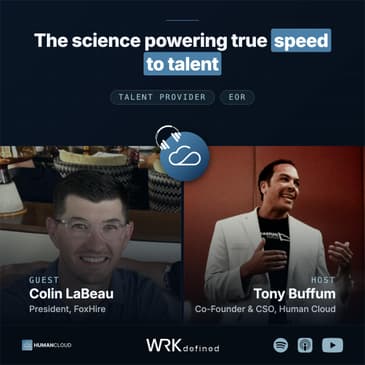
Colin LaBeau runs FoxHire, an employer of record that has served staffing and recruiting buyers and sellers since 1992. FoxHire builds the compliance rules for all 50 states directly into its software, so hiring across the country stops depending on somebody remembering the law.
We're building Human Cloud to solve the same problem from the discovery side, so businesses can find the right flexible talent solution and engage it without inheriting a compliance project.
In this episode, Colin LaBeau shares:
- Why payroll and employment law turn the US into "the fifty countries of the US", from Massachusetts pay-timing rules to three different PTO accrual laws stacked on one worker in Chicago
- Why speed to talent, not cost savings, is the real value of an EOR, and why the metric that matters is hours shaved off offer-to-start
- The onboarding trap nobody prices in: a new hire chasing four separate vendor emails, and what integrating those vendors into one flow actually does to time-to-start
- The risk you cannot put in a bill rate, including PAGA exposure in California and misclassification class actions in Illinois, and why the real danger is what you do not know you do not know
- Where he thinks onboarding goes next: a worker-owned digital wallet holding credentials, IDs and screening results, so the same background check stops getting run from scratch every time
- Why 24 states requiring healthcare staffing licenses, bill rate caps and margin caps is not a passing phase, and why employment gets harder from here
Colin LaBeau is President of FoxHire, an employer of record specializing in compliant employment across all 50 states, with deep expertise in healthcare staffing and onboarding speed.
Listen now on Apple Podcasts, Spotify, or wherever you get your podcasts.
About Human Cloud: We help companies find and deploy the right flexible talent solutions in minutes instead of months. We automate discovery, compliance, and orchestration across 1,000+ workforce platforms, so business teams move fast, procurement teams stay in control, and rogue contractor spend turns into a strategic advantage.
Powered by the WRKdefined Podcast Network.
[00:00:04] [SPEAKER_00] Hey everybody, I'm Tony Buffum, Co-Founder, Chief Strategy Officer at Human Cloud. And if you haven't seen our podcast before, they're the best because we get really, really great guests. Today on our podcast, we have Colin LaBeau of FoxHire. Colin, it's so great to have you join us today. Thanks man, excited to be here. Appreciate it.
[00:00:25] [SPEAKER_00] We met because we both live in this world that we believe is the key contributor to the future of talent around flexible talent. And how the organizations embrace different ways of working with this growing classification group of people, especially in an environment where the overall workforce participation rate for those people working those full-time jobs, that's declining every year.
[00:00:52] [SPEAKER_00] So it makes sense that if you're fishing in a pond that's shrinking, you better start fishing in a pond that's expanding at the same time. Colin, tell me about how FoxHire grew out of that demand and how you guys are supporting your clients right now.
[00:01:07] [SPEAKER_01] Yeah, absolutely. Seeing a lot of people adopt flexible work as contributors to the workforce. People like to work where they want, when they want. And there was a couple, I think, events for FoxHire that took us down that path even further. If you don't know about FoxHire, we have been serving staffing and recruiting buyers and sellers since 1992.
[00:01:30] [SPEAKER_01] And traditionally working like those normal W-2 roles that just happened to be contract, right? Start as a contract to hire position and we would serve as the EOR there. But I think two events took place really started by COVID that ramped up the adoption and interest in flexible work. First and foremost, in our specialty area, which is in healthcare, travel nursing exploded.
[00:01:52] [SPEAKER_01] And the healthcare staffing market really became a central focal point of not just the flexible talent or workforce discussion area, sort of our niche market that we all work in, but globally, and especially in the United States. And that drove a massive interest in healthcare staffing and flexible work in that space and multiple companies spawned off that. And then the other because of COVID was remote work in general.
[00:02:19] [SPEAKER_01] So, you know, the growth in healthcare staffing drove us and then also remote work and people being able to work remotely, that becoming the new normal and expectation for any technical or administrative or anybody that can work on a computer. So that's what really got us further into this space and building solutions to help enable those things.
[00:02:41] [SPEAKER_00] Yeah, I like that you referenced that massive inflection point that took place six years ago now. That feels even weird to say, but it took place quite a while ago. And since then, we've seen this pendulum swing a little bit back and forth, but now it's back more into this return to office and getting back into more of a traditional employment dynamic.
[00:03:05] [SPEAKER_00] Well, at the same time, like I said, the statistics and the data shows that that's a decreasingly available talent pool. And organizations that are sticking with embracing flexible talent are finding they can meet their needs a lot faster and easier. But, you know, in a time I've spent, you know, flirting with this and using this as an enterprise buyer and the time I spent at Upwork where I was promoting this and especially not human cloud,
[00:03:33] [SPEAKER_00] there's still so much resistance because people have deep rooted fears of classification troll. How do you help them get over those fears so they can come take a step into this new modern era of of talent?
[00:03:50] [SPEAKER_01] I think the first is just education, right? Like I'll give you an example. When we first started having conversations with buyers, at least when I began at FoxHire about eight years ago, people didn't know what an employer of record was. Right. Like I would say, hey, we're an employer of record. They'd be like, what is that? Right now through adoption of our types of solutions, competitors or Fox Air otherwise. Right. They're familiar with what we actually offer.
[00:04:14] [SPEAKER_01] But then furthermore, with with, you know, like ChatGPT and the AI solutions, they're very educated. Right. So educating them on what it actually does is the first step to sort of breaking down some of those walls. And then I would say picking the areas that you need to focus on. Right. Classification is one area of concern. 1099 versus W2 is always the conversation.
[00:04:38] [SPEAKER_01] And there are thousands and thousands of contractors that are working for companies all over the country that are classified as 1099, but also as W2. And making them unaware that you can do both of those things through an EOR and still gain the protection of, you know, a third party in the middle, managing that classification process, the indemnification insurance, etc. Once you have that conversation with buyers, they're typically much more interested in learning how they can make it work in their specific instance.
[00:05:06] [SPEAKER_00] Well, in part of what you just described is it leans right into kind of the soapbox I like to stand on, which is shifting into this talent access mode. I mean, oftentimes companies are just thinking about acquiring and pretending that they own their talent when they in reality don't. Talent is much more fluid than it ever has been, and it will only get increasingly fluid.
[00:05:29] [SPEAKER_00] But what you do is you provide them access to these different ways of working with the business that provide them the flexibility, adaptability they need to exist in an incredibly dynamic marketplace like we've never seen before that we live in Dow. You give them access to those options, regardless of what it is they need. Tell us a little bit more about it, especially for folks that maybe are listening to this and still wondering, well, what is an employer record exactly?
[00:05:58] [SPEAKER_00] How is it you give them that level of access and what access to what exactly?
[00:06:04] [SPEAKER_01] Yeah, I mean, I'll just start with like geographic access. Let's just start there, right? Like if you're a business, right, and you want to hire anybody, you typically do that in your local area, right? Because you are an entity in that state, that country, that state, that city even, right? And you know how to run payroll and do the employment-related tasks in that area.
[00:06:23] [SPEAKER_01] So like geographically, if you could hire in all 50 states through an employer record that has the same setup in every single state, knows the laws in those states, how to handle the specific payroll requirements or insurance, all the different things necessary. You have access to a much broader talent pool, just right off the bat, the geographic reach changes everything.
[00:06:42] [SPEAKER_01] But then you also gain access to different types of workers that want to work on either a contract basis, attempt to hire basis, that might be working through different platforms or through agencies, right? Back when we first started, again, I mentioned that our biggest customers were staffing firms. And back in the day, the staffing firms' database of candidates was like the most valuable thing, right? But now everybody has a database, right? Everybody has access to LinkedIn and all the different tools.
[00:07:11] [SPEAKER_01] Any hiring manager, any talent manager, any company can find a similar talent pool against all of their competitors. But those private talent pools that either they build themselves or they find through platforms are also enabled by EOR on the back end, right? Enabling those people to work under a W-2 basis, protecting the end client, especially if they're doing it on a project basis.
[00:07:33] [SPEAKER_01] And so those different types of ways enable talent to find work and the client to find those folks that they wouldn't otherwise be able to find by just posting a job and trying to hire full-time.
[00:07:45] [SPEAKER_00] Yeah, I often think of, you know, this, it is really old school to think that your talent pool is in community, a commuting distance to your offices. And that may be true for some types of work that does require you to be, of course, on site. But so much work across every industry can be done anywhere as long as it's behind a computer. And has, you know, fast and efficient access to the internet. Frankly, then you could do a lot of these jobs at anywhere in the world.
[00:08:14] [SPEAKER_00] And to think that you're getting the best talent when you're not tapping into this global pool of talent is pretty short-sighted. Just where you're able to turn on in terms of people that are not only have the skills, but, you know, have some experience or are motivated. But also have chosen to only work as contractors, potentially. Like that just opens the door to a much more abundant workforce than the restrictive one that you're going to have a little bit of a war over.
[00:08:44] [SPEAKER_01] Yeah, 100%. And also I'd say, even if you are locally focused, right, there could be multiple reasons why maybe you'd want to use an EOR to gain access to more talent, right? I'll give you a great example. You know, there's a company that we're working with that they want to hire a large amount of workers that are at a higher risk workers comp classification than their typical office workers, right? They create technology that ultimately goes out into the field and does physical work.
[00:09:13] [SPEAKER_01] And that tech, working with that technology when they're testing it and deploying it, you know, those workers that do that work are a high, are more risky workers comp classification than their technology workers, the developers and stuff, right? They aren't prepared to just deploy the amount of cash necessary to secure that level of workers comp insurance, nor do they have experience with that type of workers comp coverage. So working with an EOR like us would enable them to access that type of talent in a cost effective way that's a lower risk, right?
[00:09:42] [SPEAKER_01] And that's still local to them. So just another example, right? Like there's no different avenues of how, you know, a solution like this might help you get access to talent that's otherwise sort of locked up.
[00:09:55] [SPEAKER_00] I like that. Like this first level of acceptance being, oh, good, we can expand our geography of available talent. But then, oh, now we can expand our, the risk level that we might have in certain types of talent. It really solves a lot of different challenges that talent leaders or operators face.
[00:10:15] [SPEAKER_00] One of the biggest ones I always see, and we were talking about this previously, is how disparate the rules are all over the country in different states or even in different cities and municipalities. It's, it's, it's a lot to keep track of. And I can't imagine any enterprise that's fully staffing, keeping track of all those rules.
[00:10:37] [SPEAKER_00] So either you're deciding we're only going to operate where we are set up to operate payroll and nowhere else, or we need to partner up with somebody that can help us keep track of all this. Because this, there's, there's so many moving pieces. We were just talking about that. Like, you know, when I think back to the time I was in HR, the one that, the state that got the worst rap was California. Because it was like working, hiring people in a different country. But that's, that's changed. It's still the case. It's still the case for a lot of different reasons.
[00:11:07] [SPEAKER_00] But not to dog at all on California. They have a ton of great talent. But, but what I'm saying is so much more of these one-off restrictions exist from different classification rules or different, different laws about the way that you can engage talent that are all over the country. How do you stay on top of that on behalf of your customers? And what are some of the things that you've seen recently that should make people feel like, I want to partner and make sure I don't fall into a trap?
[00:11:37] [SPEAKER_01] Yeah, I mean, it's the 50 countries of the U.S. when it comes to payroll and employment laws, right? To your point, not just California, but we actually released a hiring complexity index on our website that sort of measures like what states are the most difficult and why and has some detail there. But, you know, we stay on top of it. We have a legal team and group that works on ensuring that we have all the most recent laws and we build it into our software so that, you know, remembering isn't really a thing, right?
[00:12:05] [SPEAKER_01] Like the software does the work for us and we build it into the software so that each and every time we're following the laws relative to the type of work, the location, right? The form of work, 1099, W-2, right? All of that type of stuff. And, you know, just some examples of things to think about, right? Like Massachusetts and California together both have payroll frequency laws, meaning they have to be paid in a certain amount of time after their last day of work. You're not physically in that state. You can't hand them a check on their last day. That's just one problem, right?
[00:12:35] [SPEAKER_01] Then you've got the different tax jurisdictions, PTO accrual laws that could differ. Illinois, a great example. The city of Chicago has a different PTO accrual law than Cook County does, which is the county that Chicago sits within. And then the state has its own as well. So like, which one are you in? Like, where's the person working at, right? Those things can be really difficult to manage. And then healthcare, then you factor in the healthcare. If you're doing healthcare, you got all that other stuff, payroll tax, right? Then you got healthcare specific stuff.
[00:13:04] [SPEAKER_01] And there's 24 states that require healthcare staffing licenses. That requires a ton of reporting. You might have bill rate caps. You might have laws around conversion fees, right? And if the worker can be converted to full-time or not, and if you can pay a fee for that or not. And for staffing firms in New York, as an example, there's legislation out there to cap not just bill rate amounts, but margins. And so all of these things are things you've got to factor in when you think about hiring in any given state or city.
[00:13:33] [SPEAKER_01] And tracking it all, if you wanted to hire across all of these states, is really, really difficult if you're just trying to also run your own business.
[00:13:41] [SPEAKER_00] Yeah. I mean, everything you just listed off that was anecdotal and just as examples is enough to make any HR person's stomach turn. For sure. Because it's like, oh my God, that is incredibly complex. And even if they review the complexity index and they're like, okay, these are places to avoid. I think the takeaway from that is it doesn't have to be complex if you have the right part.
[00:14:04] [SPEAKER_00] And tell us a little bit about how you turn all of that chaos that you just described into an easy button for organizations that want to get past that and just get straight to the town.
[00:14:16] [SPEAKER_01] Yeah. I mean, what you want to be able to do and what we are always striving for is like, why can't somebody accept a job today and start work tomorrow? What's holding that back, right? The onboarding process, making sure we're prepared. We enable all that to happen with our software and our expertise, right? So we've got employment experts. A lot of them in our business have been here 10, 20, even 30 years doing this.
[00:14:40] [SPEAKER_01] And so got a lot of internal knowledge, but we don't rest on that because we don't want the knowledge to just be here, right? We build that into the platform that basically runs off of a rules engine. So if we're in this location with this type of workers comp code, this NAICS or SOC code, all those codes build out. Okay. This is the type of employment contract we need. This is the compliant type of timesheet version of the timesheet that we need. This is when they need to be paid by, right? All of that flows into the employment agreement, into the client agreement.
[00:15:10] [SPEAKER_01] And then you have full visibility into that with the platform so that you don't feel left in the dark, right? You can see everything happening. You can verify it's compliant, but you don't have to do the work and you can spend your time finding great people running your business. So when you say easy button, it's just building that knowledge into the platform and automating it so that you don't have to remember with your brain.
[00:15:30] [SPEAKER_00] Yeah, Colin, if I put my CXRO hat on and I think of all the things you just said, I immediately think of that dashboard. And it's, you know, like you just said, it's nice to have, like really just want to know that you're compliant. But when you're talking to leaders that are implementing Fox Hire and the platform in their business, what tend to be the metrics or data points that they're most interested in once they are satisfied with compliance that you can help them with?
[00:16:00] [SPEAKER_01] Yeah, I mean, we work a lot in the healthcare space, right? And so healthcare, and if you go to any conference, you'll hear this, right? The onboarding process is the most difficult of any work. And so speed to hire, right? Time to hire, whatever you want to call that from offer to start date is one of the most important metrics. And so, you know, we work really aggressively with the help of Karma Check, Eric, and his team, who we're going to be sponsoring the dinner with, to shave as many hours off of that as possible,
[00:16:29] [SPEAKER_01] both on an individual worker basis, so case by case, but also broadly for each program that we support. So we just got back from a client meeting about this, and we're literally talking about shaving hours off. If we could do this, we do that, right? We'll shave time down. That's one of the most important metrics that I would say hiring managers care about. Because if you can't get that employment agreement signed and that worker onboarded, like you said, it's a different world of work. They'll go take another job that did get them the employment contract quicker,
[00:16:57] [SPEAKER_01] that got them to move forward faster, right? All of that type of stuff.
[00:17:02] [SPEAKER_00] I mean, Kyle, you're preaching to the choir. I look at back in my days at GE and Stanley. And early on in GE, there was this big lean Kaizen push. That's where you had Six Sigma, but then it became like lean Six Sigma. And I got exposed to that in the fashion facility. And the first thing I thought was, how can I apply these methods to staffing? Because staffing is so broken, especially the period that you were talking about. We should have total control over it.
[00:17:31] [SPEAKER_00] And at both companies, I did Kaizen events specifically around that. Because I was so, I was like, there has to be a better answer. And we get our vendors in, our hiring managers, our new hires. And we just work through what are all the ebbs and flows that we can shave off that time. Because it makes a big difference. Not just because you're going to lose somebody, but because usually you need that person yesterday.
[00:17:57] [SPEAKER_00] And every day that you don't have that person on board, you're missing something. Or it's an extra burden on the team that's waiting for them to get on. They still have to help you assimilate. So, no doubt, every minute counts. Because as dynamic as I mentioned before, as dynamic as this marketplace is, you want to be able to adapt at the turn of a dime.
[00:18:22] [SPEAKER_00] Because you don't know, as soon as you hear something, you want to be able to adjust your team, make decisions, shift investments, etc. That's really hard to make happen on your own. So, no matter how much we put those ties on, it still took a solid two weeks to get someone from offer to start. Even though they didn't have to get noticed. What are some of the things that have popped out of that process for you guys where you've said,
[00:18:46] [SPEAKER_00] Oh, God, like, yeah, we can expedite this piece of it or this face?
[00:18:52] [SPEAKER_01] The number one thing that we've been focused on doing is making sure that when a worker gets an email with their offer, right, they don't have to go other places. So, the number one issue creating a time lag for the workers to go and execute those tasks is the fact that they might be told to look for four different emails. One from the background check company, one from the drug screen company, one from the training and skills checklist company, and then one from the EOR. And maybe the EOR uses a payroll company and insurance.
[00:19:21] [SPEAKER_01] Like, there's just too much stuff to look for. And so, they're working through all these different processes with all these different vendors. What we focus on at Foxhire is integrating with those partners like Eric and his team at KarmaCheck so that the view that our workers go through is only Foxhire. They go through one place, right? They don't have to go to five different places to do anything. It's one place. And so, that data all flows through integrations to the right partners and comes back to one place as well.
[00:19:47] [SPEAKER_01] So, they can go through each checkbox and feel confident that when they're done with their work with Foxhire on the onboarding, they are completely done. And they don't have to wait or do another step. That's the number one area we've been able to make a lot of strides and speed things up. Because when you aren't integrated, you're doing that transfer of data manually. And then that takes time on your end or the vendor's end and it just slows things down.
[00:20:12] [SPEAKER_01] The other thing which I think you'll hear a lot from a healthcare organization specifically is that client requirements are becoming extremely unique and burdensome and they're not standardized. So, you might have a travel assignment as an RN at one hospital and they might have 20 different specific client documents that you need to fill out. And then you go to another hospital and they have one. Right? And so, those differences across clients, right? Trying to automate that and build that into our platform.
[00:20:38] [SPEAKER_01] We do that on the front end so that we can make those documents not print and scan. Right? They're like fillable. It's a form that you fill out. But also, we're asking these clients to tell us, do you really need this information? Can we reduce the amount of unique requirements that your facility has in order to make it easier for us to get you talent? Because a lot of those requirements come from other organizations forcing it on them, like the Joint Commission, as an example.
[00:21:05] [SPEAKER_01] So, we're working sort of both ends of that spectrum on our end and their end to shorten down the life cycle and speed things up.
[00:21:13] [SPEAKER_00] How many travel nurses are listening to this podcast? I know a couple that maybe are. But, man, it's probably the folks that are in staffing or talent management or hospitals, doctors, et cetera, whatever. They're listening. But I say that because I know they have to be thinking, oh, my God, that would be so much better. Because it is overwhelming. And when you think of the candidate experience, oftentimes travel nurses are relocating or they're at least shifting cities.
[00:21:42] [SPEAKER_00] They have to learn a whole new hospital. They got to do a lot more than just find out where the bathrooms are. They have to understand the protocols and to get to know the staff so they can be effective because they're dealing with wives. And the last thing you want to worry about is paperwork in order to help get started so they can get paid on time. So, making that experience better for the candidate, no doubt, it helps them also get to speed, get to that point of productivity even faster once they join.
[00:22:09] [SPEAKER_01] 100%. And then the clients are saying, let's just say it is going slow or they aren't making as many hires as they'd like. They're asking either their vendor management system or their MSP partner or their staffing partners, like, why can't we get more people in here? And it's like, well, as an example, this is a true story, right? You guys have this form that you asked us to have our workers fill out and they filled this one worker, filled it out. And then you said, oh, wait, I need this other one filled out because it needs to be the most up-to-date one. And you look at the form and the only thing that changed was the footer.
[00:22:37] [SPEAKER_01] And the footer said, you know, reviewed this month instead of last month, right? That's truly a joint commission requirement that all docs are up-to-date. So, when you call the worker and you say, hey, can you fill this out? And it's like, I just filled that out. And you're like, okay, I know, but this is the correct one. It's like, okay, well, I have two crying babies here in my arms. I work this job that you're asking me to work. Like, you got to help me out here, right? And that's what we're trying to, like, in real life, trying to stop from happening and automate and streamline so that we can make that experience better.
[00:23:04] [SPEAKER_01] And then the hospitals and the clients, they get workers faster and more happy to work there if we can avoid those things.
[00:23:09] [SPEAKER_00] Now, Colin, in this time I've spent in this space, one thing I've learned is there's this progression from a buyer perspective around appreciating the value crop. And to me, as a practitioner, admittedly, it always started as helping me understand how I can have better control of my costs and, of course, ideally save money. Like, costs, the payment terms.
[00:23:37] [SPEAKER_00] Those were, like, the starting point for me as a buyer. But then as I started to get experience in use of what I quickly realized is the true value crop is what you just described. It's feed to talent. Like, that more than makes up for whatever you thought you were going to save in a cost reduction because when you get people in faster and they can have an impact faster, whether it's a product launch that's now on time or would have been delayed or at least you mitigated that delay.
[00:24:03] [SPEAKER_00] Or it's a reduced burden on the rest of the team that's already overstretched and now you finally have full staffing and people can be fully engaged and they can deliver their job. Whatever it is, speed to talent to me is the most important value crop. But the fact of the matter is a lot of people start at the same place I used to. What's your story around helping them understand that cost narrative as it relates to EORs compared to other options?
[00:24:30] [SPEAKER_01] Yeah, I mean, I think it depends on the buyer. I think that, you know, you got to ask yourself, like, what's the cost of an open seat versus paying for what we're talking about? Right. But let's just talk about the cost of employment. Right. So I'll start with a staffing firm, like a staffing firm looking to partner with us. The cost of employment, for the most part, is standardized. Right. FICA, FUTA, SOUTA, workers comp, those taxes and insurance and then benefits. Right. We have the luxury of scale. And so we're going to reduce those costs both on the insurance side.
[00:24:59] [SPEAKER_01] Right. But then also on the tax side, we have a whole team dedicated to ensuring that our unemployment insurance rates are as low as possible. So we are going to be equal to or slightly above the cost you would pay yourself. But then you got to think about all the work and time you spend doing that work. Right. How many hours you run running payroll and gathering time sheets and all that stuff. Right. We're going to do it so much faster, so much better. And you're not going to save money comparatively. So I think that's just one example.
[00:25:29] [SPEAKER_00] Well, at the same time, you're going to do that faster, better, usually at a lower cost in something that as a company, what you're doing for them is not their competitive advantage. No. This is not what they want to be experts in or else they be your competitor.
[00:25:46] [SPEAKER_01] Spend your time finding people. That's what you're best at. Right.
[00:25:48] [SPEAKER_00] Yeah. And delivering your products or services. And don't be worrying about that administrative piece. But not only can you add that efficiency or that streamline, but like we talked about earlier, you also add all you turn on all these other all this other talent that you now have access to. Yes. And that's that other buyer group. It's working as still relying.
[00:26:09] [SPEAKER_01] A hundred percent. And that's that other buyer group. Right. You think about the other buyer group, not the staffing firms, but the organizations that need talent. Right. The scale that they're going to have comparative to a staffing firm is much higher than normally. And that scale comes with increased risk. So how would you price the risk of a catastrophic workers comp claim or a PAGA lawsuit in California? Right. Or a misclassification class action suit in Illinois.
[00:26:38] [SPEAKER_01] How would you price that risk into your hiring decision matrix? Because I don't think you're thinking about that when all you're looking at is bill rates.
[00:26:45] [SPEAKER_00] Yeah, I think classification penalty fee lawsuit headlines are probably the number one thing that drives people to go, OK, I think I need help with this. I do not. I don't want to face that. I want to mitigate that risk as much as possible. But I'm not an expert. Where can I get help? Yeah, exactly. So go ahead.
[00:27:06] [SPEAKER_01] No, I was just saying, yeah, exactly. I mean, it's not it's not it's not about I mean, I think people try to sell that fear of like it's going to happen to you. Right. It could. Right. But there's it's not just one thing. Right. It's more about what you don't know that you don't know. There's so many areas that could be a risk that you're not even seeing.
[00:27:28] [SPEAKER_01] And so our role in these conversations around risk is less about like making fear, uncertainty, doubt creep in and more about, hey, like there's just a blind spot. And we could be a really good partner to you to help you understand where those things are. And then from there, like what populations might you want to de-risk yourselves from compared to just, hey, you guys will never figure this out. It's too scary. Let's just go with an ER.
[00:27:51] [SPEAKER_00] Well, listen, that's why I described it earlier as an easy button. And it really is a relief to take all of those things that we talked about, the headlines, whether it could happen to you or not, and put that aside so you can focus on what's really important. And that's that's all has to do with the how. But what's the most important is the what and the who. And that's what you guys enable. I'm curious. You mentioned before, and I think it's great. I encourage people to check out this complexity index after doing that research.
[00:28:21] [SPEAKER_00] And since then, what do you see as we go forward? This is where I want to wrap up Colin's view of the future. Looking into your crystal hall, what are some of the most important trends or data sets that you're interested in as it relates to this space that we work?
[00:28:38] [SPEAKER_01] I think for me, the onboarding piece is very, very interesting. I think there there needs to be some disruptive solutions built for that specifically. You know, my if I had to put money on it, I would I would venture to guess that the blockchain and AI will combine to help enable some type of onboarding solution that lives within like a digital wallet. So the concept being that the worker owns their own work product and their identity as a worker.
[00:29:09] [SPEAKER_01] Inclusive of their formal ID documents, their credentials, their vaccine records, anything necessary to get a job. And I think that would then speed up onboarding. If there's a trust based solution in place, i.e. the blockchain that allows employers to quickly access those things without having to run a background check every single time with a new vendor every time. I think that would really speed things up. And that's where I think the future is going there. As far as employment, I think it's going to continue to get harder.
[00:29:39] [SPEAKER_01] Right. And when we first, you know, when I first started even going back speaking to our founder, right? It's like every time a new law came out, we would be frustrated. Like, gosh, they're just making it harder. But now it's like, OK, well, that just increases the value of solutions like ours in the market. And unfortunately, that's going to continue to happen. And so I think employment is not going to get easier. It's going to get harder. More and more regulations will come into play around all types of areas that touch employment, unless there's a radical shift in how, you know, states and the federal government approach that.
[00:30:09] [SPEAKER_01] So I would say there's going to have to be more sophisticated solutions to handle those things and simplify them.
[00:30:14] [SPEAKER_00] Yeah, I think like any kind of technology, a lot of this change that we're seeing with the labor market and this dynamic is, to me, very much driven by technology and the way that technology changes, the way that we interact with work and employers. And we often see that regulations are so slow on that adoption curve catching up with what's happening in real life.
[00:30:37] [SPEAKER_00] And so we're starting to see that more and more in the same way that we haven't even begun to see, you know, what's going to happen with AI from a regulatory standpoint, which maybe that should also speed up. But at least for us in this space, it stands to reason that the new normal is increasing complexity as different governing territories figure out how they feel about what this means for, you know, their constituents and how do they make sure for them.
[00:31:07] [SPEAKER_00] And one of the things they care the most about is how do we make sure we're getting all the taxes we deserve? That's really what they're motivated by. Yeah. But it's also how do we make this work for our people if this is how they actually want to work, if this is a part of the reality. So it's great that you guys are a part of that.
[00:31:22] [SPEAKER_01] I would also say, though, that if any of the leaders in the government are listening to this that might live in a state that makes it difficult for employers, I would urge you to consider the fact that if you made it easier for employers to hire in your state, you would actually export talent, right? Remote workers to companies that don't exist in your state and enable them to hire and ultimately pay taxes to your state. Those employees that would otherwise not be able to work for those companies.
[00:31:49] [SPEAKER_01] There's so many more remote jobs and those are essentially exported goods, right? To other states. If you could enable that to happen more in your state, you would have more people with roles in your state and probably get more payroll tax.
[00:32:03] [SPEAKER_00] All right. Well, expect some calls from the government. Hopefully they're positive. Well, listen, man. Matt's not on this call. So in his spirit, I'll ask you what I feel like is a Matt type question. Is a hot dog a sandwich? Nah, I can't say this. Yeah, I don't think so either. Matt probably would think so. But I had to throw in like a totally irrelevant question because that's what Matt brings to the table with he's got his. I love it. What's going on?
[00:32:34] [SPEAKER_00] But he also brings a lot of incredible knowledge about the marketplaces that we're talking about. History in this freelance space, being a freelancer himself in the past and seeing how organizations struggle with this kind of adoption, especially large enterprises, which is why we appreciate you and partnering with you. And because we know that you're helping to make it possible. And oftentimes that first level of adoption for enterprises is embracing an EOR partner.
[00:33:02] [SPEAKER_00] And then they start to open up their minds to other marketplaces full of talent that you enable them to reach out to because you've taken care of a lot of the risks that has held them back before. So we're so glad to work with you and so excited about this dinner coming up. If anybody heard this and liked that conversation, you're going to be at Dallas. You're going to love having there with us. So reach out. Colin, anything left that you want to share with our listeners?
[00:33:27] [SPEAKER_01] No, I'm really excited for the for the dinner. I'm definitely going to get the same thing I had last time because it was great. So yeah.
[00:33:34] [SPEAKER_00] What did you get last time? Do you remember? I just had the steak. It was awesome. Yeah, I got a filet last time too. They're awesome. How do people get in touch with you and how do they get in touch with Foxhawk?
[00:33:43] [SPEAKER_01] Yeah, FoxHire.com or find me on LinkedIn, Colin LaBeau. Happy to chat.
[00:33:48] [SPEAKER_00] I'm always happy to chat with you too, man. Thanks a lot for your time. We're recording this on a Friday, so have a great weekend. You too, man. Thanks.
Sponsors
