
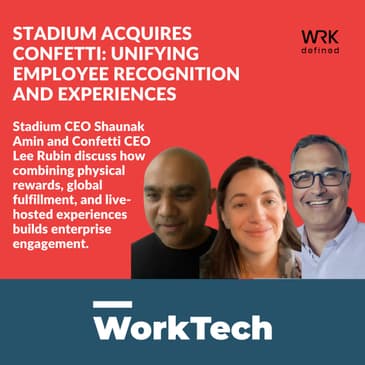
In this episode of the WorkTech Podcast, host George LaRocque digs into major M&A news shaping the human resources and talent management ecosystem: Stadium’s acquisition of Confetti. Joining the conversation are Shaunak Amin, co-founder and CEO of Stadium (the platform behind Swag Magic and Snack Magic), and Lee Rubin, founder and CEO of Confetti. Together, they share an exclusive look at why this deal came together, how it solves widespread vendor fragmentation for HR leaders, and why human-first connection is becoming an essential enterprise retention strategy in the age of AI.
Eliminating HR Vendor Fragmentation
Enterprise talent acquisition and HR teams face growing vendor fatigue. Before this deal, companies managed an average of six separate vendors for employee recognition, swag, snack boxes, corporate gifting, and team experiences. This fragmentation generated administrative overhead, inflated software spend, and prevented leaders from analyzing engagement holistically.
As Rubin explains, HR leaders want to end the hassle of managing five separate vendor relationships when a single unified partner can manage the entire engagement lifecycle. Stadium’s acquisition of Confetti solves this market pain point directly. By merging Stadium's global fulfillment infrastructure—which handles international customs, shipping logistics, swag management, and peer recognition—with Confetti's live-hosted virtual and hybrid team experiences, the combined entity gives enterprise clients a unified end-to-end solution.
Balancing Background AI with Human Connection
A key theme of the episode is balancing AI efficiency with genuine human connection. While artificial intelligence excels at removing operational friction in the background, Amin and Rubin stress that AI cannot build culture. As workplaces become increasingly digitized and remote employees experience isolation, physical touchpoints—such as custom swag, personalized rewards, and live-hosted team events—are vital for building trust and boosting team morale.
The combined platform connects digital and physical engagement seamlessy. For instance, a company launching a branded store on Stadium can pair it with a live-hosted Confetti team event and finish by sending global snack boxes to all participants. This integrated approach allows HR teams to deliver memorable moments while keeping centralized financial control alongside decentralized team execution.
Building "Global Engagement Infrastructure"
Looking ahead, Amin outlines a clear two-year vision: establishing Stadium as the standard "Global Engagement Infrastructure" for the enterprise. Just as companies rely on an HRIS for payroll and a CRM like Salesforce or HubSpot for client tracking, enterprises require a dedicated infrastructure layer to keep remote and hybrid teams connected.
With global labor pools shrinking and employee retention superseding traditional skill plays, engagement is no longer an optional perk—it is a core business necessity. By replacing flat SaaS access fees and fragmented point tools with an outcome-driven ecosystem, Stadium and Confetti are positioned to support over 10,000 corporate clients, expanding engagement across both employee and customer bases.
Key Takeaways
Eliminating Vendor Fragmentation: Enterprise HR teams were previously juggling an average of six separate vendors for swag, rewards, gifting, and team events; Stadium's acquisition of Confetti unifies these points into a single contract and workflow.
Global Fulfillment Meets Live Experiences: The acquisition pairs Confetti’s live-hosted team experiences and 10,000+ corporate client network with Stadium’s global fulfillment infrastructure, solving international customs and shipping hurdles for distributed teams.
AI Speed vs. Human Meaning: While AI automates workflow friction in the background, physical gifts, swag, and live human interactions are required to build trust, boost retention, and maintain company culture.
Centralized Control, Decentralized Execution: The platform provides enterprise leaders with budget guardrails and holistic engagement analytics while allowing individual department heads, event planners, and executive assistants to execute local events.
The Rise of "Global Engagement Infrastructure": Stadium’s two-year vision positions engagement software alongside HRIS and CRM platforms as a mandatory, third-bucket enterprise infrastructure layer to combat labor market shrinkage and drive retention.
On this episode Rajiv and George discuss Stadium Acquires Confetti, Shaunak Amin Stadium CEO, Lee Rubin Confetti CEO, WorkTech Podcast George LaRocque, HR vendor fragmentation consolidation, Swag Magic Snack Magic global fulfillment, Global engagement infrastructure, Remote team virtual hybrid experiences, Employee recognition rewards platform.
Learn more about your ad choices. Visit megaphone.fm/adchoices
Powered by the WRKdefined Podcast Network.
[00:00:00] Erfolg hat viele Gesichter, aber immer den gleichen Ursprung. Eine Entscheidung, loszulegen, niemals aufzuhören, weiter zu wachsen. So entstehen Gründergeschichten, Innovationsgeschichten, Expansionsgeschichten und viele mehr. Wir schreiben mit unseren Kunden seit über 155 Jahren Erfolgsgeschichten. Wann sprechen wir über Ihre? Commerzbank – die Bank an Ihrer Seite. Erfahren Sie mehr unter www.commerzbank.de slash Erfolgsgeschichten oder jetzt auf das Banner tippen.
[00:00:36] Erfolgsgeschichten und die Zukunft der Arbeit. Er ist in der know? Welcome to the WorkTech Podcast. Join host George LaRocque für expert insights on the trends, M&A activity, und strategies shaping the workplace. Brought to you by OneWorkTech.com und the WorkDefined Podcast Network. Hey everybody, welcome back to WorkTech. It's me, George LaRock. And we've got some really interesting industry news, some deal news to dig into.
[00:01:04] Stadium just announced the acquisition of Confetti, and I've got both CEOs here to take through it. Sean Akameen, co-founder and CEO of Stadium, and Lee Rubin, CEO and founder of Confetti. Welcome both, and congrats on the big news. Congrats on the deal. Thank you, George. We are super psyched to be here. Yeah, great. And, you know, before we get into the deal, let's do some quick intros for everyone.
[00:01:30] I'm aware of both firms, but I think let's share background on you and both platforms. And let's kick it off. Lee, do you want to go first? Sure, absolutely. So, first of all, thanks for having us. We're really excited about the news and being on WorkTech.
[00:01:50] So, I'm Lee Rubin. I'm the founder and CEO at Confetti. And to keep it short, we run virtual and hybrid team experiences, the live hosted moments that bring a typically distributed team together. Well, and I'm Sean Akameen, co-founder and CEO of Stadium. Stadium's a one-stop shop for all things recognition, swag, and gifting. It's also the company behind Snack Magic and Swag Magic, which you might have heard of.
[00:02:15] Yeah. So, I want to set the stage here a little bit. So, talk about, you know, what's happening in the market and what's happening out in the world of, depending on how you look at, recognition, rewards, you know, it'll come up in culture, engagement. Some folks view it almost as, like, you know, a benefit, depending on how formal, you know, the programs are.
[00:02:39] So, I'm really curious, you know, what was happening in the market? And I like both your takes on this from a market and timing perspective that made this the time to do this deal. So, Sean Akameen, maybe we start with you on this one. Yeah, sure. So, let me zoom out and look at the market. There were three big things that we were observing. One is when we talked to our customers, large and small, we saw that everybody had a lot of vendors they're dealing with.
[00:03:08] Like, different vendor for swag and different for recognition and different for experiences. So, there's a lot of vendor fragmentation overall in the market. Like, on average, our company's pre-stadium were using six unique vendors across all their teams, right? And that is money, right? They're paying all these vendors. There's so much coordination involved. You can't look at things holistically. So, those were some big problems that we identified like a few years back now.
[00:03:33] So, we said we want to build one platform that is unified for all things recognition, swag, gifting, and now experiences. In the process, save our customers time and money, right? So, that was one big trend that we were seeing. The other big thing is a lot of our companies, because of distributed working, have global employees. And when you talk about global, it's hard to send stuff to people like anywhere in the world because you run into customs and shipping dealers and all that.
[00:03:59] So, a lot of our customers wanted a platform to be global, which we are. But that's one other trend that we said, you know, it's got to be global. And I'd say that the third big thing is a lot of our companies want centralized control with decentralized execution because managing engagement programs and recognition and swag is nobody's full-time job. At the same time, at the company level, they want to set up some guardrails and then give the platform to the team to use.
[00:04:25] So, I'd say those would be the three big trends that we are seeing, which is leading us to do this deal. And we are overall just seeing like platforms like Stadium get stronger and stronger. Yeah. Yeah. And Lee, how about your side? I've got questions already, but I want to let you go and then I've got some additional drill downs for you both. Yeah. Well, I mean, I want to echo really everything that Sean said. Like HR teams are done managing five vendors to do what one relationship can. And there's a very big emphasis on relationship.
[00:04:55] And I think, you know, in a world of AI, Sean and I have always shared this human first approach and really leaning into making sure that we can support our customers in the best way possible throughout their needs. And we kept on just hearing the same thing from customers, right? Which is like, why isn't this one relationship already? And at least from a confetti side, like customers wanted the before and the after of the event handled by one partner.
[00:05:23] So, that's like, you know, the swag and the gifting alongside the experience itself. So, you got to always listen to your customers. Right. Right. One thing that really jumps out at me as I think about this, you talked about that human side. And that was really where my mind was going, listening to you, Sean, I can lean knowing your business.
[00:05:42] You know, there's a real, whether it's a blowback or whether it's, you know, as we're working our way through all the hype in the market about AI and, you know, just everything becoming more digital experience via AI. The blowback is, you know, people saying, you know, we want more physical live experiences. We want that connection.
[00:06:03] And, you know, you're talking about, Sean, I know there can be an online piece to recognition that's appreciated in the way you might deliver that experience. But you're also talking about swag. It's a very physical, tangible thing. And I know a lot of the experiences, Lee, are just that. Are you seeing that in your customer base, sort of folks revisiting the live and the physically, you know, present experiences here?
[00:06:32] Is that also, you know, driving some of this, you know, thoughts of growth? Yeah, 100%, I'd say. Where? Like, people want AI in the background to save them time. But they don't want, at least for what we do, AI to be at the forefront, right? Like, it's about engagement. It's about making each moment really, really special. And that happens not just on the platform, right? When people are using Stadium to send points or kudos to each other.
[00:07:00] It happens when the physical gift ultimately gets delivered, right? So I'd say, like, having a lens where you're looking at each moment end-to-end is so important. And some of it AI can help out with in the background. But the human first side of things is never going to change. In fact, it becomes more important when everybody's surrounded by just so many AI tools. Yeah. Yeah. Yeah. And go ahead, please. I was just going to say, you know, to add to that, and this is something that Sean and I have spoken in length about,
[00:07:29] is that, like, AI really makes work faster. It removes the friction. But humans make it meaningful. And I think that there's a very big, just, we're all looking at, like, how can we make work a bit more human in today's world? And especially in a time where people are a little bit nervous about how AI is automating their work. I think that there's a bigger emphasis from HR on bridging that trust and connection amongst team members. Yeah.
[00:07:59] Yeah. Really good point. So let's, you know, get into the deal a little bit. You know, I spend a lot of time having the, you know, build by partner conversation with CEOs and Sean, I'm wondering, you know, what made, we talked about the market timing and what's happening in the market. You know, what, you know, why was this, you know, the right choice? Why was confetti the right choice? Thinking about those, you know, three columns, if you will. Yeah.
[00:08:29] So, so I've known about confetti for a few years now, and I've always looked up to confetti, right? The personality of their product, the team behind the product, and just some of the feedback we've heard from our customers who are also using confetti. They've always had, like, incredibly positive things to say about confetti. So for us, we didn't even think about it. Like, it's not something we could build. Like, confetti is special. Like, the personality they built is so special.
[00:08:53] So when the opportunity came up, we didn't think twice, and it just seemed to make so much sense about just acquiring confetti. Yeah. Yeah. And, Lee, what about your side, you know, this exit and finding Stadium as a new home for confetti? What was it that drew you closer to this deal? Yeah. So for us, I'll take a sit back and talk a little bit about what we've proven to ourselves and to our customer base so far. So we've proven the model, right?
[00:09:23] So we had really strong customer love, as Shauna mentioned. We had a working host network. We had a very strong customer base of over 10,000 unique organizations that have done events with us, millions and millions of participants. What we didn't figure out was that global fulfillment component and the enterprise relationship layer that really needed, that we needed to further scale confetti. And ideally without years of additional build time.
[00:09:52] So what was really natural about the relationship with Stadium is they already had that part figured out. And it was already working very well with some of our biggest customers. So for us, this was really about gaining access to that infrastructure and having our customers gain that access. I always say, like, you know, that customer first mentality. And it would have taken us years to build it on our own. So that was kind of the most important components for us. Yeah, that's exciting.
[00:10:21] And so how will this change things? How does it change the stadium? Or does it, I should say, does it change? I'm not going to make any assumptions. You know, what will the stadium platform look like? And what should customers be excited about on both sides? Whoever wants to jump in. Yeah, I can start. And Lee, then you can add on. I mean, we internally are super excited. We've run this. We've spoken to a few customers, mutual customers. And they are as excited.
[00:10:50] I'd say, like, imagine a world where, you know, all your engagement initiatives company-wide are available on one platform, whether it's recognition, swag, snack boxes, gifting, experiences. You can use it for employees or for clients. You could measure engagement at the holistic level, right? Not in a silo. But you can look at overall engagement. You can now start measuring ROI on your engagement initiatives, right? The customers, all our customers will have access to the largest global catalog.
[00:11:18] So I'd say, like, we, there's a lot of excitement on all sides for our customers, for the team, for our vendor partners. When things start coming together, I'd say there's just so much opportunity to be unleashed. Lee, I'll let you add your thoughts also. Yeah, I think, you know, when it comes to something as sensitive as an acquisition, there's a lot of, there's a lot of emotions behind it. Because, like, you know, I've been at Confetti for 12, 13 years now. It's been over a decade.
[00:11:43] And one thing that was really comforting in many ways to me is that we weren't just, like, disappearing into a bigger company. We have the same team that built the company is continuing forward with Stadium. We have the same host network. We have the same product. And now there's just a bigger distribution engine behind it. So I think, as, you know, Sean said, like, Stadia brings the physical rewards, the swag, the peer recognition that we didn't have.
[00:12:10] And then Confetti brings that live hosted experience element. And together, Customize can really recognize someone, send them something, bring the team together, all from one relationship. And so I love that nothing disappears. It's really going to continue to operate exactly as it is today. Same booking flow, same host, same experiences. Now just a bigger distribution engine. Yeah. And, George, just to add one more thing to what Lee said.
[00:12:38] Like, imagine, like, we can make each moment now so much more special, right? People, when they're launching their company's store on Stadia, now they can club that with a live hosted event. And now that becomes memorable. When someone's doing a hosted event, they could end the event by sending everybody a snack box, right? So I'd say each moment now becomes so much more powerful, memorable, all that. So it's, again, it falls directly in line with what our purpose is, you know, to bring companies closer to employees and their clients. Yeah.
[00:13:08] So is there a technical integration that's required here, or? Erfolg has many faces, but always the same origin. A decision, to move on, never to listen, to grow, to grow. So entstehen Gründer-Geschichten, Innovations-Geschichten, Expansions-Geschichten and many more. We write with our customers since over 155 years Erfolg's stories. When we talk about your? Commerzbank, the bank on your side. Find more on the commercial bank. Commerzbank.de
[00:13:37] slash Erfolgsgeschichten or now on the Banner. As well as, you know, I just think about all of the fulfillment that you're doing on the back end with customers. Like there's integrating that. It sounds like that, you know, that's what we've just talked about. Will the platform become one over some period of time? Yeah, it's yes and no is the answer. So I think near term, I think we like everything we do.
[00:14:05] We start with humans first, team first, customers first, right? So we started doing that already. So it's the teams come together. It's one team now. This week, actually, we are doing our first in-person meetup. All teams are coming together and spending time with each other. Over time, we'll make both platforms a lot more integrated. But that doesn't mean Confetti goes anywhere. Confetti can also live as a standalone application on Stadium. But through APIs and all that, we are going to have a lot more connections on both sides.
[00:14:31] So that way, when someone's starting an order on Stadium, they could always add on a Confetti experience and vice versa. When someone's doing an experience, they'll be able to add on some of the Stadium things for this global fulfillment. Okay. Okay. And I'm thinking about those customers. How much overlap is there in not the customer base itself, but the profile of the customer? Is it the same buyer?
[00:14:57] And then, you know, are the users the same or does this, you know, does this extend that profile or change that profile at all? Sure. So the goal of the customers is the same, right? They're using Confetti or Stadium or Snack Magic or Slack Magic or Engagement, right? So they want to bring people closer to each other. So the goal is the same, but sometimes it starts with HR people. Sometimes it might start with sales and marketing.
[00:15:22] So I'd say that, but what's happening with Stadium, that it's becoming a company-wide solution, you know, end-to-end, wall-to-wall. So we have different personas within Stadium who are using Stadium different ways for different things. And a lot of them are event planners, executive assistants who tend to be Confetti customers also. So I'd say the goal is the same. There's a lot of overlap, but there's also some difference. Lee, do you want to add anything?
[00:15:46] Yeah, I think the way that we've always looked at it is like our mutual customer base is just a warm, ready expansion audience. So many of them are already running recognition and gifting programs, and they just don't have that live experience partner built in yet. And the same thing is in reverse, where a lot of our customers are doing live host events with us, and they still haven't finalized or finished their recognition and gifting program.
[00:16:14] So, you know, we're one of the things that I think is very exciting for us already is we're already seeing customers on both sides. As for one of the before the acquisition, now that we've made a few light introductions to some of the customers and played around with referrals, we're really seeing strong traction due to the customer loyalty that we've already built. Like, you know, we were joking about it, but we have some customers who are like, well, you know, we love you and anything that you guys do is great.
[00:16:40] So let's give this a shot. And we like bringing that energy into this next chapter together. That's a great place to be. So we've talked about, you know, both of your views on the market and the timing and the deal. We've talked a lot about the customers now. What about the teams? What does this represent as far as opportunity for teams on both sides? I think that's the most exciting part for us personally.
[00:17:05] Like we've, the way we've internally talked about this one plus one equals five, you know, because all our team members care about the same thing and being there for our customers. The same time, the lessons that we've learned in our journeys up until this point are so different. So we can all learn from each other, become one. And like I mentioned earlier, we are meeting in person this week and it's just awesome to sit back and watch each person interact with the member of the other team. But there's a lot of learning now.
[00:17:32] Everybody's going to have access to a much bigger catalog, which makes, you know, like their job way easier in terms of how they communicate with customers. But I'd say there's just excitement all around. That's great. That's really great. And Lee, I think you've already talked about this, but you have a whole host network as well. And it's really, I think you said really no change for the host network, more access to more potential products and services with Stadium. Is that? Exactly.
[00:18:00] I mean, like the way that we viewed it when we were, you know, pre-acquisition talking to CEO to CEO is like both brands are already successful. So we don't need to do too much off the bat. This is supposed to be additive to all the stakeholders, teams, clients, hosts. So bookings, payouts, relationships are all going to continue exactly as they are both for hosts and vendor networks, our customers, our partners.
[00:18:28] And then from a customer perspective, again, contracts, pricing, point of context for now. There's no changes. This is really supposed to be something additive where they can get more value. And I don't know if Seanuk mentioned it in the earlier parts of today that I don't remember, but I know we hear it often. Like the whole idea about Stadium is that we can save customers a lot of money because these solutions are bundled.
[00:18:52] And now there's just another way we can help them streamline their workflows and save them money, giving them access to a more global fulfillment partner. So all good things. That's great. So let's zoom out a little bit. And I know, Seanuk, this deal I'm sure aligns with a vision and a strategy that you've probably had for Stadium. And look forward a little bit.
[00:19:17] What can you share about where do you see Stadium going in the next, I don't know what's realistic anymore, six months, three years, five years, whatever you're comfortable timeframe-wise? Sure. Sure. Yeah, I'll go with two years. Okay, let's just say. And the long-term vision is very, very clear, you know, throughout the company. And I wish we could just go there, you know, like it's so clear that we are all excited to just get there. So imagine this, George, right? Today, like almost all companies have an HR system. Pretty much everybody, right?
[00:19:46] They need to pay their people, their benefits, all that. Almost all companies have a CRM. And when you think about CRM, you think of Salesforce or HubSpot. Those are like the names that come to mind first. But you ask any company, like what system do you use for engaging your employees and clients? There's no answer, right? People will have point solutions that they'll mention. But our vision, our two-year vision is we want to be that third bucket. We call it global engagement infrastructure, which includes everything. It includes recognition. It includes swag.
[00:20:16] It includes gifting, where we become the top choice. Everybody, all companies should know that they need something like this to keep their community connected, their people connected. And stadium's the choice, you know, because it's global, because it's one-stop shop. We are going to save you time. We're going to save you money. We are going to give you peace of mind. But when you do something, it's going to achieve the results you want it to achieve. And then on top of that, you're going to get this centralized control with decentralized execution
[00:20:43] where you can set up the guardrails and then allow each team to use the product the way you'd want it. So that's our two-year vision. We are already seeing several companies use us that way. But for us, it's like it has to get there, you know, because engaging your people is just so important. Like it helps in so many ways, right? Mental health, retention is creating a solid culture, positive morale. So I'd say like those are the things that we think of.
[00:21:09] Yeah, it's interesting the way you frame it because I think there, you know, you're right. I mean, there are platforms or products that are measuring engagement. Like, you know, there are surveys and analytics and now creepy listening tools and things like this, right? That feed into those analytics. And then you've got like the classic like rewards and recognition category, which is more like, I know you're doing some of that with kudos that you mentioned.
[00:21:37] And but the recognition category is very, I don't know, it's old school, like almost like, you know, catalog shopping and, you know, sending, you know, you get your your trophy or you get your badge, you get your plaque to put on the wall or something like that. But the actual, you know, like the swag and the physical experience that that's very different. And, you know, one thing that only I only know a few people that are talking about this right now, the workforce.
[00:22:06] I know we're all caught up in the hype cycle around AI eating all the jobs, but we should be really paying attention to the fact that globally, except for in Southern Africa, any projection you look at in a three, five, 10 year time frame, the workforce is actually shrinking. So the available workforce. So what's what becomes more important is retention, engagement. And it's it's not a skills play. It's not like, you know, do we have the right people trained on the right skills?
[00:22:35] That it that's a thing. But do people how do people feel when they get up and report in for work, whether that's remote or physically, you know, live in person? And that's what this is helping reinforce that engagement and sending those signals to the employees. So I want to listen to you talk. It's it's I feel like this category is is going to see, you know, you know, further uptick in the next decade.
[00:23:04] So it sounds like you're positioning yourself to be ready for that. That's exciting. Yeah, 100 percent. I mean, we're not even questioning it. I mean, we know that's going to happen. It's just a question of when and how fast we get there. Right. Where the human side of it just becomes so important. And I'd say, I mean, it starts with the basics. Right. You make people happy. You make their day. They're automatically going to come into work happier, motivated, and they'll give you your best at their best. Right.
[00:23:32] And I'd say, like, if that part's done, everything else after that is easier for companies. Right. So I say it starts there and then we want to help companies get there. Did you add anything here? Yeah, no, I completely agree. Yeah, I there's I completely agree. I mean, like the way that I see it is that companies are hungry to be able to consolidate all the different forms of engagement to. One ecosystem.
[00:23:57] And by the way, you know, one thing that we were always missing that that now stadium brings to the table is it's not just for your employees, but it's also for your customers. And there are so many different modalities today that we're interested in expanding into, like getting back into in person and not just with our virtual components that we've been working on for the last few years. And another big thing is we have live hosted events, which we're known for, but we also have some self-hosted components, which we're excited to bring into life. So there's a lot to explore here.
[00:24:27] And I think the human component is something that we need to pay extra attention to as the workplaces continuing to evolve. Yeah, that's great. So I could, you know, dig in on the category and the deal, you know, for another hour or two. But what what's the best way for folks to keep track of, you know, how this evolves and get more info on the deal? Where can they learn best place to learn more?
[00:24:55] I'd say LinkedIn is best for me. Yeah, I agree. Please, actually, I would encourage you to continue to follow the story. Follow me on LinkedIn. I'm very active there. And not just that, I'm actually going to be sharing a lot more about the ins and outs of the transition. And we have some early discussions about my rules evolution and how it's taking a much bigger step towards community, which I'm super excited about. So all of it will be on a document and on LinkedIn, which is exciting. Oh, that's great.
[00:25:22] And I'll make sure to share your links to your profiles and the show notes on YouTube and Spotify and everywhere else this goes. But I want to thank you both for being here and telling the story on WorkTech. I really appreciate your time and congrats again on the deal. Thanks so much for having us, George. All right. And thanks everyone for watching or listening out there on the WorkDefined Network. And until next time, we'll see you then.
[00:25:54] Erfolg hat viele Gesichter, aber immer den gleichen Ursprung. Eine Entscheidung, loszulegen, niemals aufzuhören, weiterzuwachsen. So entstehen Gründergeschichten, Innovationsgeschichten, Expansionsgeschichten und viele mehr. Wir schreiben mit unseren Kunden seit über 155 Jahren Erfolgsgeschichten. Wann sprechen wir über Ihre? Commerzbank, die Bank an Ihrer Seite. Erfahren Sie mehr unter comerzbank.de slash Erfolgsgeschichten oder jetzt auf das Banner tippen.
Sponsors
